
BuddhistCatholicContemplativeEvangelicalGeneral ChristianHinduJewishLatter-day SaintMuslimNew VisionsProgressive Christian
Beliefs
- Buddhist
- Catholic
- Contemplative
- Evangelical
- General Christian
- Hindu
- Jewish
- Latter-day Saint
- More Voices
- Muslim
- New Visions
- Pagan
- Progressive Christian
Topics
- Religion News
- Food and Religion
- Sports and Religion
- Religious Art
- Religious Music and Entertainment
- Religious Events
- History and Religion
- Style and Religion
- Politics and Religion
- Women in Religion
- Recreation Outdoors and Religion
- Business Finance and Religion
- Careers Workplace and Religion
- Education and Religion
- Family Parenting and Religion
- Health Fitness and Religion
- Home and Religion
- Relationships and Religion
- Technology and Religion
- Travel and Religion
Columnists
- Buddhist Columnists
- Business Finance and Religion Columnists
- Careers Workplace and Religion Columnists
- Catholic Columnists
- Contemplative Columnists
- Education and Religion Columnists
- Evangelists Columnists
- Family Parenting and Religion Columnists
- General Christian Columnists
- Health Fitness and Religion Columnists
- Hindu Columnists
- History and Religion Columnists
- Home and Religion Columnists
- Jewish Columnists
- More Voices Columnists
- Latter Day Columnists
- Muslim Columnists
- New Visions Columnists
- Nonreligious Columnists
- Pagan Columnists
- Politics and Religion Columnists
- Progressive Columnists
- Recreation Outdoors and Religion Columnists
- Relationships and Religion Columnists
- Religion News Columnists
- Religious Art Columnists
- Religious Events Columnists
- Religious Music and Entertainment Columnists
- Sports and Religion Columnists
- Style and Religion Columnists
- Technology and Religion Columnists
- Travel and Religion Columnists
- Women in Religion Columnists
Resource Library
- 2026 Calendar
- Library of World Religions
- The 100 Most Holy Places on Earth
- Patheos Answers
- Podcasts
- Videos
- Faith Leaders Database
- Anglican Episcopalian
- Bahai
- Baptist
- Buddhism
- Christianity
- Confucianism
- Eastern Orthodoxy
- Hinduism
- Holiness and Pentecostal
- ISKCON
- Islam
- Judaism
- Lutheran
- Methodist
- The Church of Jesus Christ of Latter-day Saints
- New Age
- Paganism
- Presbytarian and Reformed
- Protestantism
- Religion Behind the Scenes
- Roman Catholic
- Scientology
- Shia Islam
- Sikhism
- Sufism
- Sunni Islam
- Taoism
- Zen
- See all religions
Research Tools
 Ad-Free & Subscriber Log-In Subscription Support
Ad-Free & Subscriber Log-In Subscription Support
Follow Patheos 

- Trending:
- Forgiveness
- |
- Marriage
- |
- Consciousness
- |
- Death Penalty
- |
- Election
- |
- Halloween
 Good Letters
-
Contributors
- Home
- Catholic
- Twelve Days To Sit with the God-Made-Man
Twelve Days To Sit with the God-Made-Man
Last updated on: July 18, 2013 at 11:56 am by Lindsey Crittenden
Twelve Days To Sit with the God-Made-Man 2013-07-18T11:56:25-07:00 Lindsey Crittenden
Patheos Explore the world's faith through different perspectives on religion and spirituality! Patheos has the views of the prevalent religions and spiritualities of the world.
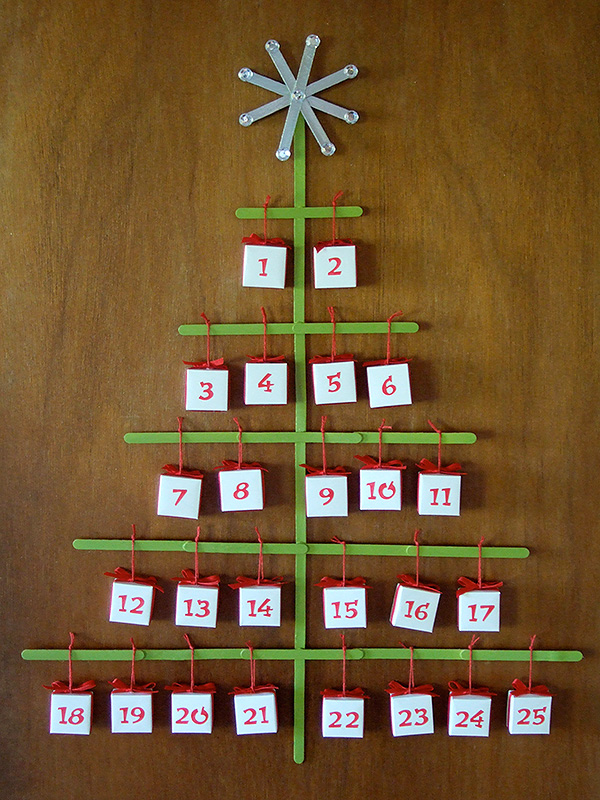 As a child, I was somewhat confused by the partridge in the pear tree and by Advent calendars. I liked both—especially the calendars, with their stiff little paper tabs opening up to an image of a toy or a bird or a tree for each day—but I didn’t understand the numerology.
Advent calendars were calendars, but they didn’t last the entire month. They ended at twenty-four, the payoff of the often-arch-shaped double door opening up to reveal a honey-tinted scene of the Christ child in the manger.
It made sense, even though I wondered about the remaining seven days of December. Anticipation ended on Christmas morning, didn’t it? My brother or I woke the other up, so neither would be first, and went down the hall to wake our parents, and opened our stockings on Mom and Dad’s big California king before heading down to the tree and the fun of eating coffee cake in the living room amongst torn wads of wrapping paper.
Christmas ended, inevitably, on the drive home from my grandfather’s, during which my parents barely spoke, my father having had too much to drink and often embarrassing (her word) my mother at the dinner table with an outburst directed at my aunt (a lush, his word), my uncle (an idiot), or my cousin (a long-haired ingrate).
The next day would be the twenty-sixth: no more little presents, no more stiff paper doors, no more anticipation, no more baby in the manger.
The Advent calendar got it right: the fun was over, until next year. So what was with this business of the gifts increasing and increasing, all the way to twelve drummers drumming? What was with these twelve days, anyway?
Much later, I learned about church seasons—not just Advent and Christmastide but Epiphany and the intriguingly named Ordinary Time (or, as the Godly Play children’s Christian education program, calls it, the “green, growing days”).
I adopted the Northern European custom of decorating the tree on Christmas Eve because up to that point— despite the tree lots that opened the day after Thanksgiving—it wasn’t Christmas yet. (This custom backfired the year I arrived to find the remaining trees being fed into the chipper.)
And I began to understand the reason that the season had felt over by early nightfall on Christmas Day—because I’d opened my gifts—showed that gifts weren’t what the anticipation was all about, after all.
Christians have lived for millennia with the knowledge that the promised-for has not yet arrived. Jesus says explicitly in several places that the end times are coming—really, really soon. But they didn’t. Or haven’t. “This generation” that Jesus refers to now goes back 2,000 years, and we’re still waiting, letting our supplies of oil dwindle dangerously low, just like the foolish bridesmaids.
Each Advent we read the prophets and make straight the way of the Lord, each Christmas Eve, we welcome the birth of the True Light, and each Boxing Day we pack up and put away for next year.
Not yet. Advent is all about waiting, about living into the not yet, and Christmas is about Emmanuel. God is with us. We are always waiting—for Christ to return, for peace, for good will, for those things we yearn for yet can’t quite, on our own, bring about.
Christmas lasts twelve days as an invitation to sit in this place with the God-made-man a bit longer. We’ll get it again—painfully so, of course, in Lent and Holy Week—but for now, let us rejoice for all twelve days.
Hope is an odd thing. The thing with feathers, as Emily Dickinson put it. It flies, it soars, it molts, it gets clipped. We hold it, we keep it, we feed it, we bag it.
I recall being disturbed by Pema Chodron’s statement, in a book of hers I read some years ago, about the dangers of hope. Dangers is my word, not hers, but a quick Google search takes me to an interview with Chodron in which she says, “Give up all hope of fruition.” To paraphrase: through hope, we attach ourselves to an outcome not yet here. By hoping, we get caught up—or caught on—the future rather than accepting the here and now.
I see much wisdom there, just as I do when Craig says to me, “Don’t drink the Kool-Aid hope,” after I get all hopeful at my nephew’s signs that he might be capable of responsibility and accountability. Hope can come crashing down, just like a bird shot in mid-flight. It doesn’t always die, and I’m not sure I could exist without it. Hope seems to me fragile and beautiful—not as a way of avoiding the here and now (that’s not really hope, is it?) as much as a way of holding onto what my mother used to call “a good thought.”
A friend just blogged about how she found hope in a cookbook called Jerusalem, by an Israeli and a Palestinian. That’s the kind of hope I look to, and thank God for, during these twelve days.
Merry Christmas, on this, the ninth day thereof.
Previous Post

December 31, 2012
Home is the Place: Twelve Songs for 2012
Next Post
January 3, 2013 Reynolds Price and Me: The Tale of Two Rhodes Scholars
Browse Our Archives
Select a Category A. G. Harmon Alissa Wilkinson Allison Backous Art Authors Brad Fruhauff Bradford Winters Bryan Bliss Caroline Langston Chad Thomas Johnston Chris Hoke Christiana N. Peterson Culture D.G. Myers D.L. Mayfield Daniel Bowman Jr. David Griffith Elizabeth Duffy Faith Film Greg Wolfe Guest Contributor Interview Jan Vallone Jeffrey Overstreet Jessica Eddings-Roeser Jessica Mesman Griffith Kelly Foster Lindsey Crittenden Morgan Meis music Natalie Vestin Nick Olson Peggy Rosenthal Personal Reflection Poetry Friday Reflection Relationships Review Richard Chess Richard Cole Sara Zarr Shannon Huffman Polson Sonya Bilocerkowycz Tania Runyan Tony Woodlief Topical Categories Uncategorized Vic Sizemore Writing
Select a Month October 2018 September 2018 August 2018 July 2018 June 2018 May 2018 April 2018 March 2018 February 2018 January 2018 December 2017 November 2017 October 2017 September 2017 August 2017 July 2017 June 2017 May 2017 April 2017 March 2017 February 2017 January 2017 December 2016 November 2016 October 2016 September 2016 August 2016 July 2016 June 2016 May 2016 April 2016 March 2016 February 2016 January 2016 December 2015 November 2015 October 2015 September 2015 August 2015 July 2015 June 2015 May 2015 April 2015 March 2015 February 2015 January 2015 December 2014 November 2014 October 2014 September 2014 August 2014 July 2014 June 2014 May 2014 April 2014 March 2014 February 2014 January 2014 December 2013 November 2013 October 2013 September 2013 August 2013 July 2013 June 2013 May 2013 April 2013 March 2013 February 2013 January 2013 December 2012 November 2012 October 2012 September 2012 August 2012 July 2012 June 2012 May 2012 February 2008
Follow Us!
TAKE THE
Religious Wisdom Quiz
Which book is written almost completely as poetry?
Select your answer to see how you score.
Lamentations Isaiah Ezra Jeremiah
Related posts from Good Letters

Poetry Friday: "The Burned Butterfly"


Poetry Friday: "The Preacher Addresses the Seminarians" by...
TRENDING AT PATHEOS Catholic

Creation, Preservation, and Teleology in Catholic Theology
As I write this, it is very early Monday morning. Like millions...

The Parable Of The Sower And The Word...
One of Christ’s most famous parables is that of the sower who...

Rejecting Doom: Christian Hope And Human Action
Christianity is a religion of hope. We are to have hope and...

Why I Choose the Eucharist Over the Sermon
Choose the Eucharist, Not the Sermon What are we supposed to get...

5 Design Elements Found in Spiritually Rooted Homes
Putting Spirituality Into Home Decor Our homes are more than our living...

Credo: A Story of God Told with the...
About 10 years ago, I began to imagine a personal "Credo" that...
view all Catholic blogs
Ad-Free & Subscriber Log-In Subscription Support
- About Us
- 2026 Calendar
- Videos
- Podcasts
- Library of World Religions
- Faith In Media Tracker
- Advertise With Us
- Write for Us
- Privacy Policy
- Terms of Service
- Do Not Sell My Data
- Contact Us
- Radiant Digital
- Manage Newsletter Subscriptions
- Unsubscribe From Notifications
- Sitemap
Copyright 2008-2026, Patheos. All rights reserved.
Subscription Support Ad-Free & Subscriber Log-In
Follow Patheos