
BuddhistCatholicContemplativeEvangelicalGeneral ChristianHinduJewishLatter-day SaintMuslimNew VisionsProgressive Christian
Beliefs
- Buddhist
- Catholic
- Contemplative
- Evangelical
- General Christian
- Hindu
- Jewish
- Latter-day Saint
- More Voices
- Muslim
- New Visions
- Pagan
- Progressive Christian
Topics
- Religion News
- Food and Religion
- Sports and Religion
- Religious Art
- Religious Music and Entertainment
- Religious Events
- History and Religion
- Style and Religion
- Politics and Religion
- Women in Religion
- Recreation Outdoors and Religion
- Business Finance and Religion
- Careers Workplace and Religion
- Education and Religion
- Family Parenting and Religion
- Health Fitness and Religion
- Home and Religion
- Relationships and Religion
- Technology and Religion
- Travel and Religion
Columnists
- Buddhist Columnists
- Business Finance and Religion Columnists
- Careers Workplace and Religion Columnists
- Catholic Columnists
- Contemplative Columnists
- Education and Religion Columnists
- Evangelists Columnists
- Family Parenting and Religion Columnists
- General Christian Columnists
- Health Fitness and Religion Columnists
- Hindu Columnists
- History and Religion Columnists
- Home and Religion Columnists
- Jewish Columnists
- More Voices Columnists
- Latter Day Columnists
- Muslim Columnists
- New Visions Columnists
- Nonreligious Columnists
- Pagan Columnists
- Politics and Religion Columnists
- Progressive Columnists
- Recreation Outdoors and Religion Columnists
- Relationships and Religion Columnists
- Religion News Columnists
- Religious Art Columnists
- Religious Events Columnists
- Religious Music and Entertainment Columnists
- Sports and Religion Columnists
- Style and Religion Columnists
- Technology and Religion Columnists
- Travel and Religion Columnists
- Women in Religion Columnists
Resource Library
- 2026 Calendar
- Library of World Religions
- The 100 Most Holy Places on Earth
- Patheos Answers
- Podcasts
- Videos
- Faith Leaders Database
- Anglican Episcopalian
- Bahai
- Baptist
- Buddhism
- Christianity
- Confucianism
- Eastern Orthodoxy
- Hinduism
- Holiness and Pentecostal
- ISKCON
- Islam
- Judaism
- Lutheran
- Methodist
- The Church of Jesus Christ of Latter-day Saints
- New Age
- Paganism
- Presbytarian and Reformed
- Protestantism
- Religion Behind the Scenes
- Roman Catholic
- Scientology
- Shia Islam
- Sikhism
- Sufism
- Sunni Islam
- Taoism
- Zen
- See all religions
Research Tools
 Ad-Free & Subscriber Log-In Subscription Support
Ad-Free & Subscriber Log-In Subscription Support
Follow Patheos 

- Trending:
- Forgiveness
- |
- Marriage
- |
- Consciousness
- |
- Death Penalty
- |
- Election
- |
- Halloween
 Good Letters
-
Contributors
- Home
- Catholic
- Silence Wounds, Silence Heals
Silence Wounds, Silence Heals
Last updated on: January 15, 2013 at 1:00 am by Richard Chess
Silence Wounds, Silence Heals 2013-01-14T15:12:55-07:00 Richard Chess
Patheos Explore the world's faith through different perspectives on religion and spirituality! Patheos has the views of the prevalent religions and spiritualities of the world.
 It was there all along.
Troubling me.
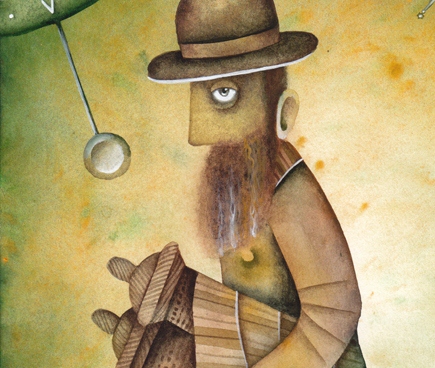
It hurt me and aroused my sympathy for that boy, that young man, the Reb’s firstborn son being groomed to replace, one day, his father as head of a Hasidic dynasty.
A father who tested this son, his future, his sect’s future, every Sabbath afternoon before an audience of devoted followers. They looked with awe on their rebbe and his son, their future leader, who never failed to catch the mistake his father would slip into the lesson he offered from the head of the table around which men and boys gathered for a light meal, the mystic’s meal, for at that hour they had little need for physical nourishment. The Sabbath’s waning hours: by then the faithful were nourished almost entirely by the soul.
And when he wasn’t teaching and testing his son? Reb Saunders would not speak to Danny, not a word to his brilliant, beloved son.
Reb Saunders’ inexplicable, unbroken silence seemed cruel to me. It seemed cruel, too, to Danny’s dear friend, Reuven Malter.
As I turned the pages of Chaim Potok’s The Chosen: sympathy for Danny, irritation at his father. Or was the irritation at myself, a reaction to not being able to understand Reb Saunders’ behavior?
Have you heard this one? “The tzaddik sits in absolute silence, saying nothing, and all his followers listen attentively.”
Tzaddik: righteous one. Rabbi Arthur Green writes that in Jewish life, one attains the title of tzaddik “primarily due to acts of extraordinary generosity and selflessness within the human community.”
I can see a *New Yorker-*esque cartoon in which a group of bearded men in black caftans crowd around their rebbe’s Sabbath table, one disciple squatting under the table hoping to catch some crumbs from the holy man’s plate. At the head of the table, their rebbe, his eyes closed, in a near trance, strokes the inverted, sour-cream streaked flames of his beard, feeling for wisdom, drawing it into his fingers, from there to flare behind his heart, illuminating it, all the while his lips tremble as if about to form a word, just one word for which his disciples ache, one word to release them from ignorance and suffering into God’s love.
As if he had been slapped by the joke that Ruben, who had heard it from another student, passed on to him, Danny’s “face froze.”
Then, for a long moment, Danny “said nothing.”
Speech: a bridge over the gap dividing one person from another.
Really? The distance between us, you and me, is, if not closed, narrowed by these words? Or will the yawning gap never be closed, no matter how skilled I am at choosing words to say what I mean, the only thing I ever mean when I speak or write to you: I am alone. I am afraid in this room, this city, in this worldwide web, in this expanding universe.
Or, speech: clothing, costume, armor. A way to protect or hide one’s self.
In Genesis, when Adam and Eve discover they are naked—exposed, vulnerable—they cover themselves. Thus, they imitate God.
How? In Genesis One, God speaks: Let there be… But before God’s opening act?
Before speech, was God exposed and vulnerable, even terrified? To clothe and protect God’s self: is that why God creates speech before anything else? To protect God’s self, and to project an image, merely a part not the whole, of God’s self?
A people of the book, we admire it, we dwell on it, God’s speech (written down), nouns, verbs, even the shapes of the letters: God’s clothing, its pleats, its seams, its stitching, the fabric from which it is sewn.
Season after season: Reb Saunders’ refusal to speak to his son, other than of Talmud, his raw silence, an exposed wound.
“The tzaddik sits in absolute silence, saying nothing, and all his followers listen attentively.”
“For a long moment, [Danny] said nothing. His eyes seemed glazed, turned inward.”
Who knows one? One God. Who knows two? Two Tablets. Who knows the value of turning one’s gaze inward?
“Then [Danny’s] face relaxed. He smiled faintly. ‘There’s more truth to that than you can realize,’ he murmured. ‘You can listen to silence, Reuven…and learn from it. It has a quality and a dimension all its own. It talks to me sometimes. I feel myself alive in it…. It doesn’t always talk. Sometimes—sometimes it cries, and you can hear the pain of the world in it. It hurts to listen to it then. But you have to.’”
Like silence, sometimes words reveal; sometimes words heal, repair, make whole.
Late in the novel, Reb Saunders explains his silence.
Already when Daniel was four-years-old, Reb Saunders saw that his son was “a mind in a body without a soul.” “A heart I need for a son, a soul I need for a son, compassion I want from my son, righteousness, mercy, strength to suffer and carry pain, that I want from my son, not a mind without a soul.”
“A tzaddik…must know of pain. A tzaddik must know how to suffer for his people,” Reb Saunders explains to Reuven.
“Words are cruel…they distort what is in the heart, they conceal the heart, the heart speaks through silence. One learns of the pain of others by suffering one’s own pain…by turning inside oneself, by finding one’s own soul.” Reb Saunders learned this from his own father, who taught his son, his successor with silence.
Destruction of the Temple, expulsion from Spain, pogroms, the Holocaust, and, since the creation of the modern State of Israel, suicide bombers, occupation, blockade: are we minds in bodies without souls? How else to explain it—God’s silence, our companion throughout history. Meanwhile, we pester God with prayer.
There is more to say about silence. For instance, this:
Previous Post

January 13, 2013
The Poetics of Painting
Next Post
January 16, 2013 A Requiem for Rejects
Browse Our Archives
Select a Category A. G. Harmon Alissa Wilkinson Allison Backous Art Authors Brad Fruhauff Bradford Winters Bryan Bliss Caroline Langston Chad Thomas Johnston Chris Hoke Christiana N. Peterson Culture D.G. Myers D.L. Mayfield Daniel Bowman Jr. David Griffith Elizabeth Duffy Faith Film Greg Wolfe Guest Contributor Interview Jan Vallone Jeffrey Overstreet Jessica Eddings-Roeser Jessica Mesman Griffith Kelly Foster Lindsey Crittenden Morgan Meis music Natalie Vestin Nick Olson Peggy Rosenthal Personal Reflection Poetry Friday Reflection Relationships Review Richard Chess Richard Cole Sara Zarr Shannon Huffman Polson Sonya Bilocerkowycz Tania Runyan Tony Woodlief Topical Categories Uncategorized Vic Sizemore Writing
Select a Month October 2018 September 2018 August 2018 July 2018 June 2018 May 2018 April 2018 March 2018 February 2018 January 2018 December 2017 November 2017 October 2017 September 2017 August 2017 July 2017 June 2017 May 2017 April 2017 March 2017 February 2017 January 2017 December 2016 November 2016 October 2016 September 2016 August 2016 July 2016 June 2016 May 2016 April 2016 March 2016 February 2016 January 2016 December 2015 November 2015 October 2015 September 2015 August 2015 July 2015 June 2015 May 2015 April 2015 March 2015 February 2015 January 2015 December 2014 November 2014 October 2014 September 2014 August 2014 July 2014 June 2014 May 2014 April 2014 March 2014 February 2014 January 2014 December 2013 November 2013 October 2013 September 2013 August 2013 July 2013 June 2013 May 2013 April 2013 March 2013 February 2013 January 2013 December 2012 November 2012 October 2012 September 2012 August 2012 July 2012 June 2012 May 2012 February 2008
Follow Us!
TAKE THE
Religious Wisdom Quiz
How did Moses' mother save him as a baby?
Select your answer to see how you score.
Sent him to another city Dressed him as a girl Placed him in a basket on the river Hid him in a cave
Related posts from Good Letters

Poetry Friday: "The Burned Butterfly"

A Conversation with Alicia Ostriker: Part 1

Leonard Cohen’s Holy and Broken Hallelujah

Ready or Not for the Days of Awe
TRENDING AT PATHEOS Catholic

Rejecting Doom: Christian Hope And Human Action
Christianity is a religion of hope. We are to have hope and...

It’s What Comes From Within Which Matters
One of the most difficult things for us to understand is why...

Why I Choose the Eucharist Over the Sermon
Choose the Eucharist, Not the Sermon What are we supposed to get...

5 Design Elements Found in Spiritually Rooted Homes
Putting Spirituality Into Home Decor Our homes are more than our living...

Credo: A Story of God Told with the...
About 10 years ago, I began to imagine a personal "Credo" that...

The Anatomy of Divine Revelation in Catholic Thought
The claim that God has made Himself known to human beings is...
view all Catholic blogs
Ad-Free & Subscriber Log-In Subscription Support
- About Us
- 2026 Calendar
- Videos
- Podcasts
- Library of World Religions
- Faith In Media Tracker
- Advertise With Us
- Write for Us
- Privacy Policy
- Terms of Service
- Do Not Sell My Data
- Contact Us
- Radiant Digital
- Manage Newsletter Subscriptions
- Unsubscribe From Notifications
- Sitemap
Copyright 2008-2026, Patheos. All rights reserved.
Subscription Support Ad-Free & Subscriber Log-In
Follow Patheos