
BuddhistCatholicContemplativeEvangelicalGeneral ChristianHinduJewishLatter-day SaintMuslimNew VisionsProgressive Christian
Beliefs
- Buddhist
- Catholic
- Contemplative
- Evangelical
- General Christian
- Hindu
- Jewish
- Latter-day Saint
- More Voices
- Muslim
- New Visions
- Pagan
- Progressive Christian
Topics
- Religion News
- Food and Religion
- Sports and Religion
- Religious Art
- Religious Music and Entertainment
- Religious Events
- History and Religion
- Style and Religion
- Politics and Religion
- Women in Religion
- Recreation Outdoors and Religion
- Business Finance and Religion
- Careers Workplace and Religion
- Education and Religion
- Family Parenting and Religion
- Health Fitness and Religion
- Home and Religion
- Relationships and Religion
- Technology and Religion
- Travel and Religion
Columnists
- Buddhist Columnists
- Business Finance and Religion Columnists
- Careers Workplace and Religion Columnists
- Catholic Columnists
- Contemplative Columnists
- Education and Religion Columnists
- Evangelists Columnists
- Family Parenting and Religion Columnists
- General Christian Columnists
- Health Fitness and Religion Columnists
- Hindu Columnists
- History and Religion Columnists
- Home and Religion Columnists
- Jewish Columnists
- More Voices Columnists
- Latter Day Columnists
- Muslim Columnists
- New Visions Columnists
- Nonreligious Columnists
- Pagan Columnists
- Politics and Religion Columnists
- Progressive Columnists
- Recreation Outdoors and Religion Columnists
- Relationships and Religion Columnists
- Religion News Columnists
- Religious Art Columnists
- Religious Events Columnists
- Religious Music and Entertainment Columnists
- Sports and Religion Columnists
- Style and Religion Columnists
- Technology and Religion Columnists
- Travel and Religion Columnists
- Women in Religion Columnists
Resource Library
- 2026 Calendar
- Library of World Religions
- The 100 Most Holy Places on Earth
- Patheos Answers
- Podcasts
- Videos
- Faith Leaders Database
- Anglican Episcopalian
- Bahai
- Baptist
- Buddhism
- Christianity
- Confucianism
- Eastern Orthodoxy
- Hinduism
- Holiness and Pentecostal
- ISKCON
- Islam
- Judaism
- Lutheran
- Methodist
- The Church of Jesus Christ of Latter-day Saints
- New Age
- Paganism
- Presbytarian and Reformed
- Protestantism
- Religion Behind the Scenes
- Roman Catholic
- Scientology
- Shia Islam
- Sikhism
- Sufism
- Sunni Islam
- Taoism
- Zen
- See all religions
Research Tools
 Ad-Free & Subscriber Log-In Subscription Support
Ad-Free & Subscriber Log-In Subscription Support
Follow Patheos 

- Trending:
- Forgiveness
- |
- Marriage
- |
- Consciousness
- |
- Death Penalty
- |
- Election
- |
- Halloween
 Good Letters
-
Contributors
- Home
- Catholic
- Beauty Is as Beauty Does
Beauty Is as Beauty Does
Last updated on: January 29, 2013 at 1:00 am by Peggy Rosenthal
Beauty Is as Beauty Does 2013-01-28T14:41:21-07:00 Peggy Rosenthal
Patheos Explore the world's faith through different perspectives on religion and spirituality! Patheos has the views of the prevalent religions and spiritualities of the world.
 The current issue of Image (#75) is full of rich mini-essays on some of the key words we rely on when we speak about the intersection of faith and the arts. Among these words is beauty, which novelist Erin McGraw chooses to parse.
McGraw’s main point is that beauty is ever-fleeting. We want to get a grip on it; yet by its very (transcendent) nature, we can’t.
I see what she means, and I delight in her brilliant, breezy prose. But I think there’s something important about beauty that McGraw is leaving out.
As her “rough and ready definition of beauty” she offers: “some display of harmony, intelligence, and genius.” I’d go along with this definition as far as it goes—but I don’t think it goes far enough.
Specifically, it leaves out beauty’s moral dimension: goodness.
Remember the Gospel story of the woman who anointed Jesus’ feet with costly perfume? When Jesus’ disciples object to the waste, he rebukes them by saying “She has done a beautiful thing for me.” In the accounts in Mark (14:6) and Matthew (26:10), the Greek word for beautiful is kalon, which has a marvelous range of meaning.
Literally it does mean beautiful, but throughout the original Greek New Testament this beauty can apply to physical appearance or to moral behavior: that is, kalon can mean lovely or free from defects; but it can also mean praiseworthy, morally good, desirable, blameless.
So this very passage is sometimes translated, aptly, “She has performed a good service for me.”
A few years ago, my husband and I wrote a book called Reclaiming Beauty for the Good of the World: Muslim & Christian Creativity as Moral Power. The book’s thesis is that at the core of each of these faiths is a vision of beauty that manifests itself in beautiful works—works not only of art but also of life.
We argue that beauty as conceived by both Christianity and Islam is a moral category, not a merely aesthetic one. It is inseparable from goodness.
As profound and wide-ranging as McGraw’s essay is, she limits her concept of beauty to art and nature. “Beauty,” she writes, “doesn’t generally rouse us to action, unless we feel it edging away from us.… It’s the rare occasion that beauty lights a fire under us to dust the living room or start a nonprofit.”
Those two examples are fun, but I’d put housecleaning and starting a nonprofit in different categories of action. Starting a nonprofit can have a moral dimension which housecleaning lacks (unless I believe that cleanliness is next to godliness—which I don’t).
For instance, the founder of Bread for the World, Lutheran minister Arthur Simon, was embarking on a beautiful enterprise, one that has improved the lives of countless people.
There is, in other words, an art of life. And what is it? Beauty in action.
A key quality in Islam is ihsan, which means beauty—but particularly the beauty that is spiritual virtue—what Islam frequently calls “transparency of heart.” The person whose heart is transparent to God’s gaze acts always as if she were face-to-face with God.
Christianity envisions beauty’s inherent link to God and to goodness differently, of course. For Christians the living God, the Resurrected Christ, dwells through the Holy Spirit within each person. The more we let God’s life live through us, the more beautiful and good are all our works.
Yet Christians can comfortably concur in the statement of Islamic scholar Seyyed Hossein Nasr that “The goal of human life is to beautify the soul through goodness and virtue and to make it worthy of offering to God Who is the Beautiful.”
One surah of the Qur’an even puts this as an imperative: “Act beautifully, as God has acted beautifully towards you” (Sura al-Qasas 28:77).
And how has God acted beautifully? Christian artist Makoto Fujimura, known to the Image community, said in an interview that his painting technique is inspired by the beauty of God’s extravagant generosity.
Then there’s the beauty of self-sacrifice and forgiveness. As modeled by Jesus on the cross, this beauty is at the heart of Christian faith.
Inspired by God’s beautiful actions (whether self-sacrifice, mercy, forgiveness, or extravagant generosity), we can be moved to act beautifully ourselves.
Think of the classic film Babette’s Feast. Babette’s generosity, in using her money to prepare a feast which is a foretaste of the heavenly realm awaiting us, moves the previously dour and bickering dinner guests an infinitesimal bit closer to the heavenly ideal of reconciling love.
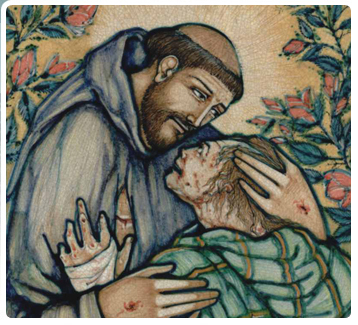
For Christians, a favorite human model of beautiful action is St. Francis. Iconic is his impulsive embrace of a leper he passes on the road.
Scott Cairns’ poem “The Leper’s Return” depicts the efficacy of this beautiful action: its transformation of the leper’s own soul from self-hatred to joy. In the poem, after receiving Francis’s unexpected embrace, the leper
found forgotten light
returning to his eyes, and looked to meet
the brother light approaching from the young man’s
beaming face. Each man blessed the other
with this light that then became the way,
thereafter, each would travel every road.
Previous Post

January 28, 2013
Remembering the Sabbath
Next Post
January 30, 2013 Learning to See Beauty
Browse Our Archives
Select a Category A. G. Harmon Alissa Wilkinson Allison Backous Art Authors Brad Fruhauff Bradford Winters Bryan Bliss Caroline Langston Chad Thomas Johnston Chris Hoke Christiana N. Peterson Culture D.G. Myers D.L. Mayfield Daniel Bowman Jr. David Griffith Elizabeth Duffy Faith Film Greg Wolfe Guest Contributor Interview Jan Vallone Jeffrey Overstreet Jessica Eddings-Roeser Jessica Mesman Griffith Kelly Foster Lindsey Crittenden Morgan Meis music Natalie Vestin Nick Olson Peggy Rosenthal Personal Reflection Poetry Friday Reflection Relationships Review Richard Chess Richard Cole Sara Zarr Shannon Huffman Polson Sonya Bilocerkowycz Tania Runyan Tony Woodlief Topical Categories Uncategorized Vic Sizemore Writing
Select a Month October 2018 September 2018 August 2018 July 2018 June 2018 May 2018 April 2018 March 2018 February 2018 January 2018 December 2017 November 2017 October 2017 September 2017 August 2017 July 2017 June 2017 May 2017 April 2017 March 2017 February 2017 January 2017 December 2016 November 2016 October 2016 September 2016 August 2016 July 2016 June 2016 May 2016 April 2016 March 2016 February 2016 January 2016 December 2015 November 2015 October 2015 September 2015 August 2015 July 2015 June 2015 May 2015 April 2015 March 2015 February 2015 January 2015 December 2014 November 2014 October 2014 September 2014 August 2014 July 2014 June 2014 May 2014 April 2014 March 2014 February 2014 January 2014 December 2013 November 2013 October 2013 September 2013 August 2013 July 2013 June 2013 May 2013 April 2013 March 2013 February 2013 January 2013 December 2012 November 2012 October 2012 September 2012 August 2012 July 2012 June 2012 May 2012 February 2008
Follow Us!
TAKE THE
Religious Wisdom Quiz
Which Psalm is famous as the "Shepherd's Psalm"?
Select your answer to see how you score.
Psalm 23 Psalm 119 Psalm 51 Psalm 1
Related posts from Good Letters


Leonard Cohen’s Holy and Broken Hallelujah

Ready or Not for the Days of Awe

TRENDING AT PATHEOS Catholic

Rejecting Doom: Christian Hope And Human Action
Christianity is a religion of hope. We are to have hope and...

It’s What Comes From Within Which Matters
One of the most difficult things for us to understand is why...

Why I Choose the Eucharist Over the Sermon
Choose the Eucharist, Not the Sermon What are we supposed to get...

5 Design Elements Found in Spiritually Rooted Homes
Putting Spirituality Into Home Decor Our homes are more than our living...

Credo: A Story of God Told with the...
About 10 years ago, I began to imagine a personal "Credo" that...

The Anatomy of Divine Revelation in Catholic Thought
The claim that God has made Himself known to human beings is...
view all Catholic blogs
Ad-Free & Subscriber Log-In Subscription Support
- About Us
- 2026 Calendar
- Videos
- Podcasts
- Library of World Religions
- Faith In Media Tracker
- Advertise With Us
- Write for Us
- Privacy Policy
- Terms of Service
- Do Not Sell My Data
- Contact Us
- Radiant Digital
- Manage Newsletter Subscriptions
- Unsubscribe From Notifications
- Sitemap
Copyright 2008-2026, Patheos. All rights reserved.
Subscription Support Ad-Free & Subscriber Log-In
Follow Patheos