
BuddhistCatholicContemplativeEvangelicalGeneral ChristianHinduJewishLatter-day SaintMuslimNew VisionsProgressive Christian
Beliefs
- Buddhist
- Catholic
- Contemplative
- Evangelical
- General Christian
- Hindu
- Jewish
- Latter-day Saint
- More Voices
- Muslim
- New Visions
- Pagan
- Progressive Christian
Topics
- Religion News
- Food and Religion
- Sports and Religion
- Religious Art
- Religious Music and Entertainment
- Religious Events
- History and Religion
- Style and Religion
- Politics and Religion
- Women in Religion
- Recreation Outdoors and Religion
- Business Finance and Religion
- Careers Workplace and Religion
- Education and Religion
- Family Parenting and Religion
- Health Fitness and Religion
- Home and Religion
- Relationships and Religion
- Technology and Religion
- Travel and Religion
Columnists
- Buddhist Columnists
- Business Finance and Religion Columnists
- Careers Workplace and Religion Columnists
- Catholic Columnists
- Contemplative Columnists
- Education and Religion Columnists
- Evangelists Columnists
- Family Parenting and Religion Columnists
- General Christian Columnists
- Health Fitness and Religion Columnists
- Hindu Columnists
- History and Religion Columnists
- Home and Religion Columnists
- Jewish Columnists
- More Voices Columnists
- Latter Day Columnists
- Muslim Columnists
- New Visions Columnists
- Nonreligious Columnists
- Pagan Columnists
- Politics and Religion Columnists
- Progressive Columnists
- Recreation Outdoors and Religion Columnists
- Relationships and Religion Columnists
- Religion News Columnists
- Religious Art Columnists
- Religious Events Columnists
- Religious Music and Entertainment Columnists
- Sports and Religion Columnists
- Style and Religion Columnists
- Technology and Religion Columnists
- Travel and Religion Columnists
- Women in Religion Columnists
Resource Library
- 2026 Calendar
- Library of World Religions
- The 100 Most Holy Places on Earth
- Patheos Answers
- Podcasts
- Videos
- Faith Leaders Database
- Anglican Episcopalian
- Bahai
- Baptist
- Buddhism
- Christianity
- Confucianism
- Eastern Orthodoxy
- Hinduism
- Holiness and Pentecostal
- ISKCON
- Islam
- Judaism
- Lutheran
- Methodist
- The Church of Jesus Christ of Latter-day Saints
- New Age
- Paganism
- Presbytarian and Reformed
- Protestantism
- Religion Behind the Scenes
- Roman Catholic
- Scientology
- Shia Islam
- Sikhism
- Sufism
- Sunni Islam
- Taoism
- Zen
- See all religions
Research Tools
 Ad-Free & Subscriber Log-In Subscription Support
Ad-Free & Subscriber Log-In Subscription Support
Follow Patheos 

- Trending:
- Forgiveness
- |
- Marriage
- |
- Consciousness
- |
- Death Penalty
- |
- Election
- |
- Halloween
 Good Letters
-
Contributors
- Home
- Catholic
- The Eclipse of the Airport Chapel
The Eclipse of the Airport Chapel
Last updated on: December 7, 2012 at 1:00 am by Caroline Langston
The Eclipse of the Airport Chapel 2012-12-04T16:29:07-07:00 Caroline Langston
Patheos Explore the world's faith through different perspectives on religion and spirituality! Patheos has the views of the prevalent religions and spiritualities of the world.
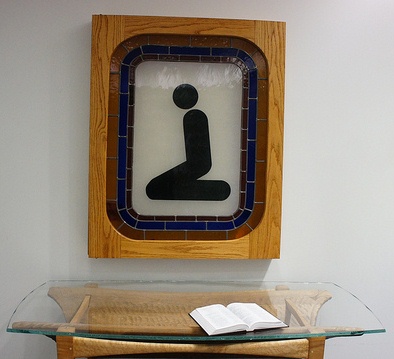 The San Francisco International Airport has a yoga room, but no chapel. At least that’s what it looked like, when I was there a couple of weeks ago at six o’clock in the morning: The Yoga Room was obviously a point of pride, with extensive signage along the concourse, but there was no indication that there might be other kinds of religious—excuse me, spiritual—spaces.
It turns out that SFO does, in fact, have a chapel, though it is tucked away in the International Terminal, and is known as “The Berman Reflection Room,” which, as an entry on IFly.com cites, “provides a center for quite self-reflection and meditation.”
Assorted photographs from Flickr, if they can be trusted, depict the space as not much different than an airport gate, with carpet, lines of chairs and window-walls of glass, plus what appears to be a vestigial Chuppah-type structure, and some potted plants. (The website for a group called the Interfaith Center at the Presidio, incidentally, laments that it was asked to raise funds for the Berman Reflection Room, but not allowed to conduct any “programming” there.)
If the cliché that all trends move eastward from California stands, then the idea of airport chapels and other incidental religious spaces would appear to be in eclipse.
Which would be too bad, for I’ve always loved sighting the airport-chapel logo out of the corner of my eye, skidding my beat-up suitcase across the concourse, and entering a hushed space of—well, exactly what?
Carpet, tidy rows of vinyl-upholstered chairs, indistinct Modernist artwork over table with a heavy old unread Bible that could have come from a funeral parlor, and the telltale compass pointing the way to Mecca.
Certainly, airport chapels never, and I mean never, cater to my own faith as an Orthodox Christian, with icons or incense. But the general airport chapel gestalt didn’t even resonate much with my beliefs before I converted, back when I was an evangelical Christian.
In the 80s and 90s, well before our national battles over pluralism became prominent, airport chapels already smacked of an earnest, non-specific Liberal Protestantism—the Protestantism of our esteemed former “liberal” Supreme Court judges, of which there are now exactly none.
And yet I loved that very non-specificity, for what it implied to me was not cheery, interfaith agreement, but passionate, personal, and often lonely fear and longing.
Inside those small spaces, with the humming of the fluorescent lights and muffled footsteps outside the door, it felt as though I were flinging my prayers out to do battle in the universe’s great silence, and that I was mystically joined with so many others, Christian or not.
In fact, praying in the ersatz chapel seemed to be a most pure form of practicing Christian faith. I dare you, whatever faith you are, to glance at the guestbook the next time you are in an airport that has a chapel, and in those pages you will find the most naked expressions of sorrow and need.
People who would crow about not darkening the door of a confessional since 1970 will scrawl an urgent, “I am so sorry. Forgive me,” in felt-tip pen across smooth white pages.
Unlike most things having to do with Washington, D.C., and thwarting the trend, the Metropolitan Washington Airports Authority does a bang-up job in its facilities at Dulles International and Reagan National, with an onsite Catholic priest and regular clergy of other faiths.
The Reagan National Airport chapel, in particular, is the one instance of a truly “open” religious space that is also truly beautiful, with glowing blond wood floors and high banquette seating around the walls that promote an atmosphere of security and calm.
Yet pluralism, the rise of the spiritual but not religious “Nones,” and the drive toward more premium retail in airports, all portend a dark future for airport chapels.
There’s a conservative Internet thread that balks to find chapels mostly serving Muslims, evidence of “creeping Sharia,” these claimants say. (But who deserted the chapels first? I want to ask. Who actually went in and took the time to pray?)
The Cleveland International Airport once housed the lavishly detailed, and explicitly Catholic Regina Caeli Chapel, with stained-glass windows and statues of Our Lady and Christ. It received constant criticism for its credal specificity, though the courts had declared its existence constitutional.
“Sadly, this unique and charming chapel was destroyed in August 2008 to make way for another mindless chain store,” noted a Flickr respondent in a caption accompanying a picture of an Easter display from years past, complete with a statue described as a smiling “Jesus Action Figure.” (Do any of you Cleveland folks know whether the contents were relocated?)
Yet I’d wager it was September 11 that spelled the general eclipse of these spaces. I recall an editorial cartoon that came out not long after the disaster, which depicted a giant (and nonspecific) Hand of God reaching down to the burning World Trade Center towers, pulling up a stairway of souls from the wreckage.
In the wake of such violence, all places became landmarks for religious practice, and religious display, and the once low-status practice of adorning car-wreck locations and murder scenes with teddy bears and bouquets of flowers became general to all of us.
“To an unknown God,” so many of them seem to say, with an intimacy that most of us find unsettling.
I remember well the faces in the thousands of photos of the lost in New York, plastered in subway stations and on telephone poles: Looking for…. Last seen Tuesday morning, 7:30 a.m. at the corner of…. Have you seen?
Icons if ever there were icons. Images of God, various and imprinted and multiple: the One in the Many, the Seed in the Ground.
Previous Post

December 6, 2012
Cicero and Machiavelli: Being and Seeming
Next Post
December 9, 2012 Science and the Death of Philosophy
Browse Our Archives
Select a Category A. G. Harmon Alissa Wilkinson Allison Backous Art Authors Brad Fruhauff Bradford Winters Bryan Bliss Caroline Langston Chad Thomas Johnston Chris Hoke Christiana N. Peterson Culture D.G. Myers D.L. Mayfield Daniel Bowman Jr. David Griffith Elizabeth Duffy Faith Film Greg Wolfe Guest Contributor Interview Jan Vallone Jeffrey Overstreet Jessica Eddings-Roeser Jessica Mesman Griffith Kelly Foster Lindsey Crittenden Morgan Meis music Natalie Vestin Nick Olson Peggy Rosenthal Personal Reflection Poetry Friday Reflection Relationships Review Richard Chess Richard Cole Sara Zarr Shannon Huffman Polson Sonya Bilocerkowycz Tania Runyan Tony Woodlief Topical Categories Uncategorized Vic Sizemore Writing
Select a Month October 2018 September 2018 August 2018 July 2018 June 2018 May 2018 April 2018 March 2018 February 2018 January 2018 December 2017 November 2017 October 2017 September 2017 August 2017 July 2017 June 2017 May 2017 April 2017 March 2017 February 2017 January 2017 December 2016 November 2016 October 2016 September 2016 August 2016 July 2016 June 2016 May 2016 April 2016 March 2016 February 2016 January 2016 December 2015 November 2015 October 2015 September 2015 August 2015 July 2015 June 2015 May 2015 April 2015 March 2015 February 2015 January 2015 December 2014 November 2014 October 2014 September 2014 August 2014 July 2014 June 2014 May 2014 April 2014 March 2014 February 2014 January 2014 December 2013 November 2013 October 2013 September 2013 August 2013 July 2013 June 2013 May 2013 April 2013 March 2013 February 2013 January 2013 December 2012 November 2012 October 2012 September 2012 August 2012 July 2012 June 2012 May 2012 February 2008
Follow Us!
TAKE THE
Religious Wisdom Quiz
I was lifted up on a pole that healed those who looked at me. What am I?
Select your answer to see how you score.
The Stone Tablets A healing statue The Golden Calf The bronze serpent
Related posts from Good Letters


Poetry Friday: "The Burned Butterfly"

Leonard Cohen’s Holy and Broken Hallelujah

Ready or Not for the Days of Awe
TRENDING AT PATHEOS Catholic

Rejecting Doom: Christian Hope And Human Action
Christianity is a religion of hope. We are to have hope and...

It’s What Comes From Within Which Matters
One of the most difficult things for us to understand is why...

Why I Choose the Eucharist Over the Sermon
Choose the Eucharist, Not the Sermon What are we supposed to get...

5 Design Elements Found in Spiritually Rooted Homes
Putting Spirituality Into Home Decor Our homes are more than our living...

Credo: A Story of God Told with the...
About 10 years ago, I began to imagine a personal "Credo" that...

The Anatomy of Divine Revelation in Catholic Thought
The claim that God has made Himself known to human beings is...
view all Catholic blogs
Ad-Free & Subscriber Log-In Subscription Support
- About Us
- 2026 Calendar
- Videos
- Podcasts
- Library of World Religions
- Faith In Media Tracker
- Advertise With Us
- Write for Us
- Privacy Policy
- Terms of Service
- Do Not Sell My Data
- Contact Us
- Radiant Digital
- Manage Newsletter Subscriptions
- Unsubscribe From Notifications
- Sitemap
Copyright 2008-2026, Patheos. All rights reserved.
Subscription Support Ad-Free & Subscriber Log-In
Follow Patheos