
BuddhistCatholicContemplativeEvangelicalGeneral ChristianHinduJewishLatter-day SaintMuslimNew VisionsProgressive Christian
Beliefs
- Buddhist
- Catholic
- Contemplative
- Evangelical
- General Christian
- Hindu
- Jewish
- Latter-day Saint
- More Voices
- Muslim
- New Visions
- Pagan
- Progressive Christian
Topics
- Religion News
- Food and Religion
- Sports and Religion
- Religious Art
- Religious Music and Entertainment
- Religious Events
- History and Religion
- Style and Religion
- Politics and Religion
- Women in Religion
- Recreation Outdoors and Religion
- Business Finance and Religion
- Careers Workplace and Religion
- Education and Religion
- Family Parenting and Religion
- Health Fitness and Religion
- Home and Religion
- Relationships and Religion
- Technology and Religion
- Travel and Religion
Columnists
- Buddhist Columnists
- Business Finance and Religion Columnists
- Careers Workplace and Religion Columnists
- Catholic Columnists
- Contemplative Columnists
- Education and Religion Columnists
- Evangelists Columnists
- Family Parenting and Religion Columnists
- General Christian Columnists
- Health Fitness and Religion Columnists
- Hindu Columnists
- History and Religion Columnists
- Home and Religion Columnists
- Jewish Columnists
- More Voices Columnists
- Latter Day Columnists
- Muslim Columnists
- New Visions Columnists
- Nonreligious Columnists
- Pagan Columnists
- Politics and Religion Columnists
- Progressive Columnists
- Recreation Outdoors and Religion Columnists
- Relationships and Religion Columnists
- Religion News Columnists
- Religious Art Columnists
- Religious Events Columnists
- Religious Music and Entertainment Columnists
- Sports and Religion Columnists
- Style and Religion Columnists
- Technology and Religion Columnists
- Travel and Religion Columnists
- Women in Religion Columnists
Resource Library
- 2026 Calendar
- Library of World Religions
- The 100 Most Holy Places on Earth
- Patheos Answers
- Podcasts
- Videos
- Faith Leaders Database
- Anglican Episcopalian
- Bahai
- Baptist
- Buddhism
- Christianity
- Confucianism
- Eastern Orthodoxy
- Hinduism
- Holiness and Pentecostal
- ISKCON
- Islam
- Judaism
- Lutheran
- Methodist
- The Church of Jesus Christ of Latter-day Saints
- New Age
- Paganism
- Presbytarian and Reformed
- Protestantism
- Religion Behind the Scenes
- Roman Catholic
- Scientology
- Shia Islam
- Sikhism
- Sufism
- Sunni Islam
- Taoism
- Zen
- See all religions
Research Tools
 Ad-Free & Subscriber Log-In Subscription Support
Ad-Free & Subscriber Log-In Subscription Support
Follow Patheos 

- Trending:
- Forgiveness
- |
- Marriage
- |
- Consciousness
- |
- Death Penalty
- |
- Election
- |
- Halloween
 Good Letters
-
Contributors
- Home
- Catholic
- Come Before Winter Part One
Come Before Winter Part One
Last updated on: December 25, 2012 at 8:35 pm by Vic Sizemore
Come Before Winter Part One 2012-12-25T20:35:59-07:00 Vic Sizemore
Patheos Explore the world's faith through different perspectives on religion and spirituality! Patheos has the views of the prevalent religions and spiritualities of the world.
 Every year when I was young, as the vibrant colors of West Virginia’s fall foliage dulled to gray-brown, my dad would preach his sermon “Come Before Winter.” He did it for a number of years, and it became so popular that people in the region would abandon their home churches on that Sunday morning to come hear him preach.
Paul is under house arrest in Rome, writing to his protégé Timothy. He writes, “Come see me, and bring my cloak.” He says, “come before winter.” If Timothy doesn’t come before winter, he will have to wait till spring—Paul is old, not in the best health; spring may well be too late.
As I remember it, the sermon deals with several types of winter, including Timothy’s possible winter of lost opportunity and Paul’s imminent winter of death.
Paul is about to die and he knows it. Though his circumstances are dire, he appears to be quite content as he looks back on his life. He knows he has fought the good fight, finished the course. As death rises like a black wall on one side of him, his life spreads behind him on the other, no more possibilities, only hard established fact. He surveys it—and there are some ugly chapters, don’t forget—and he is content and happy with what he sees.
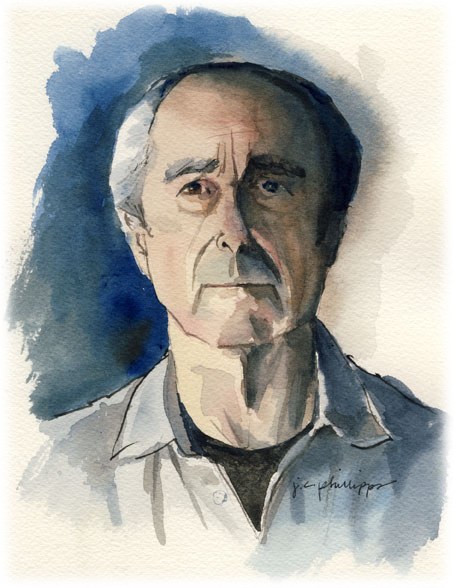
Earlier this year Philip Roth told an interviewer from the French magazine Les InRocks, he has put down his pen forever. He told them he is finished writing, is turning his back on it entirely. As a matter of fact, there is a Post-it note on the screen of his computer that says: The struggle with writing is over.
The note itself gives no indication of whether or not the end of Roth’s struggle is triumphant, or defeated, or some uneasy truce. In a New York Times article Roth explains that he sat and read back over his output and he is happy with it. He feels he has said what he has to say, and now he can kick back and fiddle with his iPhone. No kidding. He says he is playing with gadgets like a teenager, “Because I am free.” It sounds like contentment, or maybe relief.
This puzzles me. I look back over Philip Roth’s novels, famously autobiographical many of them, and this calm, content Roth in these interviews seems a stranger to the protagonist of the Zuckerman novels, or the short novels in which one story keeps rising to the surface: the aging man, dragging along baggage and estranged children and ex-wives, assessing his accomplishments and failures, seeking refuge from the onslaught of old age and death in the arms of much younger women. One of his protagonists complains that people call old age a struggle but he knows it’s not that, it’s a massacre.
That doesn’t seem to be the Roth of these interviews. This Roth says he will write no more, and he’s not kidding. He says the struggle is over, he is free.
John Updike wrote right up till the end. Joyce Carol Oates tells of how she sat by her husband’s deathbed, both of them toiling silently amid their separate flurry of manuscript pages. The nurse eventually couldn’t take it anymore, and she cried to them, “Don’t you know what is happening here?”
They both knew. He was at death’s door. But he felt he still had something to say, and so did she, so they kept writing. Leonard Cohen is still composing, and traveling the world putting on three-hour shows. At the age of ninety-seven, Herman Wouk has just published another novel, and cheerfully refuses to guarantee there won’t be more.
In a lecture on mythology, Joseph Campbell draws an arc and marks off the various stages of a human life as described by Dante in his Convivio. Youth lasts until the age of twenty five, and twenty five to forty five is the middle of life—thirty five of course is at the center of the arc. Seventy is the age at which we enter what Dante, pulling no punches, calls our decrepitude. This is the stage at which happiness is achieved in part by looking back on life with gratitude.
I can see how hanging up the tools of your calling could be a way of looking back with gratitude; I can also see how laboring on could be a way of looking back with gratitude as well, a way of being thankful that you found a life’s work that is meaningful, has value.
Paul finished the race, fought the good fight. He was ready to rest as winter moved in, and he had earned the right. Who could say Philip Roth hasn’t earned the right to some rest? Here’s to a happy decrepitude for Mr. Roth. Here’s to a happy decrepitude for Herman Wouk, and Leonard Cohen, and Joyce Carol Oates. Here’s to a happy decrepitude for all of us, every one.
Looking back with gratitude isn’t something that happens by chance. It’s not something you stumble upon. There appears to be one sure way to achieve it. I’ll explore that possibility tomorrow.
Previous Post

December 24, 2012
St. Linus the Evangelist
Next Post
December 27, 2012 Come Before Winter Part Two
Browse Our Archives
Select a Category A. G. Harmon Alissa Wilkinson Allison Backous Art Authors Brad Fruhauff Bradford Winters Bryan Bliss Caroline Langston Chad Thomas Johnston Chris Hoke Christiana N. Peterson Culture D.G. Myers D.L. Mayfield Daniel Bowman Jr. David Griffith Elizabeth Duffy Faith Film Greg Wolfe Guest Contributor Interview Jan Vallone Jeffrey Overstreet Jessica Eddings-Roeser Jessica Mesman Griffith Kelly Foster Lindsey Crittenden Morgan Meis music Natalie Vestin Nick Olson Peggy Rosenthal Personal Reflection Poetry Friday Reflection Relationships Review Richard Chess Richard Cole Sara Zarr Shannon Huffman Polson Sonya Bilocerkowycz Tania Runyan Tony Woodlief Topical Categories Uncategorized Vic Sizemore Writing
Select a Month October 2018 September 2018 August 2018 July 2018 June 2018 May 2018 April 2018 March 2018 February 2018 January 2018 December 2017 November 2017 October 2017 September 2017 August 2017 July 2017 June 2017 May 2017 April 2017 March 2017 February 2017 January 2017 December 2016 November 2016 October 2016 September 2016 August 2016 July 2016 June 2016 May 2016 April 2016 March 2016 February 2016 January 2016 December 2015 November 2015 October 2015 September 2015 August 2015 July 2015 June 2015 May 2015 April 2015 March 2015 February 2015 January 2015 December 2014 November 2014 October 2014 September 2014 August 2014 July 2014 June 2014 May 2014 April 2014 March 2014 February 2014 January 2014 December 2013 November 2013 October 2013 September 2013 August 2013 July 2013 June 2013 May 2013 April 2013 March 2013 February 2013 January 2013 December 2012 November 2012 October 2012 September 2012 August 2012 July 2012 June 2012 May 2012 February 2008
Follow Us!
TAKE THE
Religious Wisdom Quiz
Who said, "Come, follow me, and I will make you fishers of men"?
Select your answer to see how you score.
Jesus John the Baptist Paul Peter
Related posts from Good Letters

On Writing Odes: Taking Time to Celebrate


A Conversation with Barbara Brown Taylor

TRENDING AT PATHEOS Catholic

Rejecting Doom: Christian Hope And Human Action
Christianity is a religion of hope. We are to have hope and...

It’s What Comes From Within Which Matters
One of the most difficult things for us to understand is why...

Why I Choose the Eucharist Over the Sermon
Choose the Eucharist, Not the Sermon What are we supposed to get...

5 Design Elements Found in Spiritually Rooted Homes
Putting Spirituality Into Home Decor Our homes are more than our living...

Credo: A Story of God Told with the...
About 10 years ago, I began to imagine a personal "Credo" that...

The Anatomy of Divine Revelation in Catholic Thought
The claim that God has made Himself known to human beings is...
view all Catholic blogs
Ad-Free & Subscriber Log-In Subscription Support
- About Us
- 2026 Calendar
- Videos
- Podcasts
- Library of World Religions
- Faith In Media Tracker
- Advertise With Us
- Write for Us
- Privacy Policy
- Terms of Service
- Do Not Sell My Data
- Contact Us
- Radiant Digital
- Manage Newsletter Subscriptions
- Unsubscribe From Notifications
- Sitemap
Copyright 2008-2026, Patheos. All rights reserved.
Subscription Support Ad-Free & Subscriber Log-In
Follow Patheos