
BuddhistCatholicContemplativeEvangelicalGeneral ChristianHinduJewishLatter-day SaintMuslimNew VisionsProgressive Christian
Beliefs
- Buddhist
- Catholic
- Contemplative
- Evangelical
- General Christian
- Hindu
- Jewish
- Latter-day Saint
- More Voices
- Muslim
- New Visions
- Pagan
- Progressive Christian
Topics
- Religion News
- Food and Religion
- Sports and Religion
- Religious Art
- Religious Music and Entertainment
- Religious Events
- History and Religion
- Style and Religion
- Politics and Religion
- Women in Religion
- Recreation Outdoors and Religion
- Business Finance and Religion
- Careers Workplace and Religion
- Education and Religion
- Family Parenting and Religion
- Health Fitness and Religion
- Home and Religion
- Relationships and Religion
- Technology and Religion
- Travel and Religion
Columnists
- Buddhist Columnists
- Business Finance and Religion Columnists
- Careers Workplace and Religion Columnists
- Catholic Columnists
- Contemplative Columnists
- Education and Religion Columnists
- Evangelists Columnists
- Family Parenting and Religion Columnists
- General Christian Columnists
- Health Fitness and Religion Columnists
- Hindu Columnists
- History and Religion Columnists
- Home and Religion Columnists
- Jewish Columnists
- More Voices Columnists
- Latter Day Columnists
- Muslim Columnists
- New Visions Columnists
- Nonreligious Columnists
- Pagan Columnists
- Politics and Religion Columnists
- Progressive Columnists
- Recreation Outdoors and Religion Columnists
- Relationships and Religion Columnists
- Religion News Columnists
- Religious Art Columnists
- Religious Events Columnists
- Religious Music and Entertainment Columnists
- Sports and Religion Columnists
- Style and Religion Columnists
- Technology and Religion Columnists
- Travel and Religion Columnists
- Women in Religion Columnists
Resource Library
- 2026 Calendar
- Library of World Religions
- The 100 Most Holy Places on Earth
- Patheos Answers
- Podcasts
- Videos
- Faith Leaders Database
- Anglican Episcopalian
- Bahai
- Baptist
- Buddhism
- Christianity
- Confucianism
- Eastern Orthodoxy
- Hinduism
- Holiness and Pentecostal
- ISKCON
- Islam
- Judaism
- Lutheran
- Methodist
- The Church of Jesus Christ of Latter-day Saints
- New Age
- Paganism
- Presbytarian and Reformed
- Protestantism
- Religion Behind the Scenes
- Roman Catholic
- Scientology
- Shia Islam
- Sikhism
- Sufism
- Sunni Islam
- Taoism
- Zen
- See all religions
Research Tools
 Ad-Free & Subscriber Log-In Subscription Support
Ad-Free & Subscriber Log-In Subscription Support
Follow Patheos 

- Trending:
- Forgiveness
- |
- Marriage
- |
- Consciousness
- |
- Death Penalty
- |
- Election
- |
- Halloween
 Good Letters
-
Contributors
- Home
- Catholic
- The Poetics of Painting: Part Three
The Poetics of Painting: Part Three
Last updated on: November 19, 2012 at 12:03 pm by Guest Contributor
The Poetics of Painting: Part Three 2012-11-19T12:03:48-07:00 Guest Contributor
Patheos Explore the world's faith through different perspectives on religion and spirituality! Patheos has the views of the prevalent religions and spiritualities of the world.
Part Three: Standing Before a Painting
Guest Post
By Daniel A. Siedell
A painting is more than meets the eye. And yet, it meets our eye. How are we to respond? Unfortunately, we’re conditioned by museum curators to do all we can to avoid this encounter that puts us in the crosshairs of that paint-smeared canvas.
I should know—I was one of those museum curators.
We mean well, but we rush in to break up the confrontation that looms between you and the painting. We do it under the guise of education. We tell you that before you can look at this or that painting, you need to know something about the artist and her life story and philosophy, you then need to learn something about the time period, about the style, and about a dozen other things that art critics, curators, and art historians write books on, but really, when it comes right down to it, drive you away from rather than toward the painting.
After we’re done, you see the painting only as an historical artifact, a journal entry, a visual illustration of what you’ve been taught. And you leave the tour of the exhibition knowing something about the artist, her life, the time period, and art history.
You’ve left without actually listening to the painting. A curator friend once said that the problem with didactic labels in a museum exhibition is that people read them.
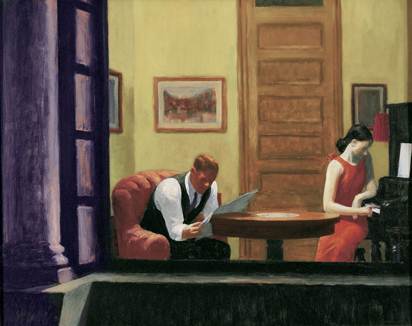
But let’s return to that painting that stands before you, calling at that moment. Consider Edward Hopper’s Room in New York (1932), a painting in the permanent collection I oversaw for over a decade. It is one of the most valuable and historically important paintings in the collection, and a pilgrimage attraction for many.
How do we receive it? We begin by allowing the painting to unfold, gradually. We notice there are two figures in an intimate and quiet setting. We recognize that they are not communicating. We also notice that we are voyeurs, glimpsing them through an open apartment window in an urban environment.
But that is not all. Gradually we become aware of a feeling the painting produces. The figures are close physically, connected by the table between them, but they are miles apart psychologically. One seems distracted, wanting to be noticed. The other is content, absorbed.
The relationship is unbalanced—one must chase another. Is this a one-time feud, or is it, as it seems, how the relationship between the two is played out daily? Perhaps we feel the thick tension of silence, what should be a retreat from the tension of the city becomes its re-enactment. This home is not safe. Do we feel suffocated, tight, claustrophobic, perhaps?
But Hopper doesn’t accomplish these feelings in us through the figures. That green wall is strange, isn’t it? It pushes into our space, shrinking the depth that the apartment window produces. The door, too, seems to push forward as well. The border of the window that frames this scene, creating a painting within a painting, flattens out the surface.
If we think about it, the indescribable green wall, prominent door, and window frame, the sharp vertical and horizontal lines contribute at least as much to the feeling we are experiencing as the figures themselves. And if we look at the figures closely, they seem to dissolve as paint strokes into the wall behind them.
The emotional impact the painting has on us, however, emerges because of our own lived experience, of isolation, of quiet desperation in an unbalanced relationship, or it reminds us of a scene in a movie or a novel, or we call to mind a line from a poem by Emily Dickinson or Robert Frost. The painting activates our memory, which St. Augustine so poignantly called, the belly of our mind.
Now, all of a sudden, we are not reading the painting, it is reading us.
And remarkably, not one word has been said about the artist, his influences, his worldview, his style, historical period, historical significance, or even how much the museum paid for the painting in 1934 (several hundred dollars) and how much it is worth today (many millions).
Edward Hopper did not paint the painting to reveal to you his thoughts, his influences, his historical epoch. He didn’t even paint the painting as a “story.” He painted the painting as a moment that unfolded in us a particular feeling, an experience that is simultaneously strange and familiar.
The “education” that we museum curators, art critics, and art historians provide undermines the integrity of a work of art if it does not attach itself to and build on the initial experience or feeling it engenders in the viewer, speaking to our experience in surprising ways.
For that is what painting is. This is exactly what the literary critic George Steiner meant when he declared that we must let the work of art have the run of our inner chambers, to let it go into those regions of heart and mind we hide to reveal what we didn’t even know existed.
No matter when a painting was made, its intended audience is the one who stands before it. This is why the Abstract Expressionist Mark Rothko once lamented that it is a risky business to send a work of art out into the world, for someone else, for you and for me.
As I hear from friends whose paintings were destroyed by Superstorm Sandy last week, I am reminded just how risky it is to send a vulnerable thing like a painting out in the world, and such an act of grace to have the courage to do it.
And such a precious gift for us to stand before it, and listen.
Daniel A. Siedell (M.A. SUNY-Stony Brook, Ph.D. Iowa) is on staff at Coral Ridge Presbyterian Church in Fort Lauderdale where he is curator of Liberate, the resource ministry of Tullian Tchividjian. He is the author of God in the Gallery (Baker Academic, 2008) and numerous writings on Christianity and modern art. He blogs weekly at Cultivare.
Read part one and part two of this series.
Previous Post

November 16, 2012
Weathering Disaster from Beirut to Brooklyn
Next Post
November 20, 2012 How To Accomplish Love
Browse Our Archives
Select a Category A. G. Harmon Alissa Wilkinson Allison Backous Art Authors Brad Fruhauff Bradford Winters Bryan Bliss Caroline Langston Chad Thomas Johnston Chris Hoke Christiana N. Peterson Culture D.G. Myers D.L. Mayfield Daniel Bowman Jr. David Griffith Elizabeth Duffy Faith Film Greg Wolfe Guest Contributor Interview Jan Vallone Jeffrey Overstreet Jessica Eddings-Roeser Jessica Mesman Griffith Kelly Foster Lindsey Crittenden Morgan Meis music Natalie Vestin Nick Olson Peggy Rosenthal Personal Reflection Poetry Friday Reflection Relationships Review Richard Chess Richard Cole Sara Zarr Shannon Huffman Polson Sonya Bilocerkowycz Tania Runyan Tony Woodlief Topical Categories Uncategorized Vic Sizemore Writing
Select a Month October 2018 September 2018 August 2018 July 2018 June 2018 May 2018 April 2018 March 2018 February 2018 January 2018 December 2017 November 2017 October 2017 September 2017 August 2017 July 2017 June 2017 May 2017 April 2017 March 2017 February 2017 January 2017 December 2016 November 2016 October 2016 September 2016 August 2016 July 2016 June 2016 May 2016 April 2016 March 2016 February 2016 January 2016 December 2015 November 2015 October 2015 September 2015 August 2015 July 2015 June 2015 May 2015 April 2015 March 2015 February 2015 January 2015 December 2014 November 2014 October 2014 September 2014 August 2014 July 2014 June 2014 May 2014 April 2014 March 2014 February 2014 January 2014 December 2013 November 2013 October 2013 September 2013 August 2013 July 2013 June 2013 May 2013 April 2013 March 2013 February 2013 January 2013 December 2012 November 2012 October 2012 September 2012 August 2012 July 2012 June 2012 May 2012 February 2008
Follow Us!
TAKE THE
Religious Wisdom Quiz
What prominent city did Paul visit, known for its altar to "an unknown god"?
Select your answer to see how you score.
Ephesus Athens Corinth Rome
Related posts from Good Letters

Praying the Art of Sean Scully: The Match...

Souvenirs from the Waste Land: An Interview with...

Transcendence: A Tribute to William Christenberry (1936-2016)

A Love Supreme: The Surprising Art of Sedrick...
TRENDING AT PATHEOS Catholic

Rejecting Doom: Christian Hope And Human Action
Christianity is a religion of hope. We are to have hope and...

It’s What Comes From Within Which Matters
One of the most difficult things for us to understand is why...

Why I Choose the Eucharist Over the Sermon
Choose the Eucharist, Not the Sermon What are we supposed to get...

5 Design Elements Found in Spiritually Rooted Homes
Putting Spirituality Into Home Decor Our homes are more than our living...

Credo: A Story of God Told with the...
About 10 years ago, I began to imagine a personal "Credo" that...

The Anatomy of Divine Revelation in Catholic Thought
The claim that God has made Himself known to human beings is...
view all Catholic blogs
Ad-Free & Subscriber Log-In Subscription Support
- About Us
- 2026 Calendar
- Videos
- Podcasts
- Library of World Religions
- Faith In Media Tracker
- Advertise With Us
- Write for Us
- Privacy Policy
- Terms of Service
- Do Not Sell My Data
- Contact Us
- Radiant Digital
- Manage Newsletter Subscriptions
- Unsubscribe From Notifications
- Sitemap
Copyright 2008-2026, Patheos. All rights reserved.
Subscription Support Ad-Free & Subscriber Log-In
Follow Patheos