
BuddhistCatholicContemplativeEvangelicalGeneral ChristianHinduJewishLatter-day SaintMuslimNew VisionsProgressive Christian
Beliefs
- Buddhist
- Catholic
- Contemplative
- Evangelical
- General Christian
- Hindu
- Jewish
- Latter-day Saint
- More Voices
- Muslim
- New Visions
- Pagan
- Progressive Christian
Topics
- Religion News
- Food and Religion
- Sports and Religion
- Religious Art
- Religious Music and Entertainment
- Religious Events
- History and Religion
- Style and Religion
- Politics and Religion
- Women in Religion
- Recreation Outdoors and Religion
- Business Finance and Religion
- Careers Workplace and Religion
- Education and Religion
- Family Parenting and Religion
- Health Fitness and Religion
- Home and Religion
- Relationships and Religion
- Technology and Religion
- Travel and Religion
Columnists
- Buddhist Columnists
- Business Finance and Religion Columnists
- Careers Workplace and Religion Columnists
- Catholic Columnists
- Contemplative Columnists
- Education and Religion Columnists
- Evangelists Columnists
- Family Parenting and Religion Columnists
- General Christian Columnists
- Health Fitness and Religion Columnists
- Hindu Columnists
- History and Religion Columnists
- Home and Religion Columnists
- Jewish Columnists
- More Voices Columnists
- Latter Day Columnists
- Muslim Columnists
- New Visions Columnists
- Nonreligious Columnists
- Pagan Columnists
- Politics and Religion Columnists
- Progressive Columnists
- Recreation Outdoors and Religion Columnists
- Relationships and Religion Columnists
- Religion News Columnists
- Religious Art Columnists
- Religious Events Columnists
- Religious Music and Entertainment Columnists
- Sports and Religion Columnists
- Style and Religion Columnists
- Technology and Religion Columnists
- Travel and Religion Columnists
- Women in Religion Columnists
Resource Library
- 2026 Calendar
- Library of World Religions
- The 100 Most Holy Places on Earth
- Patheos Answers
- Podcasts
- Videos
- Faith Leaders Database
- Anglican Episcopalian
- Bahai
- Baptist
- Buddhism
- Christianity
- Confucianism
- Eastern Orthodoxy
- Hinduism
- Holiness and Pentecostal
- ISKCON
- Islam
- Judaism
- Lutheran
- Methodist
- The Church of Jesus Christ of Latter-day Saints
- New Age
- Paganism
- Presbytarian and Reformed
- Protestantism
- Religion Behind the Scenes
- Roman Catholic
- Scientology
- Shia Islam
- Sikhism
- Sufism
- Sunni Islam
- Taoism
- Zen
- See all religions
Research Tools
 Ad-Free & Subscriber Log-In Subscription Support
Ad-Free & Subscriber Log-In Subscription Support
Follow Patheos 

- Trending:
- Forgiveness
- |
- Marriage
- |
- Consciousness
- |
- Death Penalty
- |
- Election
- |
- Halloween
 Good Letters
-
Contributors
- Home
- Catholic
- The Fool and the Beloved: Part One
The Fool and the Beloved: Part One
Last updated on: November 14, 2012 at 12:46 pm by Guest Contributor
The Fool and the Beloved: Part One 2012-11-14T12:46:48-07:00 Guest Contributor
Patheos Explore the world's faith through different perspectives on religion and spirituality! Patheos has the views of the prevalent religions and spiritualities of the world.
 Guest Post
By Stuart Scadron-Wattles
I recently gave a guest lecture for a graduate class on global development. I was told that I could do pretty much what I liked, and because it was a Christian college, I felt free to have them meditate on a particular scene from the New Testament, one that appears almost verbatim in three of the gospels. The account I chose was from chapter 12 of the book of John.
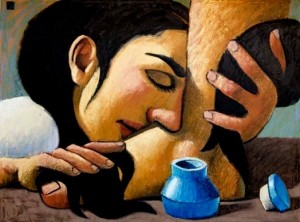
The scene begins with Jesus and his disciples at dinner in the house of Lazarus. The sister of the host, Mary, enters the room and begins weeping at the feet of Jesus, wiping his tear-soaked feet with her hair. Then she breaks open a vial of particularly expensive perfume to anoint them.
None of the guests like what’s going on. (We don’t find out what Jesus thinks until the end.) As John tells it, Judas protests at the cost of Mary’s act and points out that the perfume could have been sold and the proceeds given to the poor.
I asked my global development students to place themselves imaginatively in the scene. Where were they, I asked? What did they see or hear?
Three of them said that they were Judas, questioning the cost. Another said that he heard Judas laughing, yet another that he caught Jesus giving Judas a stern look.
As for me: I couldn’t stop thinking about Mary.
What was this woman doing, speechless with sorrow—tears dripping, sniveling with snot—wiping the filth of the road off of Jesus’ feet and using her own hair for a towel?
What possessed her to bring along a jar of perfume so costly that it was considered a superfluous luxury, and lavish it onto feet that were no doubt going to be both sticky and dirty five minutes after their owner left the dinner table?
It’s a foolish act. My students’ responses and the chronicles of those present say as much.
Then it hit me: Mary’s act is like that of an artist.
What is she doing if not making art: carrying her human sorrow for the world, crying for the futility of it all, lamenting that the beloved should need to descend to this broken, dirty place.
And perhaps hoping against hope that she could do something beautiful—or at least cleansing—with those tears, if only for a moment. She uses her own sorry self to try to make it better, her most expensive treasure to get it to smell right.
She doesn’t even know if it will do any good, she just knows that she needs to do it.
This has all of the attributes of art-making.
As artists, we like to think that we have an audience, a readership. Those of us who are professionals depend upon the commercial transactions around that relationship for our livelihood.
But Mary is doing this without regard for her audience. She is in the presence of the beloved, and that is where, if we are honest about it, we make our best art: the work that is useless to the world, wasteful of our resources. Proceeding as it does from that dark, mysterious place in our souls, it can often positively drip with embarrassment.
It is the act of a fool.
Nothing will be made better by this act; no meaningful dialogue took place in that room. This is an encounter between the Fool and the Beloved. In all three of the gospel accounts, Jesus never speaks to her.
In the middle of this encounter (or more likely towards the end) Judas decides to drag in some helpful comments about the poor, by way of adjudication and evaluation. His response is itself critiqued by the narrator. John breaks from his story and in the process betrays his own judgmental attitude, questioning the motives of Judas’ criticism.
Mary’s piece of performance art apparently cannot stand on its own. It requires two critical responses, neither of which helps us to engage with the act itself.
That said, I am grieved by Judas’ use of the poor in order to evaluate a wasteful, creative act: not because of his motives, but because he is trying to make us more comfortable with the scene—by dismissing its significance.
We’re more comfortable—less embarrassed—with Judas’ very contemporary assessment. The woman is excessive; she does not exhibit sufficient Christian wisdom about the value of things and the importance of the poor.
If the value of money at work is its highest good, Mary’s act is indeed a poor investment, possibly a worthless one.
Judas knows what Jesus is about to say, that we will always have the poor with us, and since they are right at hand, he can readily haul them in. But his use of the nameless, faceless poor is a dishonest, manipulative move that draws the narrator and then us away from the feet of the beloved, where the real action is.
Continued tomorrow.
Stuart Scadron-Wattles has written his way through music, professional theatre, and intentional Christian community. He currently lives with his wife Linda and extended family in Seattle, WA, where he serves as director of resource development for Image.
Accompanying image: “Anointing His Feet” by Wayne Forte, oil and acrylic on canvas.
Previous Post

November 7, 2012
Do-It-Yourself Sacramental Tedium
Next Post
November 9, 2012 The Fool and the Beloved: Part Two
Browse Our Archives
Select a Category A. G. Harmon Alissa Wilkinson Allison Backous Art Authors Brad Fruhauff Bradford Winters Bryan Bliss Caroline Langston Chad Thomas Johnston Chris Hoke Christiana N. Peterson Culture D.G. Myers D.L. Mayfield Daniel Bowman Jr. David Griffith Elizabeth Duffy Faith Film Greg Wolfe Guest Contributor Interview Jan Vallone Jeffrey Overstreet Jessica Eddings-Roeser Jessica Mesman Griffith Kelly Foster Lindsey Crittenden Morgan Meis music Natalie Vestin Nick Olson Peggy Rosenthal Personal Reflection Poetry Friday Reflection Relationships Review Richard Chess Richard Cole Sara Zarr Shannon Huffman Polson Sonya Bilocerkowycz Tania Runyan Tony Woodlief Topical Categories Uncategorized Vic Sizemore Writing
Select a Month October 2018 September 2018 August 2018 July 2018 June 2018 May 2018 April 2018 March 2018 February 2018 January 2018 December 2017 November 2017 October 2017 September 2017 August 2017 July 2017 June 2017 May 2017 April 2017 March 2017 February 2017 January 2017 December 2016 November 2016 October 2016 September 2016 August 2016 July 2016 June 2016 May 2016 April 2016 March 2016 February 2016 January 2016 December 2015 November 2015 October 2015 September 2015 August 2015 July 2015 June 2015 May 2015 April 2015 March 2015 February 2015 January 2015 December 2014 November 2014 October 2014 September 2014 August 2014 July 2014 June 2014 May 2014 April 2014 March 2014 February 2014 January 2014 December 2013 November 2013 October 2013 September 2013 August 2013 July 2013 June 2013 May 2013 April 2013 March 2013 February 2013 January 2013 December 2012 November 2012 October 2012 September 2012 August 2012 July 2012 June 2012 May 2012 February 2008
Follow Us!
TAKE THE
Religious Wisdom Quiz
What does Jude say certain individuals have secretly slipped in to do?
Select your answer to see how you score.
Change the grace of God into a license for immorality Deny the resurrection Persecute believers Steal from the church
Related posts from Good Letters

Leonard Cohen’s Holy and Broken Hallelujah

Ready or Not for the Days of Awe


TRENDING AT PATHEOS Catholic

Rejecting Doom: Christian Hope And Human Action
Christianity is a religion of hope. We are to have hope and...

It’s What Comes From Within Which Matters
One of the most difficult things for us to understand is why...

Why I Choose the Eucharist Over the Sermon
Choose the Eucharist, Not the Sermon What are we supposed to get...

5 Design Elements Found in Spiritually Rooted Homes
Putting Spirituality Into Home Decor Our homes are more than our living...

Credo: A Story of God Told with the...
About 10 years ago, I began to imagine a personal "Credo" that...

The Anatomy of Divine Revelation in Catholic Thought
The claim that God has made Himself known to human beings is...
view all Catholic blogs
Ad-Free & Subscriber Log-In Subscription Support
- About Us
- 2026 Calendar
- Videos
- Podcasts
- Library of World Religions
- Faith In Media Tracker
- Advertise With Us
- Write for Us
- Privacy Policy
- Terms of Service
- Do Not Sell My Data
- Contact Us
- Radiant Digital
- Manage Newsletter Subscriptions
- Unsubscribe From Notifications
- Sitemap
Copyright 2008-2026, Patheos. All rights reserved.
Subscription Support Ad-Free & Subscriber Log-In
Follow Patheos