
BuddhistCatholicContemplativeEvangelicalGeneral ChristianHinduJewishLatter-day SaintMuslimNew VisionsProgressive Christian
Beliefs
- Buddhist
- Catholic
- Contemplative
- Evangelical
- General Christian
- Hindu
- Jewish
- Latter-day Saint
- More Voices
- Muslim
- New Visions
- Pagan
- Progressive Christian
Topics
- Religion News
- Food and Religion
- Sports and Religion
- Religious Art
- Religious Music and Entertainment
- Religious Events
- History and Religion
- Style and Religion
- Politics and Religion
- Women in Religion
- Recreation Outdoors and Religion
- Business Finance and Religion
- Careers Workplace and Religion
- Education and Religion
- Family Parenting and Religion
- Health Fitness and Religion
- Home and Religion
- Relationships and Religion
- Technology and Religion
- Travel and Religion
Columnists
- Buddhist Columnists
- Business Finance and Religion Columnists
- Careers Workplace and Religion Columnists
- Catholic Columnists
- Contemplative Columnists
- Education and Religion Columnists
- Evangelists Columnists
- Family Parenting and Religion Columnists
- General Christian Columnists
- Health Fitness and Religion Columnists
- Hindu Columnists
- History and Religion Columnists
- Home and Religion Columnists
- Jewish Columnists
- More Voices Columnists
- Latter Day Columnists
- Muslim Columnists
- New Visions Columnists
- Nonreligious Columnists
- Pagan Columnists
- Politics and Religion Columnists
- Progressive Columnists
- Recreation Outdoors and Religion Columnists
- Relationships and Religion Columnists
- Religion News Columnists
- Religious Art Columnists
- Religious Events Columnists
- Religious Music and Entertainment Columnists
- Sports and Religion Columnists
- Style and Religion Columnists
- Technology and Religion Columnists
- Travel and Religion Columnists
- Women in Religion Columnists
Resource Library
- 2026 Calendar
- Library of World Religions
- The 100 Most Holy Places on Earth
- Patheos Answers
- Podcasts
- Videos
- Faith Leaders Database
- Anglican Episcopalian
- Bahai
- Baptist
- Buddhism
- Christianity
- Confucianism
- Eastern Orthodoxy
- Hinduism
- Holiness and Pentecostal
- ISKCON
- Islam
- Judaism
- Lutheran
- Methodist
- The Church of Jesus Christ of Latter-day Saints
- New Age
- Paganism
- Presbytarian and Reformed
- Protestantism
- Religion Behind the Scenes
- Roman Catholic
- Scientology
- Shia Islam
- Sikhism
- Sufism
- Sunni Islam
- Taoism
- Zen
- See all religions
Research Tools
 Ad-Free & Subscriber Log-In Subscription Support
Follow Patheos 

- Trending:
- Advent
- |
- Forgiveness
- |
- Thanksgiving
- |
- Election
- |
- Seasonal Holidays
- |
- Marriage
 Good Letters
-
Contributors
- Home
- Catholic
- Margaret and the Blight Man Was Born for
Margaret and the Blight Man Was Born for
Last updated on: November 14, 2012 at 12:49 pm by A. G. Harmon
Margaret and the Blight Man Was Born for 2012-11-14T12:49:50-07:00 A. G. Harmon
Patheos Explore the world's faith through different perspectives on religion and spirituality! Patheos has the views of the prevalent religions and spiritualities of the world.
 Near the end of Kenneth Lonergan’s film, Margaret, a seventeen-year-old girl sits next to her mother in a theater, watching a duet from Offenbach’s Tales of Hoffman.
The voices of two opera singers climb toward each other from opposite sides of the stage—rising in their plaints like two vines, hoping to unite in an arch above. The girl’s attention is rapt, her face straining at the union aspired for.
But then the singers fall back, collapsing in a cascade of defeat. The voices seem to mourn their loss—not only of the other, but also of themselves, as though in this failure to join they have discovered their own transience.
At that moment, the girl in the audience breaks loose in a storm of grief. She grasps for her mother, who grasps for her, and the spectacle all around them rings to a close.
Lonergan’s meta-drama is his most ambitious task since 2000’s You Can Count on Me. His achievement lies in the intricate composite of guilt/responsibility/mortality, and of a youth’s abrupt realization of the same.
As organizing principle, he frames the tale by way of Gerard Manley Hopkins’ short poem, *“*Spring and Fall: To a Young Child”:
Margaret, are you grieving
Over Goldengrove unleaving?
Leaves like the things of man, you
With your fresh thoughts care for, can you?
Ah! as the heart grows older
It will come to such sights colder
By and by, nor spare a sigh
Though worlds of wanwood leafmeal lie;
And yet you will weep and know why.
Now no matter, child, the name
Sorrow’s springs are the same.
Nor mouth had, no nor mind, expressed
What heart heard of, ghost guessed:
It is the blight man was born for,
It is Margaret you mourn for.
The “Margaret” in the film is named Lisa Cohen (Anna Paquin). When first introduced, she is the kind of smart, callous Manhattan girl that masks her self-doubt by way of sharpness—quick to betray and mock.
She is cruel to admirers, short with friends, and manipulative of all. Her voice even carries an unsettling competence within it, too mature and capable, and her backstory is representative of many her age—divorced parents and free license.
Still, for all her posturing, nothing seems to give her joy; she is the kind of girl—sadly, all too common—that is above such things as joy.
But in the midst of her tense progression through life she is brought up short by a tragedy, partly of her own making. By way of her heedlessness, she is the cause of a distraction—one split-second that robs a bus driver of his attention—and a woman is killed.
From then on, nothing is the same, and the movie’s power lies in the fact that Lisa does not want it to be.
She does not so much seek consolation as she does guidance, which none can give her. Her mother, an actress, is no more mature than she; her father (a cameo by Lonergan), with whom she conducts a long-distance telephone relationship, is peculiar and awkward.
And when she shares with the dead woman’s best friend some hoped-for meaning she has read into the woman’s last words, Lisa is ferociously attacked for trying to turn the moment into a private drama.
As time passes, it is as though she seeks to find even less meaning in life, inoculating herself from present and future pain—the way we do whenever we become snide. Fear and weakness are the causes here; it takes no courage to be a sarcastic detractor.
Skepticism as a means of caution is wise, but its proper use is as a defense, not as an entire ideology. Its relative safety is achieved only by never having the guts to commit.
The peculiar truth is that life’s meaning can only reveal itself through suffering. From the Christian perspective, that is the mystery of the cross. And from that perspective, the gravity of Lisa’s suffering can be explained in terms of both the frustration that comes from not acknowledging responsibility, and the catharsis that comes from finally owning up to it.
For if there is no guilt, then the woman’s death is not tragic at all. To speak of meaninglessness is no more relevant that to speak of meaning. Indeed, of what purpose are causal chains if there is no such thing as blame? Of what purpose is conscience even?
As a girl raised in an utterly secular and cynical ethos, Lisa inartfully—and maybe in the end, inadequately—looks for the place from which making any sense of life can begin.
But perhaps even that place cannot be found in our internal meanderings through worlds of wanwood, lying leafmeal about us, unless we confront the blight we are born for: that we are clothed in a shroud, that our very skin is our winding sheet.
In Margaret, Lisa’s is the ultimate tragedy—one we all share. The sky is the proscenium arch of our great disaster—the ground, the stage of our woe. There is a chorus—fellow singers, an ensemble cast—accompanying the magnum exposition, and the flaw that any hero must be blind to, that any audience must see—is that no pose or attitude can keep us safe from the ruins amongst which we play.
For it comes, whether in glorious spring, abundant summer, or fulsome autumn. It comes in the winter of our discontent, and sometimes even in the season of our bliss.
We are never safe, and no attitude—no cut of the eyes, no smirk, no snark—will stall its procession. It is our dark birthright, and from thence springs all our woe.
But an authentic life can only begin with an awareness that we are born within the arms of our own limit, cradled within the corners of our own mortality. We need not weep for what will come. It is already here. And that fresh thought must change everything.
Previous Post

November 9, 2012
The Fool and the Beloved: Part Two
Next Post
November 14, 2012 On the Marine Corps Birthday: Why Not Turn the Other Cheek?
Browse Our Archives
Select a Category A. G. Harmon Alissa Wilkinson Allison Backous Art Authors Brad Fruhauff Bradford Winters Bryan Bliss Caroline Langston Chad Thomas Johnston Chris Hoke Christiana N. Peterson Culture D.G. Myers D.L. Mayfield Daniel Bowman Jr. David Griffith Elizabeth Duffy Faith Film Greg Wolfe Guest Contributor Interview Jan Vallone Jeffrey Overstreet Jessica Eddings-Roeser Jessica Mesman Griffith Kelly Foster Lindsey Crittenden Morgan Meis music Natalie Vestin Nick Olson Peggy Rosenthal Personal Reflection Poetry Friday Reflection Relationships Review Richard Chess Richard Cole Sara Zarr Shannon Huffman Polson Sonya Bilocerkowycz Tania Runyan Tony Woodlief Topical Categories Uncategorized Vic Sizemore Writing
Select a Month October 2018 September 2018 August 2018 July 2018 June 2018 May 2018 April 2018 March 2018 February 2018 January 2018 December 2017 November 2017 October 2017 September 2017 August 2017 July 2017 June 2017 May 2017 April 2017 March 2017 February 2017 January 2017 December 2016 November 2016 October 2016 September 2016 August 2016 July 2016 June 2016 May 2016 April 2016 March 2016 February 2016 January 2016 December 2015 November 2015 October 2015 September 2015 August 2015 July 2015 June 2015 May 2015 April 2015 March 2015 February 2015 January 2015 December 2014 November 2014 October 2014 September 2014 August 2014 July 2014 June 2014 May 2014 April 2014 March 2014 February 2014 January 2014 December 2013 November 2013 October 2013 September 2013 August 2013 July 2013 June 2013 May 2013 April 2013 March 2013 February 2013 January 2013 December 2012 November 2012 October 2012 September 2012 August 2012 July 2012 June 2012 May 2012 February 2008
Follow Us!
TAKE THE
Religious Wisdom Quiz
Who was the only disciple who was not martyred?
Select your answer to see how you score.
James John Thomas Peter
Related posts from Good Letters



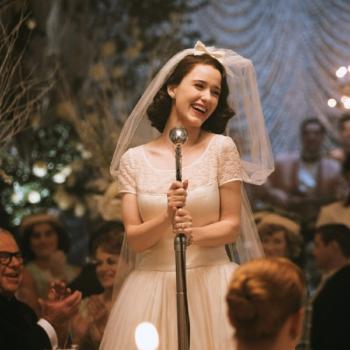
Emmy Watch: The Marvelous Mrs. Maisel
TRENDING AT PATHEOS Catholic

Bad Survey Questions Distort Eucharistic Theology
It seems to be the newest thing: someone conducts a bad survey...

If Baptism Washes Away Sin, Why Do Catholics...
The seven sacraments stand as the foundation of Catholic ecclesial life. The...

Far from promoting indifference, inaction, or quietism, Paul consistently tells us to...

The Power of Setting a Good Example
Remember last August when the Chicago White Sox hosted a "Pope Hat...

A Catholic Critique of Biblical Unitarianism
If the statistics are to be believed, Unitarianism is rising worldwide. Although...

How Grandma Tourism Helps Grandparents Live Their Vocation
Grandma, The New Travel Influencer What started as a nostalgia-inspired social media...
view all Catholic blogs
Ad-Free & Subscriber Log-In Subscription Support
- About Us
- 2026 Calendar
- Videos
- Podcasts
- Library of World Religions
- Faith In Media Tracker
- Advertise With Us
- Write for Us
- Privacy Policy
- Terms of Service
- Do Not Sell My Data
- Contact Us
- Radiant Digital
- Manage Newsletter Subscriptions
- Unsubscribe From Notifications
- Sitemap
Copyright 2008-2026, Patheos, part of the Radiant Digital network of media brands. All rights reserved.
Subscription Support Ad-Free & Subscriber Log-In
Follow Patheos