
BuddhistCatholicContemplativeEvangelicalGeneral ChristianHinduJewishLatter-day SaintMuslimNew VisionsProgressive Christian
Beliefs
- Buddhist
- Catholic
- Contemplative
- Evangelical
- General Christian
- Hindu
- Jewish
- Latter-day Saint
- More Voices
- Muslim
- New Visions
- Pagan
- Progressive Christian
Topics
- Religion News
- Food and Religion
- Sports and Religion
- Religious Art
- Religious Music and Entertainment
- Religious Events
- History and Religion
- Style and Religion
- Politics and Religion
- Women in Religion
- Recreation Outdoors and Religion
- Business Finance and Religion
- Careers Workplace and Religion
- Education and Religion
- Family Parenting and Religion
- Health Fitness and Religion
- Home and Religion
- Relationships and Religion
- Technology and Religion
- Travel and Religion
Columnists
- Buddhist Columnists
- Business Finance and Religion Columnists
- Careers Workplace and Religion Columnists
- Catholic Columnists
- Contemplative Columnists
- Education and Religion Columnists
- Evangelists Columnists
- Family Parenting and Religion Columnists
- General Christian Columnists
- Health Fitness and Religion Columnists
- Hindu Columnists
- History and Religion Columnists
- Home and Religion Columnists
- Jewish Columnists
- More Voices Columnists
- Latter Day Columnists
- Muslim Columnists
- New Visions Columnists
- Nonreligious Columnists
- Pagan Columnists
- Politics and Religion Columnists
- Progressive Columnists
- Recreation Outdoors and Religion Columnists
- Relationships and Religion Columnists
- Religion News Columnists
- Religious Art Columnists
- Religious Events Columnists
- Religious Music and Entertainment Columnists
- Sports and Religion Columnists
- Style and Religion Columnists
- Technology and Religion Columnists
- Travel and Religion Columnists
- Women in Religion Columnists
Resource Library
- 2026 Calendar
- Library of World Religions
- The 100 Most Holy Places on Earth
- Patheos Answers
- Podcasts
- Videos
- Faith Leaders Database
- Anglican Episcopalian
- Bahai
- Baptist
- Buddhism
- Christianity
- Confucianism
- Eastern Orthodoxy
- Hinduism
- Holiness and Pentecostal
- ISKCON
- Islam
- Judaism
- Lutheran
- Methodist
- The Church of Jesus Christ of Latter-day Saints
- New Age
- Paganism
- Presbytarian and Reformed
- Protestantism
- Religion Behind the Scenes
- Roman Catholic
- Scientology
- Shia Islam
- Sikhism
- Sufism
- Sunni Islam
- Taoism
- Zen
- See all religions
Research Tools
 Ad-Free & Subscriber Log-In Subscription Support
Ad-Free & Subscriber Log-In Subscription Support
Follow Patheos 

- Trending:
- Forgiveness
- |
- Marriage
- |
- Consciousness
- |
- Death Penalty
- |
- Election
- |
- Halloween
 Good Letters
-
Contributors
- Home
- Catholic
- Something Like Jasmine Meditates on Mortality
Something Like Jasmine Meditates on Mortality
Last updated on: November 14, 2012 at 12:30 pm by Peggy Rosenthal
Something Like Jasmine Meditates on Mortality 2012-11-14T12:30:19-07:00 Peggy Rosenthal
Patheos Explore the world's faith through different perspectives on religion and spirituality! Patheos has the views of the prevalent religions and spiritualities of the world.
 Living with leukemia, I naturally meditate often on our human mortality. No, often is the wrong word: the meditation is a constant undercurrent of my consciousness.
We are all mortal, of course; yet (of course) we live most of our lives trying to distract ourselves from this undeniable, unpleasant fact. The gift of a life-threatening illness is that it trumps the desire for distraction.
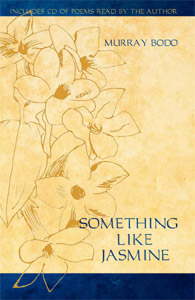
Advancing age can bring this same gift. Murray Bodo, now in his mid-seventies, wraps the gift in perfectly crafted poems offered to us in his new collection, Something Like Jasmine.
Fr. Murray Bodo is a Franciscan priest and author of acclaimed books on St. Francis. He has been Image Artist of the Month and a chaplain at the Glen Workshop.
All of his writing—poetry and prose—exudes Franciscan joy. So even the opening poem of Something Like Jasmine imagines his own inevitable death in playful terms:
Like the movies of your childhood
when you didn’t want them to end
even if you knew the ending,
you see your life and try to keep
the reel from running out because
you know it’s not just a movie…
The poems that follow pay tribute to some of his friends whose reel has run out. (And anyone in his eighth decade is bound to have many such friends.) Here’s the start of “Sweet Man Dying”:
And he, knowing he was dying,
said he didn’t know he knew
until, as the elevator
door was closing, he heard someone
whisper low, “He’s dying, you know.”
Then he couldn’t sleep for knowing,
couldn’t think of anything but O!
how it would be when it happened.
The play with “knowing” keeps us circling through the dying man’s consciousness and our own. Yes, O!—how will it be when it happens?
For my part, I hope—I pray— that it will happen with a miracle of gentle grace. Pace (the Latin meaning, “with all due respect to”) Dylan Thomas, I want to go gentle into that good night. I want to go like the person Bodo writes about in the poem “Profile”:
Like blown roses you didn’t die
but lost your petals quietly
becoming asymmetrical—
By no means are all the poems in Something Like Jasmine about death. There are clusters of poems on Francis and Clare (I’m in awe that Bodo never exhausts his creativity in writing about these two most formative figures in his life), on Bodo’s childhood in New Mexico, on Jesus, and prayer and the heart’s emptiness.
I said earlier that Bodo’s writing exudes Franciscan joy, but Francis’s joy was never facile, nor is Bodo’s. The poem “After” evokes the feeling of desolation that can overcome us:
Like a Sunday afternoon
hot and still with absence
no one about, store faces
veiled and streets empty
the mind finds the heart vacant
scans door fronts for “Open” signs
Balancing this all-too-true evocation of the emptiness we can experience is the delight of “The Clack of Grackles”:
Their bills are always clacking
up and down like a cuckoo clock’s
wooden bird or how Groucho Marx
raised and dropped his eyebrows…
Yet the theme of death and dying frames the poetry of Something Like Jasmine. Toward its close, the poems have Bodo visiting his parents’ graves and paying tribute to a special friend who has recently died.
The volume ends with what acts as a summary of its major theme. “Much here is about dying’s / Underside…” the poem (“Now and After”) confesses, then moves into a series of questions:
Is it that the shadowed form
Of God may replace those who
Brightly occupy his hours?
The surrender of what’s here
For what one fears is not there?
Or fear of pain and darkness?
Or does he want to stay where
Those who’ve died cling to him like
Fragrant night-blooming jasmine?
And, really, what except questions can we end with, as we face the mystery of death?
Previous Post

October 24, 2012
A Tale of Two Rivers
Next Post
October 26, 2012 Elections Plus Economics, a Losing Equation
Browse Our Archives
Select a Category A. G. Harmon Alissa Wilkinson Allison Backous Art Authors Brad Fruhauff Bradford Winters Bryan Bliss Caroline Langston Chad Thomas Johnston Chris Hoke Christiana N. Peterson Culture D.G. Myers D.L. Mayfield Daniel Bowman Jr. David Griffith Elizabeth Duffy Faith Film Greg Wolfe Guest Contributor Interview Jan Vallone Jeffrey Overstreet Jessica Eddings-Roeser Jessica Mesman Griffith Kelly Foster Lindsey Crittenden Morgan Meis music Natalie Vestin Nick Olson Peggy Rosenthal Personal Reflection Poetry Friday Reflection Relationships Review Richard Chess Richard Cole Sara Zarr Shannon Huffman Polson Sonya Bilocerkowycz Tania Runyan Tony Woodlief Topical Categories Uncategorized Vic Sizemore Writing
Select a Month October 2018 September 2018 August 2018 July 2018 June 2018 May 2018 April 2018 March 2018 February 2018 January 2018 December 2017 November 2017 October 2017 September 2017 August 2017 July 2017 June 2017 May 2017 April 2017 March 2017 February 2017 January 2017 December 2016 November 2016 October 2016 September 2016 August 2016 July 2016 June 2016 May 2016 April 2016 March 2016 February 2016 January 2016 December 2015 November 2015 October 2015 September 2015 August 2015 July 2015 June 2015 May 2015 April 2015 March 2015 February 2015 January 2015 December 2014 November 2014 October 2014 September 2014 August 2014 July 2014 June 2014 May 2014 April 2014 March 2014 February 2014 January 2014 December 2013 November 2013 October 2013 September 2013 August 2013 July 2013 June 2013 May 2013 April 2013 March 2013 February 2013 January 2013 December 2012 November 2012 October 2012 September 2012 August 2012 July 2012 June 2012 May 2012 February 2008
Follow Us!
TAKE THE
Religious Wisdom Quiz
Peter was staying where when he saw the vision of the great sheet with all the animals?
Select your answer to see how you score.
With Cornelius Joppa Bethabara With Simon the Tanner
Related posts from Good Letters


On Writing Odes: Taking Time to Celebrate

Poetry Friday: "The Burned Butterfly"

TRENDING AT PATHEOS Catholic

Rejecting Doom: Christian Hope And Human Action
Christianity is a religion of hope. We are to have hope and...

It’s What Comes From Within Which Matters
One of the most difficult things for us to understand is why...

Why I Choose the Eucharist Over the Sermon
Choose the Eucharist, Not the Sermon What are we supposed to get...

5 Design Elements Found in Spiritually Rooted Homes
Putting Spirituality Into Home Decor Our homes are more than our living...

Credo: A Story of God Told with the...
About 10 years ago, I began to imagine a personal "Credo" that...

The Anatomy of Divine Revelation in Catholic Thought
The claim that God has made Himself known to human beings is...
view all Catholic blogs
Ad-Free & Subscriber Log-In Subscription Support
- About Us
- 2026 Calendar
- Videos
- Podcasts
- Library of World Religions
- Faith In Media Tracker
- Advertise With Us
- Write for Us
- Privacy Policy
- Terms of Service
- Do Not Sell My Data
- Contact Us
- Radiant Digital
- Manage Newsletter Subscriptions
- Unsubscribe From Notifications
- Sitemap
Copyright 2008-2026, Patheos. All rights reserved.
Subscription Support Ad-Free & Subscriber Log-In
Follow Patheos