
BuddhistCatholicContemplativeEvangelicalGeneral ChristianHinduJewishLatter-day SaintMuslimNew VisionsProgressive Christian
Beliefs
- Buddhist
- Catholic
- Contemplative
- Evangelical
- General Christian
- Hindu
- Jewish
- Latter-day Saint
- More Voices
- Muslim
- New Visions
- Pagan
- Progressive Christian
Topics
- Religion News
- Food and Religion
- Sports and Religion
- Religious Art
- Religious Music and Entertainment
- Religious Events
- History and Religion
- Style and Religion
- Politics and Religion
- Women in Religion
- Recreation Outdoors and Religion
- Business Finance and Religion
- Careers Workplace and Religion
- Education and Religion
- Family Parenting and Religion
- Health Fitness and Religion
- Home and Religion
- Relationships and Religion
- Technology and Religion
- Travel and Religion
Columnists
- Buddhist Columnists
- Business Finance and Religion Columnists
- Careers Workplace and Religion Columnists
- Catholic Columnists
- Contemplative Columnists
- Education and Religion Columnists
- Evangelists Columnists
- Family Parenting and Religion Columnists
- General Christian Columnists
- Health Fitness and Religion Columnists
- Hindu Columnists
- History and Religion Columnists
- Home and Religion Columnists
- Jewish Columnists
- More Voices Columnists
- Latter Day Columnists
- Muslim Columnists
- New Visions Columnists
- Nonreligious Columnists
- Pagan Columnists
- Politics and Religion Columnists
- Progressive Columnists
- Recreation Outdoors and Religion Columnists
- Relationships and Religion Columnists
- Religion News Columnists
- Religious Art Columnists
- Religious Events Columnists
- Religious Music and Entertainment Columnists
- Sports and Religion Columnists
- Style and Religion Columnists
- Technology and Religion Columnists
- Travel and Religion Columnists
- Women in Religion Columnists
Resource Library
- 2026 Calendar
- Library of World Religions
- The 100 Most Holy Places on Earth
- Patheos Answers
- Podcasts
- Videos
- Faith Leaders Database
- Anglican Episcopalian
- Bahai
- Baptist
- Buddhism
- Christianity
- Confucianism
- Eastern Orthodoxy
- Hinduism
- Holiness and Pentecostal
- ISKCON
- Islam
- Judaism
- Lutheran
- Methodist
- The Church of Jesus Christ of Latter-day Saints
- New Age
- Paganism
- Presbytarian and Reformed
- Protestantism
- Religion Behind the Scenes
- Roman Catholic
- Scientology
- Shia Islam
- Sikhism
- Sufism
- Sunni Islam
- Taoism
- Zen
- See all religions
Research Tools
 Ad-Free & Subscriber Log-In Subscription Support
Ad-Free & Subscriber Log-In Subscription Support
Follow Patheos 

- Trending:
- Forgiveness
- |
- Marriage
- |
- Consciousness
- |
- Death Penalty
- |
- Election
- |
- Halloween
 Good Letters
-
Contributors
- Home
- Catholic
- Sleeping in Slave Quarters at Sweet Briar College
Sleeping in Slave Quarters at Sweet Briar College
Last updated on: November 14, 2012 at 12:32 pm by David Griffith
Sleeping in Slave Quarters at Sweet Briar College 2012-11-14T12:32:37-07:00 David Griffith
Patheos Explore the world's faith through different perspectives on religion and spirituality! Patheos has the views of the prevalent religions and spiritualities of the world.
 From my office window I can see the pale yellow plantation house, its sharply pitched roof peeking from behind a huge conifer, its two Italianate cupolas, one at either end of the house.
Since 1901, Sweet Briar House has been the home of the president of Sweet Briar College, a small women’s college in the foothills of the Blue Ridge, a bucolic place of towering trees and beautiful architecture, but also a place that was once home to nearly one hundred slaves.
Nearly all traces of this history are gone, except for possibly the most telling trace: a small log slave cabin thirty paces from the president’s home.
For years the cabin was hidden in plain sight, because it served more antebellum uses—chapel, bookstore, coffee shop, and, most recently “Farm Tool Museum” labeled on the campus maps and college website when I joined the English faculty five years ago.
Even since arriving I have wanted to write about it, but my attempts have come off as sentimental and unearned. It has never felt like my story to tell.
Fast-forward six fall semesters to the arrival of Joseph McGill, founder of the Slave Dwelling Project, whose mission propels him around the country sleeping in slave quarters as a way of raising awareness about the contributions of the enslaved to American history.
I won’t mince words: Joseph’s arrival on campus was a godsend. His presentations, in which he told the stories behind many of the thirty-eight dwellings he has slept in, attracted students who knew little to nothing of the College’s plantation past, as well as lifelong Virginia residents searching for traces of their own kin on local plantations.
But the lectures were just the beginning. The real gift and power of Joseph’s work comes through staying the night in the slave dwelling and inviting others to join him. Finally, I thought, here was a way for me to do something that would acknowledge the slave-holding legacy of this place where I now make my living.
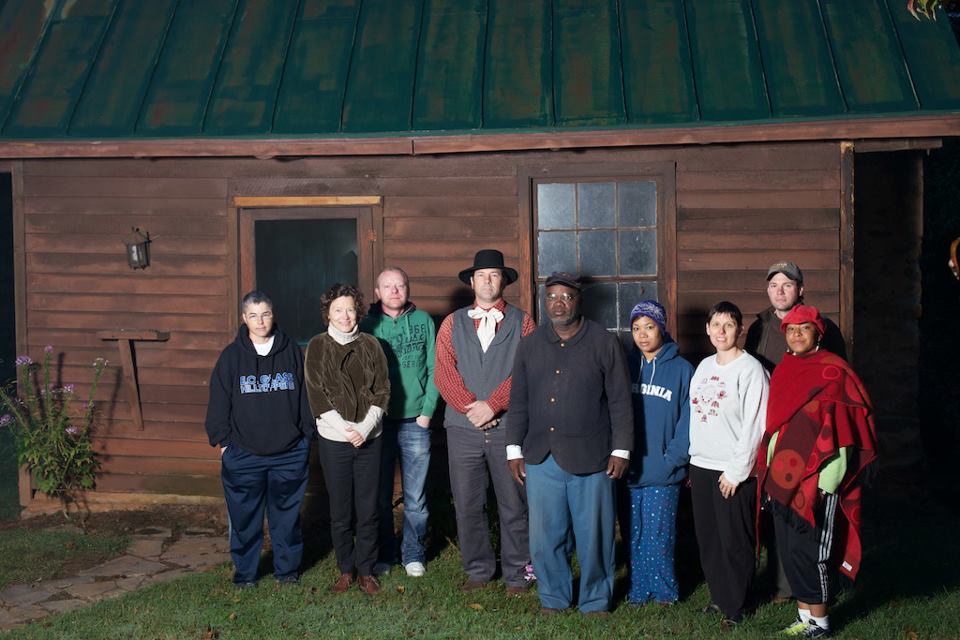
I was the last one to arrive at the cabin, as I had to help get our two kids in bed—one of the stipulations that I had worked out with my wife, Jess. When I walked in, introductions had just begun. There were nine of us, counting Joseph, and we all took a turn saying what brought us.
Joining us that evening was one of my colleagues, Lynn, an archeologist who has devoted her career to the history of enslaved peoples on the campus, an Irish writer from the artist’s colony across the road, a Sweet Briar alum who was one of my first students, a member of Coming to the Table, an organization that promotes reconciliation between the races though educational outreach, the College’s naturalist-in-residence, and, much to everyone’s surprise, a local woman and her partner, whose great-grandparents were the last residents of the cabin.
Lynn passed around a photo of the great-grandparents and their children, and a list naming the extended family. Seeing the photos and hearing what she knew about them changed the feeling inside the small square room, making what we were doing less like commemoration and more like communing.
After we finished introducing ourselves, Toni, of Coming to the Table, lead us in a ritual. She created a shrine of sorts by laying out one of her grandmother’s old blankets and then arranging framed photos of her relatives, some of whom were slaves, in a semi-circle. As a final touch, she added the photo of the cabin’s last inhabitants.
While she constructed the shrine, she carefully explained each step. I could tell that she must have performed this ritual dozens of times for different audiences, most of which were probably highly suspicious. And I have to admit, at first, the high-Mass Catholic in me was, too.
She called us to stand in a circle around the shrine and asked us to join in announcing the names from the list Lynn distributed. She went first, and we watched as she called out a litany of names, dipped her fingers into the bowl and flicked the water to the floor, followed by “aho, ashe, amen”—words of blessing in Native American, African, and Hebrew, respectively.
Each of us called out: Horace, Celia, Sarah, Frances, Virginia, Delphina, Pleasant, George Washington, July, Emeline… Moses, Daniel, Archy, Edward, Alexander, Silla, Ellen…aho, ashe, amen.
Here was the kind of the recognition and acknowledgement I had always imagined but could never accomplish on my own.
Then Toni asked us to offer up the names of our departed relatives. She proudly called out the names of the relatives whose photos lay at our feet. This was much harder. Some of us, including me, could barely get through our litanies without pausing for long moments. Voices cracked. Tears were shed.
Charlotte—grandmother, I began. Her name gave me no trouble at all. She is my daughter’s namesake and lived to the ripe age of ninety-three. Harry Henry—grandfather. Still, no problem. Though he died in 1988, I could see him in my mind’s eye. Gerald Constantine-grandfather—again, no problem.
But then came my mother—Lois… I began. She passed less than two years ago, and simply uttering her name choked me. This was the biggest surprise in a night full of surprises and revelations.
What I didn’t and couldn’t have fully understood until I joined the circle of remembrance and prayer with people I barely knew, was that the sorrow and pain that erupted when I said my mother’s name was not unique to me. The others around the circle felt it too.
My pain was theirs, and theirs mine.
Joseph McNeil’s Slave Dwelling Project is a work of a mercy. By sequestering himself in these old dwellings for a night and inviting others to join him, he is helping us to confront the paralyzing anger and pain that we feel in the face of suffering.
—Photo by Meridith deAvila Khan
Note: Joseph McGill, Jr. is a program officer at the Southern Office of the National Trust for Historic Preservation. He began the Slave Dwelling Project in May 2010. David Griffith will be reading with other Good Letters writers in Washington, D.C. on November 14th. To attend RSVP here.
Previous Post

October 26, 2012
Elections Plus Economics, a Losing Equation
Next Post
October 30, 2012 To Live by the Light of Fiction
Browse Our Archives
Select a Category A. G. Harmon Alissa Wilkinson Allison Backous Art Authors Brad Fruhauff Bradford Winters Bryan Bliss Caroline Langston Chad Thomas Johnston Chris Hoke Christiana N. Peterson Culture D.G. Myers D.L. Mayfield Daniel Bowman Jr. David Griffith Elizabeth Duffy Faith Film Greg Wolfe Guest Contributor Interview Jan Vallone Jeffrey Overstreet Jessica Eddings-Roeser Jessica Mesman Griffith Kelly Foster Lindsey Crittenden Morgan Meis music Natalie Vestin Nick Olson Peggy Rosenthal Personal Reflection Poetry Friday Reflection Relationships Review Richard Chess Richard Cole Sara Zarr Shannon Huffman Polson Sonya Bilocerkowycz Tania Runyan Tony Woodlief Topical Categories Uncategorized Vic Sizemore Writing
Select a Month October 2018 September 2018 August 2018 July 2018 June 2018 May 2018 April 2018 March 2018 February 2018 January 2018 December 2017 November 2017 October 2017 September 2017 August 2017 July 2017 June 2017 May 2017 April 2017 March 2017 February 2017 January 2017 December 2016 November 2016 October 2016 September 2016 August 2016 July 2016 June 2016 May 2016 April 2016 March 2016 February 2016 January 2016 December 2015 November 2015 October 2015 September 2015 August 2015 July 2015 June 2015 May 2015 April 2015 March 2015 February 2015 January 2015 December 2014 November 2014 October 2014 September 2014 August 2014 July 2014 June 2014 May 2014 April 2014 March 2014 February 2014 January 2014 December 2013 November 2013 October 2013 September 2013 August 2013 July 2013 June 2013 May 2013 April 2013 March 2013 February 2013 January 2013 December 2012 November 2012 October 2012 September 2012 August 2012 July 2012 June 2012 May 2012 February 2008
Follow Us!
TAKE THE
Religious Wisdom Quiz
What Christian group believes in "baptism by immersion only"?
Select your answer to see how you score.
Presbyterians Baptists Lutherans Catholics
Related posts from Good Letters

Poetry Friday: A Quick Interpretation of the Sixth...

TRENDING AT PATHEOS Catholic

Rejecting Doom: Christian Hope And Human Action
Christianity is a religion of hope. We are to have hope and...

It’s What Comes From Within Which Matters
One of the most difficult things for us to understand is why...

Why I Choose the Eucharist Over the Sermon
Choose the Eucharist, Not the Sermon What are we supposed to get...

5 Design Elements Found in Spiritually Rooted Homes
Putting Spirituality Into Home Decor Our homes are more than our living...

Credo: A Story of God Told with the...
About 10 years ago, I began to imagine a personal "Credo" that...

The Anatomy of Divine Revelation in Catholic Thought
The claim that God has made Himself known to human beings is...
view all Catholic blogs
Ad-Free & Subscriber Log-In Subscription Support
- About Us
- 2026 Calendar
- Videos
- Podcasts
- Library of World Religions
- Faith In Media Tracker
- Advertise With Us
- Write for Us
- Privacy Policy
- Terms of Service
- Do Not Sell My Data
- Contact Us
- Radiant Digital
- Manage Newsletter Subscriptions
- Unsubscribe From Notifications
- Sitemap
Copyright 2008-2026, Patheos. All rights reserved.
Subscription Support Ad-Free & Subscriber Log-In
Follow Patheos