
BuddhistCatholicContemplativeEvangelicalGeneral ChristianHinduJewishLatter-day SaintMuslimNew VisionsProgressive Christian
Beliefs
- Buddhist
- Catholic
- Contemplative
- Evangelical
- General Christian
- Hindu
- Jewish
- Latter-day Saint
- More Voices
- Muslim
- New Visions
- Pagan
- Progressive Christian
Topics
- Religion News
- Food and Religion
- Sports and Religion
- Religious Art
- Religious Music and Entertainment
- Religious Events
- History and Religion
- Style and Religion
- Politics and Religion
- Women in Religion
- Recreation Outdoors and Religion
- Business Finance and Religion
- Careers Workplace and Religion
- Education and Religion
- Family Parenting and Religion
- Health Fitness and Religion
- Home and Religion
- Relationships and Religion
- Technology and Religion
- Travel and Religion
Columnists
- Buddhist Columnists
- Business Finance and Religion Columnists
- Careers Workplace and Religion Columnists
- Catholic Columnists
- Contemplative Columnists
- Education and Religion Columnists
- Evangelists Columnists
- Family Parenting and Religion Columnists
- General Christian Columnists
- Health Fitness and Religion Columnists
- Hindu Columnists
- History and Religion Columnists
- Home and Religion Columnists
- Jewish Columnists
- More Voices Columnists
- Latter Day Columnists
- Muslim Columnists
- New Visions Columnists
- Nonreligious Columnists
- Pagan Columnists
- Politics and Religion Columnists
- Progressive Columnists
- Recreation Outdoors and Religion Columnists
- Relationships and Religion Columnists
- Religion News Columnists
- Religious Art Columnists
- Religious Events Columnists
- Religious Music and Entertainment Columnists
- Sports and Religion Columnists
- Style and Religion Columnists
- Technology and Religion Columnists
- Travel and Religion Columnists
- Women in Religion Columnists
Resource Library
- 2026 Calendar
- Library of World Religions
- The 100 Most Holy Places on Earth
- Patheos Answers
- Podcasts
- Videos
- Faith Leaders Database
- Anglican Episcopalian
- Bahai
- Baptist
- Buddhism
- Christianity
- Confucianism
- Eastern Orthodoxy
- Hinduism
- Holiness and Pentecostal
- ISKCON
- Islam
- Judaism
- Lutheran
- Methodist
- The Church of Jesus Christ of Latter-day Saints
- New Age
- Paganism
- Presbytarian and Reformed
- Protestantism
- Religion Behind the Scenes
- Roman Catholic
- Scientology
- Shia Islam
- Sikhism
- Sufism
- Sunni Islam
- Taoism
- Zen
- See all religions
Research Tools
 Ad-Free & Subscriber Log-In Subscription Support
Ad-Free & Subscriber Log-In Subscription Support
Follow Patheos 

- Trending:
- Forgiveness
- |
- Marriage
- |
- Consciousness
- |
- Death Penalty
- |
- Election
- |
- Halloween
 Good Letters
-
Contributors
- Home
- Catholic
- Torah Revealed and Withheld: Part One
Torah Revealed and Withheld: Part One
Last updated on: September 17, 2012 at 1:00 am by Richard Chess
Torah Revealed and Withheld: Part One 2012-09-16T21:56:25-07:00 Richard Chess
Patheos Explore the world's faith through different perspectives on religion and spirituality! Patheos has the views of the prevalent religions and spiritualities of the world.
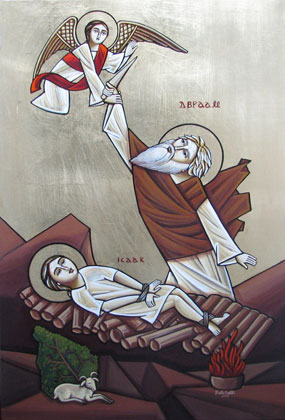 Now I know that you fear God, since you have not withheld your son. Genesis 22:12
Because you have done this and have not withheld your son. Genesis 22:16
I wouldn’t have done it. Wouldn’t do it. It’s not in my nature.
What’s not? Generosity.
There it is. I said it. If you want to stop reading now, fine. Why should I expect you to read further, given that reading is an act of generosity giving attention to someone else’s sentences. If I, the writer, am not generous, how can I expect you to be?
“Take your son . . . and offer him as a burnt offering.” A test. That’s what this is. God testing Abraham.
This test, what’s the reward for passing it? Does Abraham, who isn’t afraid to question God (remember Sodom and Gomorrah?), even think to ask?
The Torah, if it knows the answers to these obvious questions (“why” and “how dare you” are two others), doesn’t say. Is its silence a silence of ignorance, or a silence of withholding?
Withholding until Abraham acts or refuses to act. But unlike Abraham in the moment of the testing, we know how the story turns out.
Abraham’s reward (Genesis 22:16 – 18):
I will bestow my blessing upon you and make your descendants as numerous as the stars of heaven and the sands on the seashore; and your descendants shall seize the gates of their foes. All the nations of the earth shall bless themselves by your descendants, because you have obeyed my command.
Had I been in Abraham’s sandals, I wouldn’t have obeyed. And if, God forbid, somehow, by some mysterious power or force one day I am commanded to offer any one of my children (two stepdaughters, one son), I won’t do it, not even if I know in advance the reward.
Not that I’m a rebel—temperamentally disposed to resist or oppose authority. Honestly, I don’t even have the courage to stand up, when I disagree, even strongly disagree, with most human authorities. Agreeable, compliant: That’s me.
But even I have my limits.
You want me to sacrifice my son for the benefit of generations to come? Forget it.
As difficult and painful as it would be for me to refuse an order given by authority, even the Ultimate Authority, a deep parental instinct to love and protect my children, if not selfishness, would prevail.
That’s my son. What’s mine is mine. That’s the voice I listen to. How am I so sure?
Recently, on the first day of a stepdaughter’s visit home, I saw, when I joined her at the Jewish Community Center pool, a copy of Jonathan Lethem’s novel The Fortress of Solitude on her lounge chair. My copy.
It was the first book I read this summer. Reading it, I was transported to the world of its compelling, troubled characters—Brooklyn (where this particular stepdaughter lives), 1970s, crack, tagging, white idealism, experimental art, punk music, and soul. Now that I’ve finished reading it, it means more to me than just its world, its words.
My son turned me onto Lethem, this very novel, though not this particular copy.
My copy I held, lying on the couch, reading for hours and days at the beginning of a summer when I was facing interesting health challenges (I know, you’re tired of hearing about that!). The book, whose characters and experiences, having already entered my son deeply, had now become part of my story as well as the story of my life with my son.
When I saw my book at the pool, out of my house, out of my hands, out of my control, a few feet from splashing water, I tensed up. What if it gets wet? What if its cover is bent, its pages torn? What if it’s never returned to its place on my shelf?
Generosity? Nope. Hold tight onto what’s mine—which includes this very copy of The Fortress of Solitude—or else.
Another example: One morning, driving my wife to her office in the car we let our son drive, I noticed the fuel gauge pointing just a degree or two above empty. How nice it would be for my son if, when he woke up and jumped into the car to dash to his summer job, he were to find the fuel gauge returned to full. Save him some money. And time.
My time. What’s mine is mine. I had an hour or two until he woke up. Precious time when I could sit, pray, write, and read without feeling conflicted by my desire to spend every minute I can with him while he’s home for the summer.
Should I stop at the gas station, right on the way home from my wife’s office, and fill up the car? But, my time, don’t take it away from me!
Last thing my wife said before she got out of the car, “Fill up the car for Gabe.”
My wife’s directive and the opportunity to express my love through a small act of generosity weighed against my fierce desire to protect my time.
My time, my book, my son.
My new fountain pen? Don’t ask to borrow it. My meal? I’m famished; don’t ask for a bite. My white privilege? I can walk into the YMCA locker room without arousing suspicion that I might steal a cell phone from a locker. My golden reputation, earned at work, on campus, and in the community, which entitles me to resources and respect and a certain amount of self-indulgence? I earned this; get your own.
You have not withheld your son. Your favored one, Isaac, whom you love.
With considerable discomfort I let go physically (though not emotionally) of a paperback book that can easily be replaced for ten dollars and twenty cents. And I stopped at Shell to fill the tank.
But my son? Don’t touch him. He’s irreplaceable.
Continued tomorrow.
Previous Post

September 14, 2012
The Armchair Astronaut Packs for Mars
Next Post
September 18, 2012 Torah Revealed and Withheld: Part Two
Browse Our Archives
Select a Category A. G. Harmon Alissa Wilkinson Allison Backous Art Authors Brad Fruhauff Bradford Winters Bryan Bliss Caroline Langston Chad Thomas Johnston Chris Hoke Christiana N. Peterson Culture D.G. Myers D.L. Mayfield Daniel Bowman Jr. David Griffith Elizabeth Duffy Faith Film Greg Wolfe Guest Contributor Interview Jan Vallone Jeffrey Overstreet Jessica Eddings-Roeser Jessica Mesman Griffith Kelly Foster Lindsey Crittenden Morgan Meis music Natalie Vestin Nick Olson Peggy Rosenthal Personal Reflection Poetry Friday Reflection Relationships Review Richard Chess Richard Cole Sara Zarr Shannon Huffman Polson Sonya Bilocerkowycz Tania Runyan Tony Woodlief Topical Categories Uncategorized Vic Sizemore Writing
Select a Month October 2018 September 2018 August 2018 July 2018 June 2018 May 2018 April 2018 March 2018 February 2018 January 2018 December 2017 November 2017 October 2017 September 2017 August 2017 July 2017 June 2017 May 2017 April 2017 March 2017 February 2017 January 2017 December 2016 November 2016 October 2016 September 2016 August 2016 July 2016 June 2016 May 2016 April 2016 March 2016 February 2016 January 2016 December 2015 November 2015 October 2015 September 2015 August 2015 July 2015 June 2015 May 2015 April 2015 March 2015 February 2015 January 2015 December 2014 November 2014 October 2014 September 2014 August 2014 July 2014 June 2014 May 2014 April 2014 March 2014 February 2014 January 2014 December 2013 November 2013 October 2013 September 2013 August 2013 July 2013 June 2013 May 2013 April 2013 March 2013 February 2013 January 2013 December 2012 November 2012 October 2012 September 2012 August 2012 July 2012 June 2012 May 2012 February 2008
Follow Us!
TAKE THE
Religious Wisdom Quiz
What did Stephen see as he was being stoned?
Select your answer to see how you score.
The face of God Angels descending A bright light from heaven Heaven opened and Jesus standing at the right hand of God
Related posts from Good Letters

Leonard Cohen’s Holy and Broken Hallelujah

Ready or Not for the Days of Awe


TRENDING AT PATHEOS Catholic

Rejecting Doom: Christian Hope And Human Action
Christianity is a religion of hope. We are to have hope and...

It’s What Comes From Within Which Matters
One of the most difficult things for us to understand is why...

Why I Choose the Eucharist Over the Sermon
Choose the Eucharist, Not the Sermon What are we supposed to get...

5 Design Elements Found in Spiritually Rooted Homes
Putting Spirituality Into Home Decor Our homes are more than our living...

Credo: A Story of God Told with the...
About 10 years ago, I began to imagine a personal "Credo" that...

The Anatomy of Divine Revelation in Catholic Thought
The claim that God has made Himself known to human beings is...
view all Catholic blogs
Ad-Free & Subscriber Log-In Subscription Support
- About Us
- 2026 Calendar
- Videos
- Podcasts
- Library of World Religions
- Faith In Media Tracker
- Advertise With Us
- Write for Us
- Privacy Policy
- Terms of Service
- Do Not Sell My Data
- Contact Us
- Radiant Digital
- Manage Newsletter Subscriptions
- Unsubscribe From Notifications
- Sitemap
Copyright 2008-2026, Patheos. All rights reserved.
Subscription Support Ad-Free & Subscriber Log-In
Follow Patheos