
BuddhistCatholicContemplativeEvangelicalGeneral ChristianHinduJewishLatter-day SaintMuslimNew VisionsProgressive Christian
Beliefs
- Buddhist
- Catholic
- Contemplative
- Evangelical
- General Christian
- Hindu
- Jewish
- Latter-day Saint
- More Voices
- Muslim
- New Visions
- Pagan
- Progressive Christian
Topics
- Religion News
- Food and Religion
- Sports and Religion
- Religious Art
- Religious Music and Entertainment
- Religious Events
- History and Religion
- Style and Religion
- Politics and Religion
- Women in Religion
- Recreation Outdoors and Religion
- Business Finance and Religion
- Careers Workplace and Religion
- Education and Religion
- Family Parenting and Religion
- Health Fitness and Religion
- Home and Religion
- Relationships and Religion
- Technology and Religion
- Travel and Religion
Columnists
- Buddhist Columnists
- Business Finance and Religion Columnists
- Careers Workplace and Religion Columnists
- Catholic Columnists
- Contemplative Columnists
- Education and Religion Columnists
- Evangelists Columnists
- Family Parenting and Religion Columnists
- General Christian Columnists
- Health Fitness and Religion Columnists
- Hindu Columnists
- History and Religion Columnists
- Home and Religion Columnists
- Jewish Columnists
- More Voices Columnists
- Latter Day Columnists
- Muslim Columnists
- New Visions Columnists
- Nonreligious Columnists
- Pagan Columnists
- Politics and Religion Columnists
- Progressive Columnists
- Recreation Outdoors and Religion Columnists
- Relationships and Religion Columnists
- Religion News Columnists
- Religious Art Columnists
- Religious Events Columnists
- Religious Music and Entertainment Columnists
- Sports and Religion Columnists
- Style and Religion Columnists
- Technology and Religion Columnists
- Travel and Religion Columnists
- Women in Religion Columnists
Resource Library
- 2026 Calendar
- Library of World Religions
- The 100 Most Holy Places on Earth
- Patheos Answers
- Podcasts
- Videos
- Faith Leaders Database
- Anglican Episcopalian
- Bahai
- Baptist
- Buddhism
- Christianity
- Confucianism
- Eastern Orthodoxy
- Hinduism
- Holiness and Pentecostal
- ISKCON
- Islam
- Judaism
- Lutheran
- Methodist
- The Church of Jesus Christ of Latter-day Saints
- New Age
- Paganism
- Presbytarian and Reformed
- Protestantism
- Religion Behind the Scenes
- Roman Catholic
- Scientology
- Shia Islam
- Sikhism
- Sufism
- Sunni Islam
- Taoism
- Zen
- See all religions
Research Tools
 Ad-Free & Subscriber Log-In Subscription Support
Ad-Free & Subscriber Log-In Subscription Support
Follow Patheos 

- Trending:
- Forgiveness
- |
- Marriage
- |
- Consciousness
- |
- Death Penalty
- |
- Election
- |
- Halloween
 Good Letters
-
Contributors
- Home
- Catholic
- Poetry as Balance Beam
Poetry as Balance Beam
Last updated on: September 6, 2012 at 1:00 am by Dyana Herron
Poetry as Balance Beam 2012-09-05T16:55:42-07:00 Dyana Herron
Patheos Explore the world's faith through different perspectives on religion and spirituality! Patheos has the views of the prevalent religions and spiritualities of the world.
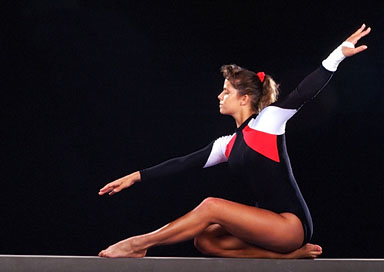 Because I don’t currently have a television, I wasn’t able to catch much of this summer’s Olympic games. But I did see just enough to remind me that once upon a time—in the summer of 1992, to be exact—I harbored my own dreams of Olympic glory.
I was ten, and a year or so earlier had happened to catch the women’s gymnastics World Championships on television. Immediately I fell in love with everything about the sport and its athletes, the serious young girls who approached their work with exactitude and fearlessness.
Flat-chested and well-muscled, with hair pulled back into strict ponytails or buns, the gymnasts looked at once prepubescent and adult. Their girlish features rarely portrayed any emotion—only fierce concentration.
While the floor routines gave them the opportunity to do something that looked close to having fun, tumbling and dancing along to selected music, the precision of their movements was too exact to portray much joy.
At the end of a routine, no matter how perfectly executed, they walked stoically back to their coaches for a short talk or perfunctory pat on the back before sitting down to wait for their scores as if they were about to be executed. A particularly high score might merit a small, brief smile and a little wave, but that was it.
I’m not sure what it says about ten-year-old me that I thought this was awesome: I fantasized about wearing a red, white, and blue tracksuit and nodding solemnly while my coach, the legendary Bela Karolyi, put his hands on my shoulders and critiqued my near-perfect performance. My curling-ironed bangs would bob a little with each nod. I’d learn what to do better next time.
My favorite gymnast headed into the 1992 Barcelona Olympics was Kim Zmeskal, who’d earned gold in both floor and beam routines in the ’92 World Championships in Paris, and had taken the all-around gold in Nationals in Indianapolis the year before. Hopes were on her to lead the U.S. women’s team to a strong Olympic showing.
The first night of the games, I sat cross-legged just a foot or so in front of our TV. Zmeskal was scheduled to perform her first compulsory routine on the beam, but then, tragedy struck. Only a few seconds into her performance, she fell off the beam. I was stunned. The announcers were stunned. The spectators were stunned. And even though she immediately remounted the beam and finished her routine, it was obvious that Zmeskal was stunned, too.
The balance beam was my favorite apparatus. It was so much my favorite that I constructed my own out of materials I found in our chicken house: two concrete cinder blocks and a thick wooden beam. I set them up on our side lawn and practiced doing handstands and cartwheels on them.
Was the beam actually attached to the blocks? No. Was the wood sanded to prevent splinters in my feet and hands? No. Did I actually believe that if I worked long enough and hard enough I could have a shot at being an Olympic gymnast and succeeding where my predecessor had failed? Yes.
It may surprise you to learn that my dream of being on the Olympic women’s gymnastics team was never realized. Instead, I went on to earn an MFA. in Creative Writing—specifically, in poetry.
A far cry from my original dream, you say? In some ways, yes. But in others, not so much.
Poetry is the balance beam of the genres. The poet works within the confines of a line—literally. She starts at one end and progresses carefully to the other, at which point she pivots and does it again until her exercise is complete
Because of the narrow confines of the apparatus, the poet has little room for error. Just as landing an inch off-point can cause a gymnast to leave the beam completely, one ill-chosen word or wrongly-stressed syllable or instance of overbearing alliteration can derail a poem, making it difficult to recover. One wobble and you’ve dropped several tenths of a point
Compare this to the floor exercise of prose writers. Sure, they have some restrictions. They are given a large square (like a page), and are forbidden to go out-of-bounds. But within that space, they can flip and turn in any direction. A misstep can be hidden in a sea of other movements, other words.
This is not to say their discipline is not as rigorous. Only that it is different. And of course these metaphors break down fairly quickly.
Like the dedicated gymnasts I idealized when I was ten, what writers of all stripes take joy in is their work, the actual labor of it, which is in both the mind and the body. True perfection is unobtainable, and a job well done on one exercise only means that expectations are higher on the next.
You are alone in writing, and you have an audience. Your coach—a teacher, a mentor, or yourself—is evaluating you, and is hard to impress. You improve only through practice, but even constant practice doesn’t guarantee success. When it comes down to it, there are times when you fall off the beam, or don’t keep your legs straight, or stumble out-of-bounds
But when you stick your landing and put up your hands, and can give that tiny smile and wave, it’s all worth it.
Previous Post

September 5, 2012
The Collapse of Western Civilization Begins in Your Dentist's Chair
Next Post

September 7, 2012 Why I Abandoned Compliance
Browse Our Archives
Select a Category A. G. Harmon Alissa Wilkinson Allison Backous Art Authors Brad Fruhauff Bradford Winters Bryan Bliss Caroline Langston Chad Thomas Johnston Chris Hoke Christiana N. Peterson Culture D.G. Myers D.L. Mayfield Daniel Bowman Jr. David Griffith Elizabeth Duffy Faith Film Greg Wolfe Guest Contributor Interview Jan Vallone Jeffrey Overstreet Jessica Eddings-Roeser Jessica Mesman Griffith Kelly Foster Lindsey Crittenden Morgan Meis music Natalie Vestin Nick Olson Peggy Rosenthal Personal Reflection Poetry Friday Reflection Relationships Review Richard Chess Richard Cole Sara Zarr Shannon Huffman Polson Sonya Bilocerkowycz Tania Runyan Tony Woodlief Topical Categories Uncategorized Vic Sizemore Writing
Select a Month October 2018 September 2018 August 2018 July 2018 June 2018 May 2018 April 2018 March 2018 February 2018 January 2018 December 2017 November 2017 October 2017 September 2017 August 2017 July 2017 June 2017 May 2017 April 2017 March 2017 February 2017 January 2017 December 2016 November 2016 October 2016 September 2016 August 2016 July 2016 June 2016 May 2016 April 2016 March 2016 February 2016 January 2016 December 2015 November 2015 October 2015 September 2015 August 2015 July 2015 June 2015 May 2015 April 2015 March 2015 February 2015 January 2015 December 2014 November 2014 October 2014 September 2014 August 2014 July 2014 June 2014 May 2014 April 2014 March 2014 February 2014 January 2014 December 2013 November 2013 October 2013 September 2013 August 2013 July 2013 June 2013 May 2013 April 2013 March 2013 February 2013 January 2013 December 2012 November 2012 October 2012 September 2012 August 2012 July 2012 June 2012 May 2012 February 2008
Follow Us!
TAKE THE
Religious Wisdom Quiz
What did Jesus say to the storm on the Sea of Galilee?
Select your answer to see how you score.
"Let there be light!" "Be gone!" "Depart from me!" "Peace, be still!"
Related posts from Good Letters


On Writing Odes: Taking Time to Celebrate

Poetry Friday: "The Burned Butterfly"

A Conversation with Alicia Ostriker: Part 1
TRENDING AT PATHEOS Catholic

Rejecting Doom: Christian Hope And Human Action
Christianity is a religion of hope. We are to have hope and...

It’s What Comes From Within Which Matters
One of the most difficult things for us to understand is why...

Why I Choose the Eucharist Over the Sermon
Choose the Eucharist, Not the Sermon What are we supposed to get...

5 Design Elements Found in Spiritually Rooted Homes
Putting Spirituality Into Home Decor Our homes are more than our living...

Credo: A Story of God Told with the...
About 10 years ago, I began to imagine a personal "Credo" that...

The Anatomy of Divine Revelation in Catholic Thought
The claim that God has made Himself known to human beings is...
view all Catholic blogs
Ad-Free & Subscriber Log-In Subscription Support
- About Us
- 2026 Calendar
- Videos
- Podcasts
- Library of World Religions
- Faith In Media Tracker
- Advertise With Us
- Write for Us
- Privacy Policy
- Terms of Service
- Do Not Sell My Data
- Contact Us
- Radiant Digital
- Manage Newsletter Subscriptions
- Unsubscribe From Notifications
- Sitemap
Copyright 2008-2026, Patheos. All rights reserved.
Subscription Support Ad-Free & Subscriber Log-In
Follow Patheos