
BuddhistCatholicContemplativeEvangelicalGeneral ChristianHinduJewishLatter-day SaintMuslimNew VisionsProgressive Christian
Beliefs
- Buddhist
- Catholic
- Contemplative
- Evangelical
- General Christian
- Hindu
- Jewish
- Latter-day Saint
- More Voices
- Muslim
- New Visions
- Pagan
- Progressive Christian
Topics
- Religion News
- Food and Religion
- Sports and Religion
- Religious Art
- Religious Music and Entertainment
- Religious Events
- History and Religion
- Style and Religion
- Politics and Religion
- Women in Religion
- Recreation Outdoors and Religion
- Business Finance and Religion
- Careers Workplace and Religion
- Education and Religion
- Family Parenting and Religion
- Health Fitness and Religion
- Home and Religion
- Relationships and Religion
- Technology and Religion
- Travel and Religion
Columnists
- Buddhist Columnists
- Business Finance and Religion Columnists
- Careers Workplace and Religion Columnists
- Catholic Columnists
- Contemplative Columnists
- Education and Religion Columnists
- Evangelists Columnists
- Family Parenting and Religion Columnists
- General Christian Columnists
- Health Fitness and Religion Columnists
- Hindu Columnists
- History and Religion Columnists
- Home and Religion Columnists
- Jewish Columnists
- More Voices Columnists
- Latter Day Columnists
- Muslim Columnists
- New Visions Columnists
- Nonreligious Columnists
- Pagan Columnists
- Politics and Religion Columnists
- Progressive Columnists
- Recreation Outdoors and Religion Columnists
- Relationships and Religion Columnists
- Religion News Columnists
- Religious Art Columnists
- Religious Events Columnists
- Religious Music and Entertainment Columnists
- Sports and Religion Columnists
- Style and Religion Columnists
- Technology and Religion Columnists
- Travel and Religion Columnists
- Women in Religion Columnists
Resource Library
- 2026 Calendar
- Library of World Religions
- The 100 Most Holy Places on Earth
- Patheos Answers
- Podcasts
- Videos
- Faith Leaders Database
- Anglican Episcopalian
- Bahai
- Baptist
- Buddhism
- Christianity
- Confucianism
- Eastern Orthodoxy
- Hinduism
- Holiness and Pentecostal
- ISKCON
- Islam
- Judaism
- Lutheran
- Methodist
- The Church of Jesus Christ of Latter-day Saints
- New Age
- Paganism
- Presbytarian and Reformed
- Protestantism
- Religion Behind the Scenes
- Roman Catholic
- Scientology
- Shia Islam
- Sikhism
- Sufism
- Sunni Islam
- Taoism
- Zen
- See all religions
Research Tools
 Ad-Free & Subscriber Log-In Subscription Support
Ad-Free & Subscriber Log-In Subscription Support
Follow Patheos 

- Trending:
- Forgiveness
- |
- Marriage
- |
- Consciousness
- |
- Death Penalty
- |
- Election
- |
- Halloween
 Good Letters
-
Contributors
- Home
- Catholic
- Monks, Mandalas, and Faith Healing
Monks, Mandalas, and Faith Healing
Last updated on: September 13, 2012 at 1:00 am by Vic Sizemore
Monks, Mandalas, and Faith Healing 2012-09-12T18:34:26-07:00 Vic Sizemore
Patheos Explore the world's faith through different perspectives on religion and spirituality! Patheos has the views of the prevalent religions and spiritualities of the world.
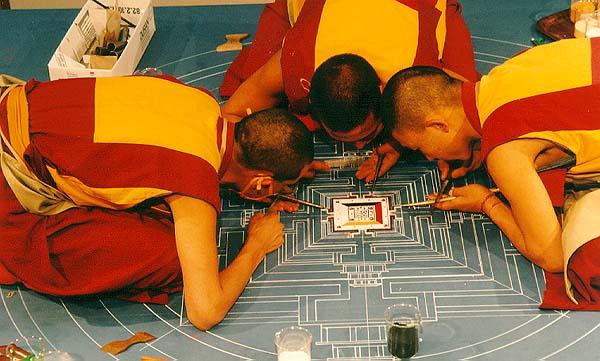 After the initial cleansing ceremony, they worked in silent concentration. Hour after hour they knelt in their maroon robes and yellow shawls, bent over their meticulous labor, creating designs and pictures with brightly colored sand.
They were Tibetan Buddhist monks from Dehra Dun, India, making a stop in my hometown as they toured America. They had set up in the chapel at Randolph College and spent a week creating an elaborate Medicine Buddha mandala.
From the reading I’ve done about the mandala, I understand that it is believed to represent, and take part in, a great multi-layered reality that consists of countless circles—a nucleus in a cell in an organism in an ecosystem on the earth in the solar system in the Milky Way, etc.
The word mandala itself comes from Sanskrit and means circle or completion. The purpose of a Medicine Buddha mandala is to heal by restoring completion, or wholeness.
The mandala they made was beautiful. All the bright colors, intricate patterns, every small part, every tiny lotus leaf symbolic of something. But did it really do any healing?
The monks were peaceful, as a friend said, “comfortable in their skin.” One student called them chill. There is no doubt that everyone who was around them felt the positive energy of their presence.
I thought to myself that even if there were no spiritual healing, there’s no doubt that these monks spread a sense of peace, a feeling of good will—and hasn’t research proven that these things can be healing, can improve your health and quality of life?
But is there something deeper? An actual spiritual level at which healing takes place? What healing power are the monks calling on? Good feelings? We know how important attitude is when fighting illness, but is that what these monks believe is going on? And what did all these westerners coming by to watch—academics most of them at that—think of it?
I can’t say what others were thinking of the event. I thought it was interesting, cool, promoted cultural understanding, and good will. But real healing? I wasn’t buying it. I’m guessing, polite as everyone was to the monks, most of the others weren’t buying it either.
I’m sorry, but it sounds ridiculous.
I think it is nice that there are people in the world who believe this kind of thing, but I admit that I concluded, even though real good feelings come from the work they do, that in the end the monks have devoted their lives to a dream, a fairytale. They are whistling in the dark, pretending to have some control over what we simply cannot control.
When I was in Santa Fe for my MFA residency, I rode out with friends to see El Santuario de Chimayo, a sight where miraculous healings are said to have taken place. The chapel there is a pilgrimage destination for those seeking healing for themselves or their loved ones. The little chapel’s walls are shaggy with dangling shoes—lots of baby shoes—crutches, thousands of photographs. Prayers all. Acts of faith.
Inside there is a hole full of healing soil. You can scoop the dusty dirt up with your hands, take some. The priests will refill it with more from the sacred healing place.
A friend standing beside me, who was once Wiccan, said, “This all just looks like magic to me.” I have to admit I agreed.
We certainly have our share of faith healers around here—and I’m not talking about the phony ones on TV; I’m talking about the ones who believe their prayers and anointings are effectual.
I once sat and listened to an apologist share research, studies that attempted to show with empirical evidence that seriously ill people who are prayed for recover at higher rates than those who go without prayer.
But if it can be tested and quantified, doesn’t that make whatever they are praying to some kind of a force they tap into and not a personal being? The Great physician? Tibetan Buddhists call the Medicine Buddha The Supreme Physician.
The tradition in which I was raised would say that they are tapping into something spiritual all right. Evil disguised as an angel of light. They would also pay lip service to the healing power of prayer, at least inside the church doors on Sunday morning—once you stepped outside, you’d best get yourself to the doctor.
I think of the quote attributed to the great curmudgeon H.L. Menken: “The philosopher is a blind man in a dark room looking for a black cat that isn’t there. The theologian has found it.”
I remember laughing the first time I read it, but immediately wondering why Menken thinks he’s the one with clear vision, the one who has turned the light on in the room, and can see every corner of it to declare with such certainty that the cat is not there.
I’m afraid that’s been my attitude toward these monks. Not only is it patronizing, it assumes I have exhaustive knowledge of something about which I actually know precious little.
When all their painstaking work was complete, the monks destroyed the intricate mandala they had just created. They poured the sand into the James River, to send this healing power down the river, to the sea, and out across the world.
I find that this last stage of the mandala suits my melancholy temperament best. The monks’ dismantling of the mandala symbolizes the impermanence of all that exists—including healing. Healed once, people will again get sick.
Brought back from the dead, Lazarus will again have to die.
Previous Post

September 12, 2012
Imago Dei
Next Post
September 14, 2012 The Armchair Astronaut Packs for Mars
Browse Our Archives
Select a Category A. G. Harmon Alissa Wilkinson Allison Backous Art Authors Brad Fruhauff Bradford Winters Bryan Bliss Caroline Langston Chad Thomas Johnston Chris Hoke Christiana N. Peterson Culture D.G. Myers D.L. Mayfield Daniel Bowman Jr. David Griffith Elizabeth Duffy Faith Film Greg Wolfe Guest Contributor Interview Jan Vallone Jeffrey Overstreet Jessica Eddings-Roeser Jessica Mesman Griffith Kelly Foster Lindsey Crittenden Morgan Meis music Natalie Vestin Nick Olson Peggy Rosenthal Personal Reflection Poetry Friday Reflection Relationships Review Richard Chess Richard Cole Sara Zarr Shannon Huffman Polson Sonya Bilocerkowycz Tania Runyan Tony Woodlief Topical Categories Uncategorized Vic Sizemore Writing
Select a Month October 2018 September 2018 August 2018 July 2018 June 2018 May 2018 April 2018 March 2018 February 2018 January 2018 December 2017 November 2017 October 2017 September 2017 August 2017 July 2017 June 2017 May 2017 April 2017 March 2017 February 2017 January 2017 December 2016 November 2016 October 2016 September 2016 August 2016 July 2016 June 2016 May 2016 April 2016 March 2016 February 2016 January 2016 December 2015 November 2015 October 2015 September 2015 August 2015 July 2015 June 2015 May 2015 April 2015 March 2015 February 2015 January 2015 December 2014 November 2014 October 2014 September 2014 August 2014 July 2014 June 2014 May 2014 April 2014 March 2014 February 2014 January 2014 December 2013 November 2013 October 2013 September 2013 August 2013 July 2013 June 2013 May 2013 April 2013 March 2013 February 2013 January 2013 December 2012 November 2012 October 2012 September 2012 August 2012 July 2012 June 2012 May 2012 February 2008
Follow Us!
TAKE THE
Religious Wisdom Quiz
Who said, "Surely this man was the Son of God!" at Jesus' crucifixion?
Select your answer to see how you score.
Peter A Roman centurion Judas Pilate
Related posts from Good Letters

Leonard Cohen’s Holy and Broken Hallelujah

Ready or Not for the Days of Awe


TRENDING AT PATHEOS Catholic

Rejecting Doom: Christian Hope And Human Action
Christianity is a religion of hope. We are to have hope and...

It’s What Comes From Within Which Matters
One of the most difficult things for us to understand is why...

Why I Choose the Eucharist Over the Sermon
Choose the Eucharist, Not the Sermon What are we supposed to get...

5 Design Elements Found in Spiritually Rooted Homes
Putting Spirituality Into Home Decor Our homes are more than our living...

Credo: A Story of God Told with the...
About 10 years ago, I began to imagine a personal "Credo" that...

The Anatomy of Divine Revelation in Catholic Thought
The claim that God has made Himself known to human beings is...
view all Catholic blogs
Ad-Free & Subscriber Log-In Subscription Support
- About Us
- 2026 Calendar
- Videos
- Podcasts
- Library of World Religions
- Faith In Media Tracker
- Advertise With Us
- Write for Us
- Privacy Policy
- Terms of Service
- Do Not Sell My Data
- Contact Us
- Radiant Digital
- Manage Newsletter Subscriptions
- Unsubscribe From Notifications
- Sitemap
Copyright 2008-2026, Patheos. All rights reserved.
Subscription Support Ad-Free & Subscriber Log-In
Follow Patheos