
BuddhistCatholicContemplativeEvangelicalGeneral ChristianHinduJewishLatter-day SaintMuslimNew VisionsProgressive Christian
Beliefs
- Buddhist
- Catholic
- Contemplative
- Evangelical
- General Christian
- Hindu
- Jewish
- Latter-day Saint
- More Voices
- Muslim
- New Visions
- Pagan
- Progressive Christian
Topics
- Religion News
- Food and Religion
- Sports and Religion
- Religious Art
- Religious Music and Entertainment
- Religious Events
- History and Religion
- Style and Religion
- Politics and Religion
- Women in Religion
- Recreation Outdoors and Religion
- Business Finance and Religion
- Careers Workplace and Religion
- Education and Religion
- Family Parenting and Religion
- Health Fitness and Religion
- Home and Religion
- Relationships and Religion
- Technology and Religion
- Travel and Religion
Columnists
- Buddhist Columnists
- Business Finance and Religion Columnists
- Careers Workplace and Religion Columnists
- Catholic Columnists
- Contemplative Columnists
- Education and Religion Columnists
- Evangelists Columnists
- Family Parenting and Religion Columnists
- General Christian Columnists
- Health Fitness and Religion Columnists
- Hindu Columnists
- History and Religion Columnists
- Home and Religion Columnists
- Jewish Columnists
- More Voices Columnists
- Latter Day Columnists
- Muslim Columnists
- New Visions Columnists
- Nonreligious Columnists
- Pagan Columnists
- Politics and Religion Columnists
- Progressive Columnists
- Recreation Outdoors and Religion Columnists
- Relationships and Religion Columnists
- Religion News Columnists
- Religious Art Columnists
- Religious Events Columnists
- Religious Music and Entertainment Columnists
- Sports and Religion Columnists
- Style and Religion Columnists
- Technology and Religion Columnists
- Travel and Religion Columnists
- Women in Religion Columnists
Resource Library
- 2026 Calendar
- Library of World Religions
- The 100 Most Holy Places on Earth
- Patheos Answers
- Podcasts
- Videos
- Faith Leaders Database
- Anglican Episcopalian
- Bahai
- Baptist
- Buddhism
- Christianity
- Confucianism
- Eastern Orthodoxy
- Hinduism
- Holiness and Pentecostal
- ISKCON
- Islam
- Judaism
- Lutheran
- Methodist
- The Church of Jesus Christ of Latter-day Saints
- New Age
- Paganism
- Presbytarian and Reformed
- Protestantism
- Religion Behind the Scenes
- Roman Catholic
- Scientology
- Shia Islam
- Sikhism
- Sufism
- Sunni Islam
- Taoism
- Zen
- See all religions
Research Tools
 Ad-Free & Subscriber Log-In Subscription Support
Ad-Free & Subscriber Log-In Subscription Support
Follow Patheos 

- Trending:
- Forgiveness
- |
- Marriage
- |
- Consciousness
- |
- Death Penalty
- |
- Election
- |
- Halloween
 Good Letters
-
Contributors
- Home
- Catholic
- Shouting “Meaningless!” at the Devil: On Mötley Crüe and Ecclesiastes
Shouting “Meaningless!” at the Devil: On Mötley Crüe and Ecclesiastes
Last updated on: August 3, 2012 at 7:03 am by Chad Thomas Johnston
Shouting “Meaningless!” at the Devil: On Mötley Crüe and Ecclesiastes 2012-08-03T07:03:39-07:00 Chad Thomas Johnston
Patheos Explore the world's faith through different perspectives on religion and spirituality! Patheos has the views of the prevalent religions and spiritualities of the world.
 This blog post is adapted from my manuscript, The Stained-Glass Kaleidoscope: Essays at Play in the Churchyard of the Mind, currently searching for a publisher.
As the son of a minister, I grew up on a musical diet that consisted solely of albums by Christian artists. In a way, I was the musical equivalent of a vegetarian.
When I was in junior high, however, a high school senior at church named Brad introduced me to musical meat in the form of Mötley Crüe.
On a youth group trip, he played the band’s most accessible song, “Home Sweet Home,” for me on his Walkman as if it were a suitable bridge between L. A.’s Sunset Strip and the padded, protected world of the Christian music nursery where I slept and suckled.
To my surprise, I liked “Home Sweet Home.”
When I caught a glimpse of the band’s Shout at the Devil cassette in Brad’s backpack, however, I saw a song title I liked less: “Bastard.” As far as I knew, bastard was a seven letter four-letter-word.
I dismissed Mötley Crüe then and there, and did not think much about them again until I was twenty-six and found Mötley Crüe’s biography, The Dirt, at Borders. I thought reading it might be a fun way to challenge my previous dismissal of the band.
Having subjected the more inflexible aspects of my faith to scrutiny in therapy after my diagnosis with OCD that year, there was a little more elastic in the waistband of my theological underwear—a little more wiggle room in the worldview that informed how I lived.
By this time, I knew bastard was not necessarily profane. I could harbor Christ-like compassion for children born out of wedlock, after all. Perhaps this was what Mötley Crüe’s song had been about all along. Perhaps, like their contemporaries in Bon Jovi, the members of this band, too, were “living on a prayer.”
But there was another reason I was drawn to Mötley Crüe’s biography—a part of me wondered if I had missed out on something by living the sheltered life of a minister’s son. While the members of Mötley Crüe resembled the kind of people one might find at a homeless shelter, I knew their lives were anything but sheltered.
After reading the book, it occurred to me that it is something of a miracle—though not necessarily a God-ordained one—that the members of Mötley Crüe are alive today. Instead of going into detail about their debauchery, I will simply put it this way:
When meat processors do to beef what the members of Mötley Crüe did to their bodies, they call the end result beef jerky. (Then again, I know little about the production of beef jerky, so I could be wrong.)
While the members of the band somehow survived the wars they waged against their bodies, survival is not the only thing a person can hope for in this life. I began to wonder if the members of Mötley Crüe found meaning in their experiences.
When God saves us, perhaps God saves us from meaninglessness more than anything else. As I thought more about Mötley Crüe’s epic tale of trash and triumph, I was struck by how much it reminded me of the book of Ecclesiastes in the Bible.
It was a conclusion I never would have made in junior high.
I had been unable to move beyond the title “Bastard” on Brad’s cassette, so it never occurred to me that people might have used this word to describe Jesus.
While the Israelites knew nothing about shotguns, they probably knew a shotgun wedding when they saw one. I imagine the people Mary lived among gossiped about a bastard who, unbeknownst to them, was the Son of God—the King of Kings.
The author of Ecclesiastes was likewise a “son of David, king in Jerusalem.” He amassed the kinds of wealth and achievements that only a king could. He also had his own harem, and in this sense he was not unlike the members of Mötley Crüe.
He lived a materialist’s dream, but in the end he declared it all meaningless—a “chasing after the wind.” Throughout the book, he repeats the refrain: “Meaningless! Meaningless!” In his experience, meaning can only be found in fearing God and keeping God’s commandments.
The members of Mötley Crüe do not reach the same conclusion in The Dirt, but parallels with Ecclesiastes exist nonetheless. As the band reflects upon its experiences, it becomes apparent that there is rot beneath rock ‘n’ roll’s vainglorious veneer.
Like Qoheleth, the narrator of Ecclesiastes, the members of Mötley Crüe are wind-chasers, too. The pleasures they experience are fleeting.
As the kings of Sunset Strip, they had everything and lacked nothing. They supped at rock ‘n’ roll’s sexual smörgåsbord, snorted elephant tranquilizers, and played countless games of one-of-these-Quaaludes-is-not-like-the-other.
Despite these passing pleasures, personal pains linger. Regrets fester. The glory of the moment cannot outshine the ruin.
After reading The Dirt, I wondered if the members of Mötley Crüe might echo the author of Ecclesiastes in shouting, “Meaningless! Meaningless!”
The Dirt may be a rock ‘n’ roll memoir, but it brought me face to face with the limits of the finite pleasures we take refuge in to escape the meaninglessness of life when God eludes us. I never expected to find something sacred in something so profane.
Perhaps there is a season for reading about decadent rock ‘n’ rollers, a season for shouting at the devil, a season for consuming musical meat after years of being a vegetarian.
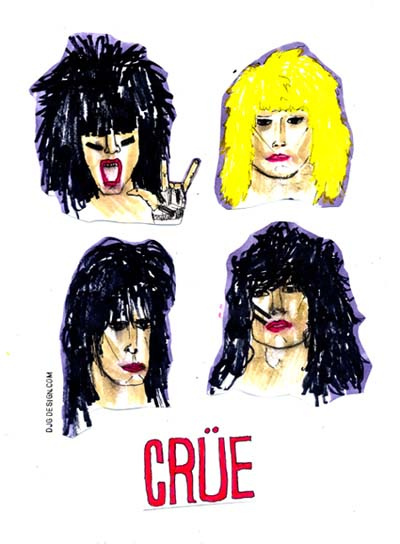
Illustration by Danny Joe Gibson
Previous Post

August 2, 2012
Finding Poetry and Meaning in Internet Clicks
Next Post
August 6, 2012 Varieties of Quiet: Christian Wiman's Pensées
Browse Our Archives
Select a Category A. G. Harmon Alissa Wilkinson Allison Backous Art Authors Brad Fruhauff Bradford Winters Bryan Bliss Caroline Langston Chad Thomas Johnston Chris Hoke Christiana N. Peterson Culture D.G. Myers D.L. Mayfield Daniel Bowman Jr. David Griffith Elizabeth Duffy Faith Film Greg Wolfe Guest Contributor Interview Jan Vallone Jeffrey Overstreet Jessica Eddings-Roeser Jessica Mesman Griffith Kelly Foster Lindsey Crittenden Morgan Meis music Natalie Vestin Nick Olson Peggy Rosenthal Personal Reflection Poetry Friday Reflection Relationships Review Richard Chess Richard Cole Sara Zarr Shannon Huffman Polson Sonya Bilocerkowycz Tania Runyan Tony Woodlief Topical Categories Uncategorized Vic Sizemore Writing
Select a Month October 2018 September 2018 August 2018 July 2018 June 2018 May 2018 April 2018 March 2018 February 2018 January 2018 December 2017 November 2017 October 2017 September 2017 August 2017 July 2017 June 2017 May 2017 April 2017 March 2017 February 2017 January 2017 December 2016 November 2016 October 2016 September 2016 August 2016 July 2016 June 2016 May 2016 April 2016 March 2016 February 2016 January 2016 December 2015 November 2015 October 2015 September 2015 August 2015 July 2015 June 2015 May 2015 April 2015 March 2015 February 2015 January 2015 December 2014 November 2014 October 2014 September 2014 August 2014 July 2014 June 2014 May 2014 April 2014 March 2014 February 2014 January 2014 December 2013 November 2013 October 2013 September 2013 August 2013 July 2013 June 2013 May 2013 April 2013 March 2013 February 2013 January 2013 December 2012 November 2012 October 2012 September 2012 August 2012 July 2012 June 2012 May 2012 February 2008
Follow Us!
TAKE THE
Religious Wisdom Quiz
How many books in the Bible are named after women?
Select your answer to see how you score.
1 10 5 2
Related posts from Good Letters

Leonard Cohen’s Holy and Broken Hallelujah

Ready or Not for the Days of Awe


TRENDING AT PATHEOS Catholic

Rejecting Doom: Christian Hope And Human Action
Christianity is a religion of hope. We are to have hope and...

It’s What Comes From Within Which Matters
One of the most difficult things for us to understand is why...

Why I Choose the Eucharist Over the Sermon
Choose the Eucharist, Not the Sermon What are we supposed to get...

5 Design Elements Found in Spiritually Rooted Homes
Putting Spirituality Into Home Decor Our homes are more than our living...

Credo: A Story of God Told with the...
About 10 years ago, I began to imagine a personal "Credo" that...

The Anatomy of Divine Revelation in Catholic Thought
The claim that God has made Himself known to human beings is...
view all Catholic blogs
Ad-Free & Subscriber Log-In Subscription Support
- About Us
- 2026 Calendar
- Videos
- Podcasts
- Library of World Religions
- Faith In Media Tracker
- Advertise With Us
- Write for Us
- Privacy Policy
- Terms of Service
- Do Not Sell My Data
- Contact Us
- Radiant Digital
- Manage Newsletter Subscriptions
- Unsubscribe From Notifications
- Sitemap
Copyright 2008-2026, Patheos. All rights reserved.
Subscription Support Ad-Free & Subscriber Log-In
Follow Patheos