
BuddhistCatholicContemplativeEvangelicalGeneral ChristianHinduJewishLatter-day SaintMuslimNew VisionsProgressive Christian
Beliefs
- Buddhist
- Catholic
- Contemplative
- Evangelical
- General Christian
- Hindu
- Jewish
- Latter-day Saint
- More Voices
- Muslim
- New Visions
- Pagan
- Progressive Christian
Topics
- Religion News
- Food and Religion
- Sports and Religion
- Religious Art
- Religious Music and Entertainment
- Religious Events
- History and Religion
- Style and Religion
- Politics and Religion
- Women in Religion
- Recreation Outdoors and Religion
- Business Finance and Religion
- Careers Workplace and Religion
- Education and Religion
- Family Parenting and Religion
- Health Fitness and Religion
- Home and Religion
- Relationships and Religion
- Technology and Religion
- Travel and Religion
Columnists
- Buddhist Columnists
- Business Finance and Religion Columnists
- Careers Workplace and Religion Columnists
- Catholic Columnists
- Contemplative Columnists
- Education and Religion Columnists
- Evangelists Columnists
- Family Parenting and Religion Columnists
- General Christian Columnists
- Health Fitness and Religion Columnists
- Hindu Columnists
- History and Religion Columnists
- Home and Religion Columnists
- Jewish Columnists
- More Voices Columnists
- Latter Day Columnists
- Muslim Columnists
- New Visions Columnists
- Nonreligious Columnists
- Pagan Columnists
- Politics and Religion Columnists
- Progressive Columnists
- Recreation Outdoors and Religion Columnists
- Relationships and Religion Columnists
- Religion News Columnists
- Religious Art Columnists
- Religious Events Columnists
- Religious Music and Entertainment Columnists
- Sports and Religion Columnists
- Style and Religion Columnists
- Technology and Religion Columnists
- Travel and Religion Columnists
- Women in Religion Columnists
Resource Library
- 2026 Calendar
- Library of World Religions
- The 100 Most Holy Places on Earth
- Patheos Answers
- Podcasts
- Videos
- Faith Leaders Database
- Anglican Episcopalian
- Bahai
- Baptist
- Buddhism
- Christianity
- Confucianism
- Eastern Orthodoxy
- Hinduism
- Holiness and Pentecostal
- ISKCON
- Islam
- Judaism
- Lutheran
- Methodist
- The Church of Jesus Christ of Latter-day Saints
- New Age
- Paganism
- Presbytarian and Reformed
- Protestantism
- Religion Behind the Scenes
- Roman Catholic
- Scientology
- Shia Islam
- Sikhism
- Sufism
- Sunni Islam
- Taoism
- Zen
- See all religions
Research Tools
 Ad-Free & Subscriber Log-In Subscription Support
Ad-Free & Subscriber Log-In Subscription Support
Follow Patheos 

- Trending:
- Forgiveness
- |
- Marriage
- |
- Consciousness
- |
- Death Penalty
- |
- Election
- |
- Halloween
 Good Letters
-
Contributors
- Home
- Catholic
- The Bleeding Woman: an Imagining
The Bleeding Woman: an Imagining
Last updated on: June 27, 2013 at 2:04 pm by Lindsey Crittenden
The Bleeding Woman: an Imagining 2013-06-27T14:04:59-07:00 Lindsey Crittenden
Patheos Explore the world's faith through different perspectives on religion and spirituality! Patheos has the views of the prevalent religions and spiritualities of the world.
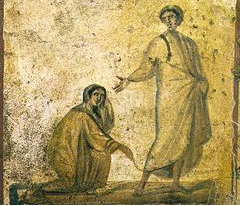 —This story was inspired by Mark 5:21-43, the gospel reading for Sunday, July 1.
Twelve years earlier, after her first baby was born cold and blue and the bleeding wouldn’t stop, the woman tried offerings and prayers. She was raised in her ancestors’ faith, believing that if you lived according to the commandments, you—if you were a man—would prosper with fruitful crops, riches, and many children. Women, some, were blessed. Sarah, Hannah.
Her husband sought the midwives, the physicians, the rabbis, asking, “What have I done to cause this?” He made repeated trips to the mikvah. The bleeding would stop for a while, long enough for her husband to lie with her again, and then it would return. The woman grew weaker, she and the servant girl unable to keep enough clean rags to stanch the flow.
One night her husband lifted his gaze from the table to peer at her. All this time, he’d taken her ailment as his own misfortune, just as he would a lame donkey or disease among the sheep. But, that night, as the lamp started to smoke and she stood, wincing, to trim the wick, he saw that this punishment, this plague had nothing to do with him.
He felt a surge of relief, and then as she seated herself again to continue her mending, agitation. She’d had a haughty streak when younger and he had taken a certain pleasure in the way she’d held herself. Now, in her misery, withdrawn further into herself, she seemed even more powerful.
That night, he left with the servant girl and the flock for another town, where he married again, fathered sons, and daughters. What good was a barren, unclean woman? He’d done the right thing. But late at night or alone in the fields, he probed the soreness at the edge of his newfound prosperity.
The woman spent her days on a straw pallet, noticed seasons only from the changing slant of sunlight through the window or the contents of the food basket left outside her door by a neighbor’s daughter.
Before her sickness, the woman had been known for her skill with the needle and on better days she could manage sewing. Each week, when she put out the empty basket for the neighbor girl to take away, she tucked in it some piece of embroidery she’d worked—a wedding sheet or a banquet cloth.
Though warned of the woman’s uncleanness, the neighbor girl wanted to see the hands that worked such delicate patterns. They could not belong to someone so unclean, reasoned the girl, if they could make such beauty. One day, she knocked.
She needn’t have. The woman knew that the girl was there, and opened the door.
“What is it, child?”
The girl was struck, not by deformity or disease but by the woman’s resemblance to her own grandmother. Pale, thin skin, like the finest vellum, and beneath it the mottled blue and brown of bruises, her face gaunt with eyes that shone from deep sockets.
The girl spoke quickly: “Jairus’ daughter is dying. My father has gone with the other elders to the synagogue. Some say the prophet is coming today, across the sea.”
“Elijah?”
“Some say. He has healed many and done many signs.” The girl put down the basket. “I brought dates, and a jug of new wine.” And then, without having planned to, the girl said, “Maybe he can heal you if—if you go to him.” She blushed.
The woman’s eyes bore into her. “Physicians have taken all I have, and I am no better, but worse. I have endured much.”
“This man is not a physician, they say.”
The woman bent to pick up the basket and went inside saying, “Wait here, child.”
The girl peeked in on a cleanly swept dirt floor, a wooden slab of table, and straw pallet, disappointing in their ordinariness.
The woman returned with a small square of embroidery. “I had to trim this due to a foolish error. But what’s here is fine. Take it.”
The girl clutched it. Now it was the woman who blushed. “I am pleased, child, for you to take such pleasure in it.”
They said goodbye.
Jairus’ wife and the woman were expecting children at the same time, twelve years earlier. Jairus’ wife had given birth to a daughter, and the woman’s baby had been born blue and cold. The years since Jairus’ daughter was born had been for the woman years of blood and death and uncleanliness. And now Jairus’ daughter was dying.
Late that afternoon, the woman set out. She took the rags from which even the most porous stones had not scoured clean the stains, and rolled the pallet on which she’d lain. She carried them up into the hills, where she made an altar and offered them. When the sun had gone down, she covered the embers with dirt and walked home.
In the basket, she found dates and wine, as well as some loaves. She ate and prepared for sleep. All night, she dreamed the longings of a girl who’d known a mother’s guidance, of a wife who lay with her husband and recalled a sweet stirring from a long-ago glance, of a mother whose breasts grew heavy and tingling with milk.
She woke strengthened and stuffed clean rags between her legs and walked to town. When she saw the crowd, she pulled her cloak over her head. If recognized, she could be stoned. People jostled and pushed, and she almost fell. She felt very weak. And then, through a gap in the press of strangers, she saw the teacher and reached out.
Lindsey Crittenden is the author of The Water Will Hold You: A Skeptic Learns to Pray and The View from Below: Stories. Her essays, short fiction, and articles have appeared in the New York Times, the San Francisco Chronicle, Image, Bellingham Review, The Best American Spiritual Writing, and other publications. She lives in San Francisco, where she teaches writing at UC Berkeley Extension. Her website is www.lindseycrittenden.com.
Previous Post

July 10, 2012
A Psalm for Surgery
Next Post
July 12, 2012 Of Monks, Conversion, and Radio Astronomy, Part 1
Browse Our Archives
Select a Category A. G. Harmon Alissa Wilkinson Allison Backous Art Authors Brad Fruhauff Bradford Winters Bryan Bliss Caroline Langston Chad Thomas Johnston Chris Hoke Christiana N. Peterson Culture D.G. Myers D.L. Mayfield Daniel Bowman Jr. David Griffith Elizabeth Duffy Faith Film Greg Wolfe Guest Contributor Interview Jan Vallone Jeffrey Overstreet Jessica Eddings-Roeser Jessica Mesman Griffith Kelly Foster Lindsey Crittenden Morgan Meis music Natalie Vestin Nick Olson Peggy Rosenthal Personal Reflection Poetry Friday Reflection Relationships Review Richard Chess Richard Cole Sara Zarr Shannon Huffman Polson Sonya Bilocerkowycz Tania Runyan Tony Woodlief Topical Categories Uncategorized Vic Sizemore Writing
Select a Month October 2018 September 2018 August 2018 July 2018 June 2018 May 2018 April 2018 March 2018 February 2018 January 2018 December 2017 November 2017 October 2017 September 2017 August 2017 July 2017 June 2017 May 2017 April 2017 March 2017 February 2017 January 2017 December 2016 November 2016 October 2016 September 2016 August 2016 July 2016 June 2016 May 2016 April 2016 March 2016 February 2016 January 2016 December 2015 November 2015 October 2015 September 2015 August 2015 July 2015 June 2015 May 2015 April 2015 March 2015 February 2015 January 2015 December 2014 November 2014 October 2014 September 2014 August 2014 July 2014 June 2014 May 2014 April 2014 March 2014 February 2014 January 2014 December 2013 November 2013 October 2013 September 2013 August 2013 July 2013 June 2013 May 2013 April 2013 March 2013 February 2013 January 2013 December 2012 November 2012 October 2012 September 2012 August 2012 July 2012 June 2012 May 2012 February 2008
Follow Us!
TAKE THE
Religious Wisdom Quiz
How long did the judges rule before kings?
Select your answer to see how you score.
300 years Approximately 350 years 200 years 400 years
Related posts from Good Letters

Why I’m Writing a Death Penalty Book for...

Finding My Sister in Young Adult Novels

Mysteries Sherlock Holmes Can't Solve
TRENDING AT PATHEOS Catholic

Rejecting Doom: Christian Hope And Human Action
Christianity is a religion of hope. We are to have hope and...

It’s What Comes From Within Which Matters
One of the most difficult things for us to understand is why...

Why I Choose the Eucharist Over the Sermon
Choose the Eucharist, Not the Sermon What are we supposed to get...

5 Design Elements Found in Spiritually Rooted Homes
Putting Spirituality Into Home Decor Our homes are more than our living...

Credo: A Story of God Told with the...
About 10 years ago, I began to imagine a personal "Credo" that...

The Anatomy of Divine Revelation in Catholic Thought
The claim that God has made Himself known to human beings is...
view all Catholic blogs
Ad-Free & Subscriber Log-In Subscription Support
- About Us
- 2026 Calendar
- Videos
- Podcasts
- Library of World Religions
- Faith In Media Tracker
- Advertise With Us
- Write for Us
- Privacy Policy
- Terms of Service
- Do Not Sell My Data
- Contact Us
- Radiant Digital
- Manage Newsletter Subscriptions
- Unsubscribe From Notifications
- Sitemap
Copyright 2008-2026, Patheos. All rights reserved.
Subscription Support Ad-Free & Subscriber Log-In
Follow Patheos