
BuddhistCatholicContemplativeEvangelicalGeneral ChristianHinduJewishLatter-day SaintMuslimNew VisionsProgressive Christian
Beliefs
- Buddhist
- Catholic
- Contemplative
- Evangelical
- General Christian
- Hindu
- Jewish
- Latter-day Saint
- More Voices
- Muslim
- New Visions
- Pagan
- Progressive Christian
Topics
- Religion News
- Food and Religion
- Sports and Religion
- Religious Art
- Religious Music and Entertainment
- Religious Events
- History and Religion
- Style and Religion
- Politics and Religion
- Women in Religion
- Recreation Outdoors and Religion
- Business Finance and Religion
- Careers Workplace and Religion
- Education and Religion
- Family Parenting and Religion
- Health Fitness and Religion
- Home and Religion
- Relationships and Religion
- Technology and Religion
- Travel and Religion
Columnists
- Buddhist Columnists
- Business Finance and Religion Columnists
- Careers Workplace and Religion Columnists
- Catholic Columnists
- Contemplative Columnists
- Education and Religion Columnists
- Evangelists Columnists
- Family Parenting and Religion Columnists
- General Christian Columnists
- Health Fitness and Religion Columnists
- Hindu Columnists
- History and Religion Columnists
- Home and Religion Columnists
- Jewish Columnists
- More Voices Columnists
- Latter Day Columnists
- Muslim Columnists
- New Visions Columnists
- Nonreligious Columnists
- Pagan Columnists
- Politics and Religion Columnists
- Progressive Columnists
- Recreation Outdoors and Religion Columnists
- Relationships and Religion Columnists
- Religion News Columnists
- Religious Art Columnists
- Religious Events Columnists
- Religious Music and Entertainment Columnists
- Sports and Religion Columnists
- Style and Religion Columnists
- Technology and Religion Columnists
- Travel and Religion Columnists
- Women in Religion Columnists
Resource Library
- 2026 Calendar
- Library of World Religions
- The 100 Most Holy Places on Earth
- Patheos Answers
- Podcasts
- Videos
- Faith Leaders Database
- Anglican Episcopalian
- Bahai
- Baptist
- Buddhism
- Christianity
- Confucianism
- Eastern Orthodoxy
- Hinduism
- Holiness and Pentecostal
- ISKCON
- Islam
- Judaism
- Lutheran
- Methodist
- The Church of Jesus Christ of Latter-day Saints
- New Age
- Paganism
- Presbytarian and Reformed
- Protestantism
- Religion Behind the Scenes
- Roman Catholic
- Scientology
- Shia Islam
- Sikhism
- Sufism
- Sunni Islam
- Taoism
- Zen
- See all religions
Research Tools
 Ad-Free & Subscriber Log-In Subscription Support
Ad-Free & Subscriber Log-In Subscription Support
Follow Patheos 

- Trending:
- Forgiveness
- |
- Marriage
- |
- Consciousness
- |
- Death Penalty
- |
- Election
- |
- Halloween
 Good Letters
-
Contributors
- Home
- Catholic
- Praying the Divine Office with Flannery O’Connor
Praying the Divine Office with Flannery O’Connor
Last updated on: June 27, 2013 at 2:30 pm by Peggy Rosenthal
Praying the Divine Office with Flannery O’Connor 2013-06-27T14:30:45-07:00 Peggy Rosenthal
Patheos Explore the world's faith through different perspectives on religion and spirituality! Patheos has the views of the prevalent religions and spiritualities of the world.
 For over twenty-five years, my husband and I have prayed morning and evening prayer together. They are the hinges of our day, a metaphor I borrow from the introduction to the prayer book we use: The Liturgy of the Hours, also known in Catholic worship as the Divine Office.
Our pattern is to pray morning prayer right after breakfast (I don’t pray well on an empty stomach), then evening prayer right after dinner. Of course we sometimes have to break the pattern and skip the prayers: if one of us is traveling, or if we have to rush out to a doctor’s appointment after breakfast or an evening event after dinner. But the pattern is followed as much as practicable, and I can’t imagine our lives without it.
Starting and ending the day with praise of God helps put into perspective our current fussing. And there’s nothing so good for a marriage as saying the Lord’s Prayer together twice a day, with its focus on forgiveness.
The Divine Office is an ancient tradition in the Catholic church. I like following a time-honored pattern, and one that is also being followed by people around the world each day. Praying the liturgy of the hours makes me feel part of the body of Christ in a real way.
So I was delighted to discover a new book that connects me through the divine office not only with unnamed believers through time and space but also with a writer whose work I’ve long treasured: Flannery O’Connor.
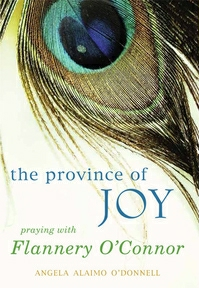
Paraclete Press has just published The Province of Joy: Praying with Flannery O’Connor, by poet and professor Angela Alaimo O’Donnell. What O’Donnell has done in this book is marvelously creative: she has put together a version of morning and evening prayer that draws specifically on prayers that Flannery prayed, as well as comments about prayer in her letters and passages from her fiction that bear on the prayers of the day. (I’m calling her Flannery in this post to avoid the awkwardness of O’Connor and O’Donnell. And I do feel a first-name intimacy with her.)
Adapting the divine office like this is perfectly acceptable. I’ve adapted it myself over the years, sometimes substituting psalm translations I prefer or scripture readings that are more meaningful to me. O’Donnell has added to each day’s morning prayer a prayer that was Flannery’s favorite, one new to me. It’s the Prayer to St. Raphael.
I find this prayer astoundingly moving, with its opening lines expressing a longing I didn’t know I had, yet certainly do:
O Raphael, lead us toward those we are waiting for,
those who are waiting for us:
Raphael, Angel of happy meeting,
lead us by the hand toward those we are looking for.
May all our movements be guided by your Light
and transfigured with your joy.
I’d never thought that each day we are waiting for the right encounters, for those happy meetings that will somehow bring us closer to God and to one another (whoever that other might turn out to be). Yet surely we are.
When Flannery copied out this prayer for a friend, she added a paraphrase from which O’Donnell takes her book’s title: “The prayer asks St. Raphael to guide us to the province of joy so that we may not be ignorant of the concerns of our true country.”
O’Donnell then reminds us that Flannery wrote this as she neared her death from the debilitating chronic illness of lupus she lived with for many years, writing that:
[She] knew that the ‘true country,’ the proper destination, orientation, and disposition of a believing Christian, is joy.… Prayer, for O’Connor, was a means of moving from the limited place in which she found herself toward the limitless space of joy, a location that can be occupied in the here and now, as well as looked forward to in eternity.
Succumbing too easily to discouragement, as I do, I’m grateful for this reminder that joy is our true home.
And grateful, too, that O’Donnell presents Flannery to us in terms that are especially resonant for the Image community. Flannery O’Connor, she says, “is of particular interest to a growing number of readers who are interested in writers who consciously explore the intersection between art and faith.” This is precisely the intersection where we in the Image community reside.
Then O’Donnell elaborates:
I see in O’Connor an example of a person who has integrated her faith and her art so thoroughly that they have become one practice. In an era wherein such integration is not only rare but is considered by many people in both the secular and sacred realms to be anathema, O’Connor demonstrates that this can be done and done beautifully.
O’Donnell’s book does this beautifully as well. The divine office is already art: it draws on the poetic art of the psalms, and its very structure is an art form that moves us more deeply into the life of Christian faith. Enhancing this structure by incorporating Flannery’s own art, O’Donnell creates a work of art that is a practice of faith.
Peggy Rosenthal is director of Poetry Retreats and writes widely on poetry as a spiritual resource. Her books include Praying through Poetry: Hope for Violent Times (Franciscan Media), and The Poets’ Jesus (Oxford). See Amazon for full list. She also teaches an online course, “Poetry as a Spiritual Practice,” through Image’s Glen Online program*.*
The Province of Joy: Praying with Flannery O'Connor
Previous Post

July 16, 2012
Living Fossils: Discovering Undercover’s Branded
Next Post
July 18, 2012 Staking My Life on Farm Boys
Browse Our Archives
Select a Category A. G. Harmon Alissa Wilkinson Allison Backous Art Authors Brad Fruhauff Bradford Winters Bryan Bliss Caroline Langston Chad Thomas Johnston Chris Hoke Christiana N. Peterson Culture D.G. Myers D.L. Mayfield Daniel Bowman Jr. David Griffith Elizabeth Duffy Faith Film Greg Wolfe Guest Contributor Interview Jan Vallone Jeffrey Overstreet Jessica Eddings-Roeser Jessica Mesman Griffith Kelly Foster Lindsey Crittenden Morgan Meis music Natalie Vestin Nick Olson Peggy Rosenthal Personal Reflection Poetry Friday Reflection Relationships Review Richard Chess Richard Cole Sara Zarr Shannon Huffman Polson Sonya Bilocerkowycz Tania Runyan Tony Woodlief Topical Categories Uncategorized Vic Sizemore Writing
Select a Month October 2018 September 2018 August 2018 July 2018 June 2018 May 2018 April 2018 March 2018 February 2018 January 2018 December 2017 November 2017 October 2017 September 2017 August 2017 July 2017 June 2017 May 2017 April 2017 March 2017 February 2017 January 2017 December 2016 November 2016 October 2016 September 2016 August 2016 July 2016 June 2016 May 2016 April 2016 March 2016 February 2016 January 2016 December 2015 November 2015 October 2015 September 2015 August 2015 July 2015 June 2015 May 2015 April 2015 March 2015 February 2015 January 2015 December 2014 November 2014 October 2014 September 2014 August 2014 July 2014 June 2014 May 2014 April 2014 March 2014 February 2014 January 2014 December 2013 November 2013 October 2013 September 2013 August 2013 July 2013 June 2013 May 2013 April 2013 March 2013 February 2013 January 2013 December 2012 November 2012 October 2012 September 2012 August 2012 July 2012 June 2012 May 2012 February 2008
Follow Us!
TAKE THE
Religious Wisdom Quiz
What does Jesus say about storing up treasures on earth?
Select your answer to see how you score.
Treasure is godliness Store as much as possible Only store in banks Do not, because they are temporary
Related posts from Good Letters

Poetry Friday: "The Burned Butterfly"


Leonard Cohen’s Holy and Broken Hallelujah

Ready or Not for the Days of Awe
TRENDING AT PATHEOS Catholic

Rejecting Doom: Christian Hope And Human Action
Christianity is a religion of hope. We are to have hope and...

It’s What Comes From Within Which Matters
One of the most difficult things for us to understand is why...

Why I Choose the Eucharist Over the Sermon
Choose the Eucharist, Not the Sermon What are we supposed to get...

5 Design Elements Found in Spiritually Rooted Homes
Putting Spirituality Into Home Decor Our homes are more than our living...

Credo: A Story of God Told with the...
About 10 years ago, I began to imagine a personal "Credo" that...

The Anatomy of Divine Revelation in Catholic Thought
The claim that God has made Himself known to human beings is...
view all Catholic blogs
Ad-Free & Subscriber Log-In Subscription Support
- About Us
- 2026 Calendar
- Videos
- Podcasts
- Library of World Religions
- Faith In Media Tracker
- Advertise With Us
- Write for Us
- Privacy Policy
- Terms of Service
- Do Not Sell My Data
- Contact Us
- Radiant Digital
- Manage Newsletter Subscriptions
- Unsubscribe From Notifications
- Sitemap
Copyright 2008-2026, Patheos. All rights reserved.
Subscription Support Ad-Free & Subscriber Log-In
Follow Patheos