
BuddhistCatholicContemplativeEvangelicalGeneral ChristianHinduJewishLatter-day SaintMuslimNew VisionsProgressive Christian
Beliefs
- Buddhist
- Catholic
- Contemplative
- Evangelical
- General Christian
- Hindu
- Jewish
- Latter-day Saint
- More Voices
- Muslim
- New Visions
- Pagan
- Progressive Christian
Topics
- Religion News
- Food and Religion
- Sports and Religion
- Religious Art
- Religious Music and Entertainment
- Religious Events
- History and Religion
- Style and Religion
- Politics and Religion
- Women in Religion
- Recreation Outdoors and Religion
- Business Finance and Religion
- Careers Workplace and Religion
- Education and Religion
- Family Parenting and Religion
- Health Fitness and Religion
- Home and Religion
- Relationships and Religion
- Technology and Religion
- Travel and Religion
Columnists
- Buddhist Columnists
- Business Finance and Religion Columnists
- Careers Workplace and Religion Columnists
- Catholic Columnists
- Contemplative Columnists
- Education and Religion Columnists
- Evangelists Columnists
- Family Parenting and Religion Columnists
- General Christian Columnists
- Health Fitness and Religion Columnists
- Hindu Columnists
- History and Religion Columnists
- Home and Religion Columnists
- Jewish Columnists
- More Voices Columnists
- Latter Day Columnists
- Muslim Columnists
- New Visions Columnists
- Nonreligious Columnists
- Pagan Columnists
- Politics and Religion Columnists
- Progressive Columnists
- Recreation Outdoors and Religion Columnists
- Relationships and Religion Columnists
- Religion News Columnists
- Religious Art Columnists
- Religious Events Columnists
- Religious Music and Entertainment Columnists
- Sports and Religion Columnists
- Style and Religion Columnists
- Technology and Religion Columnists
- Travel and Religion Columnists
- Women in Religion Columnists
Resource Library
- 2026 Calendar
- Library of World Religions
- The 100 Most Holy Places on Earth
- Patheos Answers
- Podcasts
- Videos
- Faith Leaders Database
- Anglican Episcopalian
- Bahai
- Baptist
- Buddhism
- Christianity
- Confucianism
- Eastern Orthodoxy
- Hinduism
- Holiness and Pentecostal
- ISKCON
- Islam
- Judaism
- Lutheran
- Methodist
- The Church of Jesus Christ of Latter-day Saints
- New Age
- Paganism
- Presbytarian and Reformed
- Protestantism
- Religion Behind the Scenes
- Roman Catholic
- Scientology
- Shia Islam
- Sikhism
- Sufism
- Sunni Islam
- Taoism
- Zen
- See all religions
Research Tools
 Ad-Free & Subscriber Log-In Subscription Support
Ad-Free & Subscriber Log-In Subscription Support
Follow Patheos 

- Trending:
- Forgiveness
- |
- Marriage
- |
- Consciousness
- |
- Death Penalty
- |
- Election
- |
- Halloween
 Good Letters
-
Contributors
- Home
- Catholic
- Heading Home on the Back Roads
Heading Home on the Back Roads
Last updated on: July 18, 2013 at 9:43 am by Dyana Herron
Heading Home on the Back Roads 2013-07-18T09:43:04-07:00 Dyana Herron
Patheos Explore the world's faith through different perspectives on religion and spirituality! Patheos has the views of the prevalent religions and spiritualities of the world.
 Today Good Letters welcomes back former blogger Dyana Herron as a regular contributor. Dyana is a poet who holds an MFA in Creative Writing from Seattle Pacific University. She served as SPU’s MFA Program Coordinator and Development Associate for Image Journal before relocating to Philadelphia with her husband last year. We are glad to share her words with you once again.
Since I retired as a regular contributor to Good Letters almost exactly one year ago, I’ve moved from Seattle to Philadelphia. Neither are cities I expected to live in before I had sudden reason to live in them. Living in a city at all, in fact, was never necessarily the plan.
Why, then, do I find it a shock each time I go back home to Southeast Tennessee, where my family still resides? Why, standing in the muggy July air I know the feel of as well as the feel of my own body, looking on the hills whose shape I know as intimately as the geography of my father’s face—even in the dark—do I feel so strange, so out of place?
I have been in Tennessee for the past two weeks, attending my dying grandmother, Gennie Vee.
When I say attending, I mean I have been assisting in small ways with her care—sitting with her, stealing extra cups of applesauce from the kitchen of the rehab facility she stayed at for a week to regain strength after a hospitalization, helping her find which channel is broadcasting the Braves game.
But more than that, I am attending my grandmother the way I might attend a lecture, a concert, or a church service. When I say I am attending her, I mean I am paying attention, as I would at any of those events.
And my grandmother, though she does little now but eat and sleep and laugh and tell me she loves me and struggle to breathe, is at the same time teaching me something complicated, and singing me something beautiful, and telling me something I didn’t know about God.
The first week my grandmother was in the rehab facility wasn’t as bad as I feared. It was a cheerful enough place, with a small vegetable garden outside the cafeteria and a daily activity schedule that not only included Bingo and I Love Lucy marathons, but also poker, aromatherapy, Beading with Mildred, and the mysteriously-named but probably super fun Lula Tells It All!
I’d been nervous in advance that being there would make me sad. Besides seeing my grandmother in worsening health, I worried that seeing other elderly patients—many without families to visit them, and many lost in their memories of the past without much future to look forward to—would be hard to handle.
When I arrived, though, I found that I enjoyed sitting in her room, listening to the whir of the oxygen machine, swapping stories with other family members who came to bring food and books and check in on her.
I was most anxious when she decided she wanted to return home. While she was still in the rehab facility, I realized, she was working towards a goal—regaining enough strength to go home. But after she went home, the future point she’d be moving toward was her death.
Of course home was where my grandmother wanted to be. She and my grandfather (dead fifteen years now) built the house together and raised seven children there—six have houses of their own on the same road.
She wanted—wants—to rest her head on her own pillows and look out her own windows and breathe her own air, which smells like bacon grease and tomatoes.
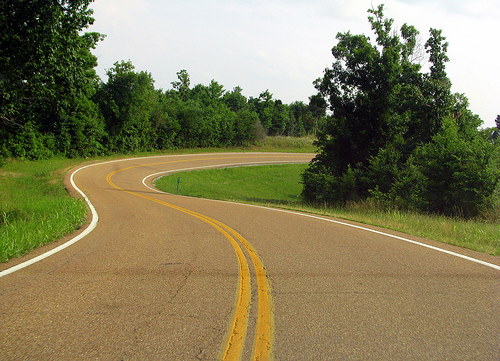
Although my grandmother’s house is only a short and uncomplicated drive from my mother’s, when going to visit her I find myself taking the longer, sinuous back roads: Gap Springs Road, Buck’s Pocket Road, Samples Chapel Road.
I was surprised by the ease with which I remembered how to steer around bends and sharp turns, and how, without thinking, I’d swerve to bypass an old pothole or dip. This muscle memory is accompanied by actual memory.
I pass the house that belongs to my first grade teacher, in whose garage I accidentally locked myself once while selling Girl Scout cookies. Later the road winds by the house my aunt and uncle rented early in their marriage.
I remember, when very small, bringing them a pair of crocheted baby booties when my aunt was first pregnant, only to find her crying in her living room chair. My mom explained later that there wouldn’t be a baby anymore. That maybe there would be later, but not then.
Finally the road curves through a long corridor of trees so tall and dense they block out light. I dream of this wooded strip so often it feels surreal to be present in it in reality. The shady darkness—especially in evening— doesn’t help matters, nor do the fireflies’ sleepy blinks in the brush, green on green.
Here’s the hard part. We aren’t taught how to go back.
We’re taught to move forward, toward something better, as quickly and efficiently as we can. We’re told there will be a road, and even if it is narrow, it is straight, and it will take us where we need to go.
We are told a story has a beginning, a middle, and end—that stories move in some kind of line. In this way we are taught to move from one place to another, and to yet another.
In reality, though, it’s rarely so simple. Our stories are convoluted, and winding, and often lack resolution. We are frustrated and baffled by them. We know what to do when a baby is coming, but not when the baby doesn’t come. We know how to help people recover, but not how to help them not recover.
For me, for now, taking the back roads feels truer to the way life moves—forward and back and around, and sometimes all this at once. For me, for now, this seems like the right way to go.
When I pull into my grandmother’s driveway, there is a light in the window. It illuminates her curtains, printed with roses. They are faded from many years of filtering sunlight.
Previous Post

July 25, 2012
The Deeds of Jerry Sandusky
Next Post
July 27, 2012 My Online Footprint
Browse Our Archives
Select a Category A. G. Harmon Alissa Wilkinson Allison Backous Art Authors Brad Fruhauff Bradford Winters Bryan Bliss Caroline Langston Chad Thomas Johnston Chris Hoke Christiana N. Peterson Culture D.G. Myers D.L. Mayfield Daniel Bowman Jr. David Griffith Elizabeth Duffy Faith Film Greg Wolfe Guest Contributor Interview Jan Vallone Jeffrey Overstreet Jessica Eddings-Roeser Jessica Mesman Griffith Kelly Foster Lindsey Crittenden Morgan Meis music Natalie Vestin Nick Olson Peggy Rosenthal Personal Reflection Poetry Friday Reflection Relationships Review Richard Chess Richard Cole Sara Zarr Shannon Huffman Polson Sonya Bilocerkowycz Tania Runyan Tony Woodlief Topical Categories Uncategorized Vic Sizemore Writing
Select a Month October 2018 September 2018 August 2018 July 2018 June 2018 May 2018 April 2018 March 2018 February 2018 January 2018 December 2017 November 2017 October 2017 September 2017 August 2017 July 2017 June 2017 May 2017 April 2017 March 2017 February 2017 January 2017 December 2016 November 2016 October 2016 September 2016 August 2016 July 2016 June 2016 May 2016 April 2016 March 2016 February 2016 January 2016 December 2015 November 2015 October 2015 September 2015 August 2015 July 2015 June 2015 May 2015 April 2015 March 2015 February 2015 January 2015 December 2014 November 2014 October 2014 September 2014 August 2014 July 2014 June 2014 May 2014 April 2014 March 2014 February 2014 January 2014 December 2013 November 2013 October 2013 September 2013 August 2013 July 2013 June 2013 May 2013 April 2013 March 2013 February 2013 January 2013 December 2012 November 2012 October 2012 September 2012 August 2012 July 2012 June 2012 May 2012 February 2008
Follow Us!
TAKE THE
Religious Wisdom Quiz
Who was Hosea's wife, whom he redeemed from slavery?
Select your answer to see how you score.
Gomer Esther Deborah Ruth
Related posts from Good Letters

On Writing Odes: Taking Time to Celebrate



TRENDING AT PATHEOS Catholic

Rejecting Doom: Christian Hope And Human Action
Christianity is a religion of hope. We are to have hope and...

It’s What Comes From Within Which Matters
One of the most difficult things for us to understand is why...

Why I Choose the Eucharist Over the Sermon
Choose the Eucharist, Not the Sermon What are we supposed to get...

5 Design Elements Found in Spiritually Rooted Homes
Putting Spirituality Into Home Decor Our homes are more than our living...

Credo: A Story of God Told with the...
About 10 years ago, I began to imagine a personal "Credo" that...

The Anatomy of Divine Revelation in Catholic Thought
The claim that God has made Himself known to human beings is...
view all Catholic blogs
Ad-Free & Subscriber Log-In Subscription Support
- About Us
- 2026 Calendar
- Videos
- Podcasts
- Library of World Religions
- Faith In Media Tracker
- Advertise With Us
- Write for Us
- Privacy Policy
- Terms of Service
- Do Not Sell My Data
- Contact Us
- Radiant Digital
- Manage Newsletter Subscriptions
- Unsubscribe From Notifications
- Sitemap
Copyright 2008-2026, Patheos. All rights reserved.
Subscription Support Ad-Free & Subscriber Log-In
Follow Patheos