
BuddhistCatholicContemplativeEvangelicalGeneral ChristianHinduJewishLatter-day SaintMuslimNew VisionsProgressive Christian
Beliefs
- Buddhist
- Catholic
- Contemplative
- Evangelical
- General Christian
- Hindu
- Jewish
- Latter-day Saint
- More Voices
- Muslim
- New Visions
- Pagan
- Progressive Christian
Topics
- Religion News
- Food and Religion
- Sports and Religion
- Religious Art
- Religious Music and Entertainment
- Religious Events
- History and Religion
- Style and Religion
- Politics and Religion
- Women in Religion
- Recreation Outdoors and Religion
- Business Finance and Religion
- Careers Workplace and Religion
- Education and Religion
- Family Parenting and Religion
- Health Fitness and Religion
- Home and Religion
- Relationships and Religion
- Technology and Religion
- Travel and Religion
Columnists
- Buddhist Columnists
- Business Finance and Religion Columnists
- Careers Workplace and Religion Columnists
- Catholic Columnists
- Contemplative Columnists
- Education and Religion Columnists
- Evangelists Columnists
- Family Parenting and Religion Columnists
- General Christian Columnists
- Health Fitness and Religion Columnists
- Hindu Columnists
- History and Religion Columnists
- Home and Religion Columnists
- Jewish Columnists
- More Voices Columnists
- Latter Day Columnists
- Muslim Columnists
- New Visions Columnists
- Nonreligious Columnists
- Pagan Columnists
- Politics and Religion Columnists
- Progressive Columnists
- Recreation Outdoors and Religion Columnists
- Relationships and Religion Columnists
- Religion News Columnists
- Religious Art Columnists
- Religious Events Columnists
- Religious Music and Entertainment Columnists
- Sports and Religion Columnists
- Style and Religion Columnists
- Technology and Religion Columnists
- Travel and Religion Columnists
- Women in Religion Columnists
Resource Library
- 2026 Calendar
- Library of World Religions
- The 100 Most Holy Places on Earth
- Patheos Answers
- Podcasts
- Videos
- Faith Leaders Database
- Anglican Episcopalian
- Bahai
- Baptist
- Buddhism
- Christianity
- Confucianism
- Eastern Orthodoxy
- Hinduism
- Holiness and Pentecostal
- ISKCON
- Islam
- Judaism
- Lutheran
- Methodist
- The Church of Jesus Christ of Latter-day Saints
- New Age
- Paganism
- Presbytarian and Reformed
- Protestantism
- Religion Behind the Scenes
- Roman Catholic
- Scientology
- Shia Islam
- Sikhism
- Sufism
- Sunni Islam
- Taoism
- Zen
- See all religions
Research Tools
 Ad-Free & Subscriber Log-In Subscription Support
Ad-Free & Subscriber Log-In Subscription Support
Follow Patheos 

- Trending:
- Forgiveness
- |
- Marriage
- |
- Consciousness
- |
- Death Penalty
- |
- Election
- |
- Halloween
 Good Letters
-
Contributors
- Home
- Catholic
- Ray Bradbury Lives Forever
Ray Bradbury Lives Forever
Last updated on: June 26, 2013 at 2:58 pm by Gregory Wolfe
Ray Bradbury Lives Forever 2013-06-26T14:58:55-07:00 Gregory Wolfe
Patheos Explore the world's faith through different perspectives on religion and spirituality! Patheos has the views of the prevalent religions and spiritualities of the world.
 Guest Post
On Labor Day weekend in 1932, a twelve year-old boy from Waukegan, Illinois, having just emerged from a family funeral, noticed a carnival tent by the shore of Lake Michigan and went to investigate. He had heard of a magician there named Mr. Electrico, who sat with a sword in hand on an electric chair with current passing through him, making his hair stand on end.
When Mr. Electrico stood up to knight the boy, making the current pass to him, he shouted: “Live forever!”
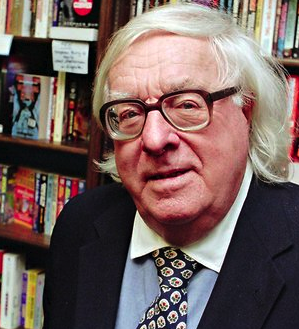
The late Ray Bradbury, who passed away on June 5, told this story about his childhood hundreds of times, insisting that the experience set him on the path to becoming a writer-magician, a teller of fantastic tales.
On one level this is a story about vocation—a baptism by electricity—but it is also a story about time and eternity, death and resurrection—themes that would preoccupy Bradbury over a writing career that spanned seven decades.
In all the tributes that have been paid to Bradbury since his death—from lengthy newspaper obituaries to blog posts—one aspect of his life and work has been conspicuously missing: the centrality of faith.
It’s an unfortunate omission, because it obscures much of what makes Bradbury’s vision distinctive and timeless.
To be sure, the tributes rightly point out the pioneering role he played in elevating science fiction and horror from pulp magazines to the literary mainstream. His classic works—Fahrenheit 451, Dandelion Wine, The Martian Chronicles, Something Wicked This Way Comes—are held up as examples of lyrical prose less concerned with the wonders of future technology than with preserving a humane vision of the world.
But this begs a question: In order to have a humane vision do you have to have an understanding of what constitutes humanness?
Ray Bradbury did have such an idea, and it turns out to be deeply traditional—a marked contrast with the secular scientism of the other writers of his generation such as Robert Heinlein and Isaac Asimov. In The Martian Chronicles one of the characters describes the modern dilemma:
They knew how to live with nature and get along with nature. They didn’t try too hard to be all men and no animal. That’s the mistake we made when Darwin showed up. We embraced him and Huxley and Freud, all smiles. And then we discovered that Darwin and our religions didn’t mix. Or at least we didn’t think they did. We were fools. We tried to budge Darwin and Huxley and Freud. They wouldn’t move very well. So, like idiots, we tried knocking down religion.
We succeeded pretty well. We lost our faith and went around wondering what life was for. If art was no more than a frustrated outflinging of desire, if religion was no more than self-delusion, what good was life? Faith had always given us answers to all things. But it all went down the drain with Freud and Darwin. We were and still are a lost people.
Bradbury’s embrace of faith may have seemed out of step with the gospel of scientific and technological progress espoused by his peers, but it was also the secret behind what made his tales of space exploration haunting and unique.
As my friend Michael Leary has pointed out, for many science fiction authors, humankind’s journey to the stars marks a symbolic movement from the ignorance of ancient moral values to a brave new world of enlightened freedom.
But when Bradbury’s characters travel to Mars their primary encounter is not with something alien. Instead, they encounter themselves.
Bradbury’s Mars is a mirror. Earthmen arrive like arrogant colonialists only to re-discover the seven deadly sins and their consequences. In “The Fire Balloons” Christian missionaries find the ancient Martians living in a “state of grace”; filled with awe and reverence, they reluctantly return to the human settlement to “handle our own kind.”
The perennial temptation for science fiction writers has been to think they can leave human nature behind when they head off into space—that they can re-write the structure of the human heart.
Bradbury never succumbed to that temptation and his legion of readers bears witness to the soundness of his instinct.
Late in life Bradbury described himself as a delicatessen religionist, taking insights from both Eastern and Western traditions. He also called himself a Zen Buddhist saying, “I don’t think about what I do. I do it. That’s Buddhism. I jump off the cliff and build my wings on the way down.”
But in my experience very few Buddhists speak—as Bradbury did, incessantly—of God, sin, forgiveness, grace, and redemption.
“The guy keeps writing about Jesus, but he doesn’t consider himself a Christian,” his biographer Sam Weller has said.
In one of Bradbury’s most famous stories, “The Man,” a spaceship from Earth lands on a planet only to be totally ignored. The incensed captain finds out that this is because a long-expected savior had come to the planet the day before.
At first the captain becomes obsessed with trying to disprove the man’s credentials, but when he finally becomes convinced about who the unnamed man is, he roars off in his rocket to try to catch him on some other planet.
The irony, of course, is that the captain remains oblivious to the man’s continuing presence among those he has already touched.
“The best description of my career as a writer,” Bradbury once said, “is ‘At play in the fields of the Lord.’”
Some of us hope that he’s playing there still.
Gregory Wolfe is the editor of Image journal and the director of the MFA in Creative Writing program at Seattle Pacific University.
Previous Post

June 15, 2012
In Another Lifetime
Next Post

June 19, 2012 Still Life
Browse Our Archives
Select a Category A. G. Harmon Alissa Wilkinson Allison Backous Art Authors Brad Fruhauff Bradford Winters Bryan Bliss Caroline Langston Chad Thomas Johnston Chris Hoke Christiana N. Peterson Culture D.G. Myers D.L. Mayfield Daniel Bowman Jr. David Griffith Elizabeth Duffy Faith Film Greg Wolfe Guest Contributor Interview Jan Vallone Jeffrey Overstreet Jessica Eddings-Roeser Jessica Mesman Griffith Kelly Foster Lindsey Crittenden Morgan Meis music Natalie Vestin Nick Olson Peggy Rosenthal Personal Reflection Poetry Friday Reflection Relationships Review Richard Chess Richard Cole Sara Zarr Shannon Huffman Polson Sonya Bilocerkowycz Tania Runyan Tony Woodlief Topical Categories Uncategorized Vic Sizemore Writing
Select a Month October 2018 September 2018 August 2018 July 2018 June 2018 May 2018 April 2018 March 2018 February 2018 January 2018 December 2017 November 2017 October 2017 September 2017 August 2017 July 2017 June 2017 May 2017 April 2017 March 2017 February 2017 January 2017 December 2016 November 2016 October 2016 September 2016 August 2016 July 2016 June 2016 May 2016 April 2016 March 2016 February 2016 January 2016 December 2015 November 2015 October 2015 September 2015 August 2015 July 2015 June 2015 May 2015 April 2015 March 2015 February 2015 January 2015 December 2014 November 2014 October 2014 September 2014 August 2014 July 2014 June 2014 May 2014 April 2014 March 2014 February 2014 January 2014 December 2013 November 2013 October 2013 September 2013 August 2013 July 2013 June 2013 May 2013 April 2013 March 2013 February 2013 January 2013 December 2012 November 2012 October 2012 September 2012 August 2012 July 2012 June 2012 May 2012 February 2008
Follow Us!
TAKE THE
Religious Wisdom Quiz
How long was Israel in Egyptian bondage?
Select your answer to see how you score.
300 years 500 years 400 years 200 years
Related posts from Good Letters

On Writing Odes: Taking Time to Celebrate


Leonard Cohen’s Holy and Broken Hallelujah

Ready or Not for the Days of Awe
TRENDING AT PATHEOS Catholic

Rejecting Doom: Christian Hope And Human Action
Christianity is a religion of hope. We are to have hope and...

It’s What Comes From Within Which Matters
One of the most difficult things for us to understand is why...

Why I Choose the Eucharist Over the Sermon
Choose the Eucharist, Not the Sermon What are we supposed to get...

5 Design Elements Found in Spiritually Rooted Homes
Putting Spirituality Into Home Decor Our homes are more than our living...

Credo: A Story of God Told with the...
About 10 years ago, I began to imagine a personal "Credo" that...

The Anatomy of Divine Revelation in Catholic Thought
The claim that God has made Himself known to human beings is...
view all Catholic blogs
Ad-Free & Subscriber Log-In Subscription Support
- About Us
- 2026 Calendar
- Videos
- Podcasts
- Library of World Religions
- Faith In Media Tracker
- Advertise With Us
- Write for Us
- Privacy Policy
- Terms of Service
- Do Not Sell My Data
- Contact Us
- Radiant Digital
- Manage Newsletter Subscriptions
- Unsubscribe From Notifications
- Sitemap
Copyright 2008-2026, Patheos. All rights reserved.
Subscription Support Ad-Free & Subscriber Log-In
Follow Patheos