
BuddhistCatholicContemplativeEvangelicalGeneral ChristianHinduJewishLatter-day SaintMuslimNew VisionsProgressive Christian
Beliefs
- Buddhist
- Catholic
- Contemplative
- Evangelical
- General Christian
- Hindu
- Jewish
- Latter-day Saint
- More Voices
- Muslim
- New Visions
- Pagan
- Progressive Christian
Topics
- Religion News
- Food and Religion
- Sports and Religion
- Religious Art
- Religious Music and Entertainment
- Religious Events
- History and Religion
- Style and Religion
- Politics and Religion
- Women in Religion
- Recreation Outdoors and Religion
- Business Finance and Religion
- Careers Workplace and Religion
- Education and Religion
- Family Parenting and Religion
- Health Fitness and Religion
- Home and Religion
- Relationships and Religion
- Technology and Religion
- Travel and Religion
Columnists
- Buddhist Columnists
- Business Finance and Religion Columnists
- Careers Workplace and Religion Columnists
- Catholic Columnists
- Contemplative Columnists
- Education and Religion Columnists
- Evangelists Columnists
- Family Parenting and Religion Columnists
- General Christian Columnists
- Health Fitness and Religion Columnists
- Hindu Columnists
- History and Religion Columnists
- Home and Religion Columnists
- Jewish Columnists
- More Voices Columnists
- Latter Day Columnists
- Muslim Columnists
- New Visions Columnists
- Nonreligious Columnists
- Pagan Columnists
- Politics and Religion Columnists
- Progressive Columnists
- Recreation Outdoors and Religion Columnists
- Relationships and Religion Columnists
- Religion News Columnists
- Religious Art Columnists
- Religious Events Columnists
- Religious Music and Entertainment Columnists
- Sports and Religion Columnists
- Style and Religion Columnists
- Technology and Religion Columnists
- Travel and Religion Columnists
- Women in Religion Columnists
Resource Library
- 2026 Calendar
- Library of World Religions
- The 100 Most Holy Places on Earth
- Patheos Answers
- Podcasts
- Videos
- Faith Leaders Database
- Anglican Episcopalian
- Bahai
- Baptist
- Buddhism
- Christianity
- Confucianism
- Eastern Orthodoxy
- Hinduism
- Holiness and Pentecostal
- ISKCON
- Islam
- Judaism
- Lutheran
- Methodist
- The Church of Jesus Christ of Latter-day Saints
- New Age
- Paganism
- Presbytarian and Reformed
- Protestantism
- Religion Behind the Scenes
- Roman Catholic
- Scientology
- Shia Islam
- Sikhism
- Sufism
- Sunni Islam
- Taoism
- Zen
- See all religions
Research Tools
 Ad-Free & Subscriber Log-In Subscription Support
Ad-Free & Subscriber Log-In Subscription Support
Follow Patheos 

- Trending:
- Forgiveness
- |
- Marriage
- |
- Consciousness
- |
- Death Penalty
- |
- Election
- |
- Halloween
 Good Letters
-
Contributors
- Home
- Catholic
- The Airman’s Final Flight
The Airman’s Final Flight
Last updated on: June 26, 2013 at 2:45 pm by A. G. Harmon
The Airman’s Final Flight 2013-06-26T14:45:08-07:00 A. G. Harmon
Patheos Explore the world's faith through different perspectives on religion and spirituality! Patheos has the views of the prevalent religions and spiritualities of the world.
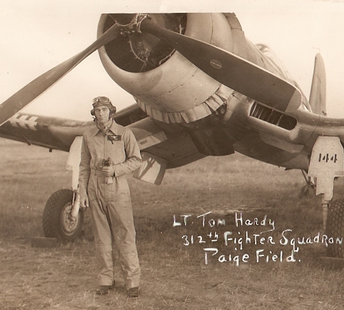 My cousin Tom Hardy died three weeks ago in Columbus, Mississippi, less than twenty miles from the plantation on which he’d been born some ninety-three years before. There are many people in a life that we would like to have known—Washington, Lincoln, Robert E. Lee; but such are the things of fancy. There are few that we would like to have known better; such are the things of regret.
I knew Tom; I would like to have known him better.
He was a man who would appear out of the sky from time to time, calling to say that he’d found himself near you. By this, I mean that when his travels in his airplane around the countryside brought him within a short drive, he would call and let us know that he had landed. A reunion would follow—perhaps a few hours—perhaps a whole day or night—but seldom was it planned. He would simply drop down out of the sky.
That was his preferred place, after all—the sky. It became so early in life, and practically by decree.
He told of a barnstormer in the 1920s whose biplane landed in a pasture outside his ancestral home. Excited, his mother—my grandmother’s sister—took him out to see the phenomenon. To Tom’s surprise, she paid the pilot’s fee and then climbed up into the cockpit. He never thought he’d see her again as the plane grew small blending into the broad, distant horizon.
Tragically, only five years later his mother left him for good, dying in childbirth. I suppose his mother must have been caught up in his thoughts whenever he found himself in a plane. The same might be said of his father, himself a pilot, killed in a crash at a young age.
But these personal tragedies never deterred Tom’s love of the sky. Later, he served in WWII’s Pacific Theatre, a marine fighter pilot who shot down three Japanese airplanes and went on a multitude of dramatic missions. He had fascinating mementos of his service, and could explain the intricacies of aerial warfare with the skill of both teacher and master.
He didn’t just visit by way of his plane though. He would take us up in it too. He even let me be the pilot one time, my attention so fixed that I lost sense of where we were. When I asked, he smiled and pointed downward, where I saw the outlines of our barn and house and my parents waving from below.
He also took me gliding, which I think must have been his true love.
Towed behind a plane by no more than a length of rope, the glider was set free high above the earth. Tom then maneuvered us among the rising thermals of air, each spiraling up beneath the clouds. All around, invisible, he explained, were these coiled currents, ascending in a quiet helix; the lovely task of the glider was to invite itself along for the trip, as though holding onto the fin of some great creature moving through a clear, silent sea.
We might have been made of paper that day, drifting down through air that held us gently, elegantly, in a courtly cascade that in time brought us back to the brown Mississippi prairie. If a man can be summed up by a motion, the motion of the glider was Tom.
But to speak of his life in the clouds is not to speak of all that he was. He was a great hunter and a charter member of the wonderful Magowah Gun Club, he loved to bike and to read, and was a boxer in his youth.
He ran the plantation his whole adult life, a mighty task—unromantic, unforgiving, unpredictable—to which any farmer can attest. And he had more to worry about than just the survival of the place his people had owned since before the Civil War. He worried about all the families that had lived there since the sharecropper days. He kept them on even when more mechanized methods of agriculture would have increased his profit; he did not want to dispossess them though, and so increased his own burden instead.
In his later years, he was also a real estate agent, flying potential farm buyers over acreage to be bought by the thousands. Later still, he would fly to Baltimore, as part of a longevity study at Johns Hopkins. There, scientists studied what it was that made him live.
As we met once at the D.C. airport, I thought I could’ve saved the doctors some trouble; their answer lay in the way that he chose to move—through the sky. For even when dying of liver cancer a few weeks back, he made the plane a portion of his departure; he flew to Starkville, Mississippi to donate his aircraft to the state university.
How much was on his mind that day as he flew? His family? His service? The home he had just left and would soon leave for good? All perhaps—but mostly, I think he just enjoyed the flight.
The instances I relate are only a handful, prompting me to reflect on how few and rare such men are: refined men, gentlemen, men who look impeccable in simple khakis and plain cotton shirts.
Men who speak in the dulcet tones and measured cadences of a people who mark each other with conversation—with question and reply—and histories relayed, weave upon weave, as the morning rises in a world to be worked in, and as the night falls, in a world made for rest.
People like Tom are disappearing, leaving into the sky. All around us they go, and I behave as though this were news—as if I had not been told it were so—had not seen it with my own eyes.
A.G. Harmon teaches Shakespeare, Law and Literature, Jurisprudence, and Writing at The Catholic University of America in Washington, D.C. His novel, A House All Stilled, won the 2001 Peter Taylor Prize for the Novel.
Previous Post

June 5, 2012
My Kite Boy
Next Post
June 8, 2012 Children Before the Ravaging
Browse Our Archives
Select a Category A. G. Harmon Alissa Wilkinson Allison Backous Art Authors Brad Fruhauff Bradford Winters Bryan Bliss Caroline Langston Chad Thomas Johnston Chris Hoke Christiana N. Peterson Culture D.G. Myers D.L. Mayfield Daniel Bowman Jr. David Griffith Elizabeth Duffy Faith Film Greg Wolfe Guest Contributor Interview Jan Vallone Jeffrey Overstreet Jessica Eddings-Roeser Jessica Mesman Griffith Kelly Foster Lindsey Crittenden Morgan Meis music Natalie Vestin Nick Olson Peggy Rosenthal Personal Reflection Poetry Friday Reflection Relationships Review Richard Chess Richard Cole Sara Zarr Shannon Huffman Polson Sonya Bilocerkowycz Tania Runyan Tony Woodlief Topical Categories Uncategorized Vic Sizemore Writing
Select a Month October 2018 September 2018 August 2018 July 2018 June 2018 May 2018 April 2018 March 2018 February 2018 January 2018 December 2017 November 2017 October 2017 September 2017 August 2017 July 2017 June 2017 May 2017 April 2017 March 2017 February 2017 January 2017 December 2016 November 2016 October 2016 September 2016 August 2016 July 2016 June 2016 May 2016 April 2016 March 2016 February 2016 January 2016 December 2015 November 2015 October 2015 September 2015 August 2015 July 2015 June 2015 May 2015 April 2015 March 2015 February 2015 January 2015 December 2014 November 2014 October 2014 September 2014 August 2014 July 2014 June 2014 May 2014 April 2014 March 2014 February 2014 January 2014 December 2013 November 2013 October 2013 September 2013 August 2013 July 2013 June 2013 May 2013 April 2013 March 2013 February 2013 January 2013 December 2012 November 2012 October 2012 September 2012 August 2012 July 2012 June 2012 May 2012 February 2008
Follow Us!
TAKE THE
Religious Wisdom Quiz
Look to the LORD and his strength; seek his face, ____________.
Select your answer to see how you score.
Eternally Always Every Time Forever
Related posts from Good Letters




Poetry Friday: A Quick Interpretation of the Sixth...
TRENDING AT PATHEOS Catholic

Rejecting Doom: Christian Hope And Human Action
Christianity is a religion of hope. We are to have hope and...

It’s What Comes From Within Which Matters
One of the most difficult things for us to understand is why...

Why I Choose the Eucharist Over the Sermon
Choose the Eucharist, Not the Sermon What are we supposed to get...

5 Design Elements Found in Spiritually Rooted Homes
Putting Spirituality Into Home Decor Our homes are more than our living...

Credo: A Story of God Told with the...
About 10 years ago, I began to imagine a personal "Credo" that...

The Anatomy of Divine Revelation in Catholic Thought
The claim that God has made Himself known to human beings is...
view all Catholic blogs
Ad-Free & Subscriber Log-In Subscription Support
- About Us
- 2026 Calendar
- Videos
- Podcasts
- Library of World Religions
- Faith In Media Tracker
- Advertise With Us
- Write for Us
- Privacy Policy
- Terms of Service
- Do Not Sell My Data
- Contact Us
- Radiant Digital
- Manage Newsletter Subscriptions
- Unsubscribe From Notifications
- Sitemap
Copyright 2008-2026, Patheos. All rights reserved.
Subscription Support Ad-Free & Subscriber Log-In
Follow Patheos