
BuddhistCatholicContemplativeEvangelicalGeneral ChristianHinduJewishLatter-day SaintMuslimNew VisionsProgressive Christian
Beliefs
- Buddhist
- Catholic
- Contemplative
- Evangelical
- General Christian
- Hindu
- Jewish
- Latter-day Saint
- More Voices
- Muslim
- New Visions
- Pagan
- Progressive Christian
Topics
- Religion News
- Food and Religion
- Sports and Religion
- Religious Art
- Religious Music and Entertainment
- Religious Events
- History and Religion
- Style and Religion
- Politics and Religion
- Women in Religion
- Recreation Outdoors and Religion
- Business Finance and Religion
- Careers Workplace and Religion
- Education and Religion
- Family Parenting and Religion
- Health Fitness and Religion
- Home and Religion
- Relationships and Religion
- Technology and Religion
- Travel and Religion
Columnists
- Buddhist Columnists
- Business Finance and Religion Columnists
- Careers Workplace and Religion Columnists
- Catholic Columnists
- Contemplative Columnists
- Education and Religion Columnists
- Evangelists Columnists
- Family Parenting and Religion Columnists
- General Christian Columnists
- Health Fitness and Religion Columnists
- Hindu Columnists
- History and Religion Columnists
- Home and Religion Columnists
- Jewish Columnists
- More Voices Columnists
- Latter Day Columnists
- Muslim Columnists
- New Visions Columnists
- Nonreligious Columnists
- Pagan Columnists
- Politics and Religion Columnists
- Progressive Columnists
- Recreation Outdoors and Religion Columnists
- Relationships and Religion Columnists
- Religion News Columnists
- Religious Art Columnists
- Religious Events Columnists
- Religious Music and Entertainment Columnists
- Sports and Religion Columnists
- Style and Religion Columnists
- Technology and Religion Columnists
- Travel and Religion Columnists
- Women in Religion Columnists
Resource Library
- 2026 Calendar
- Library of World Religions
- The 100 Most Holy Places on Earth
- Patheos Answers
- Podcasts
- Videos
- Faith Leaders Database
- Anglican Episcopalian
- Bahai
- Baptist
- Buddhism
- Christianity
- Confucianism
- Eastern Orthodoxy
- Hinduism
- Holiness and Pentecostal
- ISKCON
- Islam
- Judaism
- Lutheran
- Methodist
- The Church of Jesus Christ of Latter-day Saints
- New Age
- Paganism
- Presbytarian and Reformed
- Protestantism
- Religion Behind the Scenes
- Roman Catholic
- Scientology
- Shia Islam
- Sikhism
- Sufism
- Sunni Islam
- Taoism
- Zen
- See all religions
Research Tools
 Ad-Free & Subscriber Log-In Subscription Support
Ad-Free & Subscriber Log-In Subscription Support
Follow Patheos 

- Trending:
- Forgiveness
- |
- Marriage
- |
- Consciousness
- |
- Death Penalty
- |
- Election
- |
- Halloween
 Good Letters
-
Contributors
- Home
- Catholic
- Art at the Crossroads, Part One
Art at the Crossroads, Part One
Last updated on: June 26, 2013 at 3:15 pm by David Griffith
Art at the Crossroads, Part One 2013-06-26T15:15:19-07:00 David Griffith
Patheos Explore the world's faith through different perspectives on religion and spirituality! Patheos has the views of the prevalent religions and spiritualities of the world.
*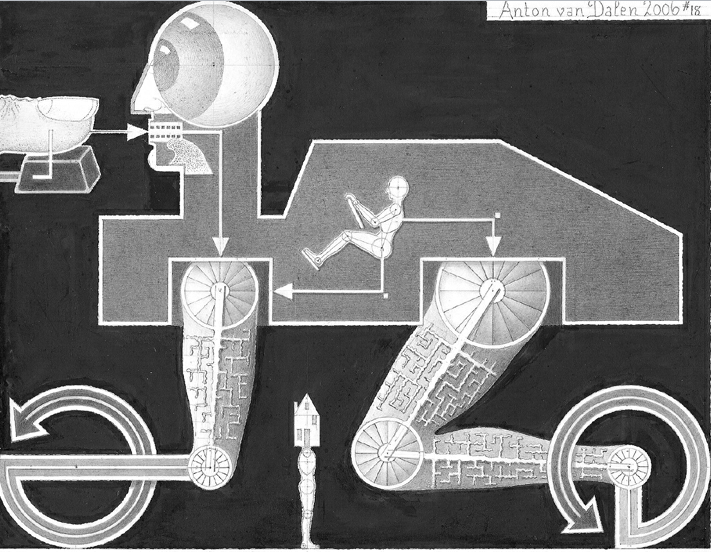 Have leisure and know that I am God. —*Psalm 65:11
For a long time now I have tried to argue that the maintenance of my various social media accounts (Facebook, Twitter, Tumblr, etc.) should be considered work. After all, maintaining a social media presence—a phrase that makes the bile rise in my throat—is an easy and free way artists can gain a wide readership/viewership for their work.
But aside from the ill feeling I get after spending a whole morning liking, sharing, blogging, and re-blogging, I also feel a strange sense of disconnectedness from the work itself—the actual art that I’m making; in my case a book manuscript of a couple hundred pages.
I think the way I feel is what Marx calls alienation and estrangement from labor. Because my job is to be the producer, the marketing department, and salesman of the work, my time and attention are constantly divided. I would even go so far as to say my very habitus seems divided by the shifting of aesthetic gears it takes in order to be able to make my work sound relevant and interesting to others.
Josef Pieper in his important work Leisure—The Basis of Culture moves past the alienation and estrangement and worries that the laborer is increasingly “fettered to one’s work,” which leads to a kind of “inner impoverishment,” a spiritual poverty.
“His life has shrunk inwardly, and contracted, with the result that he can no longer act significantly outside his work, and perhaps can no longer even conceive of such a thing.”
I know this might sound melodramatic—I mean it’s just posting to Facebook, not working in a textile factory—but anyone who makes art for a living these days finds himself at this crossroads.
Art is my livelihood, the business by which I earn money, but it is also where I draw much spiritual sustenance and promoting it on the same platform that specializes in cute pet photos and political tirades seems to cheapen it. I just can’t help it. I grew up in the late 1980s and early ‘90s when the deep-seated fear for artists was not going hungry but selling-out.
And so for years I believed that becoming an artist would magically resolve any conflict between the two, but as I’ve gotten older and taken on more financial responsibilities, the tension has increased. I now tell my wife on a regular basis: “I’m ready to sell-out.”
To reconcile this tension I feel that I have to work harder, put in longer hours. In order to make up for the time I spend updating my Tumblr or Facebook page, I have to stay longer in the office writing. Either that, or after a long day of writing—which, given the amount of administrative work I have, rarely happens—I find myself standing at the kitchen counter minutes after arriving home trying to keep up the appearance (on social media, at least) that I am an interesting and productive writer.
This drives my wife crazy. She calls it an illness. She wonders aloud when I’m going to take a break. “When is it going to be summer?” she says. My reply is always that this, too, is part of being a writer these days.
But is it necessary? Is it actually a productive use of my time? I keep thinking to myself that if I could drop the social media aspect of my job I would have more leisure time; time to chill, as I might have said in high school.
Josef Pieper theorized that it is through entering into the sphere of leisure that we can begin to see rightly. Leisure “presupposes silence, a contemplative attention to things, in which man begins to see how worthy of veneration they are.”
In his definition, leisure is not meant as a restorative so that one has more energy for work, or so that one can perform faultlessly, but so that one has the time to contemplate and, as Pieper says:
Grasp the world as a whole and realize his full potentialities as an entity meant to reach wholeness…. The power to know leisure is the power to overstep the boundaries of the workaday world and reach out to super-human life-giving existential forces that refresh and renew us before we turn back to our daily work. Only in genuine leisure does the “gate to freedom” open.
One can escape the anxiety-inducing binary of work and unemployment, where, he writes, “work and unemployment are the two inescapable poles of existence.”
As I said before, in the beginning of my career, being an artist seemed to me a way out of that binary. I believed as Pieper does that the work of artists somehow “overstep the boundaries of the workaday.”
I want to believe this. I want very badly to not feel divided, to not feel that I am constantly at this crossroads, but to do that I need to find a way to treat art making more like work and less like some sort of shamanistic calling. To think of it this way is to make it precious: a rarified act that requires incense, green tea, ambient music, and meditation, rather than the sweat equity earned by putting your butt in the chair, turning off the Wi-Fi, and not getting up until you have a draft.
—Continued on Monday
David Griffith is the author of A Good War is Hard to Find: The Art of Violence in America (Soft Skull). He teaches creative writing at Sweet Briar College in Virginia where he lives with his wife Jessica Mesman Griffith and children, Charlotte and Alexander. His essays and reviews have appeared in Image, Utne Reader, The Normal School and online atkillingthebuddha.com. He blogs at Pyramid Scheme.
Previous Post

June 21, 2012
A Living Mythology
Next Post
June 25, 2012 Art at the Crossroads, Part 2
Browse Our Archives
Select a Category A. G. Harmon Alissa Wilkinson Allison Backous Art Authors Brad Fruhauff Bradford Winters Bryan Bliss Caroline Langston Chad Thomas Johnston Chris Hoke Christiana N. Peterson Culture D.G. Myers D.L. Mayfield Daniel Bowman Jr. David Griffith Elizabeth Duffy Faith Film Greg Wolfe Guest Contributor Interview Jan Vallone Jeffrey Overstreet Jessica Eddings-Roeser Jessica Mesman Griffith Kelly Foster Lindsey Crittenden Morgan Meis music Natalie Vestin Nick Olson Peggy Rosenthal Personal Reflection Poetry Friday Reflection Relationships Review Richard Chess Richard Cole Sara Zarr Shannon Huffman Polson Sonya Bilocerkowycz Tania Runyan Tony Woodlief Topical Categories Uncategorized Vic Sizemore Writing
Select a Month October 2018 September 2018 August 2018 July 2018 June 2018 May 2018 April 2018 March 2018 February 2018 January 2018 December 2017 November 2017 October 2017 September 2017 August 2017 July 2017 June 2017 May 2017 April 2017 March 2017 February 2017 January 2017 December 2016 November 2016 October 2016 September 2016 August 2016 July 2016 June 2016 May 2016 April 2016 March 2016 February 2016 January 2016 December 2015 November 2015 October 2015 September 2015 August 2015 July 2015 June 2015 May 2015 April 2015 March 2015 February 2015 January 2015 December 2014 November 2014 October 2014 September 2014 August 2014 July 2014 June 2014 May 2014 April 2014 March 2014 February 2014 January 2014 December 2013 November 2013 October 2013 September 2013 August 2013 July 2013 June 2013 May 2013 April 2013 March 2013 February 2013 January 2013 December 2012 November 2012 October 2012 September 2012 August 2012 July 2012 June 2012 May 2012 February 2008
Follow Us!
TAKE THE
Religious Wisdom Quiz
Who built an ark to survive a great flood?
Select your answer to see how you score.
Moses David Noah Abraham
Related posts from Good Letters
Poetry Friday: "Manifest, by Reason of Birth"

The Marvelous Mrs. Maisel's Hidden Identity

From Sophocles to Twin Peaks: What Killed Laura...
TRENDING AT PATHEOS Catholic

Rejecting Doom: Christian Hope And Human Action
Christianity is a religion of hope. We are to have hope and...

It’s What Comes From Within Which Matters
One of the most difficult things for us to understand is why...

Why I Choose the Eucharist Over the Sermon
Choose the Eucharist, Not the Sermon What are we supposed to get...

5 Design Elements Found in Spiritually Rooted Homes
Putting Spirituality Into Home Decor Our homes are more than our living...

Credo: A Story of God Told with the...
About 10 years ago, I began to imagine a personal "Credo" that...

The Anatomy of Divine Revelation in Catholic Thought
The claim that God has made Himself known to human beings is...
view all Catholic blogs
Ad-Free & Subscriber Log-In Subscription Support
- About Us
- 2026 Calendar
- Videos
- Podcasts
- Library of World Religions
- Faith In Media Tracker
- Advertise With Us
- Write for Us
- Privacy Policy
- Terms of Service
- Do Not Sell My Data
- Contact Us
- Radiant Digital
- Manage Newsletter Subscriptions
- Unsubscribe From Notifications
- Sitemap
Copyright 2008-2026, Patheos. All rights reserved.
Subscription Support Ad-Free & Subscriber Log-In
Follow Patheos