
BuddhistCatholicContemplativeEvangelicalGeneral ChristianHinduJewishLatter-day SaintMuslimNew VisionsProgressive Christian
Beliefs
- Buddhist
- Catholic
- Contemplative
- Evangelical
- General Christian
- Hindu
- Jewish
- Latter-day Saint
- More Voices
- Muslim
- New Visions
- Pagan
- Progressive Christian
Topics
- Religion News
- Food and Religion
- Sports and Religion
- Religious Art
- Religious Music and Entertainment
- Religious Events
- History and Religion
- Style and Religion
- Politics and Religion
- Women in Religion
- Recreation Outdoors and Religion
- Business Finance and Religion
- Careers Workplace and Religion
- Education and Religion
- Family Parenting and Religion
- Health Fitness and Religion
- Home and Religion
- Relationships and Religion
- Technology and Religion
- Travel and Religion
Columnists
- Buddhist Columnists
- Business Finance and Religion Columnists
- Careers Workplace and Religion Columnists
- Catholic Columnists
- Contemplative Columnists
- Education and Religion Columnists
- Evangelists Columnists
- Family Parenting and Religion Columnists
- General Christian Columnists
- Health Fitness and Religion Columnists
- Hindu Columnists
- History and Religion Columnists
- Home and Religion Columnists
- Jewish Columnists
- More Voices Columnists
- Latter Day Columnists
- Muslim Columnists
- New Visions Columnists
- Nonreligious Columnists
- Pagan Columnists
- Politics and Religion Columnists
- Progressive Columnists
- Recreation Outdoors and Religion Columnists
- Relationships and Religion Columnists
- Religion News Columnists
- Religious Art Columnists
- Religious Events Columnists
- Religious Music and Entertainment Columnists
- Sports and Religion Columnists
- Style and Religion Columnists
- Technology and Religion Columnists
- Travel and Religion Columnists
- Women in Religion Columnists
Resource Library
- 2026 Calendar
- Library of World Religions
- The 100 Most Holy Places on Earth
- Patheos Answers
- Podcasts
- Videos
- Faith Leaders Database
- Anglican Episcopalian
- Bahai
- Baptist
- Buddhism
- Christianity
- Confucianism
- Eastern Orthodoxy
- Hinduism
- Holiness and Pentecostal
- ISKCON
- Islam
- Judaism
- Lutheran
- Methodist
- The Church of Jesus Christ of Latter-day Saints
- New Age
- Paganism
- Presbytarian and Reformed
- Protestantism
- Religion Behind the Scenes
- Roman Catholic
- Scientology
- Shia Islam
- Sikhism
- Sufism
- Sunni Islam
- Taoism
- Zen
- See all religions
Research Tools
 Ad-Free & Subscriber Log-In Subscription Support
Ad-Free & Subscriber Log-In Subscription Support
Follow Patheos 

- Trending:
- Forgiveness
- |
- Marriage
- |
- Consciousness
- |
- Death Penalty
- |
- Election
- |
- Halloween
 Good Letters
-
Contributors
- Home
- Catholic
- Art at the Crossroads, Part 2
Art at the Crossroads, Part 2
Last updated on: June 26, 2013 at 3:21 pm by David Griffith
Art at the Crossroads, Part 2 2013-06-26T15:21:03-07:00 David Griffith
Patheos Explore the world's faith through different perspectives on religion and spirituality! Patheos has the views of the prevalent religions and spiritualities of the world.
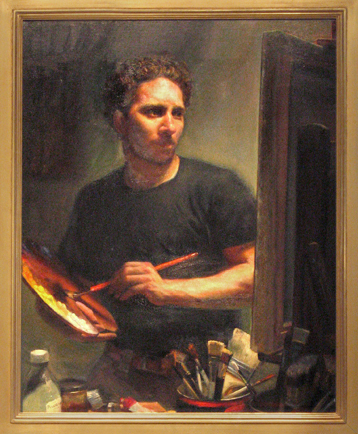 Continued from Friday
In order to start treating being an artist more like a job and less like some precious ritual, an alternative lifestyle that non-artists don’t understand, I have done a lot of reading about how people throughout history have defined art and artists.
For hundreds of years, there has been contentious discussion about who can be called an artist. For example, for many years potters, weavers, carpenters, and sculptors of religious or ritual statuary were not considered artists because what they made was useful: if I can drink out of it, carry things in it, or wield it in some way, then it is not art but a tool.
On the other hand, the term artist has always been connected to the magical—the creation of something from within, like a poem or a melody, or the transformation of one substance to another more valuable one (alchemists were known as artists). Based on this definition, up until the Renaissance, painting was not recognized as one of the arts because it was seen as merely decorative—used to adorn and gild, rather than as a medium for the creation of something new.
Leonardo da Vinci took great offense at this, and tried to make his case by attacking poetry as an inferior art because it merely appealed to the ear, whereas the painting appealed to the eye “by true likeness.”
“Take a poet who describes the beauty of a lady to her lover and a painter who paints a picture of her, and you will see to which nature will turn the young lover.”
However, in making an argument for painting as an art, and the highest one at that, his description of the painter at work introduced representations that have shaped the way the public has viewed the labor of the artist ever since.
Da Vinci writes that the painter sits “at great ease” before his work wielding an instrument much lighter than the hammer and chisel of the sculptor. Furthermore, unlike the poet or sculptor, the painter works with “attractive colors” and because he need not worry about getting dusty and dirty, he is free to be “adorned with such garments as he pleases,” and, “his dwelling is full of fine paintings and is clean and often filled with music or the sound of different beautiful works being read, which are often heard with great pleasure, unmixed with the pounding of hammers.”
Given the connection between work, virtue, and moral uprightness in the Protestant work ethic we can begin to see why it may have taken so long for art-making to be considered work.
By comparison, the artist’s labor is seen as lacking rigor and too oriented toward pleasure to be spiritually sustaining. It is also interesting to note how the description, written sometime in the mid-sixteenth century, captures the salon culture that would typify bohemias in Europe and the United States over three hundred years later.
By the time Jacques Maritain was writing the essays in Art and Scholasticism—one of the most influential works of modern theology on art-making—only one hundred years had passed since Paris’ bohemian heyday. For Maritain, whose wife was a poet and whose friends included Marc Chagall, Georges Rouault, Georges Bernanos, and Jean Cocteau, there was little debate that the artist should be considered a worker—or, rather, should consider himself a worker.
Maritain believes that the artist is chiefly concerned with making, not knowing; that too much self-consciousness can kill the art. He worries: “the artist if he is not to shatter his art or his soul, must simply be as an artist what art wants him to be—a good workman.” By saying that this is what art wants, he is locating the good of art outside of the artist, a movement away from seeing art as being expressed through individual wills and selves, a move which represents a turning away from the caricaturized bohemian ideal of the artist as Byronic hero whose personal style and predilections are just as integral to his art as his method.
As a Frenchman born in the late nineteenth century, Maritain was no doubt aware of la vie boheme and its vagaries, especially what Jerrold Seigel describes as the “cult of self” that emerged, which called for salvation through descent into the libertine lifestyle epitomized by the likes of Rimbaud and Baudelaire. Maritain laments:
The modern world, which has promised the artists everything, soon will scarcely leave him even the bare means of subsistence. Founded on the two unnatural principles of the fecundity of money and the finality of useful, multiplying needs and servitude without the possibility of there ever being a limit, destroying the leisure of the soul . . . imposing on man the panting of the machine and the accelerated movement of matter . . . is imprinting on human activity a truly inhuman mode and a diabolical direction, for the final end of all this frenzy is to prevent man from resembling God.
Upon re-reading this passage from Maritain, I’m ashamed to say I skipped over all of the meaty parts about the unnatural principles of capitalism. I completely forgot about my earnest mission to treat my art as work, because I couldn’t get the image out of my head of God checking his Facebook page.
I imagined—and here I will reveal just how deep and complete my addiction to social media is, how deluded it has made me—God irritated by how many of his friends were posting pictures of the organic meals they had prepared, the messy state of their writing desks, or the cute poses their pets fell asleep in, and then finally coming upon something I posted—a quote from Flannery O’Connor or a link to a blog post I had written—and thinking, “Now this is why I still use Facebook.”
David Griffith is the author of A Good War is Hard to Find: The Art of Violence in America (Soft Skull). He teaches creative writing at Sweet Briar College in Virginia where he lives with his wife Jessica Mesman Griffith and children, Charlotte and Alexander. His essays and reviews have appeared in Image, Utne Reader, The Normal School and online atkillingthebuddha.com. He blogs at Pyramid Scheme.
Previous Post

June 22, 2012
Art at the Crossroads, Part One
Next Post
June 26, 2012 Why All This Music?
Browse Our Archives
Select a Category A. G. Harmon Alissa Wilkinson Allison Backous Art Authors Brad Fruhauff Bradford Winters Bryan Bliss Caroline Langston Chad Thomas Johnston Chris Hoke Christiana N. Peterson Culture D.G. Myers D.L. Mayfield Daniel Bowman Jr. David Griffith Elizabeth Duffy Faith Film Greg Wolfe Guest Contributor Interview Jan Vallone Jeffrey Overstreet Jessica Eddings-Roeser Jessica Mesman Griffith Kelly Foster Lindsey Crittenden Morgan Meis music Natalie Vestin Nick Olson Peggy Rosenthal Personal Reflection Poetry Friday Reflection Relationships Review Richard Chess Richard Cole Sara Zarr Shannon Huffman Polson Sonya Bilocerkowycz Tania Runyan Tony Woodlief Topical Categories Uncategorized Vic Sizemore Writing
Select a Month October 2018 September 2018 August 2018 July 2018 June 2018 May 2018 April 2018 March 2018 February 2018 January 2018 December 2017 November 2017 October 2017 September 2017 August 2017 July 2017 June 2017 May 2017 April 2017 March 2017 February 2017 January 2017 December 2016 November 2016 October 2016 September 2016 August 2016 July 2016 June 2016 May 2016 April 2016 March 2016 February 2016 January 2016 December 2015 November 2015 October 2015 September 2015 August 2015 July 2015 June 2015 May 2015 April 2015 March 2015 February 2015 January 2015 December 2014 November 2014 October 2014 September 2014 August 2014 July 2014 June 2014 May 2014 April 2014 March 2014 February 2014 January 2014 December 2013 November 2013 October 2013 September 2013 August 2013 July 2013 June 2013 May 2013 April 2013 March 2013 February 2013 January 2013 December 2012 November 2012 October 2012 September 2012 August 2012 July 2012 June 2012 May 2012 February 2008
Follow Us!
TAKE THE
Religious Wisdom Quiz
What Christian group requires its members to serve as missionaries?
Select your answer to see how you score.
Anglicans Latter-day Saints Baptists Jehovah’s Witnesses
Related posts from Good Letters


Poetry Friday: "Manifest, by Reason of Birth"

The Marvelous Mrs. Maisel's Hidden Identity
Poetry Friday: “The Name of God”
TRENDING AT PATHEOS Catholic

Rejecting Doom: Christian Hope And Human Action
Christianity is a religion of hope. We are to have hope and...

It’s What Comes From Within Which Matters
One of the most difficult things for us to understand is why...

Why I Choose the Eucharist Over the Sermon
Choose the Eucharist, Not the Sermon What are we supposed to get...

5 Design Elements Found in Spiritually Rooted Homes
Putting Spirituality Into Home Decor Our homes are more than our living...

Credo: A Story of God Told with the...
About 10 years ago, I began to imagine a personal "Credo" that...

The Anatomy of Divine Revelation in Catholic Thought
The claim that God has made Himself known to human beings is...
view all Catholic blogs
Ad-Free & Subscriber Log-In Subscription Support
- About Us
- 2026 Calendar
- Videos
- Podcasts
- Library of World Religions
- Faith In Media Tracker
- Advertise With Us
- Write for Us
- Privacy Policy
- Terms of Service
- Do Not Sell My Data
- Contact Us
- Radiant Digital
- Manage Newsletter Subscriptions
- Unsubscribe From Notifications
- Sitemap
Copyright 2008-2026, Patheos. All rights reserved.
Subscription Support Ad-Free & Subscriber Log-In
Follow Patheos