
BuddhistCatholicContemplativeEvangelicalGeneral ChristianHinduJewishLatter-day SaintMuslimNew VisionsProgressive Christian
Beliefs
- Buddhist
- Catholic
- Contemplative
- Evangelical
- General Christian
- Hindu
- Jewish
- Latter-day Saint
- More Voices
- Muslim
- New Visions
- Pagan
- Progressive Christian
Topics
- Religion News
- Food and Religion
- Sports and Religion
- Religious Art
- Religious Music and Entertainment
- Religious Events
- History and Religion
- Style and Religion
- Politics and Religion
- Women in Religion
- Recreation Outdoors and Religion
- Business Finance and Religion
- Careers Workplace and Religion
- Education and Religion
- Family Parenting and Religion
- Health Fitness and Religion
- Home and Religion
- Relationships and Religion
- Technology and Religion
- Travel and Religion
Columnists
- Buddhist Columnists
- Business Finance and Religion Columnists
- Careers Workplace and Religion Columnists
- Catholic Columnists
- Contemplative Columnists
- Education and Religion Columnists
- Evangelists Columnists
- Family Parenting and Religion Columnists
- General Christian Columnists
- Health Fitness and Religion Columnists
- Hindu Columnists
- History and Religion Columnists
- Home and Religion Columnists
- Jewish Columnists
- More Voices Columnists
- Latter Day Columnists
- Muslim Columnists
- New Visions Columnists
- Nonreligious Columnists
- Pagan Columnists
- Politics and Religion Columnists
- Progressive Columnists
- Recreation Outdoors and Religion Columnists
- Relationships and Religion Columnists
- Religion News Columnists
- Religious Art Columnists
- Religious Events Columnists
- Religious Music and Entertainment Columnists
- Sports and Religion Columnists
- Style and Religion Columnists
- Technology and Religion Columnists
- Travel and Religion Columnists
- Women in Religion Columnists
Resource Library
- 2026 Calendar
- Library of World Religions
- The 100 Most Holy Places on Earth
- Patheos Answers
- Podcasts
- Videos
- Faith Leaders Database
- Anglican Episcopalian
- Bahai
- Baptist
- Buddhism
- Christianity
- Confucianism
- Eastern Orthodoxy
- Hinduism
- Holiness and Pentecostal
- ISKCON
- Islam
- Judaism
- Lutheran
- Methodist
- The Church of Jesus Christ of Latter-day Saints
- New Age
- Paganism
- Presbytarian and Reformed
- Protestantism
- Religion Behind the Scenes
- Roman Catholic
- Scientology
- Shia Islam
- Sikhism
- Sufism
- Sunni Islam
- Taoism
- Zen
- See all religions
Research Tools
 Ad-Free & Subscriber Log-In Subscription Support
Ad-Free & Subscriber Log-In Subscription Support
Follow Patheos 

- Trending:
- Forgiveness
- |
- Marriage
- |
- Consciousness
- |
- Death Penalty
- |
- Election
- |
- Halloween
 Good Letters
-
Contributors
- Home
- Catholic
- A Living Mythology
A Living Mythology
Last updated on: June 26, 2013 at 3:10 pm by Kelly Foster
A Living Mythology 2013-06-26T15:10:29-07:00 Kelly Foster
Patheos Explore the world's faith through different perspectives on religion and spirituality! Patheos has the views of the prevalent religions and spiritualities of the world.
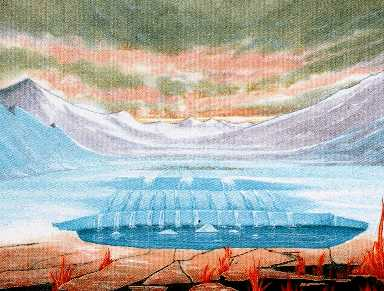 In the beginning was Ginnungagap.
So begins one of Snorri Sturluson’s Norse creation stories from the Elder Edda.
In the beginning was Ginnungagap, the great void. Then Niflheim, the primordial land of ice, and Muspelheim, the primordial land of fire, collided. Thus the world began.
It’s one of my students’ favorite stories, and as I approach marriage to a midwestern farm-boy of hardworking Scandinavian origin, it’s how this Mississippi girl with whimsical Hibernian origins tends on occasion to think of her relationship—a collision of the hard land of ice and the roiling land of fire.
When I teach my students creation mythology, we begin by asking what the physical elements from which the world gets made are and what that says about the landscape and the culture from which the stories sprung.
In the Babylonian creation story, humans are made from the blood and tears of a slaughtered god. What might that say about the Babylonian landscape and culture?
What does the Scandinavian landscape consist of? Volcanoes and glaciers. So it makes sense that the primordial elements requiring explanation would be fire and ice.
Now, it’s a convenient and a vastly over-simplified metaphor (as so many are), but I do often think that those two images have something to say about my relationship with my soon to be husband—the fire of the south meeting the ice of the north.
When he played hockey in high school, Ben’s team used to listen to Led Zeppelin’s “Immigrant Song” to get them psyched. The song opens with the lines, “We come from the land of ice and snow / from the midnight sun where the hot springs blow.” I love that image of the teenage boy I would only get to know as an adult being so excited to skate in the frozen landscape. When Ben is on the ice or even around it, he looks like a fish restored, after a too long absence, to the saving vitality of water.
And to provide an easy analogy for fire, if you want to know how bad hell will feel, visit us in Mississippi come August. You’ll be born again before your feet leave the jet bridge. I saw a T-shirt once (produced by a company in Minneapolis) that read: “Hell: it’s not the heat. It’s the humidity.” As a lifelong Mississippian, I can vouch for that.
One of the many differences between us is that the most brutal features of Ben’s native landscape are vivifying to him and the most brutal features of mine are depleting.
The heat makes for languid dreamy folk, the kind who like to sit around and talk and laugh and drink cool drinks that make them forget how miserable they feel, and who like to tell off-color stories and wear brightly colored clothes and whose personalities often match the color of their clothes.
Now these are stereotypes, it’s certain. But if you’ve spent any time at all in Mississippi and paid any kind of attention, you know they’re not far from the mark. I know about six old ladies in my hometown who make Steel Magnolias look like a minimalist study in understatement.
Likewise, Garrison Keillor wasn’t making up those Lake Wobegon types up in Minnesota. There’s an earnestness and a seriousness, perhaps even at times a sternness, about daily interactions I’ve witnessed among my friends up north. People don’t take themselves that seriously in the Mississippi Delta where I grew up.
Of the two of us, the one more given to Bergmanesque brooding and periods of internal contemplation is Ben, and the one given to telling raucous off-color stories sitting on the porch with an invigorating mixer is me. The equivalency principle of synecdoche would lead me to believe that my brooding earnest Swede must somehow easily represent the whole of his people, right? Well, perhaps not.
But these contrasts, through the repetition of future days and years, have the potential to cease to be charming and to become, if not processed and filtered through grace and love, downright explosive.
I am not a terribly earnest soul. I can be ironic, even sarcastic, and there are times when nothing is funnier to me than a shared sense of human misery and failings. In fact, I can be a little mean. I am not intentional or particularly disciplined. I enjoy wasting time.
In short, I have very little to recommend me for midwestern farm life, as I have known it, besides the fact that I love the place and the people and I think one day, not too far down the road, I could be very happy there if they will have me.
Every couple has those characteristics that are complementary (read: very different). For Ben and me, it’s his continual delight in motion—of making things from scratch, of carving, of crafting, of going outdoors, of running, of climbing, of skating—contrasted with my continual delight in laughing at myself and at the people I love, at sitting too long watching other people’s stories unfold or discussing other people’s stories, of relaxing longer than I have any right to, of watching television chefs make recipes I’ve already seen them make before.
In short, we are great for each other. He gets me outside, into the dirt, onto the ice, and I love him for it. I listen to him and talk to him for hours and slow him down and help him laugh a little, occasionally at himself, and I’m led to believe he appreciates it.
So in the ancient beginning was Ginnungagap, the great void. And then the lands of fire and ice collided. And so a world was made.
What we will make of this new world remains to be seen.
Kelly Foster is a native Southerner, and graduate of SPU’s MFA in Creative Writing program. She has taught writing and literature courses across the country. Her creative nonfiction manuscript is titled Boystown Blues.
Previous Post

June 20, 2012
To See Her More Clearly
Next Post
June 22, 2012 Art at the Crossroads, Part One
Browse Our Archives
Select a Category A. G. Harmon Alissa Wilkinson Allison Backous Art Authors Brad Fruhauff Bradford Winters Bryan Bliss Caroline Langston Chad Thomas Johnston Chris Hoke Christiana N. Peterson Culture D.G. Myers D.L. Mayfield Daniel Bowman Jr. David Griffith Elizabeth Duffy Faith Film Greg Wolfe Guest Contributor Interview Jan Vallone Jeffrey Overstreet Jessica Eddings-Roeser Jessica Mesman Griffith Kelly Foster Lindsey Crittenden Morgan Meis music Natalie Vestin Nick Olson Peggy Rosenthal Personal Reflection Poetry Friday Reflection Relationships Review Richard Chess Richard Cole Sara Zarr Shannon Huffman Polson Sonya Bilocerkowycz Tania Runyan Tony Woodlief Topical Categories Uncategorized Vic Sizemore Writing
Select a Month October 2018 September 2018 August 2018 July 2018 June 2018 May 2018 April 2018 March 2018 February 2018 January 2018 December 2017 November 2017 October 2017 September 2017 August 2017 July 2017 June 2017 May 2017 April 2017 March 2017 February 2017 January 2017 December 2016 November 2016 October 2016 September 2016 August 2016 July 2016 June 2016 May 2016 April 2016 March 2016 February 2016 January 2016 December 2015 November 2015 October 2015 September 2015 August 2015 July 2015 June 2015 May 2015 April 2015 March 2015 February 2015 January 2015 December 2014 November 2014 October 2014 September 2014 August 2014 July 2014 June 2014 May 2014 April 2014 March 2014 February 2014 January 2014 December 2013 November 2013 October 2013 September 2013 August 2013 July 2013 June 2013 May 2013 April 2013 March 2013 February 2013 January 2013 December 2012 November 2012 October 2012 September 2012 August 2012 July 2012 June 2012 May 2012 February 2008
Follow Us!
TAKE THE
Religious Wisdom Quiz
What did the angel tell the shepherds?
Select your answer to see how you score.
How to Recognize the Newborn Savior To Not Be Afraid All of These Things The Location of the Newborn Savior
Related posts from Good Letters




TRENDING AT PATHEOS Catholic

Rejecting Doom: Christian Hope And Human Action
Christianity is a religion of hope. We are to have hope and...

It’s What Comes From Within Which Matters
One of the most difficult things for us to understand is why...

Why I Choose the Eucharist Over the Sermon
Choose the Eucharist, Not the Sermon What are we supposed to get...

5 Design Elements Found in Spiritually Rooted Homes
Putting Spirituality Into Home Decor Our homes are more than our living...

Credo: A Story of God Told with the...
About 10 years ago, I began to imagine a personal "Credo" that...

The Anatomy of Divine Revelation in Catholic Thought
The claim that God has made Himself known to human beings is...
view all Catholic blogs
Ad-Free & Subscriber Log-In Subscription Support
- About Us
- 2026 Calendar
- Videos
- Podcasts
- Library of World Religions
- Faith In Media Tracker
- Advertise With Us
- Write for Us
- Privacy Policy
- Terms of Service
- Do Not Sell My Data
- Contact Us
- Radiant Digital
- Manage Newsletter Subscriptions
- Unsubscribe From Notifications
- Sitemap
Copyright 2008-2026, Patheos. All rights reserved.
Subscription Support Ad-Free & Subscriber Log-In
Follow Patheos