
BuddhistCatholicContemplativeEvangelicalGeneral ChristianHinduJewishLatter-day SaintMuslimNew VisionsProgressive Christian
Beliefs
- Buddhist
- Catholic
- Contemplative
- Evangelical
- General Christian
- Hindu
- Jewish
- Latter-day Saint
- More Voices
- Muslim
- New Visions
- Pagan
- Progressive Christian
Topics
- Religion News
- Food and Religion
- Sports and Religion
- Religious Art
- Religious Music and Entertainment
- Religious Events
- History and Religion
- Style and Religion
- Politics and Religion
- Women in Religion
- Recreation Outdoors and Religion
- Business Finance and Religion
- Careers Workplace and Religion
- Education and Religion
- Family Parenting and Religion
- Health Fitness and Religion
- Home and Religion
- Relationships and Religion
- Technology and Religion
- Travel and Religion
Columnists
- Buddhist Columnists
- Business Finance and Religion Columnists
- Careers Workplace and Religion Columnists
- Catholic Columnists
- Contemplative Columnists
- Education and Religion Columnists
- Evangelists Columnists
- Family Parenting and Religion Columnists
- General Christian Columnists
- Health Fitness and Religion Columnists
- Hindu Columnists
- History and Religion Columnists
- Home and Religion Columnists
- Jewish Columnists
- More Voices Columnists
- Latter Day Columnists
- Muslim Columnists
- New Visions Columnists
- Nonreligious Columnists
- Pagan Columnists
- Politics and Religion Columnists
- Progressive Columnists
- Recreation Outdoors and Religion Columnists
- Relationships and Religion Columnists
- Religion News Columnists
- Religious Art Columnists
- Religious Events Columnists
- Religious Music and Entertainment Columnists
- Sports and Religion Columnists
- Style and Religion Columnists
- Technology and Religion Columnists
- Travel and Religion Columnists
- Women in Religion Columnists
Resource Library
- 2026 Calendar
- Library of World Religions
- The 100 Most Holy Places on Earth
- Patheos Answers
- Podcasts
- Videos
- Faith Leaders Database
- Anglican Episcopalian
- Bahai
- Baptist
- Buddhism
- Christianity
- Confucianism
- Eastern Orthodoxy
- Hinduism
- Holiness and Pentecostal
- ISKCON
- Islam
- Judaism
- Lutheran
- Methodist
- The Church of Jesus Christ of Latter-day Saints
- New Age
- Paganism
- Presbytarian and Reformed
- Protestantism
- Religion Behind the Scenes
- Roman Catholic
- Scientology
- Shia Islam
- Sikhism
- Sufism
- Sunni Islam
- Taoism
- Zen
- See all religions
Research Tools
 Ad-Free & Subscriber Log-In Subscription Support
Ad-Free & Subscriber Log-In Subscription Support
Follow Patheos 

- Trending:
- Forgiveness
- |
- Marriage
- |
- Consciousness
- |
- Death Penalty
- |
- Election
- |
- Halloween
 Good and Truth
- Home
- Progressive Christian
- No, God didn’t tell you that your girlfriend should marry you
No, God didn’t tell you that your girlfriend should marry you
Last updated on: September 27, 2017 at 3:13 pm by Coleman Glenn
No, God didn’t tell you that your girlfriend should marry you 2017-09-27T15:13:21-07:00 Coleman Glenn
Patheos Explore the world's faith through different perspectives on religion and spirituality! Patheos has the views of the prevalent religions and spiritualities of the world.
This week in my “Introduction to New Church Theology” class we’re talking about freedom. One of the foundational principles in New Church theology is that “the Lord guards freedom in man as man guards the pupil of his eye” (Divine Providence §97). Because of this, most New Church people (myself included) are extremely wary of anyone saying, “God told me to do it.” I believe that God inspires, chastises, leads, nudges and calls people; but if someone hears a voice telling them what to do, and ESPECIALLY a voice telling them what someone else should do – I tend to think that’s probably not God.
This is expressed pretty plainly in Divine Providence §321:
[People who await influx] do not receive any, except for a few who long for it from the heart. These sometimes receive some response through a consciously experienced perception in thought, or through a tacit verbal communication in the influx, and rarely by an evident one; and the response then is for them to think and act as they will and are able, that someone who acts wisely is wise, and that someone who acts foolishly is foolish; and they are never told what to believe or what to do. They are not told in order to keep their human rationality and freedom from perishing, which is to say, to keep each of them acting in freedom in accordance with their reason, to all appearance as though they did so of themselves.
People who are told by influx what to believe or what to do are not being instructed by the Lord, nor by any angel in heaven, but by some … spirit, by whom they are led astray.
All influx from the Lord takes place in an enlightenment of the intellect, and through an affection for truth, and flows through the latter into the former.
With all that in mind, I’ve sometimes wondered about the kind of influx and inner dictate that the apostles experienced – the voice of the Holy Spirit that in some senses seems pretty close to that direct instruction about what to do, e.g. in Acts 13:2:
As they ministered to the Lord and fasted, the Holy Spirit said, “Now separate to Me Barnabas and Saul for the work to which I have called them.”
Part of the answer, I think, is that God speaks to the church differently today than He did to the early apostles (for reasons I don’t have space to go into here). Even within the context of the New Testament church, though, I think there are indications that the dictate of the Spirit was not as cut-and-dried as it sometimes seems.
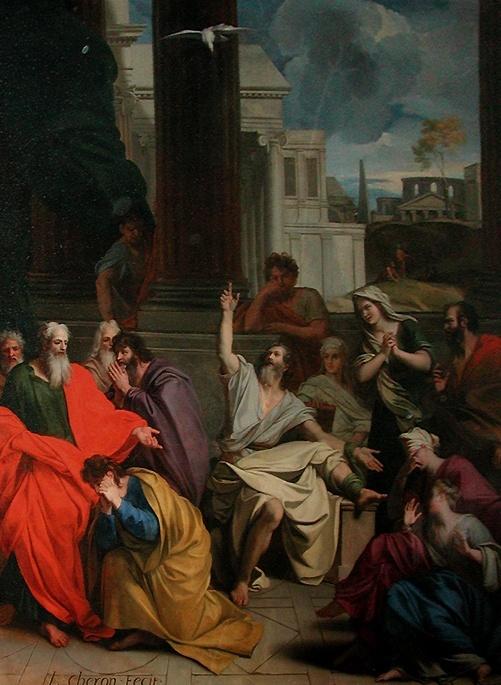
The most notable of these is described in Acts 21. Paul has set his sights on Jerusalem, with the conviction that God’s will is for him to go there. But he is told by several others from the Spirit that he should not do so. He does it anyway, apparently without going against God’s will:
(3) When we had sighted Cyprus, we passed it on the left, sailed to Syria, and landed at Tyre; for there the ship was to unload her cargo. (4) And finding disciples, we stayed there seven days. They told Paul through the Spirit not to go up to Jerusalem. …On the next day we who were Paul’s companions departed and came to Caesarea, and entered the house of Philip the evangelist, who was one of the seven, and stayed with him….. (10) And as we stayed many days, a certain prophet named Agabus came down from Judea. (11) When he had come to us, he took Paul’s belt, bound his own hands and feet, and said, “Thus says the Holy Spirit, ‘So shall the Jews at Jerusalem bind the man who owns this belt, and deliver him into the hands of the Gentiles.’ ” (12) Now when we heard these things, both we and those from that place pleaded with him not to go up to Jerusalem. (13) Then Paul answered, “What do you mean by weeping and breaking my heart? For I am ready not only to be bound, but also to die at Jerusalem for the name of the Lord Jesus.” (14) So when he would not be persuaded, we ceased, saying, “The will of the Lord be done.” (15) And after those days we packed and went up to Jerusalem. (Acts 21:3-15)
What’s going on here? Was the voice of the Spirit to the disciples in verse 4 mistaken? I don’t think so – I think the disciples really did have a sense from the Spirit that Paul should not go to Jerusalem, and the prophet Agabus really did have some perception of what might happen to him there. But Paul himself, it seems, had yet another sense of his mission – which included his persecution and death, but which did not forbid him from going to Jerusalem. It’s not that the Spirit was wrong – but the Spirit spoke in such a way that the message could be understood differently by different recipients, and the voice of the Spirit to one group was not binding on someone else.
I think it’s the same today. The Lord will still inspire, call, and guide people to do certain things. He does so in general ways through His Word, and in specific ways by each individual’s perception as they try to live by the Word. But He does not give dictates in such a way that a person is left without any freedom to interpret or understand the call in their own way. We need to be humble about our own perception of what we’re being called to. And if we think we know exactly what God wants someone else to do – we are almost certainly wrong.
(Image is The Prophecy of Agabus by Louis Cheron. Scripture taken from the New King James Version®. Copyright © 1982 by Thomas Nelson. Used by permission. All rights reserved.)
Previous Post

September 3, 2017
You can’t invite anyone in if you don’t have walls and doorways

Browse Our Archives
Select a Category Art Books Culture Humor Miscellany Morality Movies Music Personal Politics Religion Science Sermons The Best Things Theatre Uncategorized
Select a Month April 2019 October 2018 September 2018 July 2018 May 2018 April 2018 February 2018 January 2018 December 2017 November 2017 October 2017 September 2017 August 2017 July 2017 June 2017 May 2017 April 2017 March 2017 February 2017 January 2017 November 2016 July 2016 May 2016 April 2016 March 2016 September 2015 June 2015 May 2015 April 2015 March 2015 November 2014 October 2014 June 2014 May 2014 April 2014 March 2014 February 2014 November 2013 October 2013 September 2013 August 2013 June 2013 May 2013 April 2013 March 2013 October 2012 September 2012 July 2012 June 2012 May 2012 April 2012 March 2012 February 2012 January 2012 December 2011 November 2011 October 2011 September 2011 August 2011 July 2011 May 2011 April 2011 March 2011 February 2011 January 2011 December 2010 November 2010 September 2010 August 2010 July 2010 June 2010 May 2010 April 2010 January 2010
Follow Us!
TAKE THE
Religious Wisdom Quiz
What city did David capture and make his capital?
Select your answer to see how you score.
Gibeon Hebron Bethlehem Jerusalem
Related posts from Good and Truth


Four Ways of Looking at a Mirror

What Type of Christian Are You?

TRENDING AT PATHEOS Progressive Christian

Why Christians Have a Sacred Duty to Vote:...
The Bible offers strong support for the sacred duty to vote. Here...

What Being a Modern-Day Apostle Means to Me
In my last column, I discussed the ins and outs of modern-day...

Did Ancient China Once Worship the God of...
Across human history, a common thread weaves through the origins of the...

Love Your Neighbor – Including Earth-Kin: Lev. 19,...
God’s command to love your neighbor means acting in an ethical and...

Lead a Church Study of “Jesus and Lao...
Guest writer Jack Thomas (The Irreverent Reverend) reflects on leading his church...

Principles for Understanding the Apostolic Ministry Today
Whenever people discover that my formal ministry title is "apostle," as in...
view all Progressive Christian blogs
Ad-Free & Subscriber Log-In Subscription Support
- About Us
- 2026 Calendar
- Videos
- Podcasts
- Library of World Religions
- Faith In Media Tracker
- Advertise With Us
- Write for Us
- Privacy Policy
- Terms of Service
- Do Not Sell My Data
- Contact Us
- Radiant Digital
- Manage Newsletter Subscriptions
- Unsubscribe From Notifications
- Sitemap
Copyright 2008-2026, Patheos. All rights reserved.
Subscription Support Ad-Free & Subscriber Log-In
Follow Patheos