
BuddhistCatholicContemplativeEvangelicalGeneral ChristianHinduJewishLatter-day SaintMuslimNew VisionsProgressive Christian
Beliefs
- Buddhist
- Catholic
- Contemplative
- Evangelical
- General Christian
- Hindu
- Jewish
- Latter-day Saint
- More Voices
- Muslim
- New Visions
- Pagan
- Progressive Christian
Topics
- Religion News
- Food and Religion
- Sports and Religion
- Religious Art
- Religious Music and Entertainment
- Religious Events
- History and Religion
- Style and Religion
- Politics and Religion
- Women in Religion
- Recreation Outdoors and Religion
- Business Finance and Religion
- Careers Workplace and Religion
- Education and Religion
- Family Parenting and Religion
- Health Fitness and Religion
- Home and Religion
- Relationships and Religion
- Technology and Religion
- Travel and Religion
Columnists
- Buddhist Columnists
- Business Finance and Religion Columnists
- Careers Workplace and Religion Columnists
- Catholic Columnists
- Contemplative Columnists
- Education and Religion Columnists
- Evangelists Columnists
- Family Parenting and Religion Columnists
- General Christian Columnists
- Health Fitness and Religion Columnists
- Hindu Columnists
- History and Religion Columnists
- Home and Religion Columnists
- Jewish Columnists
- More Voices Columnists
- Latter Day Columnists
- Muslim Columnists
- New Visions Columnists
- Nonreligious Columnists
- Pagan Columnists
- Politics and Religion Columnists
- Progressive Columnists
- Recreation Outdoors and Religion Columnists
- Relationships and Religion Columnists
- Religion News Columnists
- Religious Art Columnists
- Religious Events Columnists
- Religious Music and Entertainment Columnists
- Sports and Religion Columnists
- Style and Religion Columnists
- Technology and Religion Columnists
- Travel and Religion Columnists
- Women in Religion Columnists
Resource Library
- 2026 Calendar
- Library of World Religions
- The 100 Most Holy Places on Earth
- Patheos Answers
- Podcasts
- Videos
- Faith Leaders Database
- Anglican Episcopalian
- Bahai
- Baptist
- Buddhism
- Christianity
- Confucianism
- Eastern Orthodoxy
- Hinduism
- Holiness and Pentecostal
- ISKCON
- Islam
- Judaism
- Lutheran
- Methodist
- The Church of Jesus Christ of Latter-day Saints
- New Age
- Paganism
- Presbytarian and Reformed
- Protestantism
- Religion Behind the Scenes
- Roman Catholic
- Scientology
- Shia Islam
- Sikhism
- Sufism
- Sunni Islam
- Taoism
- Zen
- See all religions
Research Tools
 Ad-Free & Subscriber Log-In Subscription Support
Ad-Free & Subscriber Log-In Subscription Support
Follow Patheos 

- Trending:
- Forgiveness
- |
- Marriage
- |
- Consciousness
- |
- Death Penalty
- |
- Election
- |
- Halloween
 Good and Truth
- Home
- Progressive Christian
- Small-town Faith Comes to Broadway in “Come From Away”
Small-town Faith Comes to Broadway in “Come From Away”
Last updated on: May 31, 2017 at 5:51 am by Coleman Glenn
Small-town Faith Comes to Broadway in “Come From Away” 2017-05-31T05:51:40-07:00 Coleman Glenn
Patheos Explore the world's faith through different perspectives on religion and spirituality! Patheos has the views of the prevalent religions and spiritualities of the world.
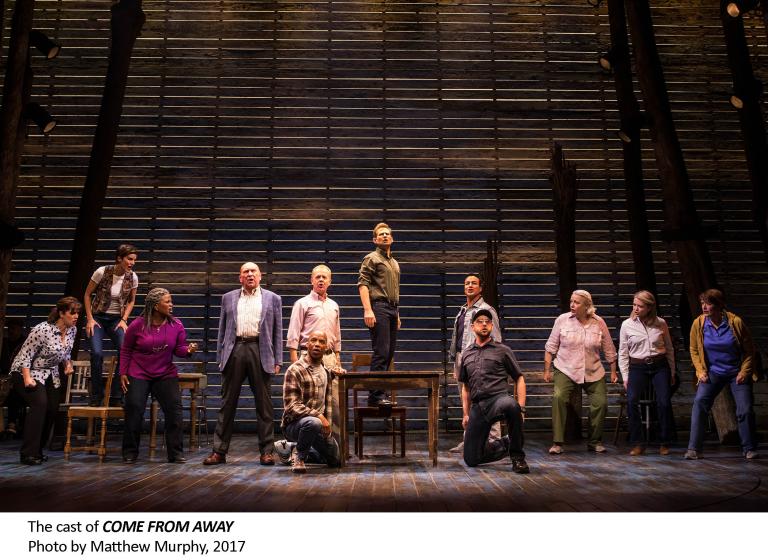
Scene: a frightened man from Africa on a bus with his wife in rural Newfoundland, being taken to who-knows-where from a plane that landed far from its destination. They come to a camp full of people in military uniforms. The bus driver stops, and motions for the passengers to get off the bus. The man doesn’t move. He does not understand the bus driver’s language. He does not trust him. And then the bus driver points to the Bible that the man’s wife is clutching. She hands it to him nervously. He flips to Philippians and points at chapter 4, verse 6. “Be anxious for nothing.” This man is a Christian. These are friends. They are safe. Now they’re talking the same language.
Is this a scene from a far-fetched Christian novel? Nope – it really happened. And it is now a part of the new Broadway musical Come From Away, which tells the true story – sometimes using verbatim dialogue from the people who lived it – of how the residents of the tiny town of Gander, Newfoundland welcomed 7,000 airline passengers who were forced to land there when U.S. airspace closed on 9/11.
The show is wonderful. It beautifully captures both the fear and anxiety of that terrible day, and the feeling of camaraderie and support that were born in its immediate aftermath. The show is by turns tense, funny (it had far more laughs than I expected), joyful, and sad. Ben Brantley captures the spirit well in his New York Times review, as does Johnny Oleksinki in his New York Post review.
What both of those reviewers – and most others – highlight is how vital the message of welcoming strangers is in today’s political climate. I think they’re right, but I also hope that conservatives aren’t turned off by an over-politicizing of the show. Despite what could be seen as some liberal leanings (e.g. focusing in part on the story of a gay couple, emphasizing multiculturalism and interfaith connections), the show is not really a political statement. If anything, it is a show that highlights the compassionate humanity of small-town folks who, if they were American, might be written off as close-minded red staters. These are the stereotypes that some of the “come-from-away” passengers have to overcome.
It’s not a religious show, but I was especially impressed by the way the show handled faith. As it turns out, those uniformed people who the African man saw from the bus were Salvation Army workers (“We rarely use ’em, but everyone’s dusted off their Salvation Army uniforms to welcome these people!”). The show makes it clear that communities of faith, like the Salvation Army and other local churches, played a key role in the efforts to house and feed the influx of guests. They weren’t the only ones, of course – but I count it as praiseworthy that the show’s writers didn’t shy away from acknowledging their part.
There’s another beautiful scene, where a Newfoundlander brings an American to church and they add their voices to the Prayer of St. Francis, which is being sung by a man who had lost touch with his childhood faith. The music of that hymn merges with the singing of “Oseh Shalom,” a Jewish Hebrew prayer for peace, and then prayers of different people of faith. I don’t subscribe to the notion that all religions are the same, but I do believe that all grasp something of the truth and that all have goodness in them – and this song highlights the bonds shared by people of faith, even if that faith differs.
This doesn’t mean the show ignores the very real religious tensions that were exacerbated on 9/11. A Muslim passenger finds sympathy and compassion from a few people, but even as the planes take off after five days on the ground, most of the other passengers continue to view him with suspicion. To me, the realism there – and the unspoken reality that some sort of religion did inspire the terrorists of 9/11 – only serves the reinforce the truth of the more positive side, that there is a way in which we are all bound together by faith, that there is something believers have in common with everyone else who is looking for meaning outside of themselves.
I could go on and on about the show, but since I’m a minister rather than a theatre critic, I’ll stop there. What I hope is that conservatives and liberals alike, religious and non-religious, will see this show. Or, since going to Broadway shows isn’t exactly an easy option for most people, at least that they will listen to the soundtrack (be forewarned that it does contain some profanity). There is a divide in our country between liberals and conservatives, Republicans and Democrats, Evangelicals and Progressive Christians. But the divide that worries me more is a growing divide I see between people who think the other side is still worth listening to and talking to, and people who think the time for dialogue is done. I place myself firmly in the former camp, and I hope that if nothing else, this show helps remind all of us of the common humanity we share – even with people who are as different from us as a small-town Catholic schoolteacher is from a Muslim world-class chef, as a Texan mother is from an English businessman, as a born and bred Newfoundlander is from a come-from-away.
UPDATE: “Oseh Shalom” is sung by a rabbi who landed with one of the planes, and it turns out that if anything that part of the true story is more dramatic than it is in the show. Amazing.
UPDATE 2: The writers, Irene Sankoff and David Hein, talk about the religious aspects of the show at 25:08 in this Guggenheim Works & Process video:
Previous Post

March 16, 2017
120 Years of a Swedenborgian "Benedict Option"
Next Post

March 21, 2017 The Best Things: The Kempton Project
Browse Our Archives
Select a Category Art Books Culture Humor Miscellany Morality Movies Music Personal Politics Religion Science Sermons The Best Things Theatre Uncategorized
Select a Month April 2019 October 2018 September 2018 July 2018 May 2018 April 2018 February 2018 January 2018 December 2017 November 2017 October 2017 September 2017 August 2017 July 2017 June 2017 May 2017 April 2017 March 2017 February 2017 January 2017 November 2016 July 2016 May 2016 April 2016 March 2016 September 2015 June 2015 May 2015 April 2015 March 2015 November 2014 October 2014 June 2014 May 2014 April 2014 March 2014 February 2014 November 2013 October 2013 September 2013 August 2013 June 2013 May 2013 April 2013 March 2013 October 2012 September 2012 July 2012 June 2012 May 2012 April 2012 March 2012 February 2012 January 2012 December 2011 November 2011 October 2011 September 2011 August 2011 July 2011 May 2011 April 2011 March 2011 February 2011 January 2011 December 2010 November 2010 September 2010 August 2010 July 2010 June 2010 May 2010 April 2010 January 2010
Follow Us!
TAKE THE
Religious Wisdom Quiz
Which major prophet book is directly after Isaiah?
Select your answer to see how you score.
Daniel Jeremiah Ezekiel Lamentations
Related posts from Good and Truth


Running the (High-Intensity Interval) Race of Faith

What community theater has taught me about incarnation
Wrestling with contradictions means we're doing something right,...
TRENDING AT PATHEOS Progressive Christian

What Being a Modern-Day Apostle Means to Me
In my last column, I discussed the ins and outs of modern-day...

Did Ancient China Once Worship the God of...
Across human history, a common thread weaves through the origins of the...

Love Your Neighbor – Including Earth-Kin: Lev. 19,...
God’s command to love your neighbor means acting in an ethical and...

Lead a Church Study of “Jesus and Lao...
Guest writer Jack Thomas (The Irreverent Reverend) reflects on leading his church...

Pastoral Wisdom for Responding to Sermon Pushback
Getting sermon pushback on your social justice sermon? Learn practical, Proverbs-based strategies...

Principles for Understanding the Apostolic Ministry Today
Whenever people discover that my formal ministry title is "apostle," as in...
view all Progressive Christian blogs
Ad-Free & Subscriber Log-In Subscription Support
- About Us
- 2026 Calendar
- Videos
- Podcasts
- Library of World Religions
- Faith In Media Tracker
- Advertise With Us
- Write for Us
- Privacy Policy
- Terms of Service
- Do Not Sell My Data
- Contact Us
- Radiant Digital
- Manage Newsletter Subscriptions
- Unsubscribe From Notifications
- Sitemap
Copyright 2008-2026, Patheos. All rights reserved.
Subscription Support Ad-Free & Subscriber Log-In
Follow Patheos