
BuddhistCatholicContemplativeEvangelicalGeneral ChristianHinduJewishLatter-day SaintMuslimNew VisionsProgressive Christian
Beliefs
- Buddhist
- Catholic
- Contemplative
- Evangelical
- General Christian
- Hindu
- Jewish
- Latter-day Saint
- More Voices
- Muslim
- New Visions
- Pagan
- Progressive Christian
Topics
- Religion News
- Food and Religion
- Sports and Religion
- Religious Art
- Religious Music and Entertainment
- Religious Events
- History and Religion
- Style and Religion
- Politics and Religion
- Women in Religion
- Recreation Outdoors and Religion
- Business Finance and Religion
- Careers Workplace and Religion
- Education and Religion
- Family Parenting and Religion
- Health Fitness and Religion
- Home and Religion
- Relationships and Religion
- Technology and Religion
- Travel and Religion
Columnists
- Buddhist Columnists
- Business Finance and Religion Columnists
- Careers Workplace and Religion Columnists
- Catholic Columnists
- Contemplative Columnists
- Education and Religion Columnists
- Evangelists Columnists
- Family Parenting and Religion Columnists
- General Christian Columnists
- Health Fitness and Religion Columnists
- Hindu Columnists
- History and Religion Columnists
- Home and Religion Columnists
- Jewish Columnists
- More Voices Columnists
- Latter Day Columnists
- Muslim Columnists
- New Visions Columnists
- Nonreligious Columnists
- Pagan Columnists
- Politics and Religion Columnists
- Progressive Columnists
- Recreation Outdoors and Religion Columnists
- Relationships and Religion Columnists
- Religion News Columnists
- Religious Art Columnists
- Religious Events Columnists
- Religious Music and Entertainment Columnists
- Sports and Religion Columnists
- Style and Religion Columnists
- Technology and Religion Columnists
- Travel and Religion Columnists
- Women in Religion Columnists
Resource Library
- 2026 Calendar
- Library of World Religions
- The 100 Most Holy Places on Earth
- Patheos Answers
- Podcasts
- Videos
- Faith Leaders Database
- Anglican Episcopalian
- Bahai
- Baptist
- Buddhism
- Christianity
- Confucianism
- Eastern Orthodoxy
- Hinduism
- Holiness and Pentecostal
- ISKCON
- Islam
- Judaism
- Lutheran
- Methodist
- The Church of Jesus Christ of Latter-day Saints
- New Age
- Paganism
- Presbytarian and Reformed
- Protestantism
- Religion Behind the Scenes
- Roman Catholic
- Scientology
- Shia Islam
- Sikhism
- Sufism
- Sunni Islam
- Taoism
- Zen
- See all religions
Research Tools
 Ad-Free & Subscriber Log-In Subscription Support
Ad-Free & Subscriber Log-In Subscription Support
Follow Patheos 

- Trending:
- Forgiveness
- |
- Marriage
- |
- Consciousness
- |
- Death Penalty
- |
- Election
- |
- Halloween
 Good and Truth
- Home
- Progressive Christian
- Faith & Fidelity: Part 2, What Should We Believe?
Faith & Fidelity: Part 2, What Should We Believe?
Last updated on: March 29, 2017 at 6:06 am by Coleman Glenn
Faith & Fidelity: Part 2, What Should We Believe? 2017-03-29T06:06:01-07:00 Coleman Glenn
Patheos Explore the world's faith through different perspectives on religion and spirituality! Patheos has the views of the prevalent religions and spiritualities of the world.
This is the second in a series of posts on the connection between belief and faithfulness, sparked by Matthew Bates’s new book Salvation by Allegiance Alone. In the first post I explored the book’s primary thesis: that the overarching meaning of “faith” (Greek pistis) in the New Testament is allegiance to Jesus as Lord and King, rather than belief as an intellectual assent.
Bates doesn’t suggest that “pistis” never means “belief,” or that faith as belief is unimportant. He identifies three dimensions to allegiance: mental affirmation, professed fealty and enacted loyalty. Mental affirmation is the starting point of faith.
In particular, this means mental affirmation of the gospel. What is the gospel? Bates suggests that a lot depends on the answer, and that many Christians have gotten it wrong. The gospel, Bates says, is not simply, “If you believe that Jesus died for your sins and have said the sinner’s prayer, you are saved,” but instead is the entire story of Jesus’ birth, life, death, and resurrection, and most importantly, His enthronement as King after the resurrection. Here’s Bates’s outline (drawn from the work of C.H. Dodd); the emphasis on the seventh point is Bates’s, since he sees this as the climax of the gospel:
Jesus the king:
preexisted with the Father,
took on human flesh, fulfilling God’s promises to David,
died for sins in accordance with the Scriptures,
was buried,
was raised on the third day in accordance with the Scriptures,
appeared to many,
7. is seated at the right hand of God as Lord, and
- will come again as judge.
The New Church statement of faith from True Christian Religion §3 similarly focuses on Jesus’ incarnation and eventual glorification and reign. It is not identical to Bates’s outline, but they run roughly parallel:
Jesus the king
Jehovah God is love itself and wisdom itself, or is good itself and truth itself; and in respect to Divine truth, which is the Word,
1. preexisted with the Father,
and which was God with God,
2. took on human flesh, fulfilling God’s promises to David,
He came down and took on the Human
3. died for sins in accordance with the Scriptures,
for the purpose of reducing to order all things that were in heaven, and all things in hell, and all things in the church; because at that time the power of hell prevailed over the power of heaven, and upon the earth the power of evil over the power of good, and in consequence a total damnation stood threatening at the door. This impending damnation Jehovah God removed by means of His Human, which was Divine truth, and thus He redeemed angels and men,
4. was buried,
5. was raised on the third day in accordance with the Scriptures,
and thereupon He united, in His Human, Divine truth with Divine good or Divine wisdom with Divine love;
6. appeared to many,
7. is seated at the right hand of God as Lord, and
and so, with and in His glorified Human, He returned into His Divine in which He was from eternity.
8. will come again as judge.
From these words it is clear that without the Lord’s coming into the world no one could have been saved. It is the same today; and therefore without the Lord’s coming again into the world in Divine truth, which is the Word, no one can be saved.
There are clearly some major and important differences here, stemming largely from different interpretations of the Trinity and the last judgment / second coming. But the general pattern is the same: the content of faith is a faith in Jesus Christ and what He did, not just in His death, but in His birth, life, death, and resurrection. And on the most important thing we agree – if the gospel has to boiled down to only one statement, it is this, per Bates:
The gospel is, in the final analysis, most succinctly good news about the enthronement of Jesus the atoning king as he brings the wider stories [of Israel and creation] to a climax. (p. 30, emphasis his)
Compare this to the summary of the gospel in True Christian Religion:
The Lord God Jesus Christ reigns, whose kingdom shall be for ages of ages, according to the prediction in Daniel 7:13-14, and in Revelation 11:15. (§791)
Why does any of this matter? For Bates, this true gospel is the starting point of allegiance. And I think it’s particularly valuable for Swedenborgians to recognize the particular faith of the New Church as outlined above as a starting point. It seems to me that we have a tendency to jump too quickly past the content of that statement of faith to the way we are called to act on it – by shunning evil and doing good. It is right that we focus more on life than on belief. But that statement of faith, that formulation of the gospel, tells us who the Lord is; and that is vital information if we are going to act from Him in loving our neighbor, which is the whole purpose of shunning evils and doing good.
I would also argue, though, that belief is not only a starting point. Scripture does show that we do need to have some kind of faith before we can act in obedience. But it also clearly teaches that we can’t even believe the truth on a deep, genuine level until we have acted in allegiance to it. I’ll write about that in the next post in the series.
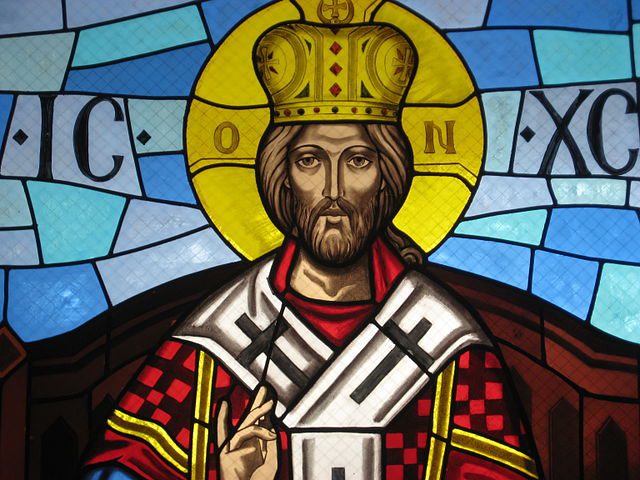
(Image of Christ the King from Melkite Catholic Annunciation Cathedral by John Stephen Dwyer, CC BY-SA 3.0, Link)
Previous Post
March 27, 2017
Faith & Fidelity: Part 1, Allegiance vs. Faith
Next Post
March 31, 2017 Faith & Fidelity: Part 3, The Upward Spiral of Faith
Browse Our Archives
Select a Category Art Books Culture Humor Miscellany Morality Movies Music Personal Politics Religion Science Sermons The Best Things Theatre Uncategorized
Select a Month April 2019 October 2018 September 2018 July 2018 May 2018 April 2018 February 2018 January 2018 December 2017 November 2017 October 2017 September 2017 August 2017 July 2017 June 2017 May 2017 April 2017 March 2017 February 2017 January 2017 November 2016 July 2016 May 2016 April 2016 March 2016 September 2015 June 2015 May 2015 April 2015 March 2015 November 2014 October 2014 June 2014 May 2014 April 2014 March 2014 February 2014 November 2013 October 2013 September 2013 August 2013 June 2013 May 2013 April 2013 March 2013 October 2012 September 2012 July 2012 June 2012 May 2012 April 2012 March 2012 February 2012 January 2012 December 2011 November 2011 October 2011 September 2011 August 2011 July 2011 May 2011 April 2011 March 2011 February 2011 January 2011 December 2010 November 2010 September 2010 August 2010 July 2010 June 2010 May 2010 April 2010 January 2010
Follow Us!
TAKE THE
Religious Wisdom Quiz
What natural disaster did God use to destroy the earth in Noah’s time?
Select your answer to see how you score.
Fire Famine Flood Earthquake
Related posts from Good and Truth


Four Ways of Looking at a Mirror

What Type of Christian Are You?

TRENDING AT PATHEOS Progressive Christian

Why Christians Have a Sacred Duty to Vote:...
The Bible offers strong support for the sacred duty to vote. Here...

What Being a Modern-Day Apostle Means to Me
In my last column, I discussed the ins and outs of modern-day...

Did Ancient China Once Worship the God of...
Across human history, a common thread weaves through the origins of the...

Love Your Neighbor – Including Earth-Kin: Lev. 19,...
God’s command to love your neighbor means acting in an ethical and...

Lead a Church Study of “Jesus and Lao...
Guest writer Jack Thomas (The Irreverent Reverend) reflects on leading his church...

Principles for Understanding the Apostolic Ministry Today
Whenever people discover that my formal ministry title is "apostle," as in...
view all Progressive Christian blogs
Ad-Free & Subscriber Log-In Subscription Support
- About Us
- 2026 Calendar
- Videos
- Podcasts
- Library of World Religions
- Faith In Media Tracker
- Advertise With Us
- Write for Us
- Privacy Policy
- Terms of Service
- Do Not Sell My Data
- Contact Us
- Radiant Digital
- Manage Newsletter Subscriptions
- Unsubscribe From Notifications
- Sitemap
Copyright 2008-2026, Patheos. All rights reserved.
Subscription Support Ad-Free & Subscriber Log-In
Follow Patheos