
BuddhistCatholicContemplativeEvangelicalGeneral ChristianHinduJewishLatter-day SaintMuslimNew VisionsProgressive Christian
Beliefs
- Buddhist
- Catholic
- Contemplative
- Evangelical
- General Christian
- Hindu
- Jewish
- Latter-day Saint
- More Voices
- Muslim
- New Visions
- Pagan
- Progressive Christian
Topics
- Religion News
- Food and Religion
- Sports and Religion
- Religious Art
- Religious Music and Entertainment
- Religious Events
- History and Religion
- Style and Religion
- Politics and Religion
- Women in Religion
- Recreation Outdoors and Religion
- Business Finance and Religion
- Careers Workplace and Religion
- Education and Religion
- Family Parenting and Religion
- Health Fitness and Religion
- Home and Religion
- Relationships and Religion
- Technology and Religion
- Travel and Religion
Columnists
- Buddhist Columnists
- Business Finance and Religion Columnists
- Careers Workplace and Religion Columnists
- Catholic Columnists
- Contemplative Columnists
- Education and Religion Columnists
- Evangelists Columnists
- Family Parenting and Religion Columnists
- General Christian Columnists
- Health Fitness and Religion Columnists
- Hindu Columnists
- History and Religion Columnists
- Home and Religion Columnists
- Jewish Columnists
- More Voices Columnists
- Latter Day Columnists
- Muslim Columnists
- New Visions Columnists
- Nonreligious Columnists
- Pagan Columnists
- Politics and Religion Columnists
- Progressive Columnists
- Recreation Outdoors and Religion Columnists
- Relationships and Religion Columnists
- Religion News Columnists
- Religious Art Columnists
- Religious Events Columnists
- Religious Music and Entertainment Columnists
- Sports and Religion Columnists
- Style and Religion Columnists
- Technology and Religion Columnists
- Travel and Religion Columnists
- Women in Religion Columnists
Resource Library
- 2026 Calendar
- Library of World Religions
- The 100 Most Holy Places on Earth
- Patheos Answers
- Podcasts
- Videos
- Faith Leaders Database
- Anglican Episcopalian
- Bahai
- Baptist
- Buddhism
- Christianity
- Confucianism
- Eastern Orthodoxy
- Hinduism
- Holiness and Pentecostal
- ISKCON
- Islam
- Judaism
- Lutheran
- Methodist
- The Church of Jesus Christ of Latter-day Saints
- New Age
- Paganism
- Presbytarian and Reformed
- Protestantism
- Religion Behind the Scenes
- Roman Catholic
- Scientology
- Shia Islam
- Sikhism
- Sufism
- Sunni Islam
- Taoism
- Zen
- See all religions
Research Tools
 Ad-Free & Subscriber Log-In Subscription Support
Ad-Free & Subscriber Log-In Subscription Support
Follow Patheos 

- Trending:
- Forgiveness
- |
- Marriage
- |
- Consciousness
- |
- Death Penalty
- |
- Election
- |
- Halloween
 Good and Truth
- Home
- Progressive Christian
- Two Snarky Comics and a Sermonette on Science
Two Snarky Comics and a Sermonette on Science
Last updated on: September 11, 2015 at 4:50 am by Coleman Glenn
Two Snarky Comics and a Sermonette on Science 2015-09-11T04:50:44-07:00 Coleman Glenn
Patheos Explore the world's faith through different perspectives on religion and spirituality! Patheos has the views of the prevalent religions and spiritualities of the world.
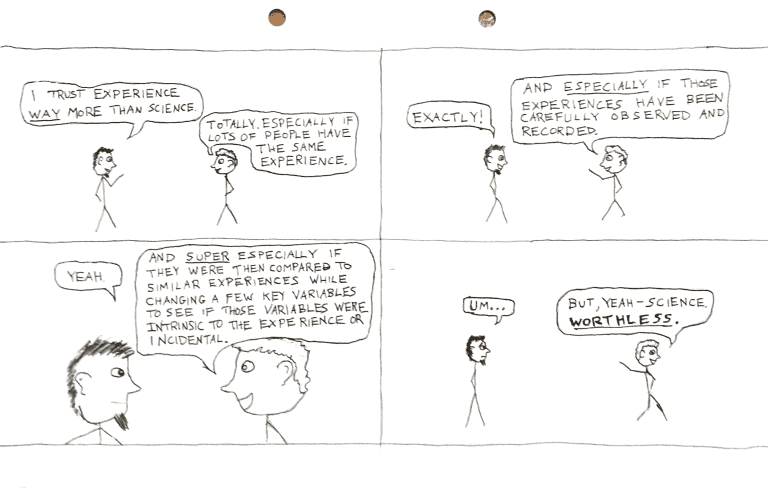
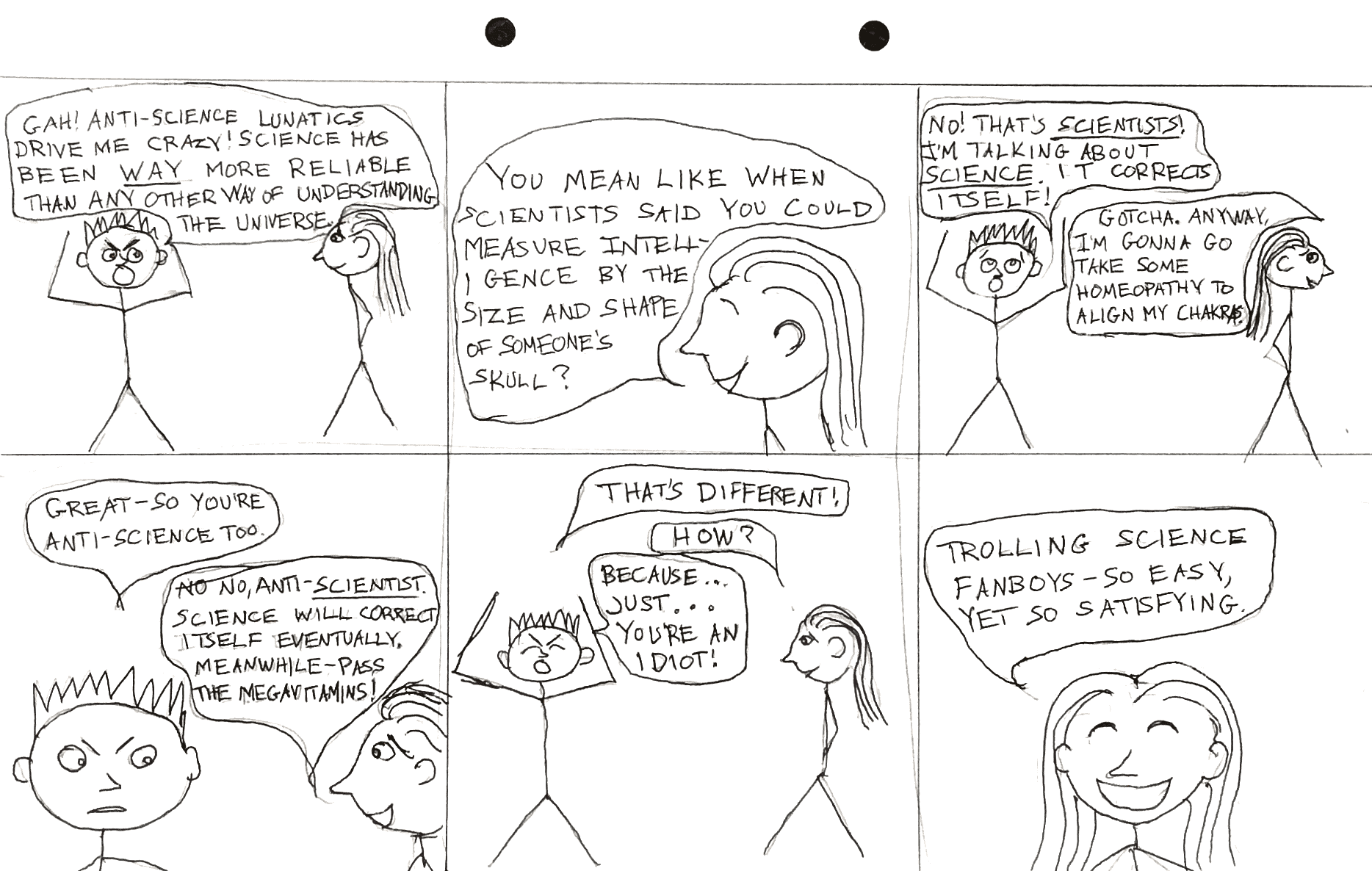
About two weeks ago, I went on a one-day low-carb diet. It was not out of any affinity for Dr. Atkins or Tim Noakes or my palaeolithic ancestors. Instead, I was intentionally starving my body of carbohydrates so that the next day I could be injected with a radioactive sugar and then lie in a machine that would take three-dimensional internal scans of my body and monitor the gamma-ray emissions from the sugar to detect whether any parts of my body were absorbing it at an inordinate rate, which would indicate fast-growing cells, such as cancerous cells. Fortunately, none were, and the Hodgkin’s lymphoma that I had in 2009 has officially been in remission for 6 years.
I love science. The unbelievable medical advances brought about by careful application of the scientific method have saved my life many times over. Besides that, it’s just cool. The careful observation and testing, the constant quest for better knowledge – that’s exciting to me. I think the scientific method has proven to be the best way to collect, assess, and build on human experience and observation. Which is why I get annoyed when people set up experience and science as antagonistic to one another. Hence the first comic I drew above.
On the other hand I do understand that attitude toward science, because science defenders have a tendency to overstate their case. The fact that there is not yet any evidence for something does not imply that it’s not real; it could just mean more testing is needed. (I love the website cochrane.org, which collates scientific research on medical treatments; one of my favourite things is that so many of the articles conclude that there is no conclusion and more study is needed.) Despite this, claims of an experience that has not been verified by scientific study are often dismissed as “anti-scientific,” even by people who should know better – who know that science’s strength lies in its lack of certainty. As one of my friends commented on Facebook in response to the second comic above, “[Science] only survives on the ability to reject previously established scientific facts when new evidence presents itself. So as soon as someone says ‘since this is a scientific fact, no one can argue against it,’ science turns into dogma, and is no longer science at all.”
To give a specific example: for a lot of scientifically-minded folks, there’s nothing more infuriating than someone saying something like, “macro-evolution is only a theory.” The typical vociferous reaction that gets comes in response to the implication that a scientific theory is just one guess among many, no different from an un-investigated opinion. And yet if in their response someone raises the theory of evolution to the level of unquestionable fact, they are being unscientific – in the end, it is only a theory, as falsifiable as any other, despite good evidence for it.
So while in theory many science fans differentiate between the scientific method and current scientific theory, I find that practically they often conflate the two, and as a result end up placing way too much faith in current theories and hypotheses. This year seems to be the year for scientists to emphasise just how unreliable experimental results and theories can be: there have been reports on massive un-reproducibility in both hard sciences and psychology, with the most recent and widely reported one being a survey finding that fewer than 1 in 3 psychological experiments is reproducible. There’s been debate about whether these studies simply reflect the way science is supposed to work, or if they reflect an unhealthy bias toward engineering positive results, or some of both. Either way, no one is disputing that lots of published studies have un-reproducible results.
That’s true in every field of science. In my opinion, there’s even more trouble with applied psychology in particular. It’s relatively easy to say “ABVD chemotherapy correlates with reduction in tumours in 80% of cases of Hodgkin’s lymphoma.” But psychology and social science rely on subjective measures like self-reported satisfaction levels and values that end up being remarkably slippery and hard to define: concepts like “human flourishing,” “emotional wellbeing,” even “pleasure” and “pain.” And given the rapidity with which psychological consensus has changed and continues to change over the last 50 years (which has aligned suspiciously well with cultural and political pressure), is there any reason at all to think that 100 years from now psychology’s opinion on what constitutes wellbeing will be anything close to what it is now?
And yet this strange myopia exists – a clear ability to see the flaws of past theories as an expected part of scientific development, but an almost religious acceptance of today’s theories, as if now we’ve gotten things right.
I notice this particularly among fans of the so-called new atheists, who aren’t particularly new anymore (confession: I haven’t read much in the new atheists themselves). In my opinion, the logical conclusion of atheism is not scientism, and it is certainly not the staid moralism of the new atheists. It is rather the anarchistic nihilism of Nietzsche, the absurdism of Sartre and Camus (another confession: I’ve read more of these guys than I have of the new atheists, but still not a lot). The new atheism has far too much certainty. But that’s human nature and human necessity: to get anything done, we have to rest on a lot of assumptions about the way the world works, assumptions that are unproven or unprovable. The mistake that a lot of materialists make, I think, is to think that even if their assumptions could theoretically be falsified, there’s at least a 99% chance that they won’t be. That degree of confidence is misplaced. It’s exactly the kind of confidence a Newtonian physicist might have had before Einstein pulled the rug out from under him.
So, we have a choice: either we functionally place our ultimate faith in tenets that we know to be as likely false as true – the absurdity of absurdism – or we choose to place our faith in tenets that claim to be absolute truth from outside of nature. The latter may seem absurd to a materialist, but I think that this is only an indication that they really haven’t thought through the absurdity of their own position. The latter position is no more absurd than the former, and it has the advantage of *possibly* being based on something other than the arbitrary valuation of the individual.
I happen to believe in the latter option – particularly that the Old and New Testaments, as well as the theological works of Emanuel Swedenborg are revealed truth. I’ve written elsewhere how I came to that belief. From where I stand now, I think this belief leads to a clearer sight of reality and a deeper experience of joy and purpose than a strictly skeptical viewpoint – in Swedenborgian terms, the former view (doubting everything) “leads to all folly and insanity,” while the latter view (trusting God’s Word) “leads to all intelligence and wisdom.” That’s me and my experience. And here’s where I actually agree with the “experience” guy in the first comic. I don’t know that science is capable of accurately measuring comparing that sense of depth and meaning between two individuals, and in particular, I don’t think science is able to make the value judgment that an individual must make about the different kinds of joy they experience, the qualitative differences between different kinds of pleasure, the different senses of purpose people have. Science is awesome, but unless a person has something other than science as the foundation for value judgments and a sense of purpose, they’re standing on quicksand. They’re asking science to bear a load it can’t carry, and was never intended to.
Previous Post

June 10, 2015
Cut from the Sermon: What Jesus Said About His Coming
Next Post

March 25, 2016 Why Did Jesus Have to Die? His Own Answer
Browse Our Archives
Select a Category Art Books Culture Humor Miscellany Morality Movies Music Personal Politics Religion Science Sermons The Best Things Theatre Uncategorized
Select a Month April 2019 October 2018 September 2018 July 2018 May 2018 April 2018 February 2018 January 2018 December 2017 November 2017 October 2017 September 2017 August 2017 July 2017 June 2017 May 2017 April 2017 March 2017 February 2017 January 2017 November 2016 July 2016 May 2016 April 2016 March 2016 September 2015 June 2015 May 2015 April 2015 March 2015 November 2014 October 2014 June 2014 May 2014 April 2014 March 2014 February 2014 November 2013 October 2013 September 2013 August 2013 June 2013 May 2013 April 2013 March 2013 October 2012 September 2012 July 2012 June 2012 May 2012 April 2012 March 2012 February 2012 January 2012 December 2011 November 2011 October 2011 September 2011 August 2011 July 2011 May 2011 April 2011 March 2011 February 2011 January 2011 December 2010 November 2010 September 2010 August 2010 July 2010 June 2010 May 2010 April 2010 January 2010
Follow Us!
TAKE THE
Religious Wisdom Quiz
Which king was famous for his wisdom and built the first temple in Jerusalem?
Select your answer to see how you score.
Rehoboam Solomon David Saul
Related posts from Good and Truth


Four Ways of Looking at a Mirror

What Type of Christian Are You?

TRENDING AT PATHEOS Progressive Christian

What Being a Modern-Day Apostle Means to Me
In my last column, I discussed the ins and outs of modern-day...

Did Ancient China Once Worship the God of...
Across human history, a common thread weaves through the origins of the...

Love Your Neighbor – Including Earth-Kin: Lev. 19,...
God’s command to love your neighbor means acting in an ethical and...

Lead a Church Study of “Jesus and Lao...
Guest writer Jack Thomas (The Irreverent Reverend) reflects on leading his church...

Pastoral Wisdom for Responding to Sermon Pushback
Getting sermon pushback on your social justice sermon? Learn practical, Proverbs-based strategies...

Principles for Understanding the Apostolic Ministry Today
Whenever people discover that my formal ministry title is "apostle," as in...
view all Progressive Christian blogs
Ad-Free & Subscriber Log-In Subscription Support
- About Us
- 2026 Calendar
- Videos
- Podcasts
- Library of World Religions
- Faith In Media Tracker
- Advertise With Us
- Write for Us
- Privacy Policy
- Terms of Service
- Do Not Sell My Data
- Contact Us
- Radiant Digital
- Manage Newsletter Subscriptions
- Unsubscribe From Notifications
- Sitemap
Copyright 2008-2026, Patheos. All rights reserved.
Subscription Support Ad-Free & Subscriber Log-In
Follow Patheos