
BuddhistCatholicContemplativeEvangelicalGeneral ChristianHinduJewishLatter-day SaintMuslimNew VisionsProgressive Christian
Beliefs
- Buddhist
- Catholic
- Contemplative
- Evangelical
- General Christian
- Hindu
- Jewish
- Latter-day Saint
- More Voices
- Muslim
- New Visions
- Pagan
- Progressive Christian
Topics
- Religion News
- Food and Religion
- Sports and Religion
- Religious Art
- Religious Music and Entertainment
- Religious Events
- History and Religion
- Style and Religion
- Politics and Religion
- Women in Religion
- Recreation Outdoors and Religion
- Business Finance and Religion
- Careers Workplace and Religion
- Education and Religion
- Family Parenting and Religion
- Health Fitness and Religion
- Home and Religion
- Relationships and Religion
- Technology and Religion
- Travel and Religion
Columnists
- Buddhist Columnists
- Business Finance and Religion Columnists
- Careers Workplace and Religion Columnists
- Catholic Columnists
- Contemplative Columnists
- Education and Religion Columnists
- Evangelists Columnists
- Family Parenting and Religion Columnists
- General Christian Columnists
- Health Fitness and Religion Columnists
- Hindu Columnists
- History and Religion Columnists
- Home and Religion Columnists
- Jewish Columnists
- More Voices Columnists
- Latter Day Columnists
- Muslim Columnists
- New Visions Columnists
- Nonreligious Columnists
- Pagan Columnists
- Politics and Religion Columnists
- Progressive Columnists
- Recreation Outdoors and Religion Columnists
- Relationships and Religion Columnists
- Religion News Columnists
- Religious Art Columnists
- Religious Events Columnists
- Religious Music and Entertainment Columnists
- Sports and Religion Columnists
- Style and Religion Columnists
- Technology and Religion Columnists
- Travel and Religion Columnists
- Women in Religion Columnists
Resource Library
- 2026 Calendar
- Library of World Religions
- The 100 Most Holy Places on Earth
- Patheos Answers
- Podcasts
- Videos
- Faith Leaders Database
- Anglican Episcopalian
- Bahai
- Baptist
- Buddhism
- Christianity
- Confucianism
- Eastern Orthodoxy
- Hinduism
- Holiness and Pentecostal
- ISKCON
- Islam
- Judaism
- Lutheran
- Methodist
- The Church of Jesus Christ of Latter-day Saints
- New Age
- Paganism
- Presbytarian and Reformed
- Protestantism
- Religion Behind the Scenes
- Roman Catholic
- Scientology
- Shia Islam
- Sikhism
- Sufism
- Sunni Islam
- Taoism
- Zen
- See all religions
Research Tools
 Ad-Free & Subscriber Log-In Subscription Support
Ad-Free & Subscriber Log-In Subscription Support
Follow Patheos 

- Trending:
- Forgiveness
- |
- Marriage
- |
- Consciousness
- |
- Death Penalty
- |
- Election
- |
- Halloween
 Good and Truth
- Home
- Progressive Christian
- Becoming Human
Becoming Human
Last updated on: March 10, 2014 at 2:27 pm by Coleman Glenn
Becoming Human 2014-03-10T14:27:52-07:00 Coleman Glenn
Patheos Explore the world's faith through different perspectives on religion and spirituality! Patheos has the views of the prevalent religions and spiritualities of the world.
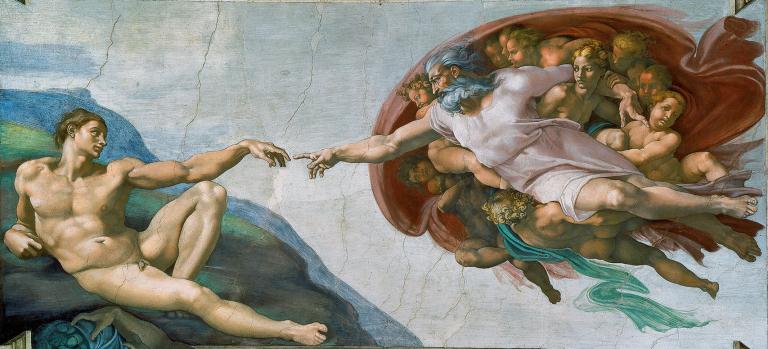 Over the past six weeks here at our church in Dawson Creek we’ve been following the story of Creation from the first chapter of Genesis. Yesterday we reached the sixth day: the creation of land animals, and ultimately, the creation of man, male and female, in God’s image and after God’s likeness. We’ve been following the interpretation of the story as laid out in the Doctrine of the New Church, specifically in the book Arcana Coelestia, which describes these days as representing the stages in a person’s regeneration and rebirth. The end of the sixth day marks the ultimate goal: that a person be made truly human, and that the image and likeness of God be restored in him. The readings (which I highly recommend reading before reading or listening to the sermon) were Genesis 1:24-31; Psalm 8; John 13:3-17; and Arcana Coelestia 12 and 49.
Sermon audio is here.
Becoming Human
Over the last several weeks we’ve been following the story of creation, and this week we reach the final point of creation. There’s still the seventh day to come, but that was a day of rest, and so on the sixth day we’re talking about the ultimate goal, the end, of the Lord’s creation. In the literal sense this is the creation of man, male and female. In the internal sense, it’s something similar. We’ve been talking about the way that the days of creation tell us about the way that a person is regenerated, made a new person, made a heavenly person. And on the sixth day, at the end of the whole process, the goal of all of this, is that we become truly human. That’s what it really means to be regenerated: that we really actually become truly human at that point. We’ll talk a little bit later about what that means, but to reach that we’ll go through the days that lead up to this, talking about where we’ve been and how we reach that final stage.
So as we’ve talked about, the first day we start out in darkness. That darkness comes from being selfish and from thinking that we are the source of everything good and true, from thinking that whatever I want is what’s good. But then the Lord in His mercy says, “Let there be light.” He gives us this idea that good and truth are something higher than myself; and more than that, that He is, that He, the Lord Jesus Christ, exists, and that He is the source of everything good and true. So we realize on that day, If I want to know what is really good, I can’t just look to my self and my selfish desires – I have to look to the Lord in His Word. What He says is true.
When we realize that, it prepares us for the second day. On the second day there is a separation between the waters above and the waters below. In the internal sense, that’s a separation between the internal man and the external man, our higher selves and our lower selves, and it’s a realization that the things in our higher mind are from the Lord alone. It’s especially a sight of higher truth. When we take a step back, we raise our minds to the Lord’s truth, and from that point have an ability to look down on our lives, and to see if we are behaving in accordance with that truth.
That leads on into the third day, because on when we’ve raised our mind on the second day and looked to the Lord’s Word, we see areas where we’re not living by the Lord’s truth, where we’re not living in accord with His commands; and the third day is when we bring it back down to earth. We even use that terminology, we have to bring these ideas down to earth, we have to ground them in practical life; and so God creates dry land. On this third day, we consciously make ourselves start living by what we know to be right. It’s especially a day of repentance: we look at evils we’re doing and we shun them as sins against God, completely as if from our own power. We say, “I will not tell lies, because I’ve seen from the higher truth that that is wrong; I will not do it.” Because it is a sin against the Lord, we stop ourselves from doing it. And if we do that, that makes a real observable change in our lives; people might even say, “I notice you’re acting differently.” We are bearing fruit on that day – our behaviour changes for the better, and we do good to others.
But we’re not there yet – we’re not finished yet. Because at that point, we’re doing these things because we’re forcing ourselves to; we don’t really feel it yet. We’re making ourselves do what we know is right, but we’re not doing it from love and faith yet. And the other thing is, at this point, because it feels like we’re making ourselves do it, we’re not really acknowledging that it is only the Lord who is doing this in us. We might say that with our lips, but we don’t even really know what that means, that this is from the Lord alone. But on the fourth day, we start to have some perception of that. We start to experience love. We start to experience that sun rising in our hearts, where in something we had to force ourselves to do we now suddenly notice, “I’m feeling love in a way that I never did before. That’s a gift. That’s not from myself. The Lord has changed something in my heart.” We experience love for others – the Lord’s love for others in ourselves. And we experience the reality of the Lord’s love for us. It’s an incredible thing when that sun rises for the first time. On that day also, the moon is created, and that’s a picture of faith; so even when we’re not feeling that love (because we won’t feel it constantly) we can walk now in confidence that the Lord will give us strength to overcome whatever comes in our way; we can walk in obedience with the knowledge that the sun will rise again, the Lord will again inspire us with love. It’s a new kind of faith because it’s a faith that acknowledges, I’m not doing this on my own – the Lord is giving me the ability to do this, the Lord will give me the strength to do the things He calls me to do, and so I will walk in faith in Him.
That brings us to the fifth day. When our minds have been inspired by love and by faith, new ideas start to take life in our minds. And we even sometimes experience these as ideas that come into our minds that have “a life of their own.” That’s those fish – the fish in the waters below represent ideas even in our lower, practical knowledge that is now transformed by love. So, for example, if we know practically how to be an architect and we’ve experienced love from the Lord, suddenly all that knowledge of how to build things comes alive – we have ideas about how I can use that to serve other people, to serve the Lord. New ideas spring up within those lower knowledges. And in the higher levels as well we start to realize thousands of new ways to live by the truths of the Lord’s Word. So whereas before we might have said, “I know I’m not supposed to tell lies,” on this day we might realize there are all sorts of ways that we can be more honest, not just with our words, but with the way we behave – honesty means so much more than just literally not telling lies. All those different ideas of how we can be honest are pictured in all the different birds, which God commanded to “be fruitful and multiply.”
On the fifth day, we have those ideas and we speak from those ideas, we speak from faith; on the sixth day, we bring those down to earth and live by them. The book Arcana Coelestia describes each of these two states:
The fifth state is when man discourses from faith, and thereby confirms himself in truth and good: the things then produced by him are animate, and are called the “fish of the sea” and the “birds of the heavens.” The sixth state is when, from faith, and thence from love, he speaks what is true, and does what is good: the things which he then brings forth are called the “living soul” and the “beast.” (AC 11, 12)
In particular, Arcana Coelestia goes on to say that those “living souls” and “beasts” and “animals” represent affections, or new experiences of love that we have from living these new ideas. And there are all sorts of different kinds of new affections that spring up. So, to take an example: think of a person who, on the second day, realized that he needed to stop telling lies. On the third day, he brought that down to earth – he forced himself to stop lying so much, because it was a sin against God. On the fourth day, He started to experience a genuine change in his heart; and on the fifth day, he started to have all those new ideas multiplying in his mind about how he could be truly honest. On the sixth day, now, he starts to live by those new ideas, and a new affection grows in him: a new sense of honesty, integrity, uprightness. That new affection is one kind of animal that might be created on the sixth day.
To take another example: imagine someone who, on the second day, realizes from those higher truths that she needs to stop taking revenge. On the third day she fights against her desire to get back at people, and stops herself from cutting people down when they have offended her. On the fourth day, she starts to experience a new kind of love, and a new sense that her ability to forgive comes from the Lord alone. And on the fifth day, she starts to have all kinds of new ideas about what it really means to forgive, beyond just not taking revenge – ideas about how to interact lovingly even in the small things, how to genuinely love someone who has hurt you, to have mercy even on people who are unkind. On the sixth day, she takes those ideas and she lives them. And as she does that, a new kind of affection grows within her – a new sense of mercy and forgiveness. That’s another kind of animal.
So we see there is that affection for mercy in the second example, and the affection for honesty in the first example – they are different from each other, but they are both very good. And the reality is, as many different ideas as there are, there are that many different affections. There are even affections for different kinds of honesty, different kinds of mercy, just as there are various different species of animal within a genus. And the more good affections the Lord brings to life in us, the more we are perfected, the more we come into love for Him.
That’s the first part of the sixth day. But the goal of all of that, the purpose of those affections, is pictured in the final part of this day: the creation of man. The goal of all these things is to transform us into something truly human. When we talk about being “human,” we use that word in two different ways. Sometimes we say things like, “Well, they messed up, they’re only human.” We use it to talk about our fallibility. But in another sense we talk about someone having real humanity, being humane – we are then talking about them having genuine compassion and love. And it’s in this sense that we are created to be truly human on this sixth day.
Now the reality is, in the highest sense, only the Lord is truly human. Only God is truly human. We read from Arcana Coelestia about the people of the Most Ancient Church, the people represented by Adam and Eve, who worshipped God in integrity – that God was the only one whom they called “man”; they only called themselves human to the extent that they had qualities from Him, qualities of love and wisdom. God is the only one who has humanity itself.
But we are created in His image and in His likeness. According to Arcana Coelestia, in particular the “image” refers to our intellect, our understanding, our wisdom. Our wisdom is a finite, imperfect reflection or image of God’s infinite, perfect wisdom. The “likeness,” the way we are like God, is in our ability to love. Our finite, imperfect love makes us like God, although His love is infinite and perfect.
The problem, though, is that we have destroyed that image and likeness. We use our wisdom, our intellect, to confirm falsity rather than truth. And in our will we are attracted to evils of every kind, receiving through heredity an inclination toward evils of every kind. Our intellect and our will, the image and likeness of God, have been broken. We are not born loving what God loves, or believing what is true. And yet, creating man in that image and likeness was the whole purpose of creation; and so God, in His Divine Providence, is willing to do everything He can to restore us to that image and likeness. There’s a passage from the book Divine Providence that describes this:
Now since God is One, and man from creation was made an image and likeness of Him, and since through infernal love and its lusts and their delights he has come into the love of all evils; and has thereby destroyed in himself the image and likeness of God, it follows that it is the continual endeavour of the Divine Providence of the Lord to unite man to Himself and Himself to man, and thus make man to be His image. It also follows that this is to the end that the Lord may be able to bestow upon man the felicities of eternal life, for such is the nature of Divine Love. (DP 123)
The Lord wants to restore His image and likeness in us so that He can bless us, so that He can make us happy to eternity. And the Lord would do anything to make that possible. And in fact, He did do something almost beyond our capacity to conceive of to restore that image and likeness. Because He knew, as soon as the first people started to turn away from Him, that if we were going to be recreated into His image and likeness, He would have to come into this world in the flesh, as a man. He would have to fight against the entire force of hell and subjugate it. He would have to glorify His human – to complete unite His human with the Divine at His soul. And so when the Lord rose again after His crucifixion, He was not just an image and likeness of God, He, in His human form, is the face of God, He is God with us. And so when we are in the image and likeness of the Lord Jesus Christ, we are in the image and likeness of God, because He IS God.
How are we brought into that image and likeness of the Lord Jesus Christ? We do it by following His commandments – as He said, “He who has My commandments and keeps them, it is he who loves Me” (John 14:21). But more than this, we do it by following in His footsteps, following His example. The Lord said, “Love one another as I have loved you.” (John 15:12) The Lord washed His disciples feet and said, “If then I have washed your feet, being the Lord and the Teacher, you also ought to wash one another’s feet. For I have given you an example, that as I have done to you, you also should do.” (John 13:14, 15). We might think, from ourselves, that if we want to be in the image of God, the likeness of God, we need to be big and powerful and important, to command others. The serpent in the garden of Eden used that very lie – be your own master! Gain all knowledge! Then you will be like God!
But the Lord came to say something different. He came to show us what God looks like. And God does not look like a tyrant who seeks to be greater than all. God looks someone kneeling down and washing His disciples feet. God looks like someone laying down His life for His friends. If we want to be created in the image and likeness of God, that is the spirit we need to seek, that spirit of service, that spirit of love, that spirit of self-sacrifice. That is God. That is what it means to be created in His image and likeness.
Now we could not and can not do that on our own. We cannot say, “I’m going to be just like Jesus.” Our path follows His path and is a reflection of it, but what He did perfectly and infinitely, we will do imperfectly and finitely. And yet we can follow that path, in our imperfect, stumbling way, because He can put His life within us. We pray to Him, “Lord, give me your life, give me your Spirit”, and when we do that, and with all our hearts strive to walk in His way, He answers that prayer. And with His Spirit within us, we can be brought more and more into His image and likeness.
And that’s the goal of creation. And it doesn’t stop when we’ve left this world. To eternity, we are perfected, created more and more into His image and likeness – more and more coming into wisdom, more and more coming into love. And we will never BE the Lord because He is infinite love and infinite wisdom, while we are still finite, and yet we can continually draw closer to Him. And the more we are made to be an image and likeness of Him, the more the Lord can conjoin Himself to us and bless us; and the more He can use us as vessels, and through us to bless others. That’s the goal of creation. That’s what it all comes down to. And when that happens – when there is that ever-closer marriage of love and wisdom represented by the male and female that God created – then we are fulfilling the Lord’s purpose. Then God looks at what He has made, and calls it not just good, but very good. “And God saw everything that He had made, and behold it was very good. And there was evening, and there was morning, the sixth day” (Genesis 1:31).
Previous Post

February 26, 2014
Days of Creation as Stages of Regeneration
Next Post

March 18, 2014 Peace, or a Sword?
Browse Our Archives
Select a Category Art Books Culture Humor Miscellany Morality Movies Music Personal Politics Religion Science Sermons The Best Things Theatre Uncategorized
Select a Month April 2019 October 2018 September 2018 July 2018 May 2018 April 2018 February 2018 January 2018 December 2017 November 2017 October 2017 September 2017 August 2017 July 2017 June 2017 May 2017 April 2017 March 2017 February 2017 January 2017 November 2016 July 2016 May 2016 April 2016 March 2016 September 2015 June 2015 May 2015 April 2015 March 2015 November 2014 October 2014 June 2014 May 2014 April 2014 March 2014 February 2014 November 2013 October 2013 September 2013 August 2013 June 2013 May 2013 April 2013 March 2013 October 2012 September 2012 July 2012 June 2012 May 2012 April 2012 March 2012 February 2012 January 2012 December 2011 November 2011 October 2011 September 2011 August 2011 July 2011 May 2011 April 2011 March 2011 February 2011 January 2011 December 2010 November 2010 September 2010 August 2010 July 2010 June 2010 May 2010 April 2010 January 2010
Follow Us!
TAKE THE
Religious Wisdom Quiz
Blessed is the one who perseveres under trial because, having stood the test, that person will receive the ____ of life that the Lord has promised to those who love him.
Select your answer to see how you score.
Crown Blessing Reward Gift
Related posts from Good and Truth


Four Ways of Looking at a Mirror

What Type of Christian Are You?

TRENDING AT PATHEOS Progressive Christian

Why Christians Have a Sacred Duty to Vote:...
The Bible offers strong support for the sacred duty to vote. Here...

What Being a Modern-Day Apostle Means to Me
In my last column, I discussed the ins and outs of modern-day...

Did Ancient China Once Worship the God of...
Across human history, a common thread weaves through the origins of the...

Love Your Neighbor – Including Earth-Kin: Lev. 19,...
God’s command to love your neighbor means acting in an ethical and...

Lead a Church Study of “Jesus and Lao...
Guest writer Jack Thomas (The Irreverent Reverend) reflects on leading his church...

Principles for Understanding the Apostolic Ministry Today
Whenever people discover that my formal ministry title is "apostle," as in...
view all Progressive Christian blogs
Ad-Free & Subscriber Log-In Subscription Support
- About Us
- 2026 Calendar
- Videos
- Podcasts
- Library of World Religions
- Faith In Media Tracker
- Advertise With Us
- Write for Us
- Privacy Policy
- Terms of Service
- Do Not Sell My Data
- Contact Us
- Radiant Digital
- Manage Newsletter Subscriptions
- Unsubscribe From Notifications
- Sitemap
Copyright 2008-2026, Patheos. All rights reserved.
Subscription Support Ad-Free & Subscriber Log-In
Follow Patheos