
BuddhistCatholicContemplativeEvangelicalGeneral ChristianHinduJewishLatter-day SaintMuslimNew VisionsProgressive Christian
Beliefs
- Buddhist
- Catholic
- Contemplative
- Evangelical
- General Christian
- Hindu
- Jewish
- Latter-day Saint
- More Voices
- Muslim
- New Visions
- Pagan
- Progressive Christian
Topics
- Religion News
- Food and Religion
- Sports and Religion
- Religious Art
- Religious Music and Entertainment
- Religious Events
- History and Religion
- Style and Religion
- Politics and Religion
- Women in Religion
- Recreation Outdoors and Religion
- Business Finance and Religion
- Careers Workplace and Religion
- Education and Religion
- Family Parenting and Religion
- Health Fitness and Religion
- Home and Religion
- Relationships and Religion
- Technology and Religion
- Travel and Religion
Columnists
- Buddhist Columnists
- Business Finance and Religion Columnists
- Careers Workplace and Religion Columnists
- Catholic Columnists
- Contemplative Columnists
- Education and Religion Columnists
- Evangelists Columnists
- Family Parenting and Religion Columnists
- General Christian Columnists
- Health Fitness and Religion Columnists
- Hindu Columnists
- History and Religion Columnists
- Home and Religion Columnists
- Jewish Columnists
- More Voices Columnists
- Latter Day Columnists
- Muslim Columnists
- New Visions Columnists
- Nonreligious Columnists
- Pagan Columnists
- Politics and Religion Columnists
- Progressive Columnists
- Recreation Outdoors and Religion Columnists
- Relationships and Religion Columnists
- Religion News Columnists
- Religious Art Columnists
- Religious Events Columnists
- Religious Music and Entertainment Columnists
- Sports and Religion Columnists
- Style and Religion Columnists
- Technology and Religion Columnists
- Travel and Religion Columnists
- Women in Religion Columnists
Resource Library
- 2026 Calendar
- Library of World Religions
- The 100 Most Holy Places on Earth
- Patheos Answers
- Podcasts
- Videos
- Faith Leaders Database
- Anglican Episcopalian
- Bahai
- Baptist
- Buddhism
- Christianity
- Confucianism
- Eastern Orthodoxy
- Hinduism
- Holiness and Pentecostal
- ISKCON
- Islam
- Judaism
- Lutheran
- Methodist
- The Church of Jesus Christ of Latter-day Saints
- New Age
- Paganism
- Presbytarian and Reformed
- Protestantism
- Religion Behind the Scenes
- Roman Catholic
- Scientology
- Shia Islam
- Sikhism
- Sufism
- Sunni Islam
- Taoism
- Zen
- See all religions
Research Tools
 Ad-Free & Subscriber Log-In Subscription Support
Ad-Free & Subscriber Log-In Subscription Support
Follow Patheos 

- Trending:
- Forgiveness
- |
- Marriage
- |
- Consciousness
- |
- Death Penalty
- |
- Election
- |
- Halloween
 God and the Machine
- Home
- Catholic
- You Have No Right to Pray
You Have No Right to Pray
Last updated on: May 6, 2015 at 2:18 pm by Thomas L. McDonald
You Have No Right to Pray 2015-05-06T14:18:16-04:00 Thomas L. McDonald
Patheos Explore the world's faith through different perspectives on religion and spirituality! Patheos has the views of the prevalent religions and spiritualities of the world.
“Likewise the Spirit helps us in our weakness; for we do not know how to pray as we ought, but the Spirit himself intercedes for us with sighs too deep for words.” Romans 8:26
“It is very important to for us to realize that we do not know how to pray. If we think of prayer as something that we can—or worse, that we should—master and become proficient at, we are in danger of seriously falsifying our relationship with God.” Simon Tugwell
Prayer is one of those things I approach like a musician approaches his instrument: if I just practice it enough, I’ll get better at it. I’ll get more proficient, and in doing so grow closer to God. Part of the reason I started the How I Pray series (which is on a break for reasons already stated) was to try to see what I could learn from my fellow travelers. I kept thinking maybe there’s a key someone has, and they can let me use it to unlock a hidden door to a deeper prayer life.
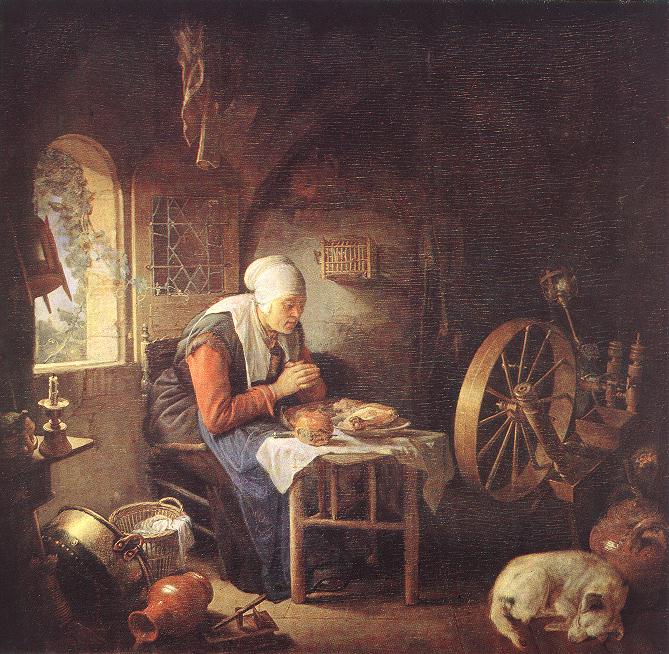
Gerard Dou: The Prayer of the Spinner
This mindset is both right and wrong. Paradox doesn’t bother me because I believe it’s a fine way to understand the ineffable mysteries of the divine, but the error in my approach is something I need to consider as I try to grow in my prayer life.
All of this, naturally, has been complicated recently by major depression, which has sapped my strength and affected my recall. (I couldn’t even remember the final prayer of the Angelus today. That’s a frightening thing.) That’s caused me to consider new ways of praying other than my standard reliance of the Divine Office.
What I plan to do is work through some notions about prayer that I’ve been thinking about lately in a series of posts for the next week or two, time and health allowing.
Simon Tugwell’s excellent little book Prayer in Practice had several revelations for me, most notably the idea that we have no natural right to pray.
In the Old Testament, God authorizes priests and prophets to pray. In the New Testament, the situation changes but the underlying rules still hold. People are baptized into Christ, and by the gift of the Holy Spirit through the sacraments our hearts and lips are opened in prayer. All who are in Christ may now pray.
What this means, as Tugwell observes, is that prayer is a privilege not a right. It is both a gift and a duty.
What should follow from this shift in perspective is the realization that we cannot rely on ourselves alone for prayer.
We meet prayer halfway by following patterns and forms.
We dispose ourselves to prayer with an open heart.
We practice prayer through spiritual exercises.
We listen for God’s words in his scripture and in his Church.
We sit in the silent majesty of the Lord and await His call.
However, none of these things is a complete prayer.
Even the simplest utterance of the Jesus Prayer or the Sign of the Cross is a way for us to find the ground upon which prayer can occur, but the rest is up to the movement of the Spirit.
Just as the efficacy of works can only function through the action of grace, so can the power of prayer only work through the action of the Spirit. Our prayer needs to be completed for us.
Does the Mass, the highest and most perfect prayer of which man is capable, function through our own powers? Are we not merely collaborators with the Priest and the people of God in the greater Work of Christ in the Mass? Is the Mass ours, or Christ’s?
What’s true of the Mass is true of personal prayer. We are not the only power driving our prayer.
It’s a mistake to think that the action of God in prayer is limited to His response. In fact, half of prayer itself is the action of God, before we even get to the response. We would not even have the desire to pray without grace. Our will and intellect cooperate with grace. We can ignore grace or we can build on grace, but we can neither create it nor demand it.
The intimacy with God which we seek in prayer is a gift on top of another gift. The prayer itself was the first gift, and as St. Paul says, “we do not know how to pray as we ought.”
What’s the result? That “the Spirit himself intercedes for us with sighs too deep for words.”
Sighs too deep for words. That’s the prayer that comes from the prompting of the Holy Spirit. God was not in the wind or the earthquake or the fire, but in the still small voice. Words may open the path for us, or dispose us to the action of grace, but in the end, the prayer of Spirit lies beyond words. It’s merely a sigh: the sigh of the lover, answered by the beloved.
Previous Post

May 6, 2015
Jesus Christ: Pro Wrestler?
Next Post
May 7, 2015 I Wasn't Charlie, and I'm Not Pamela
Browse Our Archives
Select a Category Abortion Anthropology Archaeology Art Bible Books Chickens Church Computers Culture Wars Evil Fiction Film Games Ghosts Gospel of John Gospels History How I Pray Internet iPhone Islam Israel Jesus Judaism Language Lent Literature Marshall McLuhan Media Medieval Mental Health Mobile Movies Neil Postman News Old Testament Personal Political Pope Pope Benedict Pope Francis Prayer Robots Satan Sciency Sex Shakespeare Social Media Software St. Augustine Synod Synod on the Family Tarot Technology Television Theology Transhumanism Uncategorized Verbum
Select a Month November 2015 October 2015 September 2015 July 2015 June 2015 May 2015 April 2015 March 2015
Follow Us!
TAKE THE
Religious Wisdom Quiz
What was the disciple Luke's profession?
Select your answer to see how you score.
Fisherman Physician Tentmaker Carpenter
Related posts from God and the Machine
Joanne McPortland on the Call to Self-Destruction
TRENDING AT PATHEOS Catholic

The Parable Of The Sower And The Word...
One of Christ’s most famous parables is that of the sower who...

Rejecting Doom: Christian Hope And Human Action
Christianity is a religion of hope. We are to have hope and...

Why I Choose the Eucharist Over the Sermon
Choose the Eucharist, Not the Sermon What are we supposed to get...

5 Design Elements Found in Spiritually Rooted Homes
Putting Spirituality Into Home Decor Our homes are more than our living...

Credo: A Story of God Told with the...
About 10 years ago, I began to imagine a personal "Credo" that...

The Anatomy of Divine Revelation in Catholic Thought
The claim that God has made Himself known to human beings is...
view all Catholic blogs
Ad-Free & Subscriber Log-In Subscription Support
- About Us
- 2026 Calendar
- Videos
- Podcasts
- Library of World Religions
- Faith In Media Tracker
- Advertise With Us
- Write for Us
- Privacy Policy
- Terms of Service
- Do Not Sell My Data
- Contact Us
- Radiant Digital
- Manage Newsletter Subscriptions
- Unsubscribe From Notifications
- Sitemap
Copyright 2008-2026, Patheos. All rights reserved.
Subscription Support Ad-Free & Subscriber Log-In
Follow Patheos