
BuddhistCatholicContemplativeEvangelicalGeneral ChristianHinduJewishLatter-day SaintMuslimNew VisionsProgressive Christian
Beliefs
- Buddhist
- Catholic
- Contemplative
- Evangelical
- General Christian
- Hindu
- Jewish
- Latter-day Saint
- More Voices
- Muslim
- New Visions
- Pagan
- Progressive Christian
Topics
- Religion News
- Food and Religion
- Sports and Religion
- Religious Art
- Religious Music and Entertainment
- Religious Events
- History and Religion
- Style and Religion
- Politics and Religion
- Women in Religion
- Recreation Outdoors and Religion
- Business Finance and Religion
- Careers Workplace and Religion
- Education and Religion
- Family Parenting and Religion
- Health Fitness and Religion
- Home and Religion
- Relationships and Religion
- Technology and Religion
- Travel and Religion
Columnists
- Buddhist Columnists
- Business Finance and Religion Columnists
- Careers Workplace and Religion Columnists
- Catholic Columnists
- Contemplative Columnists
- Education and Religion Columnists
- Evangelists Columnists
- Family Parenting and Religion Columnists
- General Christian Columnists
- Health Fitness and Religion Columnists
- Hindu Columnists
- History and Religion Columnists
- Home and Religion Columnists
- Jewish Columnists
- More Voices Columnists
- Latter Day Columnists
- Muslim Columnists
- New Visions Columnists
- Nonreligious Columnists
- Pagan Columnists
- Politics and Religion Columnists
- Progressive Columnists
- Recreation Outdoors and Religion Columnists
- Relationships and Religion Columnists
- Religion News Columnists
- Religious Art Columnists
- Religious Events Columnists
- Religious Music and Entertainment Columnists
- Sports and Religion Columnists
- Style and Religion Columnists
- Technology and Religion Columnists
- Travel and Religion Columnists
- Women in Religion Columnists
Resource Library
- 2026 Calendar
- Library of World Religions
- The 100 Most Holy Places on Earth
- Patheos Answers
- Podcasts
- Videos
- Faith Leaders Database
- Anglican Episcopalian
- Bahai
- Baptist
- Buddhism
- Christianity
- Confucianism
- Eastern Orthodoxy
- Hinduism
- Holiness and Pentecostal
- ISKCON
- Islam
- Judaism
- Lutheran
- Methodist
- The Church of Jesus Christ of Latter-day Saints
- New Age
- Paganism
- Presbytarian and Reformed
- Protestantism
- Religion Behind the Scenes
- Roman Catholic
- Scientology
- Shia Islam
- Sikhism
- Sufism
- Sunni Islam
- Taoism
- Zen
- See all religions
Research Tools
 Ad-Free & Subscriber Log-In Subscription Support
Ad-Free & Subscriber Log-In Subscription Support
Follow Patheos 

- Trending:
- Forgiveness
- |
- Marriage
- |
- Consciousness
- |
- Death Penalty
- |
- Election
- |
- Halloween
 God and the Machine
- Home
- Catholic
- Mental Healing and the Psalms
Mental Healing and the Psalms
Last updated on: April 28, 2015 at 12:19 pm by Thomas L. McDonald
Mental Healing and the Psalms 2015-04-28T12:19:54-04:00 Thomas L. McDonald
Patheos Explore the world's faith through different perspectives on religion and spirituality! Patheos has the views of the prevalent religions and spiritualities of the world.
There are many ways through the dark valleys of depression, and prayer must be one of them. The problem is that the depressive often cannot even stir to perform regular prayer. Simple tasks become a burden. Prayer routines fall by the wayside. Commitments are left undone.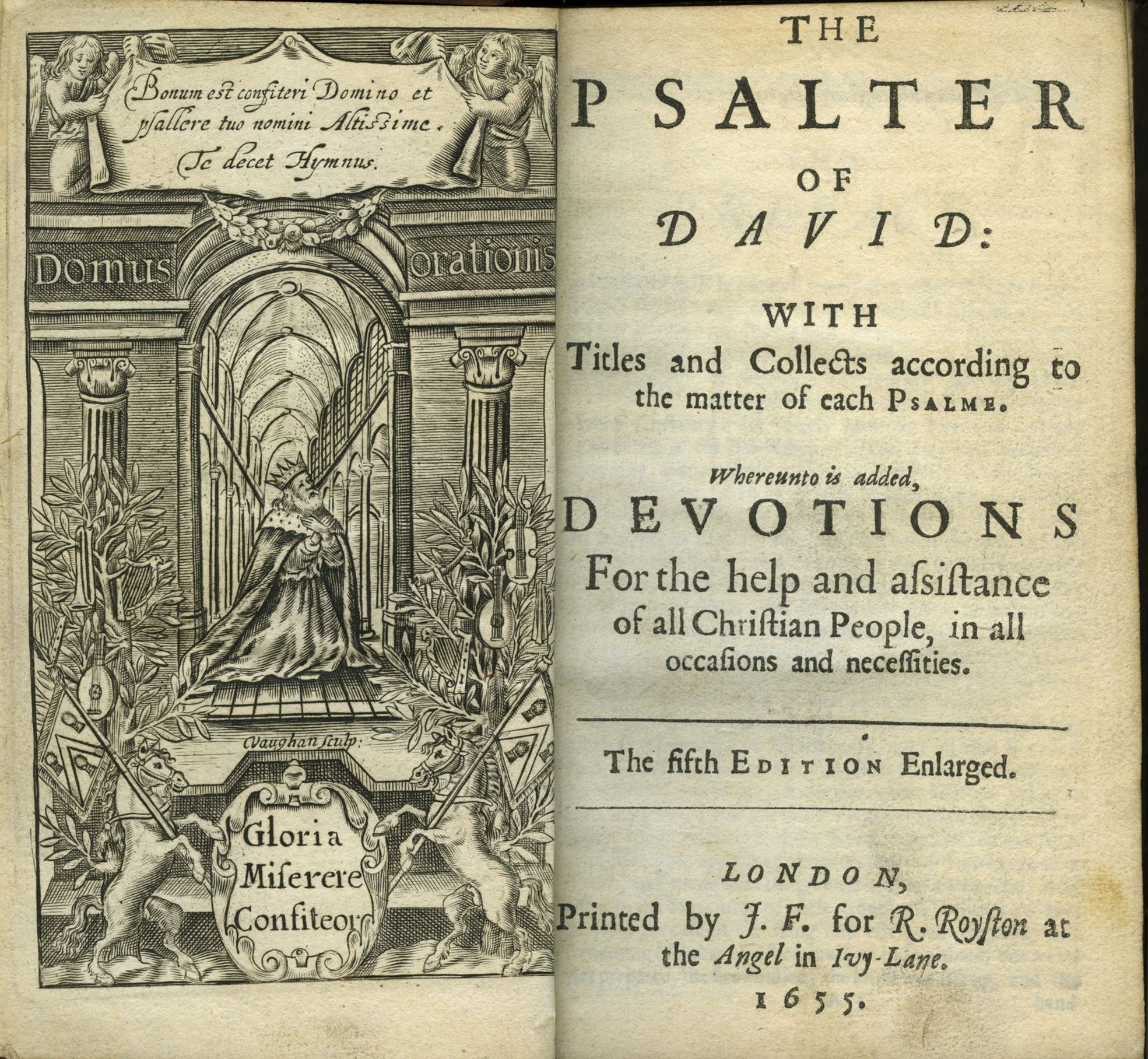
And with each little failure, the walls close in tighter and the sufferer sinks deeper.
Perhaps one way through the dark valley is to follow the trail laid down by our ancestors with the inspiration of the Holy Spirit. The Psalms have within them the entire range of human emotion and experience. If the regular routine of prayer no longer works for us, if the liturgy of the hours or the rosary or whatever discipline we try to follow has become a drudgery and burden, then we have to find a new way to speak to God and, more importantly, let God speak to us.
Fifty-nine psalms—more one-third of them—have elements of Lament. It would appear, on the surface, to be utter folly for the person in the midst of a soul-crushing sorrow to enter deeper into a world of despair. That appearance is deceiving, however.
The laments are more than that. They are a dialog between man and God. They are a howl of sorrow, yes, but they are also a plea, a thanksgiving, and a sigh of hope and trust.
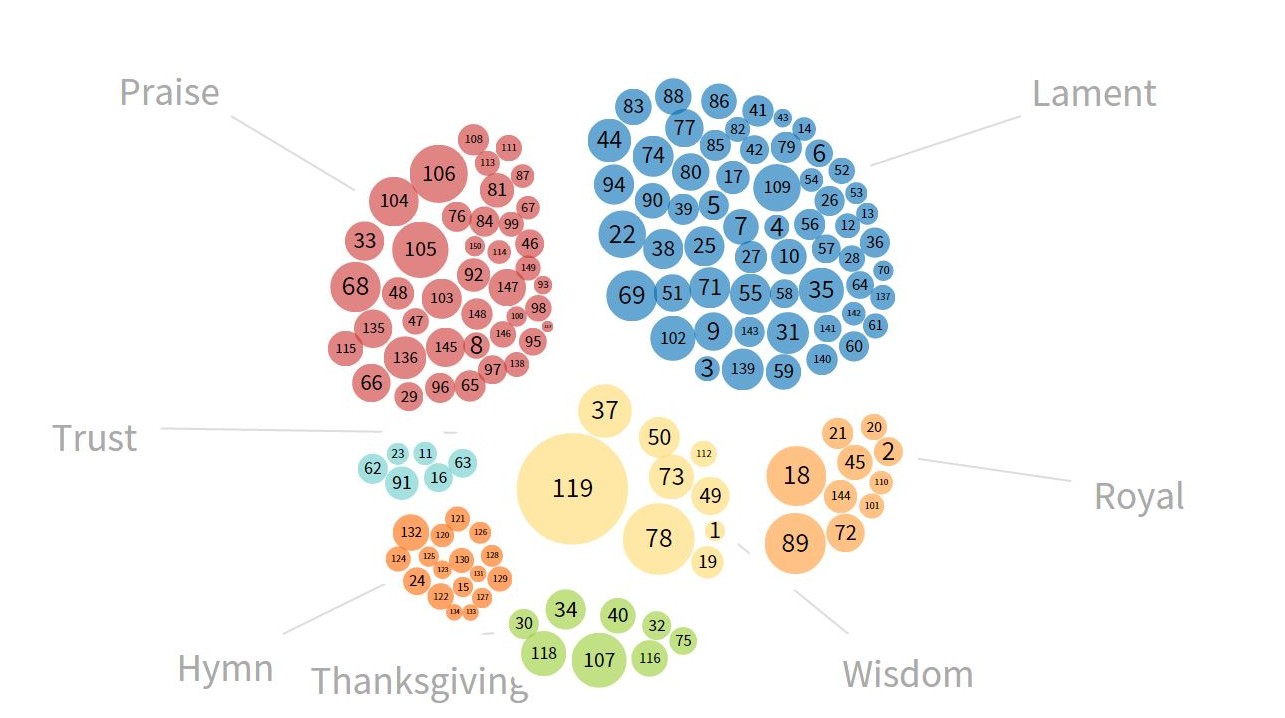
Psalms by category, from Verbum Bible Software
Perhaps we need a Depression Psalter: something to give voice to pain, speak to God, and express our hope. It could be part of our cold reboot of the soul, as we dispense with old habits, including habits of prayer, and engage cross and the desert head-on. Let me begin with Psalm 13. It opens with a question that, as so often in the psalms, is an accusation:
1 How long, O Lord? Wilt thou forget me for ever?
How long wilt thou hide thy face from me?
2 How long must I bear pain in my soul,
and have sorrow in my heart all the day?
How long shall my enemy be exalted over me?
You can see in the repetition of “How long” the urgency and pain of the psalmist, while parallelism builds gradually sharper accusations against the Lord. A common feature of Hebrew poetry is to say the same thing twice in different ways, which has the effect of both echoing and amplifying points.
At first, the speaker asks how long the Lord will “forget” him, suggesting that his distress is not the direct action of God, but mere neglect.
In the next line, however, God has chosen to actively “hide thy face.” God has not forgotten the speaker: God has deliberately turned away from him. These mounting accusations are a more circumspect way to accuse Yahweh for his present plight
The pain in our souls and the sorrow in our hearts is as good a depiction of depression as you’re likely to find. This is De profundis clamavi: a cry from the depths.
Finally, we have the characterization of the enemy who is exalted over us. We can read “enemy” in many ways. It could be the world, the flesh, and the devil (mundus, caro, et diabolus): the inverted Trinity that leads us into darkness. Any one of these things may be at the root of our depression: stresses of life present and past (the world), challenges from our body from illness or temptation (the flesh), or the evil one himself, who must not be discounted as the root of some cases of severe depression.
But I think it may be more useful for those who suffer from true clinical depression to see the enemy as the depression itself. It’s not unusual to give personality and even character to depression. That’s why it’s called the Black Dog. This runs the risk of placing the depression outside ourselves rather than something that springs from within, but it can also be useful for understanding and confronting the forces pulling us down. In prayer, confronting our depression as an Other, an enemy, is just one way to reach out to God and articulate our pain. It says that we are not our illness, and it will not define us, and it allows for us to plead for this enemy to be driven away.
The next section is a prayer for help. We are asking for deliverance from the enemy, in this case, our depression.
3 Consider and answer me, O Lord my God;
lighten my eyes, lest I sleep the sleep of death;
4 lest my enemy say, “I have prevailed over him”;
lest my foes rejoice because I am shaken.
The Hebrew word translated as “lighten my eyes” means to shine, dawn, or give light. It is a powerful way of asking for darkness to be driven away, but it also suggests enlightenment and spiritual wisdom. We are asking God not merely to drive away the pain, but to give wisdom to our souls so we may live better, and to bring the Light Himself to dwell within us.
And to make the stakes clear, God is warned that our very lives are at risk. Major depressive disorders are, in fact, a serious, life-threatening condition. Too many people today fail to understand this.
Again, we have the personification our of our pain as our “enemy” and our “foes.” We are pleading with God not to let them triumph.
The final section is common in Psalms. It’s a prayer of trust, hope, and gratitude for all the Lord has already given and will give:
5 But I have trusted in thy steadfast love;
my heart shall rejoice in thy salvation.
6 I will sing to the Lord,
because he has dealt bountifully with me.
This is key. Trust and rejoice! Whatever bears us down, the Lord bears us up. The Lord’s love is steadfast, and He will save us. We cannot despair.
However slender that reed of hope is, we must hold onto it and not be swallowed up by the darkness. We must trust and hope in the Lord. We must never give up on Him, even when we’ve given up on ourselves. If the Psalms teach us nothing else, they have to teach us that much.
Previous Post

April 21, 2015
The Cold Reboot of the Soul
Next Post
May 6, 2015 Jesus Christ: Pro Wrestler?
Browse Our Archives
Select a Category Abortion Anthropology Archaeology Art Bible Books Chickens Church Computers Culture Wars Evil Fiction Film Games Ghosts Gospel of John Gospels History How I Pray Internet iPhone Islam Israel Jesus Judaism Language Lent Literature Marshall McLuhan Media Medieval Mental Health Mobile Movies Neil Postman News Old Testament Personal Political Pope Pope Benedict Pope Francis Prayer Robots Satan Sciency Sex Shakespeare Social Media Software St. Augustine Synod Synod on the Family Tarot Technology Television Theology Transhumanism Uncategorized Verbum
Select a Month November 2015 October 2015 September 2015 July 2015 June 2015 May 2015 April 2015 March 2015
Follow Us!
TAKE THE
Religious Wisdom Quiz
I hid two spies on my roof and tied a scarlet cord in my window to save my family. Who am I?
Select your answer to see how you score.
Ruth Rahab Deborah Tamar
Related posts from God and the Machine

Marion Zimmer Bradley: Monster
Demons and Mental Illness: An Hour with Fr....

Is Transracialism The Next Frontier of Identity Politics?

Comics Legend John Byrne Angers Transsexual Activists UPDATED
TRENDING AT PATHEOS Catholic

Rejecting Doom: Christian Hope And Human Action
Christianity is a religion of hope. We are to have hope and...

It’s What Comes From Within Which Matters
One of the most difficult things for us to understand is why...

Why I Choose the Eucharist Over the Sermon
Choose the Eucharist, Not the Sermon What are we supposed to get...

5 Design Elements Found in Spiritually Rooted Homes
Putting Spirituality Into Home Decor Our homes are more than our living...

Credo: A Story of God Told with the...
About 10 years ago, I began to imagine a personal "Credo" that...

The Anatomy of Divine Revelation in Catholic Thought
The claim that God has made Himself known to human beings is...
view all Catholic blogs
Ad-Free & Subscriber Log-In Subscription Support
- About Us
- 2026 Calendar
- Videos
- Podcasts
- Library of World Religions
- Faith In Media Tracker
- Advertise With Us
- Write for Us
- Privacy Policy
- Terms of Service
- Do Not Sell My Data
- Contact Us
- Radiant Digital
- Manage Newsletter Subscriptions
- Unsubscribe From Notifications
- Sitemap
Copyright 2008-2026, Patheos. All rights reserved.
Subscription Support Ad-Free & Subscriber Log-In
Follow Patheos