
BuddhistCatholicContemplativeEvangelicalGeneral ChristianHinduJewishLatter-day SaintMuslimNew VisionsProgressive Christian
Beliefs
- Buddhist
- Catholic
- Contemplative
- Evangelical
- General Christian
- Hindu
- Jewish
- Latter-day Saint
- More Voices
- Muslim
- New Visions
- Pagan
- Progressive Christian
Topics
- Religion News
- Food and Religion
- Sports and Religion
- Religious Art
- Religious Music and Entertainment
- Religious Events
- History and Religion
- Style and Religion
- Politics and Religion
- Women in Religion
- Recreation Outdoors and Religion
- Business Finance and Religion
- Careers Workplace and Religion
- Education and Religion
- Family Parenting and Religion
- Health Fitness and Religion
- Home and Religion
- Relationships and Religion
- Technology and Religion
- Travel and Religion
Columnists
- Buddhist Columnists
- Business Finance and Religion Columnists
- Careers Workplace and Religion Columnists
- Catholic Columnists
- Contemplative Columnists
- Education and Religion Columnists
- Evangelists Columnists
- Family Parenting and Religion Columnists
- General Christian Columnists
- Health Fitness and Religion Columnists
- Hindu Columnists
- History and Religion Columnists
- Home and Religion Columnists
- Jewish Columnists
- More Voices Columnists
- Latter Day Columnists
- Muslim Columnists
- New Visions Columnists
- Nonreligious Columnists
- Pagan Columnists
- Politics and Religion Columnists
- Progressive Columnists
- Recreation Outdoors and Religion Columnists
- Relationships and Religion Columnists
- Religion News Columnists
- Religious Art Columnists
- Religious Events Columnists
- Religious Music and Entertainment Columnists
- Sports and Religion Columnists
- Style and Religion Columnists
- Technology and Religion Columnists
- Travel and Religion Columnists
- Women in Religion Columnists
Resource Library
- 2026 Calendar
- Library of World Religions
- The 100 Most Holy Places on Earth
- Patheos Answers
- Podcasts
- Videos
- Faith Leaders Database
- Anglican Episcopalian
- Bahai
- Baptist
- Buddhism
- Christianity
- Confucianism
- Eastern Orthodoxy
- Hinduism
- Holiness and Pentecostal
- ISKCON
- Islam
- Judaism
- Lutheran
- Methodist
- The Church of Jesus Christ of Latter-day Saints
- New Age
- Paganism
- Presbytarian and Reformed
- Protestantism
- Religion Behind the Scenes
- Roman Catholic
- Scientology
- Shia Islam
- Sikhism
- Sufism
- Sunni Islam
- Taoism
- Zen
- See all religions
Research Tools
 Ad-Free & Subscriber Log-In Subscription Support
Ad-Free & Subscriber Log-In Subscription Support
Follow Patheos 

- Trending:
- Forgiveness
- |
- Marriage
- |
- Consciousness
- |
- Death Penalty
- |
- Election
- |
- Halloween
 God and the Machine
- Home
- Catholic
- Verbum Catholic Software Offers $5 Million in Grants for Education Program
Verbum Catholic Software Offers $5 Million in Grants for Education Program
Last updated on: August 4, 2016 at 7:07 pm by Thomas L. McDonald
Verbum Catholic Software Offers $5 Million in Grants for Education Program 2016-08-04T19:07:30-04:00 Thomas L. McDonald
Patheos Explore the world's faith through different perspectives on religion and spirituality! Patheos has the views of the prevalent religions and spiritualities of the world.
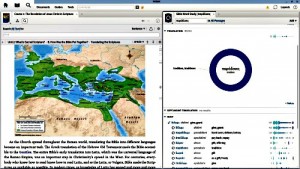 Verbum, the Catholic version of the bestselling Logos Bible Software, has created a program to provide $5 million in grant money to help high schools implement its new religious-education curriculum.
The new program called “Lumen” is a four-year series built to connect the classroom textbooks directly to powerful Verbum software, which integrates the Bible, catechisms, original documents, writings of the Church Fathers and many other resources.
As Alex Renn, Verbum’s marketing and operations team leader, pointed out, “Rather than trying to digitize a textbook, we are writing it with the expectation that students will have access to a collection of key texts, so vocabulary words are links, and reading assignments open books as well as study tools.”
The Lumen program is built software first, rather than creating a textbook and then trying to connect it to digital resources and tools. Verbum’s search features, hyperlinking and myriad visualization and analysis tools make it more than merely a collection of texts.
The software runs on PCs, Macs, iPads, iPhones, Android devices and Kindle Fire, which means students will have access to all of the material wherever they are.
In addition, the curriculum is integrated with Verbum’s Faithlife social-media platform to help facilitate questions, discussions and projects.
“Our Lumen curriculum is an entire integrated learning platform that allows a student to explore the faith in a dynamic way,” said Robert Klesko, Verbum’s Catholic educational-resources product manager. “Most high-school theological instruction gives you a textbook and a Bible. The Lumen program gives you that, plus a digital theological library of over 200 classic Catholic titles. Now, students have access to the documents of Vatican II, the YouCat and the encyclicals of John Paul II in their entirety. All the citations in their textbook are live links, which allow a seamless transition into the primary or secondary-source documents.”
“This, along with embedded catechetical videos from Catholic Answers and Word on Fire, biblical infographics, the ability to share notes and questions through our ‘Community Notes’ and a host of other software tools, allows for a very dynamic presentation of theological material,” he added.
Catechetical Goals
The Lumen program is being created to meet the goals of the U.S. Conference of Catholic Bishops’ document “Doctrinal Elements of a Curriculum Framework.” That framework outlines a four-year, eight-semester course of catechetical instruction designed to rectify the poor catechesis often found in current Catholic education.
The bishops have not been directly involved in developing the program, but Klesko said “they have been very supportive and enthusiastic about the project. They have been very helpful in explaining to us their conformity review process, which we are currently undergoing.”
The U.S. bishops’ outline calls for six core semesters covering the revelation of Christ in Scripture, who is Jesus Christ, the Pascal Mystery, the mission of the Church, sacraments and life in Christ. The other two semesters are reserved for electives in history, Scripture, discipleship, ecumenism and vocation.
While “Doctrinal Elements of a Curriculum Framework” lays out the theology viewed by the bishops as essential for an informed faith, it does not claim to be a complete curriculum.
Verbum decided that this theologically precise document would benefit from the tools and resources found in its software.
Teachers’ Feedback
Marie Pitt-Payne, chairwoman of the theology department at St. Joseph Catholic Academy Upper Campus in Kenosha, Wis., is involved in evaluating the Lumen program and cites the links to the framework as useful in ensuring that her students are meeting the bishops’ benchmarks.
“Verbum helps me as a teacher,” observed Pitt-Payne, “but also enables my students to do quality research in a ‘safe’ environment. When teaching the Catholic faith, I have to give my students specific sources or they will resort to Googling for research. The sources they can end up utilizing through Google can be incredibly inaccurate. Within Verbum, you have a sufficiently extensive but also completely solid environment to cut students loose to really engage with the richness of Church teaching — which is an incredibly enriching experience.”
Kevin Clemens, a religion teacher at Benet Academy in Lisle, Ill., agrees: “The ability to move seamlessly within Verbum from the Scriptures to the Catechism to the writings of the popes and Church Fathers has greatly improved my ability to develop dynamic lessons. My hope for using Verbum more widely in the classroom is that my students not just study about Jesus Christ, but, rather, encounter him head on in the living word as we receive it from the Church.”
The goal of the grant program is to get schools up and running with the new program. It covers a one-year trial of the freshman courses and provides freshmen and faculty with the textbook materials and the Verbum software.
To qualify for a scholarship, a school must currently have or be in the process of implementing (for fall 2015) a 1-1 technology or bring-your-own-device program. This means that students must have a computer or mobile device provided by themselves or the school. In addition, the school will be responsible for a $2,500 fee for Verbum to fly out a trainer for intensive faculty training.
This is a new kind of venture for the Logos/Verbum software family.
It springs, said Klesko, “from a deep need in secondary education. So many schools are transitioning to technology programs which require a laptop or tablet for all instruction. Publishers so invested in paperback books were not responding with the kind of high-quality digital resources that are expected, especially for the vital task of theological instruction.”
“Verbum’s thought, as being a digital-first company, was to take our already powerful software and develop courses for high-school theological instruction,” he said. “So what we’ve developed is a high-powered tool for studying the faith, and since it comes to students delivered through the medium of technology, we hope that it is a tool that they come back to time and time again in their faith formation.”
Previous Post

November 30, 2015
The End, and a Beginning
Next Post
March 17, 2015 Bishop O'Connell On His Recovery, the Synod, and More
Browse Our Archives
Select a Category Abortion Anthropology Archaeology Art Bible Books Chickens Church Computers Culture Wars Evil Fiction Film Games Ghosts Gospel of John Gospels History How I Pray Internet iPhone Islam Israel Jesus Judaism Language Lent Literature Marshall McLuhan Media Medieval Mental Health Mobile Movies Neil Postman News Old Testament Personal Political Pope Pope Benedict Pope Francis Prayer Robots Satan Sciency Sex Shakespeare Social Media Software St. Augustine Synod Synod on the Family Tarot Technology Television Theology Transhumanism Uncategorized Verbum
Select a Month November 2015 October 2015 September 2015 July 2015 June 2015 May 2015 April 2015 March 2015
Follow Us!
TAKE THE
Religious Wisdom Quiz
Who was King Zedekiah, and what did he do to anger God and ensure Jerusalem's fall?
Select your answer to see how you score.
He built an idol He killed Jeremiah He burned the scroll He rebelled against Babylon
Related posts from God and the Machine


A Clarification: Difficult Times, Difficult Thoughts
Benedict and the Bishops on Communion for the...
NY Times Joins the Temple Truthers
TRENDING AT PATHEOS Catholic

Rejecting Doom: Christian Hope And Human Action
Christianity is a religion of hope. We are to have hope and...

It’s What Comes From Within Which Matters
One of the most difficult things for us to understand is why...

Why I Choose the Eucharist Over the Sermon
Choose the Eucharist, Not the Sermon What are we supposed to get...

5 Design Elements Found in Spiritually Rooted Homes
Putting Spirituality Into Home Decor Our homes are more than our living...

Credo: A Story of God Told with the...
About 10 years ago, I began to imagine a personal "Credo" that...

The Anatomy of Divine Revelation in Catholic Thought
The claim that God has made Himself known to human beings is...
view all Catholic blogs
Ad-Free & Subscriber Log-In Subscription Support
- About Us
- 2026 Calendar
- Videos
- Podcasts
- Library of World Religions
- Faith In Media Tracker
- Advertise With Us
- Write for Us
- Privacy Policy
- Terms of Service
- Do Not Sell My Data
- Contact Us
- Radiant Digital
- Manage Newsletter Subscriptions
- Unsubscribe From Notifications
- Sitemap
Copyright 2008-2026, Patheos. All rights reserved.
Subscription Support Ad-Free & Subscriber Log-In
Follow Patheos