
BuddhistCatholicContemplativeEvangelicalGeneral ChristianHinduJewishLatter-day SaintMuslimNew VisionsProgressive Christian
Beliefs
- Buddhist
- Catholic
- Contemplative
- Evangelical
- General Christian
- Hindu
- Jewish
- Latter-day Saint
- More Voices
- Muslim
- New Visions
- Pagan
- Progressive Christian
Topics
- Religion News
- Food and Religion
- Sports and Religion
- Religious Art
- Religious Music and Entertainment
- Religious Events
- History and Religion
- Style and Religion
- Politics and Religion
- Women in Religion
- Recreation Outdoors and Religion
- Business Finance and Religion
- Careers Workplace and Religion
- Education and Religion
- Family Parenting and Religion
- Health Fitness and Religion
- Home and Religion
- Relationships and Religion
- Technology and Religion
- Travel and Religion
Columnists
- Buddhist Columnists
- Business Finance and Religion Columnists
- Careers Workplace and Religion Columnists
- Catholic Columnists
- Contemplative Columnists
- Education and Religion Columnists
- Evangelists Columnists
- Family Parenting and Religion Columnists
- General Christian Columnists
- Health Fitness and Religion Columnists
- Hindu Columnists
- History and Religion Columnists
- Home and Religion Columnists
- Jewish Columnists
- More Voices Columnists
- Latter Day Columnists
- Muslim Columnists
- New Visions Columnists
- Nonreligious Columnists
- Pagan Columnists
- Politics and Religion Columnists
- Progressive Columnists
- Recreation Outdoors and Religion Columnists
- Relationships and Religion Columnists
- Religion News Columnists
- Religious Art Columnists
- Religious Events Columnists
- Religious Music and Entertainment Columnists
- Sports and Religion Columnists
- Style and Religion Columnists
- Technology and Religion Columnists
- Travel and Religion Columnists
- Women in Religion Columnists
Resource Library
- 2026 Calendar
- Library of World Religions
- The 100 Most Holy Places on Earth
- Patheos Answers
- Podcasts
- Videos
- Faith Leaders Database
- Anglican Episcopalian
- Bahai
- Baptist
- Buddhism
- Christianity
- Confucianism
- Eastern Orthodoxy
- Hinduism
- Holiness and Pentecostal
- ISKCON
- Islam
- Judaism
- Lutheran
- Methodist
- The Church of Jesus Christ of Latter-day Saints
- New Age
- Paganism
- Presbytarian and Reformed
- Protestantism
- Religion Behind the Scenes
- Roman Catholic
- Scientology
- Shia Islam
- Sikhism
- Sufism
- Sunni Islam
- Taoism
- Zen
- See all religions
Research Tools
 Ad-Free & Subscriber Log-In Subscription Support
Ad-Free & Subscriber Log-In Subscription Support
Follow Patheos 

- Trending:
- Forgiveness
- |
- Marriage
- |
- Consciousness
- |
- Death Penalty
- |
- Election
- |
- Halloween
 PaterFamilias Today
- Home
- Evangelical
- Gutting Creation of Meaning Guts Scripture
Gutting Creation of Meaning Guts Scripture
Last updated on: February 18, 2019 at 8:17 am by C. R. Wiley
Gutting Creation of Meaning Guts Scripture 2019-02-18T08:17:02-04:00 C. R. Wiley
Patheos Explore the world's faith through different perspectives on religion and spirituality! Patheos has the views of the prevalent religions and spiritualities of the world.

Well, I’m back.
Sorry for the long absence. I was pretty busy, first preparing to deliver a talk at a conference sponsored by Touchstone Magazine back in October. And then by a book I just finished writing that is based on that talk.
I’m happy to announce that Canon Press will publish the book in April. It is entitled, Piety and the War for the Cosmos.
More about that another time. On to the subject of the day–language, creation, and scripture. They’re a package deal.
Another project that has occupied my of late is an institute I am helping to start along with a couple of friends. We’re calling it The Logos Center. (Oddly, “logos”, the Greek for “word” and “reason,” is both overused and under-utilized. We tried to think of something else to call it, but as you’ll see in this post and others that follow, it is the best word for it.)
What follows is a statement of need–a justification for yet another institution of higher learning. Here goes:
The Logos Center
Promoting the best in Christian thought for the practice of ministry
Statement of Need
The practice of pastoral ministry is growing more difficult due to shifts in both academic and popular thought. Changes in our assumptions concerning the natures of the sexes, the conduct of family life, the meaning of justice, and the relationship between public and private realms have produced a crisis of confidence for many pastors.
Because the public standards that had been formed by a Christian civilization were considered sacrosanct, even common sense, almost no work has been done to effectively strengthen or defend them theologically. When it comes to pastoral ministry evangelicals have generally focused on producing “decisions for Christ”. The meaning of the faith is now assumed to fit within a small package known as “a personal relationship with Christ”; the question of how that can be promoted has supplanted every other matter for most pastors. This has led to the restructuring of churches around “felt needs” and market demand. Rather than proclaim the truth about reality, many churches let the market define what is really important for them to say—or, as it is often put, what is “relevant.”
Because of their growing dependence on the market, and because of their highly leveraged ministries kept afloat by debt and public demand, as well as the power of social media to ruin someone’s reputation almost instantly, many mega-church pastors are susceptible to compromising orthodoxy. For example, the Marcionism of Andy Stanley may have as much to do with his need to distance himself from unpopular Old Testament passages as it has to do with his lack of theological acumen.
While this has been going on the enemies of reason and the Christian faith have continued their long war of attrition against public standards. And they have been largely successful in casting them as impediments to personal happiness.
Because many churches have based their message on an experienced sense of personal meaning rather than the truth, even ostensibly conservative ones have difficulty maintaining their own standards. And in some cases, instead of recovering the rationale for those standards, church leaders are actually using the very tools that have undermined standards in society at large to undermine them in the church. We now see a new and aggressive relativism that will not even entertain the idea that these standards may have served a legitimate purpose at one time. Instead it is more common to hear that they were always invidious and without any basis.
To meet these challenges two Christian doctrines should be revitalized: the doctrines of creation and transcendence.
Returning to creation will give us a place to stand. This might sound like the wrong place to begin. For many people the word “creation” brings the interminable debate surrounding Darwin to mind. But that debate is usually focused on only one aspect of the doctrine of creation; and for the most part the strongest advocates for what has become derisively known as “creationism” are indifferent to the features of the doctrine that do not concern the first cause understood in a purely efficient sense. These people want God to get the credit, but they think that the doctrine of creation ends there. It does not. But another reason it may sound odd is due to the juxtaposition of revelation over against creation in some circles. In this view revelation is so alien to the created order it may as well be addressing a formless void, or a world so corrupted by evil so as to have been made meaningless.
But these ways of thinking are self-defeating. Just consider the matter of language. You can’t have a Bible without it. So, at least in this sense, the words were there before the Word. But what is the origin story of human language? And why should we believe it is able to communicate truths that transcend it?
Let’s begin with trees. Could we talk about sin or salvation without them? (Perhaps in a different creation—but we have been placed in this one, and the trees God planted here serve as points of reference.) Consider these trees: the Tree of the Knowledge of Good and Evil, and the Tree of Life. Trees say something about knowledge and about life. Due to their size, their life spans, their usefulness, their beauty, and especially their fruitfulness, they speak. Contrast trees with grass; what grass seems to say is quite different, and we see that in the Bible. It is because the world speaks to us that we have a basis for human language. This is even the case with the humble preposition. Could we string together our sentences without them? They help us organize our thoughts, and make them possible to communicate. They perform this trick by conceptually positioning our ideas spatially and chronologically—in, on, with, through, after, before, etc. And as Einstein taught us (and Augustine before him), time and space are as much created things as trees and grass.
What we are witnessing today is a war upon the meaning of the world. And we’re seeing it being fought right at the level of language. It is being waged in the sciences with the war on the meaning of the word human, and in the humanities with the hostility towards the words maleand female. (It is not without irony that the two cultures C. P. Snow spoke of are now waging a culture war of their own.) But the implications for scripture are fatal. If the world does not speak, then neither does the Bible.
Christians increasingly have exercised the gnostic option and turned inward for meaning. But you can’t dignify this my calling it mysticism. It is simple emotivism. It is nothing but swampy—often mawkish—subjectivism. And getting out of that muck calls for help from above. What we need is transcendence.
(More about that in my next post.)
Podcasts
One of the things that we’re doing to promote The Logos Center is a podcast. We’re calling it The Theology Pugcast because we record it at a local watering hole called, The Corner Pug.
We got our first installment recorded, and when it is up and ready to listen to, I’ll be sure to let you know.
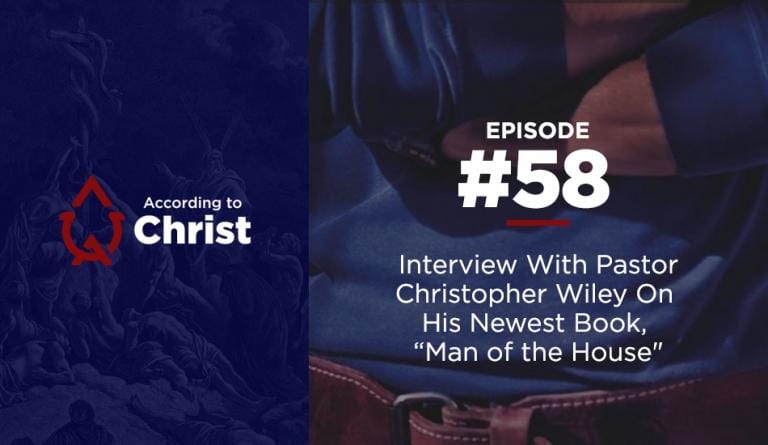 In the meantime, here’s something else to listen to. I was recently interviewed by the fine fellows over at According the Christ. Here’s a link to that interview. I hope you enjoy it. By the way they have a number of other fine interviews there. You should make a point of subscribing.
Until next time, ciao!
Author and Speaking Appearances
Previous Post

November 16, 2018
The Antifragile Pastor
Next Post

February 18, 2019 Transcendence: Meaning from Above
Browse Our Archives
Select a Category Advising a Daughter Aristotle Art Atheism Author and Speaking Appearances Beauty Building Working Houses C R Wiley Children Community Creativity Cultural Apologetics Fatherhood Fiction Fidelity in marriage Film Freedom Gravitas H. P. Lovecraft Happiness Household Economy Infant Baptism Inklings Interpreting the Bible Interviews Jack Donovan Liturgy Localism Man of the House Manliness Martial Virtue Medieval Cosmology Metaphysics Mortimus Clay NecronomiCon New Left New Testament Household Codes Nietzsche Nominalism/Realism Politics Poverty Preaching Productive Property Reaching men Science Self-Sufficiency Side Hustles Social Ethics Social Security Spiritual Disciplines Sublime Techno-gnosticism The Pastor's Survival Guide Theology of the Family Tradition Uncategorized Virtue Weird Fiction
Select a Month February 2019 November 2018 October 2018 July 2018 June 2018 May 2018 April 2018 March 2018 February 2018 January 2018 December 2017 November 2017 October 2017 September 2017 August 2017 July 2017 June 2017 May 2017 April 2017 March 2017 February 2017 January 2017 December 2016 November 2016 October 2016 September 2016 August 2016 July 2016 June 2016 May 2016 April 2016 March 2016 February 2016 January 2016 December 2015
Follow Us!
TAKE THE
Religious Wisdom Quiz
Which king of Judah burned the scroll of Jeremiah's prophecy?
Select your answer to see how you score.
Zedekiah Hezekiah Jehoiakim Josiah
Books by This Author Books by PaterFamilias Today
Books by C. R. Wiley

The Purloined Boy (The Weirdling Cycle #1)

Man of the House: A Handbook for Building a Shelter That Will Last in a World That Is Falling Apart
Related posts from PaterFamilias Today
Transcendence: Meaning from Above
My Latest Appearance on The Chris Craft Show

Is This Evangelicalism's Red-Pill Moment?

Manhood at First Things and Touchstone
TRENDING AT PATHEOS Evangelical

How the author of the world's best hymn...
I've been working with John Newton for a while now. This makes...

Long before this Lectio Divina, Psalm 130 - the song - started...

What About the Trees? Another Living Parable
After I finished writing the last article about falling leaves as a...

Why Classical Education Is a Conversation, Not a...
Come and Read: Joy in Classical Education When I was a little...

Falling Leaves: A Living Parable on Letting Go
I’ve spent the vast majority of my life in the southeast corner...

Cornell University has received a great deal of negative publicity and intense...
view all Evangelical blogs
Ad-Free & Subscriber Log-In Subscription Support
- About Us
- 2026 Calendar
- Videos
- Podcasts
- Library of World Religions
- Faith In Media Tracker
- Advertise With Us
- Write for Us
- Privacy Policy
- Terms of Service
- Do Not Sell My Data
- Contact Us
- Radiant Digital
- Manage Newsletter Subscriptions
- Unsubscribe From Notifications
- Sitemap
Copyright 2008-2026, Patheos. All rights reserved.
Subscription Support Ad-Free & Subscriber Log-In
Follow Patheos