
BuddhistCatholicContemplativeEvangelicalGeneral ChristianHinduJewishLatter-day SaintMuslimNew VisionsProgressive Christian
Beliefs
- Buddhist
- Catholic
- Contemplative
- Evangelical
- General Christian
- Hindu
- Jewish
- Latter-day Saint
- More Voices
- Muslim
- New Visions
- Pagan
- Progressive Christian
Topics
- Religion News
- Food and Religion
- Sports and Religion
- Religious Art
- Religious Music and Entertainment
- Religious Events
- History and Religion
- Style and Religion
- Politics and Religion
- Women in Religion
- Recreation Outdoors and Religion
- Business Finance and Religion
- Careers Workplace and Religion
- Education and Religion
- Family Parenting and Religion
- Health Fitness and Religion
- Home and Religion
- Relationships and Religion
- Technology and Religion
- Travel and Religion
Columnists
- Buddhist Columnists
- Business Finance and Religion Columnists
- Careers Workplace and Religion Columnists
- Catholic Columnists
- Contemplative Columnists
- Education and Religion Columnists
- Evangelists Columnists
- Family Parenting and Religion Columnists
- General Christian Columnists
- Health Fitness and Religion Columnists
- Hindu Columnists
- History and Religion Columnists
- Home and Religion Columnists
- Jewish Columnists
- More Voices Columnists
- Latter Day Columnists
- Muslim Columnists
- New Visions Columnists
- Nonreligious Columnists
- Pagan Columnists
- Politics and Religion Columnists
- Progressive Columnists
- Recreation Outdoors and Religion Columnists
- Relationships and Religion Columnists
- Religion News Columnists
- Religious Art Columnists
- Religious Events Columnists
- Religious Music and Entertainment Columnists
- Sports and Religion Columnists
- Style and Religion Columnists
- Technology and Religion Columnists
- Travel and Religion Columnists
- Women in Religion Columnists
Resource Library
- 2026 Calendar
- Library of World Religions
- The 100 Most Holy Places on Earth
- Patheos Answers
- Podcasts
- Videos
- Faith Leaders Database
- Anglican Episcopalian
- Bahai
- Baptist
- Buddhism
- Christianity
- Confucianism
- Eastern Orthodoxy
- Hinduism
- Holiness and Pentecostal
- ISKCON
- Islam
- Judaism
- Lutheran
- Methodist
- The Church of Jesus Christ of Latter-day Saints
- New Age
- Paganism
- Presbytarian and Reformed
- Protestantism
- Religion Behind the Scenes
- Roman Catholic
- Scientology
- Shia Islam
- Sikhism
- Sufism
- Sunni Islam
- Taoism
- Zen
- See all religions
Research Tools
 Ad-Free & Subscriber Log-In Subscription Support
Ad-Free & Subscriber Log-In Subscription Support
Follow Patheos 

- Trending:
- Forgiveness
- |
- Marriage
- |
- Consciousness
- |
- Death Penalty
- |
- Election
- |
- Halloween
 PaterFamilias Today
- Home
- Evangelical
- On Committing Fiction as a Pastor
On Committing Fiction as a Pastor
Last updated on: April 4, 2018 at 8:38 am by C. R. Wiley
On Committing Fiction as a Pastor 2018-04-04T08:38:54-04:00 C. R. Wiley
Patheos Explore the world's faith through different perspectives on religion and spirituality! Patheos has the views of the prevalent religions and spiritualities of the world.

From a children’s picture book I’m working on.
What follows are some concluding remarks to a talk I am delivering at Eastern Nazarene College tomorrow (4/5/18). The whole talk will hopefully be published somewhere in the near future.
Preachers rarely excel at writing fiction. Not many try, but those who do are often accused of preaching under false pretenses.
(For atheists preachers do nothing but produce fiction–we’re the greatest story-tellers of all time. But you know that’s not what I’m getting at.)
Now, I think most of us rationalize away artistic failure. One way to do it is by defining things incorrectly. Here’s an example of how that can work in this case. A preacher who fails with fiction may say, “Well, truth is more important than art. And since I am a preacher, I use my fiction to preach. I am not an entertainer. I would never stoop so low.”
Well, yes and no. Neil Gaiman has some thoughts on this, and while I’m not a fan of his fiction, he’s certainly a bright fellow with many good things to say about the craft of writing.
Here he is in The Guardian.
We writers – and especially writers for children, but all writers – have an obligation to our readers: it’s the obligation to write true things, especially important when we are creating tales of people who do not exist in places that never were – to understand that truth is not in what happens but what it tells us about who we are. Fiction is the lie that tells the truth, after all. We have an obligation not to bore our readers, but to make them need to turn the pages. One of the best cures for a reluctant reader, after all, is a tale they cannot stop themselves from reading. And while we must tell our readers true things and give them weapons and give them armour and pass on whatever wisdom we have gleaned from our short stay on this green world, we have an obligation not to preach, not to lecture, not to force predigested morals and messages down our readers’ throats like adult birds feeding their babies pre-masticated maggots; and we have an obligation never, ever, under any circumstances, to write anything for children that we would not want to read ourselves. Neil Gaiman in The Guardian, Why Our Future Depends on Libraries, Reading, and Daydreaming,
This assumes that we’d never want to consume predigested morals—but I know many, many readers who want nothing but that. Even so, Gaiman is a tad disingenuous here because he’s preaching very forcefully against preaching, which is what you would expect a modern writer to do. But to his credit he wants to tell the truth, and to show us who we are. And this, he tells us, is not compatible with preaching. Fiction is something you should chew on for yourself in order to draw whatever nourishment you can from it. And apparently that’s not what preaching does.
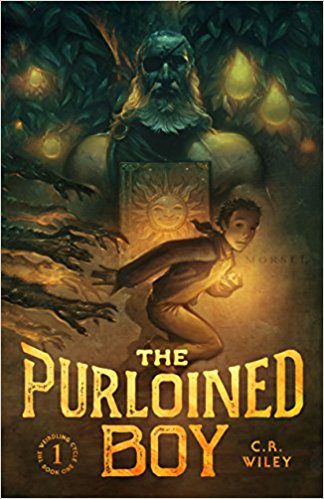
http://canonpress.com/PurloinedBoy/
Being a preacher myself I’m more sympathetic to the task. Beside the fact that writing well is harder than it looks, I think the primary reason preachers are often bad writers is because we don’t want people to miss the point. We want them to understand.
Yet, for people who claim to be following in Jesus steps, this is a little odd. Jesus was accused to being obscure and difficult, of not speaking plainly; why, he even told stories where bad guys look good, and good guys look bad. And he once actually said that he spoke in parables precisely so that certain people wouldn’t know what he was talking about.
Jesus didn’t make things easy I believe, in part, because making things easy doesn’t change minds. It merely confirms what people already think, that, or it fails to get past the defenses they erect against things they don’t want to think about anyway. We make things so easy to understand people can see them coming a mile off. When people have to work to understand something difficult their thinking is altered to accommodate it. And the mind never goes back to its original shape. For the truth teller, that’s half the job. The other half is getting people to love the truth. And this is where fiction works supremely well. Fiction is a form of virtual reality that people can safely enter knowing they can leave at any time. And when they sympathize with imaginary people, their new sympathies can go with them out into the real world, the one we all share. Just think of the story of the Good Samaritan.
But we’re still in familiar territory. For an older, and much stranger view, let’s return to Flannery O’Connor, a woman who could write stories as disturbing as those we have from Neil Gaiman, yet which leave you in a very different place than Gaiman would have you go.
According to O’Connor the form of the story cannot be separated from its truth.
I prefer to talk about the meaning in a story rather than the theme of a story. People talk the theme of a story as if the theme were like a string that a sack of chicken feed is tied with. They think that if you can pick out the theme, the way you pick the right thread in the chicken feed sack, you can rip the story open and feed the chickens. But this is not the way meaning works in fiction. When you can state the theme of a story, when you can separate it from the story itself, then you can be sure the story is not a very good one. The meaning of the story has to be embedded in it, has to be made concrete in it. A story is a way to say something that can’t be said any other way, and it takes every word in the story to say what the meaning is. You tell a story because a statement would be inadequate.

A character I drew for a children’s picture book I’m working on.
There is something profound here. We tend to think that propositional truth is truth’s highest form rather than a mere distillation of it. Abstraction abstracts. It tries to remove the essences of things and leave their husks behind. That begs the question of what language is, though. What about words, and how do they carry their freights? Is language a kind of trick, leaving us with images but nothing real? Or can words communicate reality itself. When John said “In the beginning was the Word, and the Word was with God, and the Word was God.” he was getting at this. You cannot abstract the truth of Jesus from Jesus. He is the Word, and he is God, at the same time.
Paradoxically, a story can be closer to the truth than a proposition is. I suspect that’s one reason that people perk up when the stories begin. I’m certainly not against propositions. I’ve been using them my entire life. But they simplify things. That’s their genius. If we had nothing but stories we might feel the meaning of our lives more acutely, but we’d also have shorter lives. My only objective here is to knock the proposition off its perch as the best way to tell the truth. The gospel is a story, after all, not a proposition, not even four of them.
I am now at high point of my argument. This is precisely so because stories get us closer to the ground. Stories, like people, rise from the soil of creation. That’s why they can reveal things. As Flannery O’Connor said, it is through a story that you see a theme. And that can only be so because the world as a whole, with all of its many parts, gives us our words. And the world contains a theme: the glory of God.
It’s all in Psalm 19, all in Psalm 19, what do they teach these preachers in these seminaries? The preacherly story-teller, even when he writes a fiction, if he does it well, tells a story that will preach. It may even help him employ propositional truths.
Author and Speaking Appearances
Previous Post

March 14, 2018
The Family that Votes Together Stays Together
Next Post

April 6, 2018 A Young Man Reflects on Gun Violence Walkout Protest
Browse Our Archives
Select a Category Advising a Daughter Aristotle Art Atheism Author and Speaking Appearances Beauty Building Working Houses C R Wiley Children Community Creativity Cultural Apologetics Fatherhood Fiction Fidelity in marriage Film Freedom Gravitas H. P. Lovecraft Happiness Household Economy Infant Baptism Inklings Interpreting the Bible Interviews Jack Donovan Liturgy Localism Man of the House Manliness Martial Virtue Medieval Cosmology Metaphysics Mortimus Clay NecronomiCon New Left New Testament Household Codes Nietzsche Nominalism/Realism Politics Poverty Preaching Productive Property Reaching men Science Self-Sufficiency Side Hustles Social Ethics Social Security Spiritual Disciplines Sublime Techno-gnosticism The Pastor's Survival Guide Theology of the Family Tradition Uncategorized Virtue Weird Fiction
Select a Month February 2019 November 2018 October 2018 July 2018 June 2018 May 2018 April 2018 March 2018 February 2018 January 2018 December 2017 November 2017 October 2017 September 2017 August 2017 July 2017 June 2017 May 2017 April 2017 March 2017 February 2017 January 2017 December 2016 November 2016 October 2016 September 2016 August 2016 July 2016 June 2016 May 2016 April 2016 March 2016 February 2016 January 2016 December 2015
Follow Us!
TAKE THE
Religious Wisdom Quiz
Which parable teaches about praying persistently, like a widow before a judge?
Select your answer to see how you score.
The Talents The Persistent Widow The Sower The Mustard Seed
Books by This Author Books by PaterFamilias Today
Books by C. R. Wiley

The Purloined Boy (The Weirdling Cycle #1)

Man of the House: A Handbook for Building a Shelter That Will Last in a World That Is Falling Apart
Related posts from PaterFamilias Today

Gutting Creation of Meaning Guts Scripture
My Latest Appearance on The Chris Craft Show

Manhood at First Things and Touchstone
TRENDING AT PATHEOS Evangelical

How the author of the world's best hymn...
I've been working with John Newton for a while now. This makes...

Long before this Lectio Divina, Psalm 130 - the song - started...

What About the Trees? Another Living Parable
After I finished writing the last article about falling leaves as a...

Why Classical Education Is a Conversation, Not a...
Come and Read: Joy in Classical Education When I was a little...

Falling Leaves: A Living Parable on Letting Go
I’ve spent the vast majority of my life in the southeast corner...

Cornell University has received a great deal of negative publicity and intense...
view all Evangelical blogs
Ad-Free & Subscriber Log-In Subscription Support
- About Us
- 2026 Calendar
- Videos
- Podcasts
- Library of World Religions
- Faith In Media Tracker
- Advertise With Us
- Write for Us
- Privacy Policy
- Terms of Service
- Do Not Sell My Data
- Contact Us
- Radiant Digital
- Manage Newsletter Subscriptions
- Unsubscribe From Notifications
- Sitemap
Copyright 2008-2026, Patheos. All rights reserved.
Subscription Support Ad-Free & Subscriber Log-In
Follow Patheos