
BuddhistCatholicContemplativeEvangelicalGeneral ChristianHinduJewishLatter-day SaintMuslimNew VisionsProgressive Christian
Beliefs
- Buddhist
- Catholic
- Contemplative
- Evangelical
- General Christian
- Hindu
- Jewish
- Latter-day Saint
- More Voices
- Muslim
- New Visions
- Pagan
- Progressive Christian
Topics
- Religion News
- Food and Religion
- Sports and Religion
- Religious Art
- Religious Music and Entertainment
- Religious Events
- History and Religion
- Style and Religion
- Politics and Religion
- Women in Religion
- Recreation Outdoors and Religion
- Business Finance and Religion
- Careers Workplace and Religion
- Education and Religion
- Family Parenting and Religion
- Health Fitness and Religion
- Home and Religion
- Relationships and Religion
- Technology and Religion
- Travel and Religion
Columnists
- Buddhist Columnists
- Business Finance and Religion Columnists
- Careers Workplace and Religion Columnists
- Catholic Columnists
- Contemplative Columnists
- Education and Religion Columnists
- Evangelists Columnists
- Family Parenting and Religion Columnists
- General Christian Columnists
- Health Fitness and Religion Columnists
- Hindu Columnists
- History and Religion Columnists
- Home and Religion Columnists
- Jewish Columnists
- More Voices Columnists
- Latter Day Columnists
- Muslim Columnists
- New Visions Columnists
- Nonreligious Columnists
- Pagan Columnists
- Politics and Religion Columnists
- Progressive Columnists
- Recreation Outdoors and Religion Columnists
- Relationships and Religion Columnists
- Religion News Columnists
- Religious Art Columnists
- Religious Events Columnists
- Religious Music and Entertainment Columnists
- Sports and Religion Columnists
- Style and Religion Columnists
- Technology and Religion Columnists
- Travel and Religion Columnists
- Women in Religion Columnists
Resource Library
- 2026 Calendar
- Library of World Religions
- The 100 Most Holy Places on Earth
- Patheos Answers
- Podcasts
- Videos
- Faith Leaders Database
- Anglican Episcopalian
- Bahai
- Baptist
- Buddhism
- Christianity
- Confucianism
- Eastern Orthodoxy
- Hinduism
- Holiness and Pentecostal
- ISKCON
- Islam
- Judaism
- Lutheran
- Methodist
- The Church of Jesus Christ of Latter-day Saints
- New Age
- Paganism
- Presbytarian and Reformed
- Protestantism
- Religion Behind the Scenes
- Roman Catholic
- Scientology
- Shia Islam
- Sikhism
- Sufism
- Sunni Islam
- Taoism
- Zen
- See all religions
Research Tools
 Ad-Free & Subscriber Log-In Subscription Support
Ad-Free & Subscriber Log-In Subscription Support
Follow Patheos 

- Trending:
- Forgiveness
- |
- Marriage
- |
- Consciousness
- |
- Death Penalty
- |
- Election
- |
- Halloween
 PaterFamilias Today
- Home
- Evangelical
- The Big Short: A Little Reminder
The Big Short: A Little Reminder
Last updated on: October 17, 2017 at 8:05 am by C. R. Wiley
The Big Short: A Little Reminder 2017-10-17T08:05:50-04:00 C. R. Wiley
Patheos Explore the world's faith through different perspectives on religion and spirituality! Patheos has the views of the prevalent religions and spiritualities of the world.
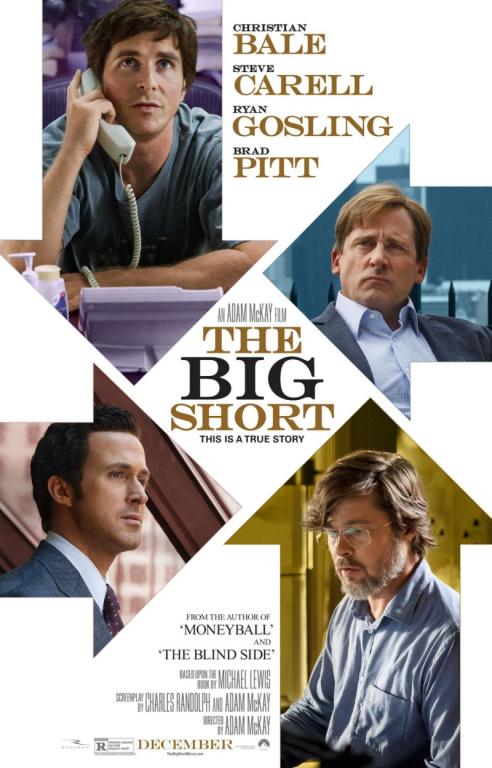
http://www.movieinsider.com/m6937/the-big-short-inside-the-doomsday-machine
This review was originally published at Patheos February 1, 2016. A year and a half later maybe we should think about its message again.
—
By 2004 I owned real estate in 3 states, had 18 tenants, and two people worked for me part-time. In 2006 I sold it all, paid enough capital gains tax to support a family of 4 for a year, and sat down to watch the world come to an end.
I did pretty well. Really well, considering I had a wife, three small children, a growing church, a church building program, and I taught philosophy at a local college. I built the real estate portfolio in my spare time.
Getting rich wasn’t the goal, financial independence was. I was on my way out of my old denomination and I needed a golden parachute. In the corporate world sometimes you get one of those when you leave that world behind. I had to make my own.
But I could see what was coming with the housing bubble. Don’t let anyone fool you, lots of people saw what was coming. The problem wasn’t information, the problem was psychology. I’ll get to that in a minute.
So, after I left my old church, I decided to help others get out.
From 2004 through 2007 I represented small real estate investors as they liquidated their holdings. Those were halcyon days if you were a seller.
The prices made no sense from an investor’s point of view and all the old timers knew it. So I bought the grand lists from the nearby towns (a grand list is a list of properties and their owners including the mailing addresses of owners) and I began a direct marketing campaign.
My message was simple. I was the Jeremiah of my market. “Get out now before it’s too late!” I helped a lot of people get out. In my first year I became the number one listing agent of small investment property in a 20 mile radius. By the end of 2007 it really was too late and I went on to do other things.
This is why watching, The Big Short was a little trip down memory lane for me. I could feel the old juices flowing. Those were fun times if you kept your head. Most people didn’t. I recommend seeing the film, it’s great. If you’re not familiar with it, here’s the trailer–
I just have some quick thoughts on this. The film gets some things right, but it is a little fraudulent itself in a few ways.
First, you need to understand how a short works.
He’s the concept that most people don’t understand: when prices move, you can make money, no matter which way they move. Anyone can make money in a rising market. That’s when everyone is happy and even idiots pat themselves on the back. But you can also make money when the herd is losing it. That takes real intelligence and lots of guts.
A short is something that increases in value when something else goes down in value. Think of it like a see-saw. When one is up, the other is down and vice-versa.
The derivatives market is where folk can invest in this sort of thing. You can buy puts on equities that will increase in value as the underlying equities lose value. It’s subtle, and only for the big boys. People didn’t think that sort of thing could be done with mortgages. What happened with the men who shorted the market in mortgaged backed securities is they actually created a way to short the market, something called a credit default swap.
You really don’t need to understand the instrument itself, just keep that see-saw concept in mind. When the market went down and millions of people lost billions of dollars, these guys hit the jackpot.
What The Big Short got right:
The madness of crowds
Have you ever seen a piñata burst at a child’s birthday party and the mad scramble that follows? That’s what it was like. People turned their houses into ATMs, cashing out equity to buy boats, fund trips to Disney World, and buy many other things that either evaporate or depreciate rapidly. Everybody was on a first name basis with their mortgage brokers since they refinanced their homes at least once a year. Maybe worse, many of these people became mortgage brokers themselves.
But what made it different from a piñata is many people thought the world generated piñatas, it was made of piñatas. And when you brought up how crazy it all was people said what they always say when there’s a financial bubble, “It’s different this time.”
Wall Street itself is a bubble–of a different kind
The people who work there think they live and work in the real world, but they don’t. Wall Street is an echo chamber, worse, it’s like high school, where all the cool rich kids really don’t believe the rules that apply to others also apply to them. Everything is mediated, people live by the numbers, and the numbers are trusted even when they don’t add up with home-truths like, “This is too good to be true”.
In the film, Mark Baum, the character Steve Carell plays, suspects there is a bubble keeping him from the truth, so he gets out and visits the world I lived in, the world of wildly over-valued real estate and sleazy mortgage brokers (I knew some). Then he goes off to another world where the folks who worked bundling bonds and bond-rating all reveal themselves to be on the make. After each encounter Baum ups his bet against the system.
It takes a commitment to reality and tremendous self-confidence to bet against the mob
When people want something to be the case, you run the risk of making lots of people angry when you tell the truth. That, or you’re laughed out of the room. Both happened to our heroes in The Big Short. But these men had the strength of will and the courage to remain true to their convictions. Why? Because they were in touch with reality. It is amazing how people can succumb to the belief that reality is subject to a vote, that if enough people want something to be true, it is. But it happens a lot.
There is a larger bubble than the one on Wall Street, it is the mediated world of popular culture. Millions of people don’t live in reality. Unlike the outsiders in The Big Short, they have no basis for independent judgment and consequently no self-confidence. They always defer to authority, whether that authority is CNBC or the latest narrative handed down by the savants of political correctness. We’re a nation of patsies.
Now for what the film misses
The big banks had a lot of help
The moral of the film is: big banks are evil. That’s just too easy. Complicity was nearly universal. Sure, the banks have a lot to account for. I hate big banks. (I didn’t use them at all when I was investing. I only worked with local banks. I knew the people who lent me money and they knew me.)
But you’re fooling yourself if you think the banks acted alone. No one wanted the gravy train to stop.
Liberals were part of the problem
Guess what, politicians like Barney Frank, actually played a role in creating the whole crisis by encouraging lenders to lower credit worthiness standards in order to get low income people in on the bonanza.
I remember a deal I helped broker with an ethic minority buyer with bad credit who actually managed to get 100% financing on a two family in need of a new roof. $20,000 went back to him at closing to pay for it. A year later I drove down the street the house is on. It was in foreclosure and nothing had been done to the roof. Checking into it I discovered the buyer put the money up his nose (cocaine) and he had not made single payment on the loan. The mortgage broker had played by the rules and everyone had gone away from the deal thinking he was an agent of social justice.
Breaking up the big banks won’t solve the problem
Do you recognize any of these names? Cape Cod Bank, Savings Bank of Manchester, Rockville Bank? Those were the banks I worked with a decade ago. They were all local banks, I think all of them were over a hundred years old when I did business with them. They knew their communities well. They’re all gone now.
Rockville Bank actually survived the crash and didn’t need any bailout money. The crash isn’t why it is gone. The reason its gone is the global market. In order to compete its shareholders felt it need more resources, so it merged with another bank. Now it is a regional bank and all the people I knew there are long gone.
There has been a brain-drain in local banking. The accumulated wisdom that took decades to create is gone. It is nearly impossible to find a bank with a real commitment to the community it is in. Breaking up the big banks won’t bring that back. It is a resource that will take decades to nourish to have again, if we can ever get it back.
A final thought–the next bubble to burst
Bubbles form when people no longer have any direct basis in reality for judging the value of things. People want experts to tell them what to believe and they want other people to take the risks.
Where do we see this today? It’s all around us.
I’m shorting the welfare state. It is overvalued and unsustainable. But when I say this to people, they look a me like I’m insane. The welfare state is a bubble that could never burst.
I’ve seen that look before. You may want to join me in shorting the welfare state, I’ll tell you how I’m doing it piecemeal in this blog over time.
Previous Post
October 10, 2017
Man of the House Reviewed in Chronicles
Next Post

October 23, 2017 Christianity is a Record-Keeping Religion
Browse Our Archives
Select a Category Advising a Daughter Aristotle Art Atheism Author and Speaking Appearances Beauty Building Working Houses C R Wiley Children Community Creativity Cultural Apologetics Fatherhood Fiction Fidelity in marriage Film Freedom Gravitas H. P. Lovecraft Happiness Household Economy Infant Baptism Inklings Interpreting the Bible Interviews Jack Donovan Liturgy Localism Man of the House Manliness Martial Virtue Medieval Cosmology Metaphysics Mortimus Clay NecronomiCon New Left New Testament Household Codes Nietzsche Nominalism/Realism Politics Poverty Preaching Productive Property Reaching men Science Self-Sufficiency Side Hustles Social Ethics Social Security Spiritual Disciplines Sublime Techno-gnosticism The Pastor's Survival Guide Theology of the Family Tradition Uncategorized Virtue Weird Fiction
Select a Month February 2019 November 2018 October 2018 July 2018 June 2018 May 2018 April 2018 March 2018 February 2018 January 2018 December 2017 November 2017 October 2017 September 2017 August 2017 July 2017 June 2017 May 2017 April 2017 March 2017 February 2017 January 2017 December 2016 November 2016 October 2016 September 2016 August 2016 July 2016 June 2016 May 2016 April 2016 March 2016 February 2016 January 2016 December 2015
Follow Us!
TAKE THE
Religious Wisdom Quiz
What did the soldier dress Jesus in after he was accused?
Select your answer to see how you score.
Nothing Thorns Golden Robe Scarlet Robe
Books by This Author Books by PaterFamilias Today
Books by C. R. Wiley

The Purloined Boy (The Weirdling Cycle #1)

Man of the House: A Handbook for Building a Shelter That Will Last in a World That Is Falling Apart
Related posts from PaterFamilias Today


Advice for a Single Woman Who Is Looking...

Making the Good Life from Home
TRENDING AT PATHEOS Evangelical

How the author of the world's best hymn...
I've been working with John Newton for a while now. This makes...

Long before this Lectio Divina, Psalm 130 - the song - started...

What About the Trees? Another Living Parable
After I finished writing the last article about falling leaves as a...

Why Classical Education Is a Conversation, Not a...
Come and Read: Joy in Classical Education When I was a little...

Falling Leaves: A Living Parable on Letting Go
I’ve spent the vast majority of my life in the southeast corner...

Cornell University has received a great deal of negative publicity and intense...
view all Evangelical blogs
Ad-Free & Subscriber Log-In Subscription Support
- About Us
- 2026 Calendar
- Videos
- Podcasts
- Library of World Religions
- Faith In Media Tracker
- Advertise With Us
- Write for Us
- Privacy Policy
- Terms of Service
- Do Not Sell My Data
- Contact Us
- Radiant Digital
- Manage Newsletter Subscriptions
- Unsubscribe From Notifications
- Sitemap
Copyright 2008-2026, Patheos. All rights reserved.
Subscription Support Ad-Free & Subscriber Log-In
Follow Patheos