
BuddhistCatholicContemplativeEvangelicalGeneral ChristianHinduJewishLatter-day SaintMuslimNew VisionsProgressive Christian
Beliefs
- Buddhist
- Catholic
- Contemplative
- Evangelical
- General Christian
- Hindu
- Jewish
- Latter-day Saint
- More Voices
- Muslim
- New Visions
- Pagan
- Progressive Christian
Topics
- Religion News
- Food and Religion
- Sports and Religion
- Religious Art
- Religious Music and Entertainment
- Religious Events
- History and Religion
- Style and Religion
- Politics and Religion
- Women in Religion
- Recreation Outdoors and Religion
- Business Finance and Religion
- Careers Workplace and Religion
- Education and Religion
- Family Parenting and Religion
- Health Fitness and Religion
- Home and Religion
- Relationships and Religion
- Technology and Religion
- Travel and Religion
Columnists
- Buddhist Columnists
- Business Finance and Religion Columnists
- Careers Workplace and Religion Columnists
- Catholic Columnists
- Contemplative Columnists
- Education and Religion Columnists
- Evangelists Columnists
- Family Parenting and Religion Columnists
- General Christian Columnists
- Health Fitness and Religion Columnists
- Hindu Columnists
- History and Religion Columnists
- Home and Religion Columnists
- Jewish Columnists
- More Voices Columnists
- Latter Day Columnists
- Muslim Columnists
- New Visions Columnists
- Nonreligious Columnists
- Pagan Columnists
- Politics and Religion Columnists
- Progressive Columnists
- Recreation Outdoors and Religion Columnists
- Relationships and Religion Columnists
- Religion News Columnists
- Religious Art Columnists
- Religious Events Columnists
- Religious Music and Entertainment Columnists
- Sports and Religion Columnists
- Style and Religion Columnists
- Technology and Religion Columnists
- Travel and Religion Columnists
- Women in Religion Columnists
Resource Library
- 2026 Calendar
- Library of World Religions
- The 100 Most Holy Places on Earth
- Patheos Answers
- Podcasts
- Videos
- Faith Leaders Database
- Anglican Episcopalian
- Bahai
- Baptist
- Buddhism
- Christianity
- Confucianism
- Eastern Orthodoxy
- Hinduism
- Holiness and Pentecostal
- ISKCON
- Islam
- Judaism
- Lutheran
- Methodist
- The Church of Jesus Christ of Latter-day Saints
- New Age
- Paganism
- Presbytarian and Reformed
- Protestantism
- Religion Behind the Scenes
- Roman Catholic
- Scientology
- Shia Islam
- Sikhism
- Sufism
- Sunni Islam
- Taoism
- Zen
- See all religions
Research Tools
 Ad-Free & Subscriber Log-In Subscription Support
Ad-Free & Subscriber Log-In Subscription Support
Follow Patheos 

- Trending:
- Forgiveness
- |
- Marriage
- |
- Consciousness
- |
- Death Penalty
- |
- Election
- |
- Halloween
 PaterFamilias Today
- Home
- Evangelical
- Rev. Gore’s Altar Call: An Inconvenient Sequel Reviewed
Rev. Gore’s Altar Call: An Inconvenient Sequel Reviewed
Last updated on: September 28, 2017 at 10:55 am by C. R. Wiley
Rev. Gore’s Altar Call: An Inconvenient Sequel Reviewed 2017-09-28T10:55:03-04:00 C. R. Wiley
Patheos Explore the world's faith through different perspectives on religion and spirituality! Patheos has the views of the prevalent religions and spiritualities of the world.
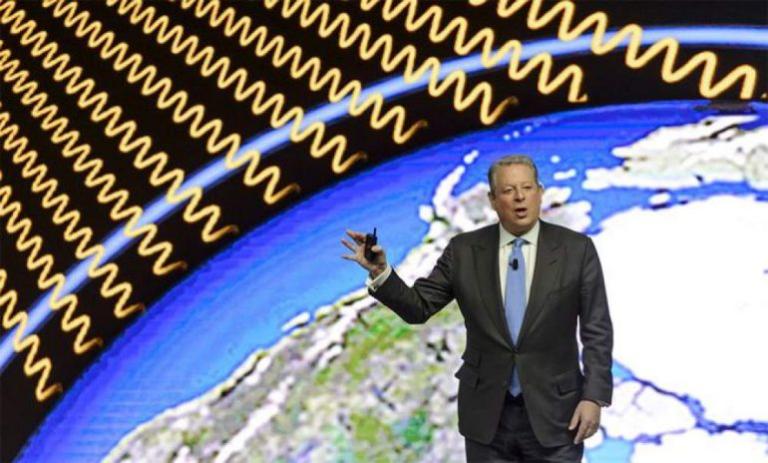
It’s propaganda, but there is more Elmer Gantry than Goebbels to it. Rev. Gore has delivered an End Times sermon, complete with charts and an altar call. (My review of An Inconvenient Sequel originally published at Scenes Media and partially reproduced here by permission.)
—
I’m not a climate scientist, and I don’t play one on television. Even so, I was invited to a private screening of Al Gore’s new documentary, An Inconvenient Sequel. I’m sorry to say I don’t feel any closer to being one after seeing it — more about that in a moment.
—
I wasn’t asked to attend because I am some sort of advocate for the environment. If anything, I’d describe myself as a climate change agnostic. (I have more questions than answers.) My guess is I was invited to the screening because I’m a minor league theologian who writes about film when he’s asked to. So there I was, just a few days ago, surrounded by the Al Gore cheerleading squad, watching An Inconvenient Sequel. Afterwards the directors of the film appeared to answer questions.
—
Now, I do have a background in the visual arts, and this helps me evaluate the use (and misuse) of images. And just on that basis, I can tell you that Al Gore’s new film is pretty much propaganda.
—
It is a film, and images are what films are made of. But images are always framed, not just by cropping things out, but also by what you surround them with. When you set an image in a particular place, the place goes a long way toward helping you interpret what you see. Sometimes the place is a story. And sometimes the story distorts the image.Here’s what I mean. When we see someone suffering we naturally feel uncomfortable. Our capacity to feel with the victim gets working. This fellow-feeling is what we call sympathy. We want to act, ostensibly to relieve the suffering, but also because we don’t like feeling uncomfortable. Since we can’t actually do anything for a person on a screen we’re open to suggestion. And this is what makes us patsies for manipulation. When the voice-over says: “This is why this person is suffering, and this is what you can do to help,” we want to believe it. But would the recommended action actually help? Perhaps there is another agenda being served. Or maybe the narrator is just plain wrong.
—
An Inconvenient Sequel is full of this sort of thing. That and statistics, as in “damned lies and statistics”, as Mark Twain memorably put it. These are always framed so as to serve the storyline, then fade into the distance before we have a chance to think about them.
—
The Myth of the Cave
As I watched An Inconvenient Sequel I felt a need to reach for Plato in order to review his thoughts on why images can’t be trusted. Now that should get you thinking of the best known part of The Republic, the Myth of the Cave. I could identify with it. As I looked at the shadows being cast on the wall, alongside the others who were similarly chained to their seats, something in me rebelled, and I felt a need to get up and walk out of the darkness.
You may remember that in Plato’s story the man who does that comes back to bring a report from a sunlit land outside the cave. But things don’t go well for him. The discomforting light he shines into their eyes is resented and he’s attacked. If you’re a climate change agnostic, like me — or worse, a skeptic, like some of my friends — you’re used to this sort of thing:
“He doesn’t care about the planet!”
“He’s stupid!”
“What a callous ass! Think of all those people dying in those preventable hurricanes!” (Yep, preventable.)
“Get him!”
If you’d like to drag me to your pillory just now, I advise calm. For one thing, your strident impatience raises suspicion. Years ago, when I worked in the inner city, I heard a lot of sad tales that I, only I, could bring to a happy conclusion. But I had to act right now! No time for thought! No time to question! Just cough up the money! Delay only proved that I was unfeeling and probably evil.
What I learned the hard way, more times than I care to recount, is the more impatient the demand to act, the more likely a scam is going on.
At the Temple to the Climate
A temple to climate change seems to have been raised on questionable foundations. They even appear to have a quasi-religious character, more articles of faith than simple facts. I’d like to dig them up and think about them a little. (By the way, the term “true believer” was used positively by one of the directors of the film in his comments following the screening, thereby demonstrating both his ignorance of its provenance — the book by Eric Hoffer — and the fact that Hoffer used it pejoratively for people who are dangerous ideologues.)
Here are some questions begged in the film that I think are worth questioning.
The Climate Isn’t Supposed to Change
Obviously, responsible scientists don’t believe this. But I’m not talking about them. I’m referring to the man in the street. The man in the street is constitutionally conservative, even when his politics are left-wing. Change unnerves him, like hard turbulence on a cross-country flight. His alarm makes him susceptible to suggestion.
But scientists tell us that our planet has had remarkable climate change over its history. I used to live on a sandbar that scientists believe was formed by a receding glacier at the end of the last Ice Age. I’m speaking of Cape Cod. It’s a beautiful place. From my perspective global warming was a good thing in that instance. But I know what you’re thinking, “You moron, think about the damage climate change brings!” I think damage here can be broken down into two categories—damage to the environment, and more directly, damage to ourselves. Let’s look at each:
Nature is fragile
Well, yes it is, and no it isn’t. It depends.
Yes, people can change the physical environments they live in for the worse. Just take a look at Haiti from space. That orange ring surrounding it beneath the water is the once fertile topsoil that was washed away after deforestation. But even Haiti can heal in time.
But nature, remember, is often the perpetrator of damage as well as the victim. I recall seeing the devastation following the Mount St. Helen’s eruption. For miles around the place looked like the industrial wasteland left by the mining of the oil sands in Alberta, Canada. But today, to the untrained eye, it looks like nothing happened. There are trees, and flowers, and wildlife. Does this justify harvesting the oil sands of Alberta? I’m not saying that. But it does put it in a different light, and I think a clearer one.
People die in hurricanes because of climate change
Yes, Mr. Gore put it that baldly. But severe weather has been with us for a long, long time. The thousands of people who died in Galveston, Texas in 1900 died needlessly. But not because of climate change as Al Gore thinks of it. If there had cameras recording the event, a voiceover blaming climate change could be no more substantiated than the claim that the Typhoon Haiyan in 2013 was.
The reason the folks died at Galveston had something to do with being on a sandbar off the coast of Texas. Maybe a global movement should be underway to make coastal regions safer? It seems to me that the correlation between better levies and few hurricane deaths is easier to prove that any such claims for lower CO2 levels.
Is severe weather getting worse? Possibly. But our data sample is pretty small. The planet has been killing people far, far longer than we’ve been recording temperatures. Maybe more people are living in places where severe weather can kill you. Maybe it is a combination of many factors.
People can be morally spotless
When it comes to morality, human beings just muddle along. We will never build Utopia. (By definition it doesn’t exist.) Instead every choice is a kind of tradeoff. And we don’t always get to choose between good and bad. Sometimes it is between good and better, or just one pretty-good thing and another pretty-good thing. Hopefully the goods we choose are better for us than the choices we don’t make. But we can’t be sure of that sometimes.
Take Mr. Gore’s film. Ostensibly it is about choosing in favor of the environment. But what the film leaves to our imaginations is the very real people who suffer when this choice is made. For example, I’m thinking of all the people who have been left behind in West Virginia and in other places that depend on coal mining. The only time this is hinted at is by dismissive abstractions like “the fossil fuel industry.” That brings to mind cigar-puffing fat cats. But what I think about is working people who have taken pride in their work for generations. They are Untouchables now, and invisible to the beautiful people. Donald Trump comes up a lot in the film as a sinister and ignorant fellow. But if Mr. Gore of An Inconvenient Sequel is the Lorax who speaks for the trees, then why isn’t Mr. Trump Horton from Horton Hears a Who? The Whoville of Mr. Trump’s story is situated in West Virginia where people are so economically tiny that people in New York, Washington, and San Francisco don’t believe that they even exist — or have a right to.
This brings me to my favorite part of the film. (Yes, I have a favorite part.) At the Paris Agreement, the Indian Prime Minister, Narendra Modi, demonstrating he understands The Art of the Deal, threatens to build 400 coal-fired power plants unless he gets concessions from Western nations on loans. Mr. Gore, seeing his chance, strong-arms the owners of Solar City to give away proprietary technology to the Indian government. (Prediction: India will soon be a big exporter of cheap solar panels.) The gist of Modi’s argument is powerful, and to my way of thinking, persuasive. Essentially it is this: isn’t it convenient that the West gets 150 years of cheap, dirty energy to build a civilization that now dominates the globe and just when India, using the same technology, begins to challenge that dominance, there is a global climate change crisis?
Less cynically, Modi turns morality back on the West during his speech at the Paris Climate Talks, he put it this way, (I’m paraphrasing): “I have 300 million people without power in my country. And you tell me that building 400 coal-fired electrical plants is immoral? I tell you leaving them without power is immoral!”
This is what I mean by trade-offs.
But science makes us certain!
Actually, no. Scientific forecasts give us probabilities, not certainties. But most people don’t look to science for that.
Climate scientists are not time travelers from the future who have come to warn us about something that has actually happened fifty years from now. They’re not reading the entrails of a goat, either. They occupy a space somewhere in between. And the more actual history they have to work with, the better their forecasts tend to be. Furthermore, scientists are often surprised by what they see when they look at real events. The math and computer models can only take you so far.
And I won’t list for you all the scientific red herrings and false alarms I can remember just in the course of my lifetime. Even the climate change crisis isn’t unprecedented. I remember the Club of Rome and The Limits to Growth like it was yesterday. Their fevered predictions of overpopulation and mass famine didn’t come to pass, but they did keep Charlton Heston working for about a decade: Omega Man, Planet of the Apes, and my favorite, Soylent Green. Fun stuff. Please forgive my lightheartedness concerning something so many people take very seriously, but once burned, twice shy. I just don’t believe scientists are infallible.
If this bothers you, see my previous point about muddling through. If you can’t bring yourself to do that, I recommend getting religion. But whatever you do, don’t make climate change fever your religion. And this brings me to my conclusion and the Reverend Gore’s.
Pastor Gore’s Altar Call
Click here to read about Rev. Gore’s conclusion, and mine.
Previous Post

August 1, 2017
I'm interviewed on The Eric Metaxas Show
Next Post

August 11, 2017 Why I Don't Give Advice Anymore
Browse Our Archives
Select a Category Advising a Daughter Aristotle Art Atheism Author and Speaking Appearances Beauty Building Working Houses C R Wiley Children Community Creativity Cultural Apologetics Fatherhood Fiction Fidelity in marriage Film Freedom Gravitas H. P. Lovecraft Happiness Household Economy Infant Baptism Inklings Interpreting the Bible Interviews Jack Donovan Liturgy Localism Man of the House Manliness Martial Virtue Medieval Cosmology Metaphysics Mortimus Clay NecronomiCon New Left New Testament Household Codes Nietzsche Nominalism/Realism Politics Poverty Preaching Productive Property Reaching men Science Self-Sufficiency Side Hustles Social Ethics Social Security Spiritual Disciplines Sublime Techno-gnosticism The Pastor's Survival Guide Theology of the Family Tradition Uncategorized Virtue Weird Fiction
Select a Month February 2019 November 2018 October 2018 July 2018 June 2018 May 2018 April 2018 March 2018 February 2018 January 2018 December 2017 November 2017 October 2017 September 2017 August 2017 July 2017 June 2017 May 2017 April 2017 March 2017 February 2017 January 2017 December 2016 November 2016 October 2016 September 2016 August 2016 July 2016 June 2016 May 2016 April 2016 March 2016 February 2016 January 2016 December 2015
Follow Us!
TAKE THE
Religious Wisdom Quiz
Who is the author of the Book of Revelation?
Select your answer to see how you score.
John Paul Peter Ezekiel
Books by This Author Books by PaterFamilias Today
Books by C. R. Wiley

The Purloined Boy (The Weirdling Cycle #1)

Man of the House: A Handbook for Building a Shelter That Will Last in a World That Is Falling Apart
Related posts from PaterFamilias Today

Is This Evangelicalism's Red-Pill Moment?

Manhood at First Things and Touchstone


TRENDING AT PATHEOS Evangelical

How the author of the world's best hymn...
I've been working with John Newton for a while now. This makes...

Long before this Lectio Divina, Psalm 130 - the song - started...

What About the Trees? Another Living Parable
After I finished writing the last article about falling leaves as a...

Why Classical Education Is a Conversation, Not a...
Come and Read: Joy in Classical Education When I was a little...

Falling Leaves: A Living Parable on Letting Go
I’ve spent the vast majority of my life in the southeast corner...

Cornell University has received a great deal of negative publicity and intense...
view all Evangelical blogs
Ad-Free & Subscriber Log-In Subscription Support
- About Us
- 2026 Calendar
- Videos
- Podcasts
- Library of World Religions
- Faith In Media Tracker
- Advertise With Us
- Write for Us
- Privacy Policy
- Terms of Service
- Do Not Sell My Data
- Contact Us
- Radiant Digital
- Manage Newsletter Subscriptions
- Unsubscribe From Notifications
- Sitemap
Copyright 2008-2026, Patheos. All rights reserved.
Subscription Support Ad-Free & Subscriber Log-In
Follow Patheos