
BuddhistCatholicContemplativeEvangelicalGeneral ChristianHinduJewishLatter-day SaintMuslimNew VisionsProgressive Christian
Beliefs
- Buddhist
- Catholic
- Contemplative
- Evangelical
- General Christian
- Hindu
- Jewish
- Latter-day Saint
- More Voices
- Muslim
- New Visions
- Pagan
- Progressive Christian
Topics
- Religion News
- Food and Religion
- Sports and Religion
- Religious Art
- Religious Music and Entertainment
- Religious Events
- History and Religion
- Style and Religion
- Politics and Religion
- Women in Religion
- Recreation Outdoors and Religion
- Business Finance and Religion
- Careers Workplace and Religion
- Education and Religion
- Family Parenting and Religion
- Health Fitness and Religion
- Home and Religion
- Relationships and Religion
- Technology and Religion
- Travel and Religion
Columnists
- Buddhist Columnists
- Business Finance and Religion Columnists
- Careers Workplace and Religion Columnists
- Catholic Columnists
- Contemplative Columnists
- Education and Religion Columnists
- Evangelists Columnists
- Family Parenting and Religion Columnists
- General Christian Columnists
- Health Fitness and Religion Columnists
- Hindu Columnists
- History and Religion Columnists
- Home and Religion Columnists
- Jewish Columnists
- More Voices Columnists
- Latter Day Columnists
- Muslim Columnists
- New Visions Columnists
- Nonreligious Columnists
- Pagan Columnists
- Politics and Religion Columnists
- Progressive Columnists
- Recreation Outdoors and Religion Columnists
- Relationships and Religion Columnists
- Religion News Columnists
- Religious Art Columnists
- Religious Events Columnists
- Religious Music and Entertainment Columnists
- Sports and Religion Columnists
- Style and Religion Columnists
- Technology and Religion Columnists
- Travel and Religion Columnists
- Women in Religion Columnists
Resource Library
- 2026 Calendar
- Library of World Religions
- The 100 Most Holy Places on Earth
- Patheos Answers
- Podcasts
- Videos
- Faith Leaders Database
- Anglican Episcopalian
- Bahai
- Baptist
- Buddhism
- Christianity
- Confucianism
- Eastern Orthodoxy
- Hinduism
- Holiness and Pentecostal
- ISKCON
- Islam
- Judaism
- Lutheran
- Methodist
- The Church of Jesus Christ of Latter-day Saints
- New Age
- Paganism
- Presbytarian and Reformed
- Protestantism
- Religion Behind the Scenes
- Roman Catholic
- Scientology
- Shia Islam
- Sikhism
- Sufism
- Sunni Islam
- Taoism
- Zen
- See all religions
Research Tools
 Ad-Free & Subscriber Log-In Subscription Support
Ad-Free & Subscriber Log-In Subscription Support
Follow Patheos 

- Trending:
- Forgiveness
- |
- Marriage
- |
- Consciousness
- |
- Death Penalty
- |
- Election
- |
- Halloween
 PaterFamilias Today
- Home
- Evangelical
- Flannery O’Connor and the Meaning of the World
Flannery O’Connor and the Meaning of the World
Last updated on: September 28, 2017 at 10:57 am by C. R. Wiley
Flannery O’Connor and the Meaning of the World 2017-09-28T10:57:50-04:00 C. R. Wiley
Patheos Explore the world's faith through different perspectives on religion and spirituality! Patheos has the views of the prevalent religions and spiritualities of the world.
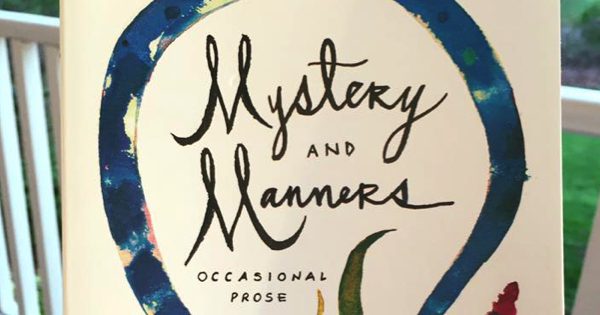
I’ve been reading essays from Flannery O’Connor’s occasional prose. Since I write fiction, I’m interested in hearing what other authors of fiction have to say about the craft. The collection entitled Mystery and Manners includes an essay entitled, “The Nature and Aim of Fiction”. I came across this passage and started underlining:
The kind of vision the fiction writer needs to have, or to develop, in order to increase the meaning of his story is called anagogical vision, and that is the kind of vision that is able to see different levels of reality in one image or situation. The medieval commentators on Scripture found three kinds of meaning in the literal level of the sacred text: one they called allegorical, in which one fact pointed to another; one they called tropological, or moral, which had to do with what should be done; and one they called anagogical, which had to do with the Divine life and our participation in it. Although this was the method applied to exegesis, it was also an attitude toward all of creation, and a way of reading nature which included most possibilities, and I think it is this enlarged view of the human scene that the fiction writer has to cultivate if he is ever going to write stories that have any chance of becoming a permanent part of our literature.
O’Connor wrote anagogically, and that is why we still read her stories today.
This also the case with C. S. Lewis, J. R. R. Tolkien, and G. K. Chesterton. It is what makes Milton’s Paradise Lost, and Dante’s Divine Comedy what they are. And I even think this is true for the more subtle and seemingly more realistic work of Marilyn Robinson and Wendell Berry. It is not true of John Bunyan’s Pilgrim’s Progress. Bunyan worked solely in the allegorical mode. And for the slew of writers you can find in the typical Christian bookstore, they’re working almost exclusively tropologically. For those writers fiction is just a way to make moralism more palatable.
This explains why so much religious fiction is flat; it works at only one level. This is also the case for much of the preaching in our churches. It’s flat, too.
When I was in seminary professors of hermeneutics liked it that way. The flatter the better. They did their best to beat any inclination to think anagogically right out of us. They made a mockery of the medievals and sometimes would state plainly that the only method for right-thinking people when it comes to scripture is the historical-critical method. Anything else opens the door to fantastical and subjective interpretations.
This is sort of funny as I think about it today, because the result of the historical-critical approach has been to turn us inward when it comes to finding meaning in our lives.
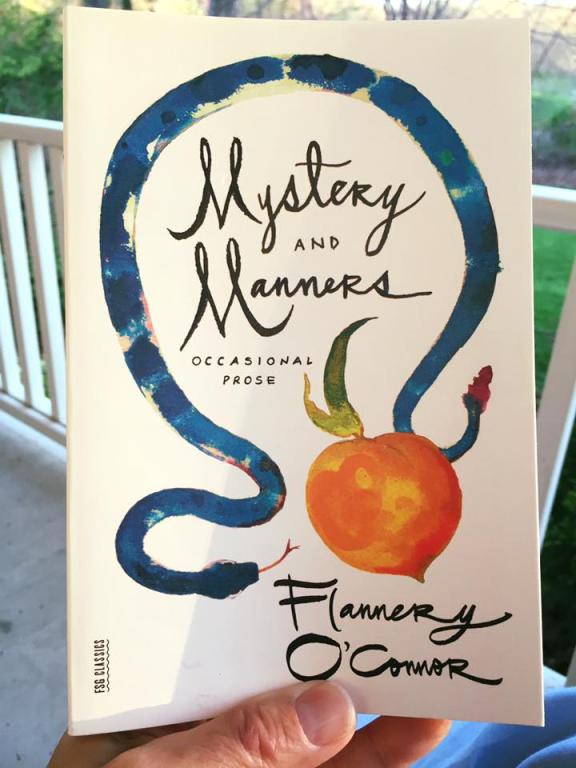 O’Connor makes a connection between the anagogical method of interpretation and the world outside our heads. She said, if it works for scripture, it works for the world. I think she’d agree that in fact it is really the other way around. Since it is true of the world, it must be true of scripture. And since that’s the case, it can also be true of the stories we write.
Here’s how it works: since the world is a creation, not merely a brute fact, we can legitimately look for meaning beneath its surface. And since we can write our own stories this way, we can infer that the reason we can do so is because God has already done so with his creation. Just as anagogical meaning exists both in our stories and in the head of the reader, we can say that some readers understand the stories at two levels, while other readers can only see the surface. Likewise with the world. There are historical facts that make a contingent historical sense, while at the same moment point beyond themselves to meaning not fully contained by them.
People who fear this approach because of its “subjectivity” miss its external dimension. Meanings are reflected in the mind, but they don’t originate there. They are perceived through the facts.
Paradoxically, the triumph of the historical-critical method has made meaning largely subjective for most Christians. The past and parousia are clear through scripture, but the present is inscrutable. It is a flow of contingencies. Those who look for meaning in it usually turn to their feelings hoping to find the Spirit there.
Liberals tend to side with Schleiermacher, seeing religion as mainly a matter of sentiment. It begins in us and flows outward. Although this is usually balanced with justice-talk in liberal churches, justice isn’t concerned with the meanings of things. Instead, justice is concerned with making sure people are free to make their own meanings. For “conservatives” there is a stronger sense of personal responsibility for living meaningfully. But the meaning is bound to God’s law. But beyond this, the world remains a meaningless place.
The problem as I see it is this isn’t scriptural. The Apostle Paul tells us in Ephesians 5, for instance, that the marriage of a man and a woman is a real way points beyond itself. “One flesh” he says isn’t just about sex. It can’t even be reduced to a common life, or a commonwealth. It is a mystery–something that reflects something at the very core of God’s purposes.
This is largely why we don’t get the meaning of marriage these days. We think it can be reduced to either sentiment divorced from physical considerations (hey, it’s about love right?) or it is just obedience to a divine law that needs no further justification. (The bible says it. I believe it. That settles it. Amen.)
But according to the Apostle Paul–there is another level of meaning here. Paul interpreted the world, and the scriptures, anagogically.

Next Post
June 9, 2017 Aristotle's Robots, and More!
Browse Our Archives
Select a Category Advising a Daughter Aristotle Art Atheism Author and Speaking Appearances Beauty Building Working Houses C R Wiley Children Community Creativity Cultural Apologetics Fatherhood Fiction Fidelity in marriage Film Freedom Gravitas H. P. Lovecraft Happiness Household Economy Infant Baptism Inklings Interpreting the Bible Interviews Jack Donovan Liturgy Localism Man of the House Manliness Martial Virtue Medieval Cosmology Metaphysics Mortimus Clay NecronomiCon New Left New Testament Household Codes Nietzsche Nominalism/Realism Politics Poverty Preaching Productive Property Reaching men Science Self-Sufficiency Side Hustles Social Ethics Social Security Spiritual Disciplines Sublime Techno-gnosticism The Pastor's Survival Guide Theology of the Family Tradition Uncategorized Virtue Weird Fiction
Select a Month February 2019 November 2018 October 2018 July 2018 June 2018 May 2018 April 2018 March 2018 February 2018 January 2018 December 2017 November 2017 October 2017 September 2017 August 2017 July 2017 June 2017 May 2017 April 2017 March 2017 February 2017 January 2017 December 2016 November 2016 October 2016 September 2016 August 2016 July 2016 June 2016 May 2016 April 2016 March 2016 February 2016 January 2016 December 2015
Follow Us!
TAKE THE
Religious Wisdom Quiz
What does "Capernaum" mean?
Select your answer to see how you score.
Village of comfort Port of peace City of trade Place of water
Books by This Author Books by PaterFamilias Today
Books by C. R. Wiley

The Purloined Boy (The Weirdling Cycle #1)

Man of the House: A Handbook for Building a Shelter That Will Last in a World That Is Falling Apart
Related posts from PaterFamilias Today

Transcendence: Meaning from Above

Gutting Creation of Meaning Guts Scripture

Advice for a Single Woman Who Is Looking...
TRENDING AT PATHEOS Evangelical

How the author of the world's best hymn...
I've been working with John Newton for a while now. This makes...

Long before this Lectio Divina, Psalm 130 - the song - started...

What About the Trees? Another Living Parable
After I finished writing the last article about falling leaves as a...

Why Classical Education Is a Conversation, Not a...
Come and Read: Joy in Classical Education When I was a little...

Falling Leaves: A Living Parable on Letting Go
I’ve spent the vast majority of my life in the southeast corner...

Cornell University has received a great deal of negative publicity and intense...
view all Evangelical blogs
Ad-Free & Subscriber Log-In Subscription Support
- About Us
- 2026 Calendar
- Videos
- Podcasts
- Library of World Religions
- Faith In Media Tracker
- Advertise With Us
- Write for Us
- Privacy Policy
- Terms of Service
- Do Not Sell My Data
- Contact Us
- Radiant Digital
- Manage Newsletter Subscriptions
- Unsubscribe From Notifications
- Sitemap
Copyright 2008-2026, Patheos. All rights reserved.
Subscription Support Ad-Free & Subscriber Log-In
Follow Patheos