
BuddhistCatholicContemplativeEvangelicalGeneral ChristianHinduJewishLatter-day SaintMuslimNew VisionsProgressive Christian
Beliefs
- Buddhist
- Catholic
- Contemplative
- Evangelical
- General Christian
- Hindu
- Jewish
- Latter-day Saint
- More Voices
- Muslim
- New Visions
- Pagan
- Progressive Christian
Topics
- Religion News
- Food and Religion
- Sports and Religion
- Religious Art
- Religious Music and Entertainment
- Religious Events
- History and Religion
- Style and Religion
- Politics and Religion
- Women in Religion
- Recreation Outdoors and Religion
- Business Finance and Religion
- Careers Workplace and Religion
- Education and Religion
- Family Parenting and Religion
- Health Fitness and Religion
- Home and Religion
- Relationships and Religion
- Technology and Religion
- Travel and Religion
Columnists
- Buddhist Columnists
- Business Finance and Religion Columnists
- Careers Workplace and Religion Columnists
- Catholic Columnists
- Contemplative Columnists
- Education and Religion Columnists
- Evangelists Columnists
- Family Parenting and Religion Columnists
- General Christian Columnists
- Health Fitness and Religion Columnists
- Hindu Columnists
- History and Religion Columnists
- Home and Religion Columnists
- Jewish Columnists
- More Voices Columnists
- Latter Day Columnists
- Muslim Columnists
- New Visions Columnists
- Nonreligious Columnists
- Pagan Columnists
- Politics and Religion Columnists
- Progressive Columnists
- Recreation Outdoors and Religion Columnists
- Relationships and Religion Columnists
- Religion News Columnists
- Religious Art Columnists
- Religious Events Columnists
- Religious Music and Entertainment Columnists
- Sports and Religion Columnists
- Style and Religion Columnists
- Technology and Religion Columnists
- Travel and Religion Columnists
- Women in Religion Columnists
Resource Library
- 2026 Calendar
- Library of World Religions
- The 100 Most Holy Places on Earth
- Patheos Answers
- Podcasts
- Videos
- Faith Leaders Database
- Anglican Episcopalian
- Bahai
- Baptist
- Buddhism
- Christianity
- Confucianism
- Eastern Orthodoxy
- Hinduism
- Holiness and Pentecostal
- ISKCON
- Islam
- Judaism
- Lutheran
- Methodist
- The Church of Jesus Christ of Latter-day Saints
- New Age
- Paganism
- Presbytarian and Reformed
- Protestantism
- Religion Behind the Scenes
- Roman Catholic
- Scientology
- Shia Islam
- Sikhism
- Sufism
- Sunni Islam
- Taoism
- Zen
- See all religions
Research Tools
 Ad-Free & Subscriber Log-In Subscription Support
Ad-Free & Subscriber Log-In Subscription Support
Follow Patheos 

- Trending:
- Forgiveness
- |
- Marriage
- |
- Consciousness
- |
- Death Penalty
- |
- Election
- |
- Halloween
 PaterFamilias Today
- Home
- Evangelical
- Against the Recreational Household: Part 5, Bringing Productive Property Back Home
Against the Recreational Household: Part 5, Bringing Productive Property Back Home
Last updated on: September 28, 2017 at 10:57 am by C. R. Wiley
Against the Recreational Household: Part 5, Bringing Productive Property Back Home 2017-09-28T10:57:58-04:00 C. R. Wiley
Patheos Explore the world's faith through different perspectives on religion and spirituality! Patheos has the views of the prevalent religions and spiritualities of the world.

Here I am again with yet another ramble. This is the fifth and final one for material I am using for a paper I will be delivering at The Academy of Philosophy and Letters at its annual conference.
You can read my first ramble here, the second you can read here, and here’s the third, and here’s the fourth.
(By the way, ad hominem comments will be deleted. And comments that deal with my family members are not only unwelcome, they are rude.)
Bringing Productive Property Back Home.
I discovered the difference between personal property and productive property when I wanted to quit my job.
I was a pastor in a denomination that was moving in a direction I didn’t want to go in. My own theological convictions were changing as well. But I had a homeschooling wife and three small children to feed. I had no prospects elsewhere to speak of. I needed a way out, but I didn’t want my family to suffer. So in my spare time I got into investment real estate. It took me four years to do it. But at the end I had property in three states and 18 tenants.
Providentially, when the final straw landed on the camel’s back I was ready to resign. So resign I did and I lived off my investments. I later supplemented my income as a building contractor. (I had worked my way through seminary working for a builder.)
Eventually I was called to be the pastor of the church I now serve. But the experience revealed to me how the freedom to live according to my convictions and ownership of productive property go together.
As you can see, what distinguishes productive property from personal property—you know, something like a toothbrush—is its ability to give you a living. The founders of our country knew this, and many of them believed it was what qualified a man for the franchise. The following quote is taken again from Family Cycles, by Allan C. Carlson:
“In his book, The Myth of American Individualism, Barry Shain describes the various notions of liberty extant in the eighteenth century:…. Distinctive to America…was a strong emphasis on familial liberty. By this was meant ownership of sufficient real property—land and tools—to ensure household autonomy: ‘he who would govern himself must own his own soul.’ As the Founder James Wilson wrote in 1774, men whose poverty left them subject to the influence of others ‘have no will of their own; and it is judged improper that they should vote in the representation of a free state.’ As Shane summarizes: ‘Real property was viewed as an instrumental good that made possible familial independence.’” (p. 63)
Technology Can Bring Productive Property Home
Today, most productive property is in the hands of large corporations. But new technologies make it possible to imagine something like its redistribution.
Tools are instrumental to the creation of productive property. And in fact, they are a form of it. Through their use they can help you acquire more of it.
Technology 1.0 is what gave us the household in the first place. The plow, the smithy, the loom and spinning wheel—they made settling down possible. Before that hunter-gatherers had to follow the food.
Technology 2.0 gave us the industrial revolution. As I noted earlier, this broke up our households. The tools that produced the revolution were large, expensive, and often immovable. Workers usually had to leave home to get to them. But a new set of tools have been forged, and they are changing everything.
Technology 3.0 is bringing the economy back home. I’m referring primarily to the information revolution, of course. The tools of this revolution are small, inexpensive, and mobile. Bits travel more quickly and less expensively than bodies. Telecommuting makes it possible for large corporate employers to send people back home while keeping them on the payroll. But it also makes it possible to downsize and hire them back on a contract basis. Although this is distressing initially—as my father-in-law could have told you—many people find that they are more capable of taking care of themselves than they once believed. But it doesn’t stop there.
Retail is breaking up. Boutique producers are now able to compete with large businesses through Amazon and other distribution networks. Even manufacturing is decentralizing as flexible manufacturers produce specialized goods in supply chains with 3D printers. With coming of low-cost robots, small-scale manufacturing will have even more parity with large producers.
Technology is even revolutionizing capital markets through new forms of hard money micro-lending. Now personal loans can be managed through third parties, making lending more transparent and accountable. Then there is the whole crowd-funding phenomenon for innovators, and new forms of patronage for artists.
Everything seems to be shrinking and new forms of closely held productive property are being created. And households can benefits from these developments if they care to try.
The Revenge of Handmade
Of all the things that I think will bring men home, the most surprising may be the recovery of the trades. This isn’t just the result of a shortage of skilled workers in the physical economy. Many men miss working with their hands, and they long for the meaning that comes with working with real things. Our world isn’t a formless soup of raw matter. It comes pre-formed and working with it informs you. Attention to the meaning of your materials, and the submission that this calls for, paradoxically lends a man mastery over them.
And this isn’t just for guys who couldn’t get into college. Highly educated men are sick and tired of cubicles, or working exclusively in virtual reality. They are turning to the trades and bringing their status with them. Books like Shop Class as Soul Craft, and Masters of Craft are bestsellers largely because highly educated men are looking to escape the world of corporate employment.
But these men are not leaving the information economy completely behind. Instead they are leveraging it in some cases to actually revive dead trades. Take for instance the curious example of Alec Steele, the 19 year-old English blacksmithing prodigy with nearly 300,000 subscribers on Youtube. With a friend he just began a business selling do-it-yourself forges that you can purchase on line for $300.
Final Thoughts
 None of this is inevitable. But the winds of the zeitgeist are blowing in the favor of the household economy for the first time in a long time.
Whether or not men bring productive property home will determine whether we see a transition back to household economics, or just more of the same old thing we’ve seen since the 19th century.
In the past, those who have called for a recovery of household economics were also forced to reject many of the goods of the modern world. For most people, this was too much to ask. But now we may be able to actually push our way through modernity to a post-modern world that looks strikingly like the pre-modern one.
There remain unanswered questions in my mind; for example, how can we bring a wife and children into this? Nevertheless, it is worth hoping that the post-modern household brings together the best of the pre-modern household, and the modern one. That, it seems to me, would be real progress.
From the draft of a paper that I am slated to read at The Academy of Philosophy and Letters.
_________
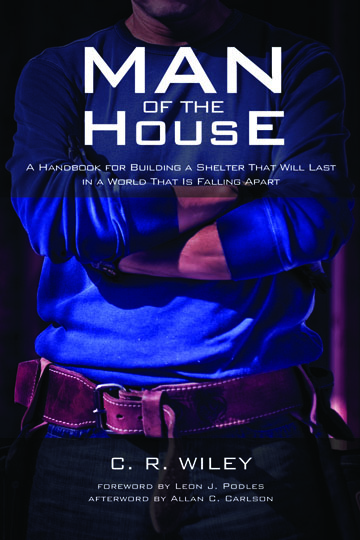
Here’s something else for you to enjoy. Wipf and Stock, the publisher of my book, Man of the House, has given me permission to share a little sample of the book with you. The hope, of course, is you will like it enough to purchase a copy. Enjoy!.
Click here to download the book excerpt as a PDF: Man of the House_Excerpt
Previous Post

May 31, 2017
Against the Recreational Household, Part 4: Signs of Hope
Next Post

June 6, 2017 Flannery O'Connor and the Meaning of the World
Browse Our Archives
Select a Category Advising a Daughter Aristotle Art Atheism Author and Speaking Appearances Beauty Building Working Houses C R Wiley Children Community Creativity Cultural Apologetics Fatherhood Fiction Fidelity in marriage Film Freedom Gravitas H. P. Lovecraft Happiness Household Economy Infant Baptism Inklings Interpreting the Bible Interviews Jack Donovan Liturgy Localism Man of the House Manliness Martial Virtue Medieval Cosmology Metaphysics Mortimus Clay NecronomiCon New Left New Testament Household Codes Nietzsche Nominalism/Realism Politics Poverty Preaching Productive Property Reaching men Science Self-Sufficiency Side Hustles Social Ethics Social Security Spiritual Disciplines Sublime Techno-gnosticism The Pastor's Survival Guide Theology of the Family Tradition Uncategorized Virtue Weird Fiction
Select a Month February 2019 November 2018 October 2018 July 2018 June 2018 May 2018 April 2018 March 2018 February 2018 January 2018 December 2017 November 2017 October 2017 September 2017 August 2017 July 2017 June 2017 May 2017 April 2017 March 2017 February 2017 January 2017 December 2016 November 2016 October 2016 September 2016 August 2016 July 2016 June 2016 May 2016 April 2016 March 2016 February 2016 January 2016 December 2015
Follow Us!
TAKE THE
Religious Wisdom Quiz
What does Jesus say about storing up treasures on earth?
Select your answer to see how you score.
Do not, because they are temporary Treasure is godliness Store as much as possible Only store in banks
Books by This Author Books by PaterFamilias Today
Books by C. R. Wiley

The Purloined Boy (The Weirdling Cycle #1)

Man of the House: A Handbook for Building a Shelter That Will Last in a World That Is Falling Apart
Related posts from PaterFamilias Today


Advice for a Single Woman Who Is Looking...


Is This Evangelicalism's Red-Pill Moment?
TRENDING AT PATHEOS Evangelical

How the author of the world's best hymn...
I've been working with John Newton for a while now. This makes...

Long before this Lectio Divina, Psalm 130 - the song - started...

What About the Trees? Another Living Parable
After I finished writing the last article about falling leaves as a...

Why Classical Education Is a Conversation, Not a...
Come and Read: Joy in Classical Education When I was a little...

Falling Leaves: A Living Parable on Letting Go
I’ve spent the vast majority of my life in the southeast corner...

Cornell University has received a great deal of negative publicity and intense...
view all Evangelical blogs
Ad-Free & Subscriber Log-In Subscription Support
- About Us
- 2026 Calendar
- Videos
- Podcasts
- Library of World Religions
- Faith In Media Tracker
- Advertise With Us
- Write for Us
- Privacy Policy
- Terms of Service
- Do Not Sell My Data
- Contact Us
- Radiant Digital
- Manage Newsletter Subscriptions
- Unsubscribe From Notifications
- Sitemap
Copyright 2008-2026, Patheos. All rights reserved.
Subscription Support Ad-Free & Subscriber Log-In
Follow Patheos