
BuddhistCatholicContemplativeEvangelicalGeneral ChristianHinduJewishLatter-day SaintMuslimNew VisionsProgressive Christian
Beliefs
- Buddhist
- Catholic
- Contemplative
- Evangelical
- General Christian
- Hindu
- Jewish
- Latter-day Saint
- More Voices
- Muslim
- New Visions
- Pagan
- Progressive Christian
Topics
- Religion News
- Food and Religion
- Sports and Religion
- Religious Art
- Religious Music and Entertainment
- Religious Events
- History and Religion
- Style and Religion
- Politics and Religion
- Women in Religion
- Recreation Outdoors and Religion
- Business Finance and Religion
- Careers Workplace and Religion
- Education and Religion
- Family Parenting and Religion
- Health Fitness and Religion
- Home and Religion
- Relationships and Religion
- Technology and Religion
- Travel and Religion
Columnists
- Buddhist Columnists
- Business Finance and Religion Columnists
- Careers Workplace and Religion Columnists
- Catholic Columnists
- Contemplative Columnists
- Education and Religion Columnists
- Evangelists Columnists
- Family Parenting and Religion Columnists
- General Christian Columnists
- Health Fitness and Religion Columnists
- Hindu Columnists
- History and Religion Columnists
- Home and Religion Columnists
- Jewish Columnists
- More Voices Columnists
- Latter Day Columnists
- Muslim Columnists
- New Visions Columnists
- Nonreligious Columnists
- Pagan Columnists
- Politics and Religion Columnists
- Progressive Columnists
- Recreation Outdoors and Religion Columnists
- Relationships and Religion Columnists
- Religion News Columnists
- Religious Art Columnists
- Religious Events Columnists
- Religious Music and Entertainment Columnists
- Sports and Religion Columnists
- Style and Religion Columnists
- Technology and Religion Columnists
- Travel and Religion Columnists
- Women in Religion Columnists
Resource Library
- 2026 Calendar
- Library of World Religions
- The 100 Most Holy Places on Earth
- Patheos Answers
- Podcasts
- Videos
- Faith Leaders Database
- Anglican Episcopalian
- Bahai
- Baptist
- Buddhism
- Christianity
- Confucianism
- Eastern Orthodoxy
- Hinduism
- Holiness and Pentecostal
- ISKCON
- Islam
- Judaism
- Lutheran
- Methodist
- The Church of Jesus Christ of Latter-day Saints
- New Age
- Paganism
- Presbytarian and Reformed
- Protestantism
- Religion Behind the Scenes
- Roman Catholic
- Scientology
- Shia Islam
- Sikhism
- Sufism
- Sunni Islam
- Taoism
- Zen
- See all religions
Research Tools
 Ad-Free & Subscriber Log-In Subscription Support
Ad-Free & Subscriber Log-In Subscription Support
Follow Patheos 

- Trending:
- Forgiveness
- |
- Marriage
- |
- Consciousness
- |
- Death Penalty
- |
- Election
- |
- Halloween
 PaterFamilias Today
- Home
- Evangelical
- Theological Foundations of the Family: Family as Image of the Covenant
Theological Foundations of the Family: Family as Image of the Covenant
Last updated on: March 3, 2017 at 8:56 am by C. R. Wiley
Theological Foundations of the Family: Family as Image of the Covenant 2017-03-03T08:56:53-04:00 C. R. Wiley
Patheos Explore the world's faith through different perspectives on religion and spirituality! Patheos has the views of the prevalent religions and spiritualities of the world.

We live in a world where the givens of family life no longer can be received as givens. They must be justified to modern people.
Longtime readers of this blog know I am an apologist for traditional ways, especially home ways. I’ve long felt that more is at stake with the loss of traditional ways than is generally believed. Some of my co-belligerents defend them strictly to preserve the goodness of creation–natural law and all that.
But I believe that the new creation is also at stake. There is a deep linkage between the first creation and the second and the linkage is found in family life.
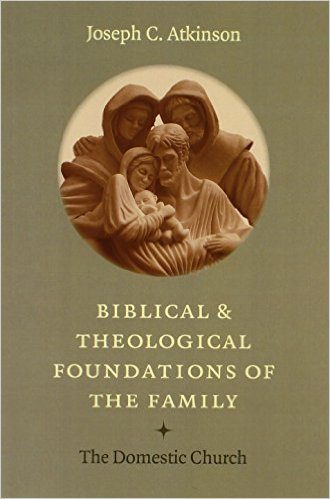
Joseph C. Atkinson sees the same linkage in scripture and points it out in his marvelous study: Biblical and Theological Foundations of the Family.
Now how does this linkage between the first creation and the new creation work?
Here Atkinson is in the introductory paragraph of the chapter entitled, Family as Image of the Covenant:
Although the differences between a sign and a symbol are not always clear, one general distinction is that the symbol inwardly participates in the reality and shows forth what it represents, whereas the sign is of an arbitrary nature vis-a-vis the object represented. (p.128)
Atkinson is a Roman Catholic and we’re getting into territory here that makes Protestants uneasy. Protestants like to stick to explicit statements, implicit meanings seem to open a hole for clerics to smuggle in just about anything they please.
But in this case I think that limiting ourselves to explicit statements can smuggle in something of its own–something easy to overlook because it is itself a breech. By limiting ourselves to explicit commands we can imply that there is a greater discontinuity between creations than scripture warrants. Scripture should be read to say that the new creation fulfills the first, it doesn’t supplant it with something utterly alien.
Look at the language of revelation: Father and Son, new birth, one flesh, bride and groom, and so on. Without the first creation the new creation is incomprehensible. I’m not sure how we can dispense with the structures of the first creation without in the process losing touch with the second.
Back to Atkinson:
Is the relationship between the covenant and marriage merely extrinsic (which would render marriage and family arbitrary signs, used to help explain the covenant because of an accidental, surface resemblance)? Or do marriage and family have an intrinsic relationship to the covenant and somehow interiorly participate in it? Put another way, is this prophetic use of familial language only metaphoric or is something greater going on? (p.132)
Just how much is at stake here? Like I said, more than many evangelicals seem willing to admit.
Perhaps this has something to do with the trend among evangelicals to model churches on shopping malls and business corporations? And when they do attend to family concerns, everything evangelicals do has the flavor of Disneyesque amusement.
There is an unchallenged atomization that has occurred in evangelicalism which accommodates the patterns of modern life. Even the enthusiasm for “community” among young progressive evangelicals smacks of modernism. It is fundamentally disconnected from the structures of creation. Community for hipsters is a bunch of 20 somethings sharing a house and pitching in for food; it isn’t based on the family.
As I noted above, until just yesterday we could take family life largely for granted–we could even denigrate it without much fear, it was so solid we had no need to justify it. But in the age of Heather has Two Mommies, that has changed.
And homosexuality is really just surface of this brave new world. Just the other day I read something about breakthroughs in gene splicing that make it conceptually possible to create a person without parents. Think about it: if we can splice a gene here, and another there, a little bit from a dozen different people or so, we can make the perfect orphan. And if we ever manage to make artificial wombs, we won’t even need surrogate mothers.
What does that do to evangelism, let alone to the poor kid?
And even if we outlaw such practices, how do we retain the power of scripture’s language? If creation is only self-referential, then nothing is at stake when it comes to the new creation. There’s nothing to keep us from throwing out the old metaphors.
I hope that notion makes you queasy.
Previous Post

February 28, 2017
Freedom: I don't think it means what you think it means
Next Post

March 7, 2017 Bombadil at Home
Browse Our Archives
Select a Category Advising a Daughter Aristotle Art Atheism Author and Speaking Appearances Beauty Building Working Houses C R Wiley Children Community Creativity Cultural Apologetics Fatherhood Fiction Fidelity in marriage Film Freedom Gravitas H. P. Lovecraft Happiness Household Economy Infant Baptism Inklings Interpreting the Bible Interviews Jack Donovan Liturgy Localism Man of the House Manliness Martial Virtue Medieval Cosmology Metaphysics Mortimus Clay NecronomiCon New Left New Testament Household Codes Nietzsche Nominalism/Realism Politics Poverty Preaching Productive Property Reaching men Science Self-Sufficiency Side Hustles Social Ethics Social Security Spiritual Disciplines Sublime Techno-gnosticism The Pastor's Survival Guide Theology of the Family Tradition Uncategorized Virtue Weird Fiction
Select a Month February 2019 November 2018 October 2018 July 2018 June 2018 May 2018 April 2018 March 2018 February 2018 January 2018 December 2017 November 2017 October 2017 September 2017 August 2017 July 2017 June 2017 May 2017 April 2017 March 2017 February 2017 January 2017 December 2016 November 2016 October 2016 September 2016 August 2016 July 2016 June 2016 May 2016 April 2016 March 2016 February 2016 January 2016 December 2015
Follow Us!
TAKE THE
Religious Wisdom Quiz
To whom does Paul say he has become all things so that by all possible means he might save some?
Select your answer to see how you score.
The Gentiles The Jews Everyone The weak
Books by This Author Books by PaterFamilias Today
Books by C. R. Wiley

The Purloined Boy (The Weirdling Cycle #1)

Man of the House: A Handbook for Building a Shelter That Will Last in a World That Is Falling Apart
Related posts from PaterFamilias Today

Transcendence: Meaning from Above

Gutting Creation of Meaning Guts Scripture


Advice for a Single Woman Who Is Looking...
TRENDING AT PATHEOS Evangelical

How the author of the world's best hymn...
I've been working with John Newton for a while now. This makes...

Long before this Lectio Divina, Psalm 130 - the song - started...

What About the Trees? Another Living Parable
After I finished writing the last article about falling leaves as a...

Why Classical Education Is a Conversation, Not a...
Come and Read: Joy in Classical Education When I was a little...

Falling Leaves: A Living Parable on Letting Go
I’ve spent the vast majority of my life in the southeast corner...

Cornell University has received a great deal of negative publicity and intense...
view all Evangelical blogs
Ad-Free & Subscriber Log-In Subscription Support
- About Us
- 2026 Calendar
- Videos
- Podcasts
- Library of World Religions
- Faith In Media Tracker
- Advertise With Us
- Write for Us
- Privacy Policy
- Terms of Service
- Do Not Sell My Data
- Contact Us
- Radiant Digital
- Manage Newsletter Subscriptions
- Unsubscribe From Notifications
- Sitemap
Copyright 2008-2026, Patheos. All rights reserved.
Subscription Support Ad-Free & Subscriber Log-In
Follow Patheos