
BuddhistCatholicContemplativeEvangelicalGeneral ChristianHinduJewishLatter-day SaintMuslimNew VisionsProgressive Christian
Beliefs
- Buddhist
- Catholic
- Contemplative
- Evangelical
- General Christian
- Hindu
- Jewish
- Latter-day Saint
- More Voices
- Muslim
- New Visions
- Pagan
- Progressive Christian
Topics
- Religion News
- Food and Religion
- Sports and Religion
- Religious Art
- Religious Music and Entertainment
- Religious Events
- History and Religion
- Style and Religion
- Politics and Religion
- Women in Religion
- Recreation Outdoors and Religion
- Business Finance and Religion
- Careers Workplace and Religion
- Education and Religion
- Family Parenting and Religion
- Health Fitness and Religion
- Home and Religion
- Relationships and Religion
- Technology and Religion
- Travel and Religion
Columnists
- Buddhist Columnists
- Business Finance and Religion Columnists
- Careers Workplace and Religion Columnists
- Catholic Columnists
- Contemplative Columnists
- Education and Religion Columnists
- Evangelists Columnists
- Family Parenting and Religion Columnists
- General Christian Columnists
- Health Fitness and Religion Columnists
- Hindu Columnists
- History and Religion Columnists
- Home and Religion Columnists
- Jewish Columnists
- More Voices Columnists
- Latter Day Columnists
- Muslim Columnists
- New Visions Columnists
- Nonreligious Columnists
- Pagan Columnists
- Politics and Religion Columnists
- Progressive Columnists
- Recreation Outdoors and Religion Columnists
- Relationships and Religion Columnists
- Religion News Columnists
- Religious Art Columnists
- Religious Events Columnists
- Religious Music and Entertainment Columnists
- Sports and Religion Columnists
- Style and Religion Columnists
- Technology and Religion Columnists
- Travel and Religion Columnists
- Women in Religion Columnists
Resource Library
- 2026 Calendar
- Library of World Religions
- The 100 Most Holy Places on Earth
- Patheos Answers
- Podcasts
- Videos
- Faith Leaders Database
- Anglican Episcopalian
- Bahai
- Baptist
- Buddhism
- Christianity
- Confucianism
- Eastern Orthodoxy
- Hinduism
- Holiness and Pentecostal
- ISKCON
- Islam
- Judaism
- Lutheran
- Methodist
- The Church of Jesus Christ of Latter-day Saints
- New Age
- Paganism
- Presbytarian and Reformed
- Protestantism
- Religion Behind the Scenes
- Roman Catholic
- Scientology
- Shia Islam
- Sikhism
- Sufism
- Sunni Islam
- Taoism
- Zen
- See all religions
Research Tools
 Ad-Free & Subscriber Log-In Subscription Support
Ad-Free & Subscriber Log-In Subscription Support
Follow Patheos 

- Trending:
- Forgiveness
- |
- Marriage
- |
- Consciousness
- |
- Death Penalty
- |
- Election
- |
- Halloween
 PaterFamilias Today
- Home
- Evangelical
- And Now, in Conclusion: How to End a Story
And Now, in Conclusion: How to End a Story
Last updated on: September 6, 2016 at 10:40 am by C. R. Wiley
And Now, in Conclusion: How to End a Story 2016-09-06T10:40:50-04:00 C. R. Wiley
Patheos Explore the world's faith through different perspectives on religion and spirituality! Patheos has the views of the prevalent religions and spiritualities of the world.
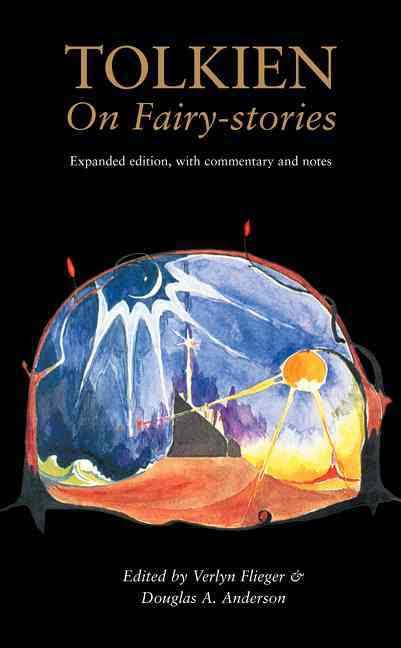
https://books.google.com/books/about/Tolkien_on_Fairy_Stories.html?id=4k8cngEACAAJ&source=kp_cover
“Have the courage to conclude.” (Don’t recall where I read that, but it’s good advice.)
Then there’s–
“Begin with the end in mind.” (More good advice, if you can think that far ahead.)
These things are easier said than done. (There’s another truism for you.) But what makes for a good ending? How do you know it when you see it? Ah, that’s the trick.
I’m midway through my middle grade series, two books down and two to go, and I have a confession to make: I just discovered how the story ends yesterday. It’s going to be a good ending, and I believe a very satisfying one, but I had to have the first two books behind me before I could see how book four ends. (I also know how book three ends, thankfully.)
I don’t know why it works this way, but it just does for many authors. Which brings up the whole matter of having the courage to begin when you don’t have the end in mind. So, how do you muster the courage for that?
I think it has mostly to do with knowing what you’re looking for in a story. When you know that, you can recognize the ending when you come to it.
I think this comes as something of a surprise to people who don’t tell stories. I think most people believe stories are things we have complete control over, that they are formed entirely in our heads. But in my experience, and the experience of others, that’s just not the way it works. Endings are discoveries, like coming to a vista after a long hike. When you arrive you say, “So this is what I’ve been looking for!”
For a story to succeed it truly does need to end well. I don’t mean happily, just in a way that satisfies the reader. Etymology is a help here. A text is a weaving. (Think textiles.) When you write, you weave threads together, characters, settings, and so forth, into a plot. When you get to the end, you take the loose ends and tie them up. The magic is in the knot.
Getting to happy endings: I believe Christianity introduced them to the world.
You can’t live happily ever after, you see, if you’re dead. And for pagans, that’s how every story ends.
The Greeks gave us comedy and tragedy. Now what they had in mind when it came to comedy is not what we think of when we think of a rom-com. That’s a happy ending tale. What the Greeks had in mind was a parade of fools. Who’s in the parade? Everyone. We’re all fools because we live our lives by false hopes. The Greeks agreed with Keynes, in the long run we’re all dead. Tragedy just shows us that in graphic detail. And usually the protagonist dies because of some foolishness on his part.
What the Norse gave us is the nobel end. Everyone is still dead, but they die heroically. You see, Valhalla is not an everlasting paradise, it is a pleasant holding cell for the greatest warriors of history. Odin is a assembling his army for the last stand against the forces of chaos. They’ll lose in the end, but they will lose valiantly.
It took the resurrection of the Son of God to give us, “And they all lived happily ever after.”
But the trick is saying that in a satisfying and faith inspiring way. And it is quite a trick.
I’ve been using C. S. Lewis and J. R. R. Tolkien throughout these essays, and I’m going to do it again. I think when it comes to the happy ending, Lewis gives you the scent of it from a distance and Tolkien helps you recognize it when you see it.
Sehnsucht
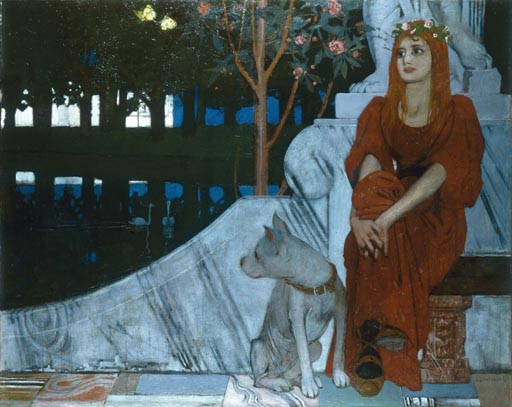
2-M145-A2-1895-17-C
——————– D: ——————–
Oskar Zwintscher, Sehnsucht/ 1895
Zwintscher, Oskar
1870-1916.
“Sehnsucht”, 1895.
Oel auf Leinwand, 120 x 150 cm.
Meissen, Stadtmuseum
That unnameable something, desire for which pierces us like a rapier at the smell of bonfire, the sound of wild ducks flying overhead, the title of The Well at the World’s End, the opening lines of “Kubla Khan“, the morning cobwebs in late summer, or the noise of falling waves.
If you’ve felt what Lewis is talking about, you don’t need further explanation. If you haven’t felt this, I can’t help you. It is a longing for something we can only descry from a great distance.
I’m assuming here that you’re a Christian, or at least wish you were one, and you want to tell a story with a happy ending. If you’re not interested in happy endings, if you want to tell a story where everyone is dead in the end, nothing could be easier. The only purpose sehnsucht can serve in that case is for setting up the fool. See Kafka, Sartre, or even Lovecraft if that’s the story you want to tell.
But if the happy ending is what you’re after, you need the longing Lewis is talking about here. But there there is the problem of arrival. It is really tough to do that.
Eucatastrophe
This is where Tolkien comes to the rescue. Lewis does deliver a marvelous ending to The Chronicles of Narnia at the end of The Last Battle, but it took Tolkien to describe just how it is done.
In his marvelous address, On Fairy Stories, Tolkien coins a term, eucatastrophe. It is “the joyous turn” that catches the breath. The thing about it that keeps it from the clumsiness of the standard Deus ex machina plot device is the confluence of elements that swirl together in the end. There’s a miraculous combination of inevitability and surprise that satisfies rather than exasperates. Pulling it off is the trick. Lewis succeeded, so did Tolkien. But I believe J. K. Rowling failed. (That’s something we can talk about another time.)
If you can pull it off, maybe you can join that august assembly of story-tellers. I hope you can. The world would be a richer place for it.
Previous Post
September 2, 2016
Tales of the Sublime: They aren't Safe, but They Can be Good
Next Post
September 9, 2016 How to Tell a Story Like an Inkling
Browse Our Archives
Select a Category Advising a Daughter Aristotle Art Atheism Author and Speaking Appearances Beauty Building Working Houses C R Wiley Children Community Creativity Cultural Apologetics Fatherhood Fiction Fidelity in marriage Film Freedom Gravitas H. P. Lovecraft Happiness Household Economy Infant Baptism Inklings Interpreting the Bible Interviews Jack Donovan Liturgy Localism Man of the House Manliness Martial Virtue Medieval Cosmology Metaphysics Mortimus Clay NecronomiCon New Left New Testament Household Codes Nietzsche Nominalism/Realism Politics Poverty Preaching Productive Property Reaching men Science Self-Sufficiency Side Hustles Social Ethics Social Security Spiritual Disciplines Sublime Techno-gnosticism The Pastor's Survival Guide Theology of the Family Tradition Uncategorized Virtue Weird Fiction
Select a Month February 2019 November 2018 October 2018 July 2018 June 2018 May 2018 April 2018 March 2018 February 2018 January 2018 December 2017 November 2017 October 2017 September 2017 August 2017 July 2017 June 2017 May 2017 April 2017 March 2017 February 2017 January 2017 December 2016 November 2016 October 2016 September 2016 August 2016 July 2016 June 2016 May 2016 April 2016 March 2016 February 2016 January 2016 December 2015
Follow Us!
TAKE THE
Religious Wisdom Quiz
What Christian group is known for the doctrine of purgatory?
Select your answer to see how you score.
Methodists Catholics Lutherans Baptists
Books by This Author Books by PaterFamilias Today
Books by C. R. Wiley

The Purloined Boy (The Weirdling Cycle #1)

Man of the House: A Handbook for Building a Shelter That Will Last in a World That Is Falling Apart
Related posts from PaterFamilias Today

Transcendence: Meaning from Above

Gutting Creation of Meaning Guts Scripture

Advice for a Single Woman Who Is Looking...

Is This Evangelicalism's Red-Pill Moment?
TRENDING AT PATHEOS Evangelical

How the author of the world's best hymn...
I've been working with John Newton for a while now. This makes...

Long before this Lectio Divina, Psalm 130 - the song - started...

What About the Trees? Another Living Parable
After I finished writing the last article about falling leaves as a...

Why Classical Education Is a Conversation, Not a...
Come and Read: Joy in Classical Education When I was a little...

Falling Leaves: A Living Parable on Letting Go
I’ve spent the vast majority of my life in the southeast corner...

Cornell University has received a great deal of negative publicity and intense...
view all Evangelical blogs
Ad-Free & Subscriber Log-In Subscription Support
- About Us
- 2026 Calendar
- Videos
- Podcasts
- Library of World Religions
- Faith In Media Tracker
- Advertise With Us
- Write for Us
- Privacy Policy
- Terms of Service
- Do Not Sell My Data
- Contact Us
- Radiant Digital
- Manage Newsletter Subscriptions
- Unsubscribe From Notifications
- Sitemap
Copyright 2008-2026, Patheos. All rights reserved.
Subscription Support Ad-Free & Subscriber Log-In
Follow Patheos