
BuddhistCatholicContemplativeEvangelicalGeneral ChristianHinduJewishLatter-day SaintMuslimNew VisionsProgressive Christian
Beliefs
- Buddhist
- Catholic
- Contemplative
- Evangelical
- General Christian
- Hindu
- Jewish
- Latter-day Saint
- More Voices
- Muslim
- New Visions
- Pagan
- Progressive Christian
Topics
- Religion News
- Food and Religion
- Sports and Religion
- Religious Art
- Religious Music and Entertainment
- Religious Events
- History and Religion
- Style and Religion
- Politics and Religion
- Women in Religion
- Recreation Outdoors and Religion
- Business Finance and Religion
- Careers Workplace and Religion
- Education and Religion
- Family Parenting and Religion
- Health Fitness and Religion
- Home and Religion
- Relationships and Religion
- Technology and Religion
- Travel and Religion
Columnists
- Buddhist Columnists
- Business Finance and Religion Columnists
- Careers Workplace and Religion Columnists
- Catholic Columnists
- Contemplative Columnists
- Education and Religion Columnists
- Evangelists Columnists
- Family Parenting and Religion Columnists
- General Christian Columnists
- Health Fitness and Religion Columnists
- Hindu Columnists
- History and Religion Columnists
- Home and Religion Columnists
- Jewish Columnists
- More Voices Columnists
- Latter Day Columnists
- Muslim Columnists
- New Visions Columnists
- Nonreligious Columnists
- Pagan Columnists
- Politics and Religion Columnists
- Progressive Columnists
- Recreation Outdoors and Religion Columnists
- Relationships and Religion Columnists
- Religion News Columnists
- Religious Art Columnists
- Religious Events Columnists
- Religious Music and Entertainment Columnists
- Sports and Religion Columnists
- Style and Religion Columnists
- Technology and Religion Columnists
- Travel and Religion Columnists
- Women in Religion Columnists
Resource Library
- 2026 Calendar
- Library of World Religions
- The 100 Most Holy Places on Earth
- Patheos Answers
- Podcasts
- Videos
- Faith Leaders Database
- Anglican Episcopalian
- Bahai
- Baptist
- Buddhism
- Christianity
- Confucianism
- Eastern Orthodoxy
- Hinduism
- Holiness and Pentecostal
- ISKCON
- Islam
- Judaism
- Lutheran
- Methodist
- The Church of Jesus Christ of Latter-day Saints
- New Age
- Paganism
- Presbytarian and Reformed
- Protestantism
- Religion Behind the Scenes
- Roman Catholic
- Scientology
- Shia Islam
- Sikhism
- Sufism
- Sunni Islam
- Taoism
- Zen
- See all religions
Research Tools
 Ad-Free & Subscriber Log-In Subscription Support
Ad-Free & Subscriber Log-In Subscription Support
Follow Patheos 

- Trending:
- Forgiveness
- |
- Marriage
- |
- Consciousness
- |
- Death Penalty
- |
- Election
- |
- Halloween
 PaterFamilias Today
- Home
- Evangelical
- Is the Scientific Method a Form of Mental Illness?
Is the Scientific Method a Form of Mental Illness?
Last updated on: June 28, 2016 at 3:27 pm by C. R. Wiley
Is the Scientific Method a Form of Mental Illness? 2016-06-28T15:27:54-04:00 C. R. Wiley
Patheos Explore the world's faith through different perspectives on religion and spirituality! Patheos has the views of the prevalent religions and spiritualities of the world.
https://en.wikipedia.org/wiki/David_(Michelangelo)#/media/File:%27David%27_by_Michelangelo_JBU14.JPG
I had thought of naming this post: Science and the Quotidian Mind, but I was pretty sure no one would read it. Call me a cheap sensationalist, but you must admit, I’ve got you.
I’ve had a number of good friends over the years who have been scientists, some of them world-class in their respective fields of study. I’ve enjoyed their company, but I’ve also been disappointed with the woodenness of their thinking when it comes to the arts.
My friends tell me that the imagination is indispensable in their work. And they can even quote Einstein on the subject:
But their understanding of the imagination is not as inclusive as his. For these folk the imagination is just a tool for problem solving. It’s not a window to view the real world through; it’s more a technique for envisioning ways out of conceptual impasses.
They’re unable to get past the factness of things. Meaning eludes them.
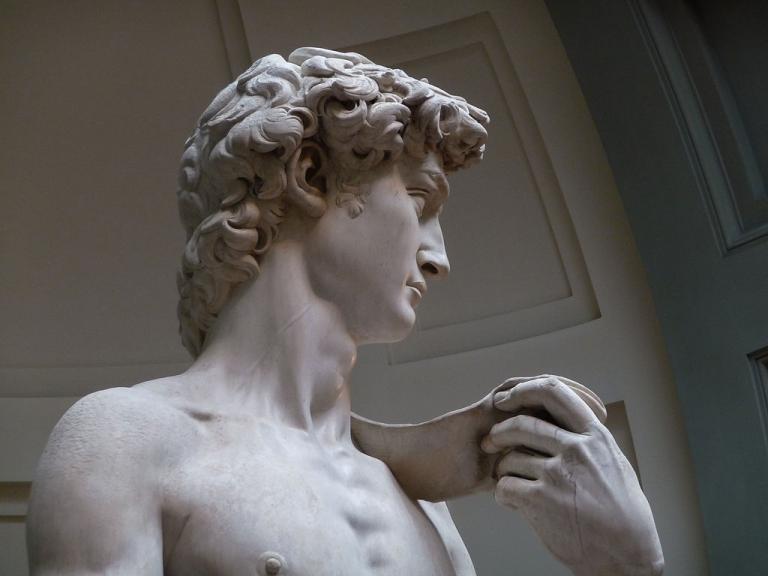
I suspect that an assignment that required a report on Michelangelo’s David from them would read something like this:
“The object known as David, by the Renaissance artist, Michelangelo is seventeen feet tall and weighs approximately six tons. It is made of marble and resembles a naked youth. It’s “head” and “hands” are too large, and it is said by some authorities to express Renaissance ideals.”
While that’s all perfectly true, it misses the point. When I ask my scientific friends, “what does it say?” (referring to any work of art) they look at me blankly. They seem to be unable to move from facts to meanings. Worse, they reduce meaning to facts in some sense. There’s a savanna theory for instance, which asserts with darwinian certitude that the reason some landscapes seem beautiful to us is because our prehistoric ancestors found savannas conducive to survival. (Darwinians have the same answer for everything, what C. S. Lewis is said to have called, “nothing-butterism”, meaning, whatever you think is the case can be reduced to “nothing but” survival.)
Seeing that the scientific method is a fairly recent phenomenon and we’ve had interest in meaning of things from the very beginning of recorded history, what is going on here?
I can’t help but believe something has gone wrong, that in the interest of understanding the world we’ve lost the world. The world is reduced to cause and effect, but its meaning is something we can no longer see.
Is there any hope? These days I despair for our children. STEM is everything (Science, Technology, Engineering, and Math) and the humanities are in disarray. Humanists have lost the transcendentals. Everything has been reduced to power games. The arts suffer from nothing-butterism too. (Can we even call these scholars “humanists” any longer?)
How can we be made to see again?
Previous Post

June 24, 2016
Brexit and The Great Homogenizator
Next Post

June 30, 2016 I Miss the Religious But Not Spiritual
Browse Our Archives
Select a Category Advising a Daughter Aristotle Art Atheism Author and Speaking Appearances Beauty Building Working Houses C R Wiley Children Community Creativity Cultural Apologetics Fatherhood Fiction Fidelity in marriage Film Freedom Gravitas H. P. Lovecraft Happiness Household Economy Infant Baptism Inklings Interpreting the Bible Interviews Jack Donovan Liturgy Localism Man of the House Manliness Martial Virtue Medieval Cosmology Metaphysics Mortimus Clay NecronomiCon New Left New Testament Household Codes Nietzsche Nominalism/Realism Politics Poverty Preaching Productive Property Reaching men Science Self-Sufficiency Side Hustles Social Ethics Social Security Spiritual Disciplines Sublime Techno-gnosticism The Pastor's Survival Guide Theology of the Family Tradition Uncategorized Virtue Weird Fiction
Select a Month February 2019 November 2018 October 2018 July 2018 June 2018 May 2018 April 2018 March 2018 February 2018 January 2018 December 2017 November 2017 October 2017 September 2017 August 2017 July 2017 June 2017 May 2017 April 2017 March 2017 February 2017 January 2017 December 2016 November 2016 October 2016 September 2016 August 2016 July 2016 June 2016 May 2016 April 2016 March 2016 February 2016 January 2016 December 2015
Follow Us!
TAKE THE
Religious Wisdom Quiz
"Resist the devil, and he will _____."
Select your answer to see how you score.
Pursue You Despise You Flee From You Grudgingly Respect You
Books by This Author Books by PaterFamilias Today
Books by C. R. Wiley

The Purloined Boy (The Weirdling Cycle #1)

Man of the House: A Handbook for Building a Shelter That Will Last in a World That Is Falling Apart
Related posts from PaterFamilias Today

Transcendence: Meaning from Above

Gutting Creation of Meaning Guts Scripture

Is This Evangelicalism's Red-Pill Moment?

Making the Good Life from Home
TRENDING AT PATHEOS Evangelical

How the author of the world's best hymn...
I've been working with John Newton for a while now. This makes...

Long before this Lectio Divina, Psalm 130 - the song - started...

What About the Trees? Another Living Parable
After I finished writing the last article about falling leaves as a...

Why Classical Education Is a Conversation, Not a...
Come and Read: Joy in Classical Education When I was a little...

Falling Leaves: A Living Parable on Letting Go
I’ve spent the vast majority of my life in the southeast corner...

Cornell University has received a great deal of negative publicity and intense...
view all Evangelical blogs
Ad-Free & Subscriber Log-In Subscription Support
- About Us
- 2026 Calendar
- Videos
- Podcasts
- Library of World Religions
- Faith In Media Tracker
- Advertise With Us
- Write for Us
- Privacy Policy
- Terms of Service
- Do Not Sell My Data
- Contact Us
- Radiant Digital
- Manage Newsletter Subscriptions
- Unsubscribe From Notifications
- Sitemap
Copyright 2008-2026, Patheos. All rights reserved.
Subscription Support Ad-Free & Subscriber Log-In
Follow Patheos