
BuddhistCatholicContemplativeEvangelicalGeneral ChristianHinduJewishLatter-day SaintMuslimNew VisionsProgressive Christian
Beliefs
- Buddhist
- Catholic
- Contemplative
- Evangelical
- General Christian
- Hindu
- Jewish
- Latter-day Saint
- More Voices
- Muslim
- New Visions
- Pagan
- Progressive Christian
Topics
- Religion News
- Food and Religion
- Sports and Religion
- Religious Art
- Religious Music and Entertainment
- Religious Events
- History and Religion
- Style and Religion
- Politics and Religion
- Women in Religion
- Recreation Outdoors and Religion
- Business Finance and Religion
- Careers Workplace and Religion
- Education and Religion
- Family Parenting and Religion
- Health Fitness and Religion
- Home and Religion
- Relationships and Religion
- Technology and Religion
- Travel and Religion
Columnists
- Buddhist Columnists
- Business Finance and Religion Columnists
- Careers Workplace and Religion Columnists
- Catholic Columnists
- Contemplative Columnists
- Education and Religion Columnists
- Evangelists Columnists
- Family Parenting and Religion Columnists
- General Christian Columnists
- Health Fitness and Religion Columnists
- Hindu Columnists
- History and Religion Columnists
- Home and Religion Columnists
- Jewish Columnists
- More Voices Columnists
- Latter Day Columnists
- Muslim Columnists
- New Visions Columnists
- Nonreligious Columnists
- Pagan Columnists
- Politics and Religion Columnists
- Progressive Columnists
- Recreation Outdoors and Religion Columnists
- Relationships and Religion Columnists
- Religion News Columnists
- Religious Art Columnists
- Religious Events Columnists
- Religious Music and Entertainment Columnists
- Sports and Religion Columnists
- Style and Religion Columnists
- Technology and Religion Columnists
- Travel and Religion Columnists
- Women in Religion Columnists
Resource Library
- 2026 Calendar
- Library of World Religions
- The 100 Most Holy Places on Earth
- Patheos Answers
- Podcasts
- Videos
- Faith Leaders Database
- Anglican Episcopalian
- Bahai
- Baptist
- Buddhism
- Christianity
- Confucianism
- Eastern Orthodoxy
- Hinduism
- Holiness and Pentecostal
- ISKCON
- Islam
- Judaism
- Lutheran
- Methodist
- The Church of Jesus Christ of Latter-day Saints
- New Age
- Paganism
- Presbytarian and Reformed
- Protestantism
- Religion Behind the Scenes
- Roman Catholic
- Scientology
- Shia Islam
- Sikhism
- Sufism
- Sunni Islam
- Taoism
- Zen
- See all religions
Research Tools
 Ad-Free & Subscriber Log-In Subscription Support
Ad-Free & Subscriber Log-In Subscription Support
Follow Patheos 

- Trending:
- Forgiveness
- |
- Marriage
- |
- Consciousness
- |
- Death Penalty
- |
- Election
- |
- Halloween
 PaterFamilias Today
- Home
- Evangelical
- Front Porches: What Makes for a Good One?
Front Porches: What Makes for a Good One?
Last updated on: May 27, 2016 at 9:12 am by C. R. Wiley
Front Porches: What Makes for a Good One? 2016-05-27T09:12:04-04:00 C. R. Wiley
Patheos Explore the world's faith through different perspectives on religion and spirituality! Patheos has the views of the prevalent religions and spiritualities of the world.
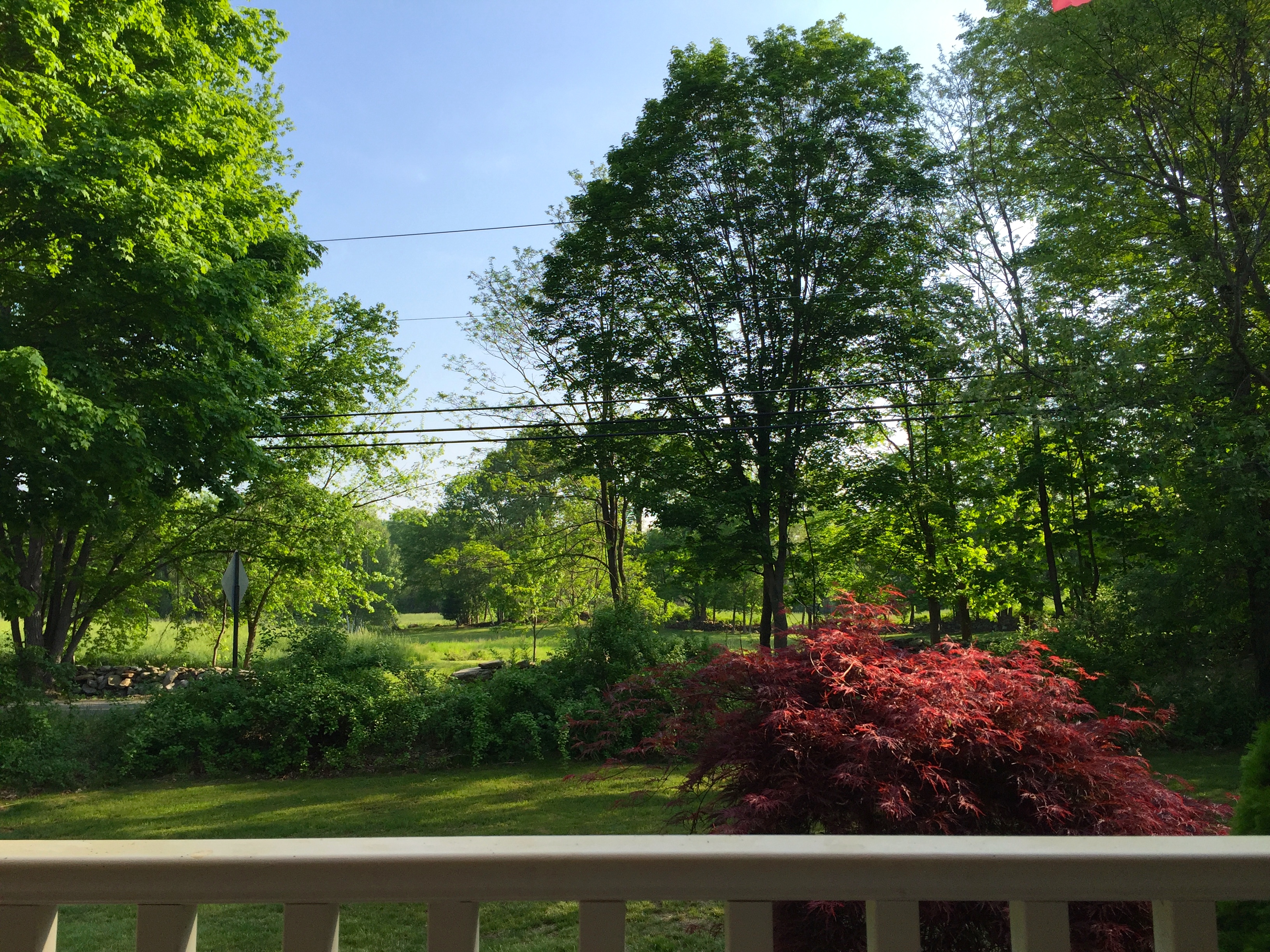
The view from my porch, May 27, 2016. (The field across the way belongs to one of my parishioners. Her home was built circa 1750.)
Well, I’m heading down to Baltimore for the Annual Meeting of the Academy of Philosophy and Letters. (It looks to be a good one, we’ll have Rod Dreher with us and he’ll be addressing the Benedict Option.)
I’ll miss my front porch. It’s where I drink coffee and read each morning. This time of year traveling is a sacrifice.
I will get to spend some time with a few of my friends from Front Porch Republic while I’m at the meeting; that reminded me of something I wrote on front porches for FPR not too long ago. Here it is–
I heard someone say recently, “Porches are back. They’re on all the new houses.” And I thought, “No, no they’re not.”
Porches on newer houses are hardly more than façades, sort of like shutters. My shutters don’t even shut; and if you have them I bet yours don’t either. Real shutters came with hinges in the old days. Back then, when a storm came through, you shut them. Usually they were louvered so a little light could filter in. But they lost their jobs when storm windows came along. You may remember those, or you may not. They were replaced by the double-paned, vinyl-clad, tilt-in-to-clean, windows we have today.
The reason we still have things that we like to call shutters is because they look nice. They’re like mascara for houses. Mine are made of plastic and they’re screwed on. When I think about them I feel a little like a fraud, so I don’t. And this is the reason people put faux porches on houses today. They look nice; they make houses look “homey”.
I’ve been thinking about porches lately because I just replaced the handrail on mine.
After three fixer-uppers in twelve years I was ready for a new house. And so I bought nearly new—it was just three years old at time of purchase. But I was kidding myself. It was a charmless modern box. I’ve been working on it ever since, turning it into a home.
It’s a farmhouse colonial without the farm part. That means it’s a two-story with a porch running along the front. As far as newer houses go, the porch is better than most, but it had three problems. One I could fix—the handrail. But the others I’ll just have to live with.
So how do you get a porch right? Well, you have to remember what it is for. It’s an in-between space separating the sheltered inside and the wide-open outside. You may think that’s almost too obvious to mention. But this is just where most new porches fail.

The view from my rocker looking west. Behold the new rail in its surroundings. I have yellow finches, oriels, and cardinals at that feeder regularly.
Houses shelter us from two things: the elements and other people. A porch that works gives you partial exposure to both.
Let’s start with the elements. Sometimes you want to step out for a little air, or maybe a better view, or you may even want to hear the sound of the rain without getting wet. The exception is sunshine. You don’t go on the porch for that. If you want sun, you want a deck. This brings me to a big reason porches on contemporary houses don’t work—they’re not deep enough. To stay out of the sun in summer, or the rain in a downpour, a porch should be at least eight feet deep. If it’s too shallow, you might as well be on a deck.
Old porches almost always meet this standard. That’s because people actually used them. When central air conditioning invaded out homes one of the chief reasons for stepping outside was lost. Now a porch is a place to put that rocker that you bought on a whim at Cracker Barrel or a pumpkin or two at Halloween. My porch is just a little over six feet deep. That’s passable in my case, since it is on the north side of the house. But when it rains I am driven inside, which is a shame since a enjoying a good lightning storm is one of the best things about a porch.
But I can’t change that without a lot of demolition. But I did address another problem with my porch at relatively little expense. I lowered the handrail.
A handrail gives you shelter from other people. But whereas shallow porches don’t give you enough shelter from the elements, most contemporary handrails give you too much. They’re just too stinking high. And that’s because people have confused them with safety rails.
You want to be able to see over the thing when you’re sitting down. You’re out there, in part for the view, but also so other people can view you. You still want something in between; you don’t want to foist yourself on them when they’re out for a walk. You just want them to know you’re there. A handrail says—“Say hello if you’d like, but if you don’t, that’s fine too.” No rail leaves you naked, and that’s awkward for everybody. A rail clothes you. But when it is too high, it veils you; and a veil seems to say, “Do not disturb”.
The rails on old porches tend to be 32 inches high or lower, some as low as 24 inches. Most rails these days are 40 inches and higher—often right at eye-level for someone in a chair. The reasons have to do with building codes and the confusion surrounding what they’re for—those things and skinflint builders.
Building code usually sets the safety rail height at 36 inches, a tad high for a porch, but tolerable if you’re tall. But that’s still six inches lower than the 42 inch rail I just replaced. Where did the additional six inches come from? That’s where the skinflint comes in.
Because certain rail designs call for a full 36-inch baluster to meet code balusters come 36 inches long (or longer) straight from the manufacturer. But even when the rail design doesn’t call for a 36-inch baluster many contractors leave them that long. Cutting them is labor intensive, usually calling for 2 cuts per baluster because the baluster’s profile. (If it’s been turned on a lathe, the profile should be evenly spaced between the top and bottom rails.) Since labor is usually the biggest expense in construction, the general rule of thumb for contractors is the fewer cuts the better. So balusters are often taken directly from the box and attached to the top and bottom rails. And since those rails are usually 1 and a half inches thick, that gives you an additional 3 inches, bringing you up to 39 inches. Naturally you need a space beneath the lower rail to allow water to escape and to keep people from stubbing their toes. So add another 3 inches and voila, you’ve got a 42-inch rail.
A couple of more things that you’ll need for a porch as I’m thinking about it; first, it should be the right distance from the road. A porch that is too far back can’t support a conversation. People not only need to be able to see you, they need to be able to hear you. Mine is about 50 feet back from the curb—about as far back as you can go without having to shout to be heard. You still need to raise your voice, but it isn’t too taxing. Even most elderly people can manage it.
Now here’s the last thing—something I can’t fix on mine. A porch needs to be in a neighborhood where people know what porches are for.
I live in New England—a notoriously cold place in more ways than one—and I live in the country, right across the way from Tracy’s field. Tracy lives alone in a Cape-style home built sometime in the 1750s. (Yes, you read that correctly.) In the afternoons she putters around in her lawn tractor and since I’m her pastor she has to wave back when I wave to her. But there are plenty of folk who don’t know me or apparently want to who pass by: joggers, dog walkers, the farmer down the street chugging by on his Farmall, neighborhood boys on bikes (we still have those). Mostly they’re unsettled by the guy on the porch. That’d be me.
This may have to do with just having a porch. It’s just about the only one around. (Oh, there’s the Gorsky’s porch, but it has to be three hundred yards back from the road.) You see, the porch is something of an import. New England vernacular just doesn’t speak porch—capes, saltboxes, true colonials—nary a porch in the bunch. Porches are most at home in warm weather states where they once had a function. (Here in New England you still find homes without central air conditioning, believe it or not.) Now it is true that we have them on town greens and in the old mill towns, but those were built in the 19th century and were inspired by designs in house books published by enterprising architects. But even those porches tend to be places to store firewood for winter rather than to sitting out on in the summer.
But it may not have anything to do with New England at all. It may just be that sitting outside and hoping for a little neighborliness makes you an undesirable neighbor these days.
I do get out and about in my neighborhood. Two or three times a week I go for a run. And I’ve discovered that I’m not the only person sitting out. There’s Joe, the metal sculptor. We exchange waves. He doesn’t have a porch, but he does sit out in a lawn chair in front of his garage workshop. (It must get hot in there with all the welding stuff.) He’s surrounded by the work of his hands. There’s the eight-foot wide spider made out of rebar—an early work—then there’s the sheet metal tree frog that’s the size of a small car. His yard is covered with oversized creepy-crawlies. (Apparently Joe is having trouble moving inventory.) Then there’s the Wizard of Tolland just around the bend. (I’m not joking—we have a guy who thinks he’s a wizard: robe, pointy hat, long beard, the works.) He drives a Subaru with a sign that reads, “Wizard of Tolland”. He’s usually having tea, enthroned upon a cast iron ornamental chair, the sort no one ever seems to use. I think he likes me, he gives me a thumbs up when I go running by. I wave back.
And there you have it. If you sit out on your porch you may be numbered with the artists and the mentally ill. Considering the new normal, it may not be a bad thing. This requires a gracious indifference to the opinions of others, something artists and the insane are known for. Well, that’s my thoughts on the porch. Now I’m off to enjoy a pipe on mine and annoy my neighbors with a little neighborliness.
Next week I hope to give my readers a little report of my time at the Academy of Philosophy and Letters. (BTW, there is at least one fellow Patheos blogger I think I’ll be seeing. Maybe I’ll even have pictures.)
Academy of Philosophy and Letters
Previous Post

May 25, 2016
Are Men Obsolete? (Short answer, no.)
Next Post

June 1, 2016 Calvinism and the Sublime: the Art of Darkness
Browse Our Archives
Select a Category Advising a Daughter Aristotle Art Atheism Author and Speaking Appearances Beauty Building Working Houses C R Wiley Children Community Creativity Cultural Apologetics Fatherhood Fiction Fidelity in marriage Film Freedom Gravitas H. P. Lovecraft Happiness Household Economy Infant Baptism Inklings Interpreting the Bible Interviews Jack Donovan Liturgy Localism Man of the House Manliness Martial Virtue Medieval Cosmology Metaphysics Mortimus Clay NecronomiCon New Left New Testament Household Codes Nietzsche Nominalism/Realism Politics Poverty Preaching Productive Property Reaching men Science Self-Sufficiency Side Hustles Social Ethics Social Security Spiritual Disciplines Sublime Techno-gnosticism The Pastor's Survival Guide Theology of the Family Tradition Uncategorized Virtue Weird Fiction
Select a Month February 2019 November 2018 October 2018 July 2018 June 2018 May 2018 April 2018 March 2018 February 2018 January 2018 December 2017 November 2017 October 2017 September 2017 August 2017 July 2017 June 2017 May 2017 April 2017 March 2017 February 2017 January 2017 December 2016 November 2016 October 2016 September 2016 August 2016 July 2016 June 2016 May 2016 April 2016 March 2016 February 2016 January 2016 December 2015
Follow Us!
TAKE THE
Religious Wisdom Quiz
What does 2 John emphasize believers should walk in?
Select your answer to see how you score.
Love and truth Fear and wisdom Knowledge and power Faith and law
Books by This Author Books by PaterFamilias Today
Books by C. R. Wiley

The Purloined Boy (The Weirdling Cycle #1)

Man of the House: A Handbook for Building a Shelter That Will Last in a World That Is Falling Apart
Related posts from PaterFamilias Today

Transcendence: Meaning from Above

Gutting Creation of Meaning Guts Scripture

Advice for a Single Woman Who Is Looking...

Is This Evangelicalism's Red-Pill Moment?
TRENDING AT PATHEOS Evangelical

The REST of Your Life: A Creative Wrestles...
This week I had a conversation with a good friend from church....

How the author of the world's best hymn...
I've been working with John Newton for a while now. This makes...

Long before this Lectio Divina, Psalm 130 - the song - started...

What About the Trees? Another Living Parable
After I finished writing the last article about falling leaves as a...

Why Classical Education Is a Conversation, Not a...
Come and Read: Joy in Classical Education When I was a little...

Cornell University has received a great deal of negative publicity and intense...
view all Evangelical blogs
Ad-Free & Subscriber Log-In Subscription Support
- About Us
- 2026 Calendar
- Videos
- Podcasts
- Library of World Religions
- Faith In Media Tracker
- Advertise With Us
- Write for Us
- Privacy Policy
- Terms of Service
- Do Not Sell My Data
- Contact Us
- Radiant Digital
- Manage Newsletter Subscriptions
- Unsubscribe From Notifications
- Sitemap
Copyright 2008-2026, Patheos. All rights reserved.
Subscription Support Ad-Free & Subscriber Log-In
Follow Patheos