
BuddhistCatholicContemplativeEvangelicalGeneral ChristianHinduJewishLatter-day SaintMuslimNew VisionsProgressive Christian
Beliefs
- Buddhist
- Catholic
- Contemplative
- Evangelical
- General Christian
- Hindu
- Jewish
- Latter-day Saint
- More Voices
- Muslim
- New Visions
- Pagan
- Progressive Christian
Topics
- Religion News
- Food and Religion
- Sports and Religion
- Religious Art
- Religious Music and Entertainment
- Religious Events
- History and Religion
- Style and Religion
- Politics and Religion
- Women in Religion
- Recreation Outdoors and Religion
- Business Finance and Religion
- Careers Workplace and Religion
- Education and Religion
- Family Parenting and Religion
- Health Fitness and Religion
- Home and Religion
- Relationships and Religion
- Technology and Religion
- Travel and Religion
Columnists
- Buddhist Columnists
- Business Finance and Religion Columnists
- Careers Workplace and Religion Columnists
- Catholic Columnists
- Contemplative Columnists
- Education and Religion Columnists
- Evangelists Columnists
- Family Parenting and Religion Columnists
- General Christian Columnists
- Health Fitness and Religion Columnists
- Hindu Columnists
- History and Religion Columnists
- Home and Religion Columnists
- Jewish Columnists
- More Voices Columnists
- Latter Day Columnists
- Muslim Columnists
- New Visions Columnists
- Nonreligious Columnists
- Pagan Columnists
- Politics and Religion Columnists
- Progressive Columnists
- Recreation Outdoors and Religion Columnists
- Relationships and Religion Columnists
- Religion News Columnists
- Religious Art Columnists
- Religious Events Columnists
- Religious Music and Entertainment Columnists
- Sports and Religion Columnists
- Style and Religion Columnists
- Technology and Religion Columnists
- Travel and Religion Columnists
- Women in Religion Columnists
Resource Library
- 2026 Calendar
- Library of World Religions
- The 100 Most Holy Places on Earth
- Patheos Answers
- Podcasts
- Videos
- Faith Leaders Database
- Anglican Episcopalian
- Bahai
- Baptist
- Buddhism
- Christianity
- Confucianism
- Eastern Orthodoxy
- Hinduism
- Holiness and Pentecostal
- ISKCON
- Islam
- Judaism
- Lutheran
- Methodist
- The Church of Jesus Christ of Latter-day Saints
- New Age
- Paganism
- Presbytarian and Reformed
- Protestantism
- Religion Behind the Scenes
- Roman Catholic
- Scientology
- Shia Islam
- Sikhism
- Sufism
- Sunni Islam
- Taoism
- Zen
- See all religions
Research Tools
 Ad-Free & Subscriber Log-In Subscription Support
Ad-Free & Subscriber Log-In Subscription Support
Follow Patheos 

- Trending:
- Forgiveness
- |
- Marriage
- |
- Consciousness
- |
- Death Penalty
- |
- Election
- |
- Halloween
 PaterFamilias Today
- Home
- Evangelical
- Are You a Bubble-Baby?
Are You a Bubble-Baby?
Last updated on: April 4, 2016 at 3:42 pm by C. R. Wiley
Are You a Bubble-Baby? 2016-04-04T15:42:39-04:00 C. R. Wiley
Patheos Explore the world's faith through different perspectives on religion and spirituality! Patheos has the views of the prevalent religions and spiritualities of the world.

A real bubble child — someone we should feel for. The problem with the bubble babies I’m talking about is they can’t feel for people out side their bubbles. http://www.pbs.org/wgbh/amex/bubble/
Probably the thing that bugs me most about those tender sprouts who have grown up in the hermetically sealed safe-spaces of the upper-middle class is the paradoxical blend of blithe knowingness and naiveté.
Here are people who’ve spent their entire lives in controlled environments. Even those programs designed to provide exposure to the world outside the bubble suffer from being what they are–programs–with oversight, learning outcomes, itineraries, daily schedules, matching water bottles, and plenty of liability insurance.
And yet, for all the padding, there is sureness of conviction. These are people who know what is wrong with the world and they’re determined to fix it.
It generally takes me all of ten minutes to burst their bubbles. I don’t say mean things. I just ask questions, like Socrates. Sometimes I even suggest alternative explanations to their knowing-answers.
I’ve had more opportunities to do this lately. The Trump phenomenon, you know.
It really doesn’t matter which side of the political divide the subject is on, if the person grew up in the upper middle class, he or she is sure there is no sane reason a person would support the New York billionaire. It all comes down to either racism, xenophobia, or the manipulations of a demagogue. (Probably all the above.)
My first question is, where did you grow up? (They don’t see the point of that.) Then I ask, where did you go to school? (Here the defenses begin to go up.) By the time I get to employment; for example, have you ever worked with your hands? people begin to get a little angry. When I ask, do you know any Trump supporters who you respect, or even admire? now the contempt begins to show. (No, no they do not, what a stupid question.)
I’m not really interested in defending Trump here. What I’m really interested in is bubbles. The thing about bubbles is their transparency; they can surround us, and insulate us, and all the while we remain oblivious to them.
Recently Charles Murray’s bubble test has been making the rounds. It’s designed to help bubble-encased people detect the bubbles that surround them, like mimes in a park. It’s pretty good, (Go ahead and take it.)
I scored 70, btw. I have yet to compared my score with someone who scored higher. If my tastes in television were different my score would have been higher–some bubbles aren’t all bad.
Some of the dumbest people I know have PhDs.
I’m an odd duck. I come from a family filled with intellectuals and artists. Yet as a kid I lived in a housing project, spent time in a foster home, and saw my mother trucked off to mental institutions. As a young man I was a framer and a home improvement contractor. I’ve lived in Cambridge, Massachusetts (smack dab between Harvard and MIT), spent some time at Harvard Divinity School, taught philosophy to undergraduates, and even spent more time than I care to recall around the sort of people who think Bernie Sanders is the hope of the ages (they used to feel that way about Obama, but they don’t like to be reminded of that).
I’ve lived something of an unstructured existence. To this day I have friends who call themselves rednecks, others who teach at elite colleges, still others on welfare, and plenty who live in cul-de-sac in tony towns. I never set out to know people from such a wide range of backgrounds, ethnicities, social classes, and lifestyles. It just turned out that way.
And I can say this with some authority, some of the best educated people I know are phenomenally stupid.
And their stupidity seems to rise with their confidence that they really know the score.
I think it comes down to a couple of things. One, they’ve never really gotten Socrates’s point about wisdom beginning with an admission of ignorance. These are people who are deathly afraid of ever admitting they don’t know something.
The other thing is the bubble.
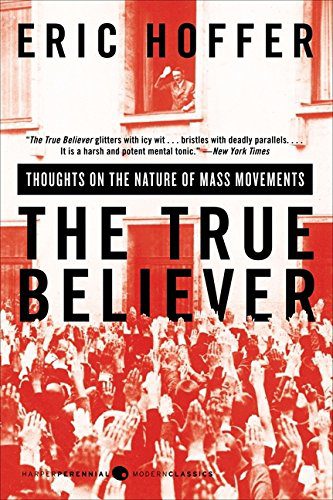
http://www.amazon.com/True-Believer-Thoughts-Movements-Perennial/dp/0060505915/ref=sr_1_1?s=books&ie=UTF8&qid=1459775036&sr=1-1&keywords=the+true+believer+by+hoffer
Blue Collar Intellectuals
I think people got out of their bubbles more in the past–probably not the distant past, but definitely during the 19th and 20th centuries.
I just finished reading, Blue Collar Intellectuals by Daniel J. Flynn. It’s a series of biographical sketches of five “blue collar” intellectuals. Here’s the list: Will and Ariel Durant, Mortimer Adler, Milton Friedman, Eric Hoffer, and Ray Bradbury.
Each rose from a humble, working class background and went on to pursue the life of the mind. In each case their sentiments remained sympathetic to blue collar people. They wanted to engage in uplift, and spread learning among the illiterati. This, unsurprisingly, but disappointingly, earned them the contempt of literati.
My favorite of the bunch was Eric Hoffer (with Ray Bradbury a close second). Hoffer was a San Francisco longshoreman. He spent nearly his entire working life as one of the working class, but in the evenings he wrote slim but profound social analysis. His best known book is, The True Believer. I’d heard of it, but had not read it. After reading about him, I picked it up and I’m working through it.
Hoffer has never been picked up by the left, mainly because he saw through leftists with the eye of a true blue collar intellectual. Here’s an extract from a marvelous interview of Hoffer from 1967. (I love the chain-smoking.)
“Whenever intellectuals are in power there is total raping going on.”
Strong stuff. But I think he’s right.
Have you wondered why the people Bernie Sanders ostensibly speaks for are more likely to support Trump, billionaire status and all? Hoffer sums it up. Anyway, I encourage you to listen to whole interview on Youtube. This is just a sample.
I wish we had some blue collar public intellectuals today. Perhaps we do and I don’t know who they are. But there you go, back in the day many people could identify them.
Bubble-babies for Jesus
I suppose the biggest thing that bugs me as a minister is the bubble-factor among ministers. We have all these bright good doobies, huffing and puffing, with their neat little theological answer books, their soft-hands, tender hearts, and blinkered expressions. They’ve been on mission trips to Haiti, they’ve taken classes on social justice in seminary–and increasingly Bible college, they wring their hands about domestic violence and gender equality.
But all the sympathy is based on second-hand, manufactured, pseudo-experience. They don’t really know anything, and frankly I just wish they’d shut up.
Here’s the straight truth. Once a bubble-baby, always a bubble-baby. Our sympathies form in childhood. And we can detect those sympathies by thousands of subtle clues: clothing, body language, accents, tastes, and so forth. Bubble-babies tend to cluster, just like every other group. But unlike other groups, they presume to know the truth about the rest of us, and their contempt is getting worse.
I think our only hope lies in humility. Unfortunately the bubble-babies live in a curved structure that only affirms what is already present inside the worlds they inhabit. And like hamsters in plastic exercise balls they’re running over the rest of us.
Previous Post

March 31, 2016
I Am the NRA and I'm a Minister of the Gospel
Next Post

April 7, 2016 Telling Stories: Why Preachers Should Learn to Write Good Fiction
Browse Our Archives
Select a Category Advising a Daughter Aristotle Art Atheism Author and Speaking Appearances Beauty Building Working Houses C R Wiley Children Community Creativity Cultural Apologetics Fatherhood Fiction Fidelity in marriage Film Freedom Gravitas H. P. Lovecraft Happiness Household Economy Infant Baptism Inklings Interpreting the Bible Interviews Jack Donovan Liturgy Localism Man of the House Manliness Martial Virtue Medieval Cosmology Metaphysics Mortimus Clay NecronomiCon New Left New Testament Household Codes Nietzsche Nominalism/Realism Politics Poverty Preaching Productive Property Reaching men Science Self-Sufficiency Side Hustles Social Ethics Social Security Spiritual Disciplines Sublime Techno-gnosticism The Pastor's Survival Guide Theology of the Family Tradition Uncategorized Virtue Weird Fiction
Select a Month February 2019 November 2018 October 2018 July 2018 June 2018 May 2018 April 2018 March 2018 February 2018 January 2018 December 2017 November 2017 October 2017 September 2017 August 2017 July 2017 June 2017 May 2017 April 2017 March 2017 February 2017 January 2017 December 2016 November 2016 October 2016 September 2016 August 2016 July 2016 June 2016 May 2016 April 2016 March 2016 February 2016 January 2016 December 2015
Follow Us!
TAKE THE
Religious Wisdom Quiz
To whom does Paul say he has become all things so that by all possible means he might save some?
Select your answer to see how you score.
The Gentiles The Jews Everyone The weak
Books by This Author Books by PaterFamilias Today
Books by C. R. Wiley

The Purloined Boy (The Weirdling Cycle #1)

Man of the House: A Handbook for Building a Shelter That Will Last in a World That Is Falling Apart
Related posts from PaterFamilias Today

Transcendence: Meaning from Above

Gutting Creation of Meaning Guts Scripture

Advice for a Single Woman Who Is Looking...

Is This Evangelicalism's Red-Pill Moment?
TRENDING AT PATHEOS Evangelical

How the author of the world's best hymn...
I've been working with John Newton for a while now. This makes...

Long before this Lectio Divina, Psalm 130 - the song - started...

What About the Trees? Another Living Parable
After I finished writing the last article about falling leaves as a...

Why Classical Education Is a Conversation, Not a...
Come and Read: Joy in Classical Education When I was a little...

Falling Leaves: A Living Parable on Letting Go
I’ve spent the vast majority of my life in the southeast corner...

Cornell University has received a great deal of negative publicity and intense...
view all Evangelical blogs
Ad-Free & Subscriber Log-In Subscription Support
- About Us
- 2026 Calendar
- Videos
- Podcasts
- Library of World Religions
- Faith In Media Tracker
- Advertise With Us
- Write for Us
- Privacy Policy
- Terms of Service
- Do Not Sell My Data
- Contact Us
- Radiant Digital
- Manage Newsletter Subscriptions
- Unsubscribe From Notifications
- Sitemap
Copyright 2008-2026, Patheos. All rights reserved.
Subscription Support Ad-Free & Subscriber Log-In
Follow Patheos