
BuddhistCatholicContemplativeEvangelicalGeneral ChristianHinduJewishLatter-day SaintMuslimNew VisionsProgressive Christian
Beliefs
- Buddhist
- Catholic
- Contemplative
- Evangelical
- General Christian
- Hindu
- Jewish
- Latter-day Saint
- More Voices
- Muslim
- New Visions
- Pagan
- Progressive Christian
Topics
- Religion News
- Food and Religion
- Sports and Religion
- Religious Art
- Religious Music and Entertainment
- Religious Events
- History and Religion
- Style and Religion
- Politics and Religion
- Women in Religion
- Recreation Outdoors and Religion
- Business Finance and Religion
- Careers Workplace and Religion
- Education and Religion
- Family Parenting and Religion
- Health Fitness and Religion
- Home and Religion
- Relationships and Religion
- Technology and Religion
- Travel and Religion
Columnists
- Buddhist Columnists
- Business Finance and Religion Columnists
- Careers Workplace and Religion Columnists
- Catholic Columnists
- Contemplative Columnists
- Education and Religion Columnists
- Evangelists Columnists
- Family Parenting and Religion Columnists
- General Christian Columnists
- Health Fitness and Religion Columnists
- Hindu Columnists
- History and Religion Columnists
- Home and Religion Columnists
- Jewish Columnists
- More Voices Columnists
- Latter Day Columnists
- Muslim Columnists
- New Visions Columnists
- Nonreligious Columnists
- Pagan Columnists
- Politics and Religion Columnists
- Progressive Columnists
- Recreation Outdoors and Religion Columnists
- Relationships and Religion Columnists
- Religion News Columnists
- Religious Art Columnists
- Religious Events Columnists
- Religious Music and Entertainment Columnists
- Sports and Religion Columnists
- Style and Religion Columnists
- Technology and Religion Columnists
- Travel and Religion Columnists
- Women in Religion Columnists
Resource Library
- 2026 Calendar
- Library of World Religions
- The 100 Most Holy Places on Earth
- Patheos Answers
- Podcasts
- Videos
- Faith Leaders Database
- Anglican Episcopalian
- Bahai
- Baptist
- Buddhism
- Christianity
- Confucianism
- Eastern Orthodoxy
- Hinduism
- Holiness and Pentecostal
- ISKCON
- Islam
- Judaism
- Lutheran
- Methodist
- The Church of Jesus Christ of Latter-day Saints
- New Age
- Paganism
- Presbytarian and Reformed
- Protestantism
- Religion Behind the Scenes
- Roman Catholic
- Scientology
- Shia Islam
- Sikhism
- Sufism
- Sunni Islam
- Taoism
- Zen
- See all religions
Research Tools
 Ad-Free & Subscriber Log-In Subscription Support
Ad-Free & Subscriber Log-In Subscription Support
Follow Patheos 

- Trending:
- Forgiveness
- |
- Marriage
- |
- Consciousness
- |
- Death Penalty
- |
- Election
- |
- Halloween
 PaterFamilias Today
- Home
- Evangelical
- Getting Your Brain Out of a Vat
Getting Your Brain Out of a Vat
Last updated on: March 21, 2016 at 5:28 pm by C. R. Wiley
Getting Your Brain Out of a Vat 2016-03-21T17:28:32-04:00 C. R. Wiley
Patheos Explore the world's faith through different perspectives on religion and spirituality! Patheos has the views of the prevalent religions and spiritualities of the world.
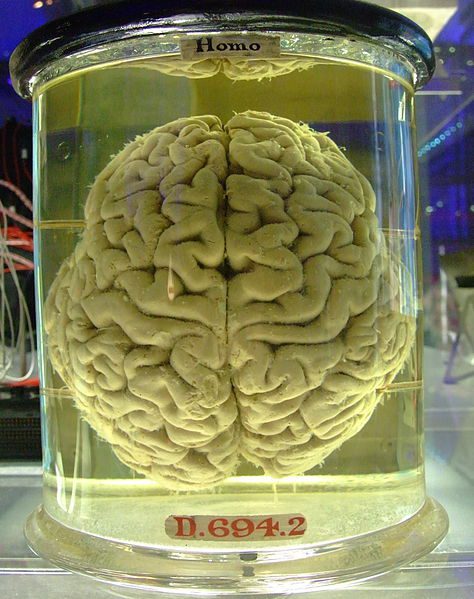
https://en.wikipedia.org/wiki/File:Human_brain_in_a_vat.jpg
It’s a classic science fiction trope, the old brain in a vat schtick.
You see it in H. P. Lovecraft’s weird fiction; the Matrix is actually a brain in a vat story with a twist–the whole body is in a vat, but only to keep the brain alive; then there’s classic Star Trek and the episode entitled, Spock’s Brain.
But the whole thing actually has its origin in modern philosophy. (Modern philosophy is its own horror story, you could say. It gave us Marx, among others. Would that his ideas has stayed in his brain the not found their way into the body politic.)
Some have identified Rene Descartes as our Dr. Frankenstein; but instead of inserting a brain in a body, he took yours out. When he said, “I think, therefore I am” he implied that your mind is the real you.
This is the origin of the mind-body problem. If you are essentially mind, how do you move your body? Is there something really, really sensitive that can detect fluctuations of thought and amplify them so you can move your arm? If so, why don’t we consider those fluctuations physical phenomena?
But Descartes was a particular sort of philosopher; he was what we call a, rationalist. You might think another school of thought, something called, empiricism, with its higher regard for sense data, would help. You would be wrong.
Empiricists believe that our minds are stimulated by our senses, but we are still sealed off in them. Is the sky truly blue, or is that just the way is appears to us given the faculties we have to perceive it with? We can’t really know, “the thing in itself”. We can only know how it appears to us, at least that’s the way the theory goes.
Since the seventeenth and eighteenth centuries we’ve made a little progress. We’ve situated the mind in a physical thing, the brain. But we still tend to think of our brains primarily as a place for the true you to live.
It’s not a big leap from this to brains in vats. If I really live in my brain, then perhaps it could be extracted from this body someday and either inhabit a virtual reality, like we see in the Matrix, or better still, maybe it could be placed in a new, upgraded body?
Help from a surprising source
We’re beginning to see that not only would this be technically difficult to pull off, you would no longer be you even if we could. And the people who are helping us to see this, believe it or not, are the people working on artificial intelligence.
The weekend edition of The Wall Street Journal, in a article entitled, Machines That Will Think and Feel, addressed the challenge of replacing people with robots. If you are going to have a robot who can understand humans and interact with them comfortably, then they must be made to feel, or at least have simulated feelings. And if they’re going to learn, they’ll need to actually be placed in human environments and learn by interacting with people.
To spell it out, robots will need bodies like ours to be intelligent social agents.
This isn’t in the article, but it occurred to me as I read it. What about empathy? Is it merely an algorithm, our do you truly need to feel pain to feel it? Let’s say we could upload consciousness onto a cyborg, and let’s say the cyborg even had sensors that simulated pain, would it be the same? Or would it be something different? I vote for different.
The resurrection of the body and the sacraments
I don’t think most Western Christians see the point of resurrecting our bodies. Heavenly spirits should suffice. If they think about it at all, they tend to think of it as trading in an old model, with things they’re not crazy about, for some new, sleek movie star or supermodel, model. It’s not even the same body transformed, its new from the bottom up.
It’s been noted by people smarter than me, that we suffer from a gnosticism problem in American Christianity. Harold Bloom in, The American Religion goes so far as to say genuine Christianity has never really taken root in the new world, it’s all gnosticism–everything from the Southern Baptist Convention to the Mormons. (He blamed it on John Wesley, actually since he likes gnosticism you could say he praises him for it.)
But gnosticism is the mind-body problem taken to the cosmic level. And I agree with Bloom, it’s very much at home in America, which is a reason something I call techno-gnosticism is growing in popularity. With the techno-gnostics the body isn’t really you; that’s why you can upgrade it forever, continually transferring the real you, your consciousness, time and time again. (I think it’s also a reason why Darwinism coexists so easily with New Age thinking. Who cares if our bodies emerged from a violent and seemingly random process, if your body is just temporary housing? That’s certainly the way Scientologists look at it.)
In conservative Protestant circles, those of us who lament the gnosticism in our churches denounce it frequently and loudly, but to seemingly little effect. Some of us have noted that there is an irony here–relying on disembodied reason to heal the rift between the mind and the body. And some of these people have commended a return to sacraments–making them the center of church life and worship.
But there is still a problem with this in my view, frequency in observance does not seem to heal the rift.
Another rift between the mind and the body
The division of labor has been with us for an awful long time, and it appears that it’s here to stay. Still, a good thing can go too far. And one division that I think bedevils all our attempts to heal the breach between the mind and the body is the division between work that is primarily mental and work that is primarily physical.
Any intelligent craftsman will tell you his materials and this tools speak to him. They inform his work and make him more intelligent. I think one of the most misleading things about plastic is the way it passes itself off as protean, only subject to human will.
When you actually work with real materials, with your hands especially, you come to see the native structure present in things. And these in turn shape your mind. They inform you.
Fewer people than ever work with the real world. And I’m afraid that robotics and artificial intelligence will utterly cut us off, at least economically. There will still be sex I suppose, but even sex may be robotized.
Back to my main point, in order to heal the breach, and even receive the grace to be found in the sacraments, we need to first return to the physical world and learn to listen to it again.
Previous Post

March 18, 2016
The Han Solo Ethic
Next Post

March 24, 2016 Household Economics Coming to Your Living Room
Browse Our Archives
Select a Category Advising a Daughter Aristotle Art Atheism Author and Speaking Appearances Beauty Building Working Houses C R Wiley Children Community Creativity Cultural Apologetics Fatherhood Fiction Fidelity in marriage Film Freedom Gravitas H. P. Lovecraft Happiness Household Economy Infant Baptism Inklings Interpreting the Bible Interviews Jack Donovan Liturgy Localism Man of the House Manliness Martial Virtue Medieval Cosmology Metaphysics Mortimus Clay NecronomiCon New Left New Testament Household Codes Nietzsche Nominalism/Realism Politics Poverty Preaching Productive Property Reaching men Science Self-Sufficiency Side Hustles Social Ethics Social Security Spiritual Disciplines Sublime Techno-gnosticism The Pastor's Survival Guide Theology of the Family Tradition Uncategorized Virtue Weird Fiction
Select a Month February 2019 November 2018 October 2018 July 2018 June 2018 May 2018 April 2018 March 2018 February 2018 January 2018 December 2017 November 2017 October 2017 September 2017 August 2017 July 2017 June 2017 May 2017 April 2017 March 2017 February 2017 January 2017 December 2016 November 2016 October 2016 September 2016 August 2016 July 2016 June 2016 May 2016 April 2016 March 2016 February 2016 January 2016 December 2015
Follow Us!
TAKE THE
Religious Wisdom Quiz
How did God speak to Moses at the burning bush?
Select your answer to see how you score.
Through wind By name Through lightning Symbols from the fire
Books by This Author Books by PaterFamilias Today
Books by C. R. Wiley

The Purloined Boy (The Weirdling Cycle #1)

Man of the House: A Handbook for Building a Shelter That Will Last in a World That Is Falling Apart
Related posts from PaterFamilias Today

Transcendence: Meaning from Above

Gutting Creation of Meaning Guts Scripture

Is This Evangelicalism's Red-Pill Moment?

Making the Good Life from Home
TRENDING AT PATHEOS Evangelical

The REST of Your Life: A Creative Wrestles...
This week I had a conversation with a good friend from church....

How the author of the world's best hymn...
I've been working with John Newton for a while now. This makes...

Long before this Lectio Divina, Psalm 130 - the song - started...

What About the Trees? Another Living Parable
After I finished writing the last article about falling leaves as a...

Why Classical Education Is a Conversation, Not a...
Come and Read: Joy in Classical Education When I was a little...

Cornell University has received a great deal of negative publicity and intense...
view all Evangelical blogs
Ad-Free & Subscriber Log-In Subscription Support
- About Us
- 2026 Calendar
- Videos
- Podcasts
- Library of World Religions
- Faith In Media Tracker
- Advertise With Us
- Write for Us
- Privacy Policy
- Terms of Service
- Do Not Sell My Data
- Contact Us
- Radiant Digital
- Manage Newsletter Subscriptions
- Unsubscribe From Notifications
- Sitemap
Copyright 2008-2026, Patheos. All rights reserved.
Subscription Support Ad-Free & Subscriber Log-In
Follow Patheos