
BuddhistCatholicContemplativeEvangelicalGeneral ChristianHinduJewishLatter-day SaintMuslimNew VisionsProgressive Christian
Beliefs
- Buddhist
- Catholic
- Contemplative
- Evangelical
- General Christian
- Hindu
- Jewish
- Latter-day Saint
- More Voices
- Muslim
- New Visions
- Pagan
- Progressive Christian
Topics
- Religion News
- Food and Religion
- Sports and Religion
- Religious Art
- Religious Music and Entertainment
- Religious Events
- History and Religion
- Style and Religion
- Politics and Religion
- Women in Religion
- Recreation Outdoors and Religion
- Business Finance and Religion
- Careers Workplace and Religion
- Education and Religion
- Family Parenting and Religion
- Health Fitness and Religion
- Home and Religion
- Relationships and Religion
- Technology and Religion
- Travel and Religion
Columnists
- Buddhist Columnists
- Business Finance and Religion Columnists
- Careers Workplace and Religion Columnists
- Catholic Columnists
- Contemplative Columnists
- Education and Religion Columnists
- Evangelists Columnists
- Family Parenting and Religion Columnists
- General Christian Columnists
- Health Fitness and Religion Columnists
- Hindu Columnists
- History and Religion Columnists
- Home and Religion Columnists
- Jewish Columnists
- More Voices Columnists
- Latter Day Columnists
- Muslim Columnists
- New Visions Columnists
- Nonreligious Columnists
- Pagan Columnists
- Politics and Religion Columnists
- Progressive Columnists
- Recreation Outdoors and Religion Columnists
- Relationships and Religion Columnists
- Religion News Columnists
- Religious Art Columnists
- Religious Events Columnists
- Religious Music and Entertainment Columnists
- Sports and Religion Columnists
- Style and Religion Columnists
- Technology and Religion Columnists
- Travel and Religion Columnists
- Women in Religion Columnists
Resource Library
- 2026 Calendar
- Library of World Religions
- The 100 Most Holy Places on Earth
- Patheos Answers
- Podcasts
- Videos
- Faith Leaders Database
- Anglican Episcopalian
- Bahai
- Baptist
- Buddhism
- Christianity
- Confucianism
- Eastern Orthodoxy
- Hinduism
- Holiness and Pentecostal
- ISKCON
- Islam
- Judaism
- Lutheran
- Methodist
- The Church of Jesus Christ of Latter-day Saints
- New Age
- Paganism
- Presbytarian and Reformed
- Protestantism
- Religion Behind the Scenes
- Roman Catholic
- Scientology
- Shia Islam
- Sikhism
- Sufism
- Sunni Islam
- Taoism
- Zen
- See all religions
Research Tools
 Ad-Free & Subscriber Log-In Subscription Support
Ad-Free & Subscriber Log-In Subscription Support
Follow Patheos 

- Trending:
- Forgiveness
- |
- Marriage
- |
- Consciousness
- |
- Death Penalty
- |
- Election
- |
- Halloween
 PaterFamilias Today
- Home
- Evangelical
- Is Gardening Essential for Your Salvation?
Is Gardening Essential for Your Salvation?
Last updated on: February 17, 2016 at 1:57 pm by C. R. Wiley
Is Gardening Essential for Your Salvation? 2016-02-17T13:57:53-04:00 C. R. Wiley
Patheos Explore the world's faith through different perspectives on religion and spirituality! Patheos has the views of the prevalent religions and spiritualities of the world.
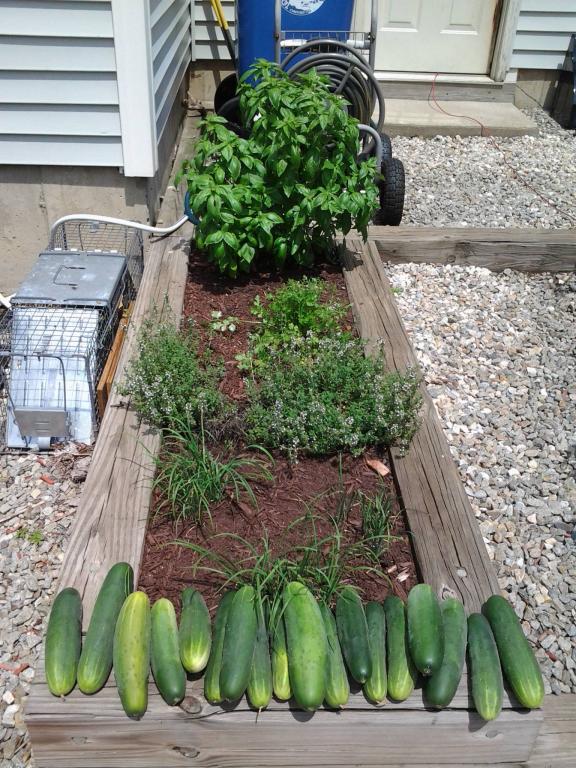
Cucumbers harvested by the wife.
I think the biggest benefit of gardening is it grounds you. I really mean that.
We are the soil, you know. Not entirely, but it is a big part of who we are.
Adam means “soil”–he was the first, “earth-man”. Humus, where we get the word, “human” means soil too. Our bodies are formed from the soil and upon death, our bodies will return to it. In the meantime our bodies clothe our spirits.
(Which reminds me, once I asked my students in Introduction to Philosophy, “Is your body a machine?” Most of them said, “Yes, what else could it be?” When I said, “A temple” they looked at me quizzically. I tried to explain, I don’t think I convinced them.)
Gardening reminds us of who we are and where we come from. I also think it provides the tableau against which the drama of salvation is played out. Without that background I’m not sure you can really get the point of it all.
Is gardening essential to salvation?
Yes and no.
I belong to a theological tradition that loves to pare away the excess. That can be a good thing, but sometimes fools get ahold the knife and the cutting goes too deep.

The upper garden in late May from the look it. My office is on the right. I have a nice view of things.
Some of these people seem to think that if something is not explicitly stated in the form of a proposition in the Bible it is nonessential. What these folks miss is that deeper structure that makes a proposition comprehensible. Like the old adage, “Fish don’t know what water is until it is gone,” I think we’re beginning to see how our alienation from the workings of nature makes it harder for people to understand the message of the Bible.
People don’t learn everything they know by listening to well crafted arguments. We learn many things through our hands, and noses, and eyes, and even our tastebuds. And many of these things are never put into words. Take a seed, an inert, seemingly dead thing, press it into the fragrant earth, a living thing we know now, teeming with microscopic life, add sunshine and water, and soon something is emerging from the ground, a living thing which, if fruitful, can help you live. Amazing.
I read somewhere recently that an alarming number of people don’t know where eggs come from. You know, chicken eggs. Perhaps it is an urban legend, but the fact that something so amazing could be credible implies that some biblical metaphors may go right past some people.
What do I mean? How about this? Given that we are soil (there’s a parable about that, remember) and God’s Word is seed, and that we are expected to produce fruit, and that the Lord uses a pruning knife to makes us even more fruitful–can you begin to see how Gardening may be essential to salvation after all? At least as something people can imagine and enter into sympathetically?
Metaphors Matter
Here’s a pet peeve of mine. (I keep my peeves locked up most of the time, they’ve been known to bite.) Pastors are substituting mechanical metaphors for biblical ones.
I think it has something to do with the problem I just mentioned. Most people spend all their time in the built environment, working in air-conditioned offices, tied to machines. And so pastors talk about “plugging in” and “networking” and so on. The problems with this are legion. But perhaps the biggest one is losing touch with creation.
We may come to think of the creation itself as a kind of machine. Viewing the world as a vast machine is in part the legacy of Newtonian physics. But most of us could never know otherwise since we have so little direct contact with it.
Machines are things that people make. I’ve got nothing against them. Almost daily I marvel at the work of human hands. But that’s just it, mechanical metaphors can obscure the hand of God. Worse, the natural order can be seen as something subject to obsolescence–that’s how the transhumanists look at things. My first encounter with this line of thought came with viewing the science fiction classic, Silent Running back when I was just a kid in 1972. You don’t need to be an eco-terroist to know the natural order is something humans cannot replace.
I think another danger is we can lose the connection between the first creation and the new creation. Paul, for instance, speaks of the mortal body as a seed that falls to the ground only to rise again in the new creation. (Don’t get me started on Christians and how cremation obscures this.) But we don’t do that with our old mobile phones. Those fall into the landfill of forgetfulness never to return.
You know, I can’t help but think that these preachers consider Jesus a “Johnny come lately” to creation, sort of wandering around and arbitrarily selecting things to illustrate his message. I’ve actually heard these guys say things like, “If Jesus were alive today he’d use metaphors drawn from high tech.” And I think to myself, “Have you ever read the Gospel of John?”
The Logos spoke long before Jesus walked the countryside in Galilee. In fact, those fields were spoken into being by the very Logos who walked around in them. Christians believe the metaphors he crafted were based on the very natural processes he created. Do you suppose he had those metaphors in mind when he made those processes?
No, I don’t believe you need to be a gardener to be saved, but I think it sure helps.
Previous Post

February 15, 2016
Organic Before It was Cool
Next Post

February 19, 2016 Two and a Half Cheers for Tiny Houses
Browse Our Archives
Select a Category Advising a Daughter Aristotle Art Atheism Author and Speaking Appearances Beauty Building Working Houses C R Wiley Children Community Creativity Cultural Apologetics Fatherhood Fiction Fidelity in marriage Film Freedom Gravitas H. P. Lovecraft Happiness Household Economy Infant Baptism Inklings Interpreting the Bible Interviews Jack Donovan Liturgy Localism Man of the House Manliness Martial Virtue Medieval Cosmology Metaphysics Mortimus Clay NecronomiCon New Left New Testament Household Codes Nietzsche Nominalism/Realism Politics Poverty Preaching Productive Property Reaching men Science Self-Sufficiency Side Hustles Social Ethics Social Security Spiritual Disciplines Sublime Techno-gnosticism The Pastor's Survival Guide Theology of the Family Tradition Uncategorized Virtue Weird Fiction
Select a Month February 2019 November 2018 October 2018 July 2018 June 2018 May 2018 April 2018 March 2018 February 2018 January 2018 December 2017 November 2017 October 2017 September 2017 August 2017 July 2017 June 2017 May 2017 April 2017 March 2017 February 2017 January 2017 December 2016 November 2016 October 2016 September 2016 August 2016 July 2016 June 2016 May 2016 April 2016 March 2016 February 2016 January 2016 December 2015
Follow Us!
TAKE THE
Religious Wisdom Quiz
What is the main lesson of the Parable of the Net?
Select your answer to see how you score.
Only some are chosen Angels are everywhere Earthly riches corrupt God's kingdom includes many; judgment will sort them
Books by This Author Books by PaterFamilias Today
Books by C. R. Wiley

The Purloined Boy (The Weirdling Cycle #1)

Man of the House: A Handbook for Building a Shelter That Will Last in a World That Is Falling Apart
Related posts from PaterFamilias Today

Transcendence: Meaning from Above

Gutting Creation of Meaning Guts Scripture


Advice for a Single Woman Who Is Looking...
TRENDING AT PATHEOS Evangelical

How the author of the world's best hymn...
I've been working with John Newton for a while now. This makes...

Long before this Lectio Divina, Psalm 130 - the song - started...

What About the Trees? Another Living Parable
After I finished writing the last article about falling leaves as a...

Why Classical Education Is a Conversation, Not a...
Come and Read: Joy in Classical Education When I was a little...

Falling Leaves: A Living Parable on Letting Go
I’ve spent the vast majority of my life in the southeast corner...

Cornell University has received a great deal of negative publicity and intense...
view all Evangelical blogs
Ad-Free & Subscriber Log-In Subscription Support
- About Us
- 2026 Calendar
- Videos
- Podcasts
- Library of World Religions
- Faith In Media Tracker
- Advertise With Us
- Write for Us
- Privacy Policy
- Terms of Service
- Do Not Sell My Data
- Contact Us
- Radiant Digital
- Manage Newsletter Subscriptions
- Unsubscribe From Notifications
- Sitemap
Copyright 2008-2026, Patheos. All rights reserved.
Subscription Support Ad-Free & Subscriber Log-In
Follow Patheos