
BuddhistCatholicContemplativeEvangelicalGeneral ChristianHinduJewishLatter-day SaintMuslimNew VisionsProgressive Christian
Beliefs
- Buddhist
- Catholic
- Contemplative
- Evangelical
- General Christian
- Hindu
- Jewish
- Latter-day Saint
- More Voices
- Muslim
- New Visions
- Pagan
- Progressive Christian
Topics
- Religion News
- Food and Religion
- Sports and Religion
- Religious Art
- Religious Music and Entertainment
- Religious Events
- History and Religion
- Style and Religion
- Politics and Religion
- Women in Religion
- Recreation Outdoors and Religion
- Business Finance and Religion
- Careers Workplace and Religion
- Education and Religion
- Family Parenting and Religion
- Health Fitness and Religion
- Home and Religion
- Relationships and Religion
- Technology and Religion
- Travel and Religion
Columnists
- Buddhist Columnists
- Business Finance and Religion Columnists
- Careers Workplace and Religion Columnists
- Catholic Columnists
- Contemplative Columnists
- Education and Religion Columnists
- Evangelists Columnists
- Family Parenting and Religion Columnists
- General Christian Columnists
- Health Fitness and Religion Columnists
- Hindu Columnists
- History and Religion Columnists
- Home and Religion Columnists
- Jewish Columnists
- More Voices Columnists
- Latter Day Columnists
- Muslim Columnists
- New Visions Columnists
- Nonreligious Columnists
- Pagan Columnists
- Politics and Religion Columnists
- Progressive Columnists
- Recreation Outdoors and Religion Columnists
- Relationships and Religion Columnists
- Religion News Columnists
- Religious Art Columnists
- Religious Events Columnists
- Religious Music and Entertainment Columnists
- Sports and Religion Columnists
- Style and Religion Columnists
- Technology and Religion Columnists
- Travel and Religion Columnists
- Women in Religion Columnists
Resource Library
- 2026 Calendar
- Library of World Religions
- The 100 Most Holy Places on Earth
- Patheos Answers
- Podcasts
- Videos
- Faith Leaders Database
- Anglican Episcopalian
- Bahai
- Baptist
- Buddhism
- Christianity
- Confucianism
- Eastern Orthodoxy
- Hinduism
- Holiness and Pentecostal
- ISKCON
- Islam
- Judaism
- Lutheran
- Methodist
- The Church of Jesus Christ of Latter-day Saints
- New Age
- Paganism
- Presbytarian and Reformed
- Protestantism
- Religion Behind the Scenes
- Roman Catholic
- Scientology
- Shia Islam
- Sikhism
- Sufism
- Sunni Islam
- Taoism
- Zen
- See all religions
Research Tools
 Ad-Free & Subscriber Log-In Subscription Support
Ad-Free & Subscriber Log-In Subscription Support
Follow Patheos 

- Trending:
- Forgiveness
- |
- Marriage
- |
- Consciousness
- |
- Death Penalty
- |
- Election
- |
- Halloween
 PaterFamilias Today
- Home
- Evangelical
- Household Political Economy–what we should be working for
Household Political Economy–what we should be working for
Last updated on: February 12, 2016 at 11:38 am by C. R. Wiley
Household Political Economy–what we should be working for 2016-02-12T11:38:32-04:00 C. R. Wiley
Patheos Explore the world's faith through different perspectives on religion and spirituality! Patheos has the views of the prevalent religions and spiritualities of the world.
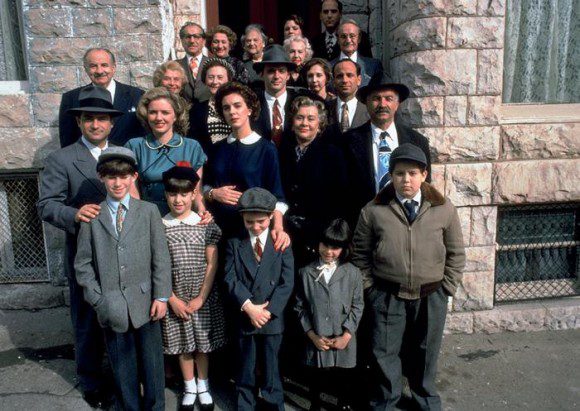
The cast of the film, Avalon, 1990. Probably the best film about the Household Political Economy ever made, http://blog.sundancenow.com/weekly-columns/here-now-then-1990
So what in the world is this thing? Let’s begin with what it isn’t.
It is not a synonym for the family.
It is a shelter
It shelters families. It is bound up with them; but households can shelter non-family members, and family members can actually leave a household and still be members of the family.
The key thing though is shelter. Houses shelter their occupants. I’m not talking about the buildings we sleep in and share with others. Those are just analogs for the things that really shelter us. And those things are political economies.
In a household political economy people can live in different buildings–extended families for instance spread throughout a community–but these people still work together, sheltering each other in practical ways. Eldercare for instance: in my case, my wife and our grown sons look in on my mother-in-law every day. (She’s just 5 miles away.) And they get help from my brother-in-law and his family. (Again, just about 5 miles away.)
It is an economy
From the afore mentioned example, I hope you can see that a household is a place to work and exchange goods. Today, when we think of households, we tend to think of them as places to escape the work-a-day world. We’ve turned them into recreational-centers, and we feel put upon when our relations call upon us for help.

The film shows how a household political economy functions, and how American culture works to undermine it.
http://thisdistractedglobe.com/2008/01/13/avalon-1990/
A commonwealth
Internally the economy works by means of gift exchange. The members care for each other and look out for each other’s interests. It is a commonwealth, reconciling men and women, and the generations, by a common life.
And this is why, at the core of a household, there is a union of a man and a woman. Through the union of their flesh they create a common life, and a commonwealth. (And there is even more going on here that what may immediately come to mind.) And from that union, if it is fruitful, their household grows.
Two terrible things to come out of the corporate economy are the monetization of just about everything and the transformation of every relationship into a competition. Men and women are at odds now–even husbands and wives–and the generations are set against each other.
These developments serve the interests of States (by turning every exchange into a taxable event–and that’s just for starters) and corporations by siphoning off the productive energies of people and turning them into wage-slaves.
Stewardship of Productive Property
The gift-giving economy of a household is only half the economy–its internal half. The other half looks out to the world as it works with productive property.
Productive property is not personal property–such as a boat used for strictly pleasurable purposes. Now if that boat were turned into a fishing boat, or for whale-watching for paying customers, it would be productive property. Because productive property gives you a living.
Today the vast majority of productive property is held by mega-corporations. This must change if we’re going to return to a household-centered culture that promotes a common life for men and women across the generations.
For the last 200 years it has been a rout. The corporations have grown and households have not only been sidelined, they’ve been slandered and pilloried. But the good news is this is beginning to change. For the first time in a long time we may have the a chance to recenter the economy in households–or at least gain some leverage. (That’s what this blog is about, at least in part.)
Productive property can take many forms–a business, income producing real estate (my favorite), intellectual property–those sorts of things. The main thing to remember, apart from the income productive property generates, is the property is held by the household. There may be a name on a deed for legal purposes, but that person knows that he or she holds it in trust for the whole household and for the next generation.
It is a polity
What we have in the New Testament household codes is the polity that serves the interests of a household economy. And the reason why hardly anyone can see the sense in them is most households today are not working economies–they are recreation centers.
People have no trouble submitting to authority in the corporate economy. Women are even willing to wear hats there when they’re told to–at least most of them. (Little joke there son. 1 Corinthians 11 starts to look a wee bit different now, I hope.)
What’s a polity to do in a household? What polities always do in an economy–order the work in the most beneficial way, secure the interests of the members from those who threaten those interests from the outside, and promote justice within the house. And historically, and I believe it is still the case today, the patriarch of the household performs these functions best.
And now you know why patriarchy is a good thing. And why enemies of the household economy hate patriarchy.
Next time I will share how I came to change my mind about those New Testament household codes and see them as I see them today.
I leave you with the trailer for Avalon. A world lost. But we can have it again if we are willing to work for it.
Previous Post

February 8, 2016
Advice for a Nice Christian Young Man
Next Post

February 15, 2016 Organic Before It was Cool
Browse Our Archives
Select a Category Advising a Daughter Aristotle Art Atheism Author and Speaking Appearances Beauty Building Working Houses C R Wiley Children Community Creativity Cultural Apologetics Fatherhood Fiction Fidelity in marriage Film Freedom Gravitas H. P. Lovecraft Happiness Household Economy Infant Baptism Inklings Interpreting the Bible Interviews Jack Donovan Liturgy Localism Man of the House Manliness Martial Virtue Medieval Cosmology Metaphysics Mortimus Clay NecronomiCon New Left New Testament Household Codes Nietzsche Nominalism/Realism Politics Poverty Preaching Productive Property Reaching men Science Self-Sufficiency Side Hustles Social Ethics Social Security Spiritual Disciplines Sublime Techno-gnosticism The Pastor's Survival Guide Theology of the Family Tradition Uncategorized Virtue Weird Fiction
Select a Month February 2019 November 2018 October 2018 July 2018 June 2018 May 2018 April 2018 March 2018 February 2018 January 2018 December 2017 November 2017 October 2017 September 2017 August 2017 July 2017 June 2017 May 2017 April 2017 March 2017 February 2017 January 2017 December 2016 November 2016 October 2016 September 2016 August 2016 July 2016 June 2016 May 2016 April 2016 March 2016 February 2016 January 2016 December 2015
Follow Us!
TAKE THE
Religious Wisdom Quiz
Who said, "Let us build us a city and a tower, whose top may reach unto heaven"?
Select your answer to see how you score.
Israelites Egyptians People of Babel Chaldeans
Books by This Author Books by PaterFamilias Today
Books by C. R. Wiley

The Purloined Boy (The Weirdling Cycle #1)

Man of the House: A Handbook for Building a Shelter That Will Last in a World That Is Falling Apart
Related posts from PaterFamilias Today

Transcendence: Meaning from Above

Gutting Creation of Meaning Guts Scripture


Advice for a Single Woman Who Is Looking...
TRENDING AT PATHEOS Evangelical

The REST of Your Life: A Creative Wrestles...
This week I had a conversation with a good friend from church....

How the author of the world's best hymn...
I've been working with John Newton for a while now. This makes...

Long before this Lectio Divina, Psalm 130 - the song - started...

What About the Trees? Another Living Parable
After I finished writing the last article about falling leaves as a...

Why Classical Education Is a Conversation, Not a...
Come and Read: Joy in Classical Education When I was a little...

Cornell University has received a great deal of negative publicity and intense...
view all Evangelical blogs
Ad-Free & Subscriber Log-In Subscription Support
- About Us
- 2026 Calendar
- Videos
- Podcasts
- Library of World Religions
- Faith In Media Tracker
- Advertise With Us
- Write for Us
- Privacy Policy
- Terms of Service
- Do Not Sell My Data
- Contact Us
- Radiant Digital
- Manage Newsletter Subscriptions
- Unsubscribe From Notifications
- Sitemap
Copyright 2008-2026, Patheos. All rights reserved.
Subscription Support Ad-Free & Subscriber Log-In
Follow Patheos