
BuddhistCatholicContemplativeEvangelicalGeneral ChristianHinduJewishLatter-day SaintMuslimNew VisionsProgressive Christian
Beliefs
- Buddhist
- Catholic
- Contemplative
- Evangelical
- General Christian
- Hindu
- Jewish
- Latter-day Saint
- More Voices
- Muslim
- New Visions
- Pagan
- Progressive Christian
Topics
- Religion News
- Food and Religion
- Sports and Religion
- Religious Art
- Religious Music and Entertainment
- Religious Events
- History and Religion
- Style and Religion
- Politics and Religion
- Women in Religion
- Recreation Outdoors and Religion
- Business Finance and Religion
- Careers Workplace and Religion
- Education and Religion
- Family Parenting and Religion
- Health Fitness and Religion
- Home and Religion
- Relationships and Religion
- Technology and Religion
- Travel and Religion
Columnists
- Buddhist Columnists
- Business Finance and Religion Columnists
- Careers Workplace and Religion Columnists
- Catholic Columnists
- Contemplative Columnists
- Education and Religion Columnists
- Evangelists Columnists
- Family Parenting and Religion Columnists
- General Christian Columnists
- Health Fitness and Religion Columnists
- Hindu Columnists
- History and Religion Columnists
- Home and Religion Columnists
- Jewish Columnists
- More Voices Columnists
- Latter Day Columnists
- Muslim Columnists
- New Visions Columnists
- Nonreligious Columnists
- Pagan Columnists
- Politics and Religion Columnists
- Progressive Columnists
- Recreation Outdoors and Religion Columnists
- Relationships and Religion Columnists
- Religion News Columnists
- Religious Art Columnists
- Religious Events Columnists
- Religious Music and Entertainment Columnists
- Sports and Religion Columnists
- Style and Religion Columnists
- Technology and Religion Columnists
- Travel and Religion Columnists
- Women in Religion Columnists
Resource Library
- 2026 Calendar
- Library of World Religions
- The 100 Most Holy Places on Earth
- Patheos Answers
- Podcasts
- Videos
- Faith Leaders Database
- Anglican Episcopalian
- Bahai
- Baptist
- Buddhism
- Christianity
- Confucianism
- Eastern Orthodoxy
- Hinduism
- Holiness and Pentecostal
- ISKCON
- Islam
- Judaism
- Lutheran
- Methodist
- The Church of Jesus Christ of Latter-day Saints
- New Age
- Paganism
- Presbytarian and Reformed
- Protestantism
- Religion Behind the Scenes
- Roman Catholic
- Scientology
- Shia Islam
- Sikhism
- Sufism
- Sunni Islam
- Taoism
- Zen
- See all religions
Research Tools
 Ad-Free & Subscriber Log-In Subscription Support
Ad-Free & Subscriber Log-In Subscription Support
Follow Patheos 

- Trending:
- Forgiveness
- |
- Marriage
- |
- Consciousness
- |
- Death Penalty
- |
- Election
- |
- Halloween
 PaterFamilias Today
- Home
- Evangelical
- The Purloined Boy: Plato Pottering Around
The Purloined Boy: Plato Pottering Around
Last updated on: January 29, 2016 at 11:04 am by C. R. Wiley
The Purloined Boy: Plato Pottering Around 2016-01-29T11:04:11-04:00 C. R. Wiley
Patheos Explore the world's faith through different perspectives on religion and spirituality! Patheos has the views of the prevalent religions and spiritualities of the world.
Guest review by David Deavel–the Associate Editor of Logos: A Journal of Catholic Thought and Culture and adjunct professor of Catholic Studies at the University of St. Thomas in St. Paul, MN.
Reviewed: The Purloined Boy, by Mortimus Clay
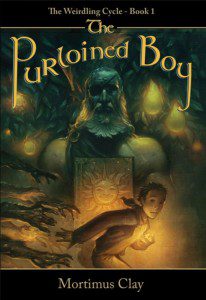 Several books into the Harry Potter series, Joseph Bottum wrote that J. K. Rowling’s genius was her ability to mush together elements in themselves of little worth: “A writer who puts one cliché into a book manages to produce pulp fiction. A writer who uses a dozen can produce a classic. And a writer who includes them all—well, only Homer has ever managed that.”
The idea was that Rowling is a fairly talented writer, courageous enough to stand back and let the “most standard, hackneyed old tropes and figures. . . perform their magic.” There was something to Bottom’s assessment, of course. But by the end of the Potter books readers discovered that what drove them was some fairly serious ideas about the nature of evil, the virtuous life, and the truest, deepest magic—common to Hogwarts and our world: sacrificial love.The Purloined Boy, written by “Mortimus Clay,” certainly has the clichés necessary for a bildungsroman fantasy classic: magical creatures and magical gadgets, a back story shrouded in myth, deus ex machina-escapes, and budding romance. But for these tropes to work they must be embedded in an engaging plot, which, without saying every plot point rings perfectly true, The Purloined Boy possesses.
Trevor Upjohn, a boy in a prison school run by bogeymen in their gray industrial nightmare town of Superbia, has dreams of a home and parents and being kidnapped by a bogeyman. The bogeys and the humans who work for them strive to convince the children that home and parents are mythical concepts, but Trevor believes his dreams are memories. His insistence on this fact provokes the assistance of human and magical allies who help him to escape the fate of becoming bogey food and lead him to a mysterious society known as the Guild. The Guild is dedicated to rescuing children and pushing back the dark power of the bogeys and their mysterious human lord, Lucian. The first book in what the author calls “The Weirdling Cycle” does an admirable job of introducing characters and back story through the excitement of Trevor’s discovery of the menacing truth about the world he escapes and the struggle between Guild and bogeys. As you might guess, Trevor finds he is a very important player in this fight—he may be the subject of prophecy.
As with the Potter books, however, what makes this plot with its “hackneyed tropes” so powerful is the thematic content. Looking at the reviews available online (many linked to the author’s website), one might think that this is another “tween” fantasy. But none of the reviewers has discerned the intellectual framework that should be evident to anyone who reads the mock puffery on the back of the book by “Charles Dickens in The Dead Author’s Review“: Splendid! Plato meets Poe! Mortimus has outdone himself.”
The joke is that “Mortimus Clay” was a Dickens-envying professor at “Her Majesty’s Knitting College for Wayward Girls” whose 1885 death resulted in his writing taking an immediate turn for the better.” The serious part is that this tale does show signs of both Poe and Plato. Poe’s presence is obvious in the darkness and sense of dread that characterizes much of this book. Trevor’s escape from Superbia into the happiness of the Guild is short-lived; by volume’s end the Guild is on the run, a main sympathetic character is dead, and the dark is rising. But it is a Christianized Plato who supplies the method behind the magic.

Zephyr
Drawing by Justin Gerard
At the beginning of the book Trevor, like the souls in Plato’s cave, dwells in darkness—the sun is not visible in Superbia (the city’s name being the Latin word for the chief sin, pride). But like a good Platonic soul, he remembers his own “pre-existence” in a better reality, a family with a home and the sun shining. Plato posited that the denizens of the cave would need help in escaping the cave and entering the world of reality. Christian Platonists said that help had come in the form of Jesus Christ and his Body, the Church. While no Christ figure is evident, Trevor’s escape from Superbia is aided by a mysterious mouse, the secret help of the Guild, whose qualities resemble those of the Holy Spirit. The mouse enables superhuman action but demands effort on the parts of those he helps. Further Christian images abound; for example, Trevor’s deliverance features a harrowing plunge into water, members of the Guild who rescue children are known as “fishers,” and the final initiation of the Guild is a feast in which everyone eats the fruit of a tree whose power both keeps the Guild safe and gives a temporary real communion of heart and mind.
Like the hackneyed tropes, the Christian and Platonic themes look a bit overdone when they are listed in a short paragraph. But like the clichéd elements in any classic, setting them free in a good plot produces not a philosophical treatise or an evangelical altar call, but something much more interesting. Something more like what happens in Narnia or Harry Potter, a story that anyone can appreciate and indeed thrill to, but whose deeper foundations can be glimpsed by those with eyes to see.
In a story like this one, glimpsing the foundations can mean, as Plato might say, participating in them.
This review originally appeared in the April/May 2010 edition of Gilbert!, the official publication of The American Chesterton Society.
Mortimus Clay is none other than C. R. Wiley.
Previous Post

January 27, 2016
Stirred by Shakers: the Elegant Errors of a Failed Sect
Next Post

February 1, 2016 The Big Short: the Rest of the Story
Browse Our Archives
Select a Category Advising a Daughter Aristotle Art Atheism Author and Speaking Appearances Beauty Building Working Houses C R Wiley Children Community Creativity Cultural Apologetics Fatherhood Fiction Fidelity in marriage Film Freedom Gravitas H. P. Lovecraft Happiness Household Economy Infant Baptism Inklings Interpreting the Bible Interviews Jack Donovan Liturgy Localism Man of the House Manliness Martial Virtue Medieval Cosmology Metaphysics Mortimus Clay NecronomiCon New Left New Testament Household Codes Nietzsche Nominalism/Realism Politics Poverty Preaching Productive Property Reaching men Science Self-Sufficiency Side Hustles Social Ethics Social Security Spiritual Disciplines Sublime Techno-gnosticism The Pastor's Survival Guide Theology of the Family Tradition Uncategorized Virtue Weird Fiction
Select a Month February 2019 November 2018 October 2018 July 2018 June 2018 May 2018 April 2018 March 2018 February 2018 January 2018 December 2017 November 2017 October 2017 September 2017 August 2017 July 2017 June 2017 May 2017 April 2017 March 2017 February 2017 January 2017 December 2016 November 2016 October 2016 September 2016 August 2016 July 2016 June 2016 May 2016 April 2016 March 2016 February 2016 January 2016 December 2015
Follow Us!
TAKE THE
Religious Wisdom Quiz
Which country has the largest number of Christians?
Select your answer to see how you score.
Russia Brazil Germany United States
Books by This Author Books by PaterFamilias Today
Books by C. R. Wiley

The Purloined Boy (The Weirdling Cycle #1)

Man of the House: A Handbook for Building a Shelter That Will Last in a World That Is Falling Apart
Related posts from PaterFamilias Today

Transcendence: Meaning from Above

Gutting Creation of Meaning Guts Scripture

Is This Evangelicalism's Red-Pill Moment?

Making the Good Life from Home
TRENDING AT PATHEOS Evangelical

How the author of the world's best hymn...
I've been working with John Newton for a while now. This makes...

Long before this Lectio Divina, Psalm 130 - the song - started...

What About the Trees? Another Living Parable
After I finished writing the last article about falling leaves as a...

Why Classical Education Is a Conversation, Not a...
Come and Read: Joy in Classical Education When I was a little...

Falling Leaves: A Living Parable on Letting Go
I’ve spent the vast majority of my life in the southeast corner...

Cornell University has received a great deal of negative publicity and intense...
view all Evangelical blogs
Ad-Free & Subscriber Log-In Subscription Support
- About Us
- 2026 Calendar
- Videos
- Podcasts
- Library of World Religions
- Faith In Media Tracker
- Advertise With Us
- Write for Us
- Privacy Policy
- Terms of Service
- Do Not Sell My Data
- Contact Us
- Radiant Digital
- Manage Newsletter Subscriptions
- Unsubscribe From Notifications
- Sitemap
Copyright 2008-2026, Patheos. All rights reserved.
Subscription Support Ad-Free & Subscriber Log-In
Follow Patheos