
BuddhistCatholicContemplativeEvangelicalGeneral ChristianHinduJewishLatter-day SaintMuslimNew VisionsProgressive Christian
Beliefs
- Buddhist
- Catholic
- Contemplative
- Evangelical
- General Christian
- Hindu
- Jewish
- Latter-day Saint
- More Voices
- Muslim
- New Visions
- Pagan
- Progressive Christian
Topics
- Religion News
- Food and Religion
- Sports and Religion
- Religious Art
- Religious Music and Entertainment
- Religious Events
- History and Religion
- Style and Religion
- Politics and Religion
- Women in Religion
- Recreation Outdoors and Religion
- Business Finance and Religion
- Careers Workplace and Religion
- Education and Religion
- Family Parenting and Religion
- Health Fitness and Religion
- Home and Religion
- Relationships and Religion
- Technology and Religion
- Travel and Religion
Columnists
- Buddhist Columnists
- Business Finance and Religion Columnists
- Careers Workplace and Religion Columnists
- Catholic Columnists
- Contemplative Columnists
- Education and Religion Columnists
- Evangelists Columnists
- Family Parenting and Religion Columnists
- General Christian Columnists
- Health Fitness and Religion Columnists
- Hindu Columnists
- History and Religion Columnists
- Home and Religion Columnists
- Jewish Columnists
- More Voices Columnists
- Latter Day Columnists
- Muslim Columnists
- New Visions Columnists
- Nonreligious Columnists
- Pagan Columnists
- Politics and Religion Columnists
- Progressive Columnists
- Recreation Outdoors and Religion Columnists
- Relationships and Religion Columnists
- Religion News Columnists
- Religious Art Columnists
- Religious Events Columnists
- Religious Music and Entertainment Columnists
- Sports and Religion Columnists
- Style and Religion Columnists
- Technology and Religion Columnists
- Travel and Religion Columnists
- Women in Religion Columnists
Resource Library
- 2026 Calendar
- Library of World Religions
- The 100 Most Holy Places on Earth
- Patheos Answers
- Podcasts
- Videos
- Faith Leaders Database
- Anglican Episcopalian
- Bahai
- Baptist
- Buddhism
- Christianity
- Confucianism
- Eastern Orthodoxy
- Hinduism
- Holiness and Pentecostal
- ISKCON
- Islam
- Judaism
- Lutheran
- Methodist
- The Church of Jesus Christ of Latter-day Saints
- New Age
- Paganism
- Presbytarian and Reformed
- Protestantism
- Religion Behind the Scenes
- Roman Catholic
- Scientology
- Shia Islam
- Sikhism
- Sufism
- Sunni Islam
- Taoism
- Zen
- See all religions
Research Tools
 Ad-Free & Subscriber Log-In Subscription Support
Ad-Free & Subscriber Log-In Subscription Support
Follow Patheos 

- Trending:
- Forgiveness
- |
- Marriage
- |
- Consciousness
- |
- Death Penalty
- |
- Election
- |
- Halloween
 PaterFamilias Today
- Home
- Evangelical
- Stirred by Shakers: the Elegant Errors of a Failed Sect
Stirred by Shakers: the Elegant Errors of a Failed Sect
Last updated on: January 29, 2016 at 7:21 am by C. R. Wiley
Stirred by Shakers: the Elegant Errors of a Failed Sect 2016-01-29T07:21:37-04:00 C. R. Wiley
Patheos Explore the world's faith through different perspectives on religion and spirituality! Patheos has the views of the prevalent religions and spiritualities of the world.
https://en.wikipedia.org/wiki/Shakers
When it comes to the opinion of the people who matter, the Shakers are hip. They had all the correct views: They practiced sustainable agriculture and gender equality, and they even reduced their carbon footprint to almost zero. (There are said to be only three Shakers left in North America—that’s what celibacy will do for you if you don’t watch out.)
Today, Shaker villages appear to be populated mostly by supporters of National Public Radio. Amish communities don’t seem to have the same appeal to the NPR crowd. A superficial assessment might lead you to believe that, if you love one, you should love the other: long dresses, straw hats, cows, the simple life, community—both have them. But there are differences in the ways the two sects relate to the natural order that I think correspond to differences between the ways two groups of people think in contemporary America. If you like Fox News, you probably like the Amish; if you prefer the PBS News Hour, you likely favor the Shakers.
So why is that?
It comes down to sex. If you are the sort who sees a telos in sex—namely, children—then you should like the Amish. But if you’re the sort who thinks sex should serve personal goals—if you see children as an avoidable and even unfortunate consequence of sex—then you probably like the Shakers.
Demographers tell us that as a society grows more egalitarian a price is paid in fertility. Mother Ann Lee, the sad Shaker heresiarch whose eight children all died before the age of six, seemed to understand the connection. Since union always implies submission, gender equality requires some strategy for keeping the sexes separate; so Mother Ann drew a line straight up to heaven to keep them that way. (She taught the line passed right through God’s very nature, breaking God up into male and female halves.)
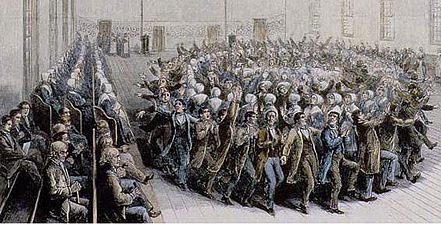
Worship tells a theological tale, and the tale Shaker worship tells is a sad and sterile one. There was no preaching in Shaker worship and no sacramental life. What was there? Well, there was a lot of singing and dancing. The dances were especially revealing: groups of men would draw near the women, a pitiful mess of conflicted yearnings, and then withdraw. The women would do the same. At other times they would march around each other in concentric circles, men in one and women in the other, stomping their feet and clapping their hands, all the while singing at the top of their lungs about shaking out sin and beating out carnal thoughts.
While I find their ontology repellant, think their theology fatal, and even believe the world is better off without them, yet for all that, I feel some resonance with the Shakers. And I wonder, What is it about those nutty gnostics that calls to me? Could there be something worthwhile in Shakerism? And if so, is it possible, like an apothecary, to draw that something out for medicinal purposes?
Visions & Ingenuity
https://en.wikipedia.org/wiki/Hannah_Cohoon#/media/File:Tree_of_Life_-_Shaker_-_painted_by_Hannah_Cohoon.JPG
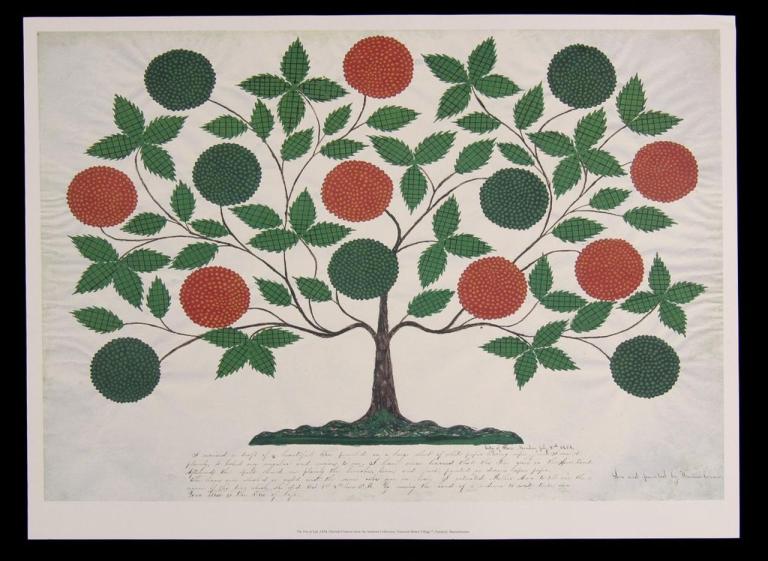
I have been to three Shaker villages, and recently my wife and I celebrated our twenty-fifth wedding anniversary with a pleasant afternoon at the Pittsfield Shaker village in the Massachusetts Berkshires. From the paucity of reading material at these villages, it is clear that the Shakers were not bookish people. One of the curators at the Pittsfield village told me that this was due to the rigors of nineteenth-century agriculture. That is nonsense, of course. The history of Christianity is full of scholarship amid rural privation. No, you make time for what you care about. The more likely reason is that the Shakers did not think they had a good reason for reading. When it came to doctrine, they had Mother Ann, and besides her, they had visions. Here is a sample of one of those visions, as recorded by Hannah Cohoon beneath her famous folk painting, The Tree of Life:
I received a draft of a beautiful Tree penciled on a large sheet of white paper bearing ripe fruit. I saw it plainly; it looked very singular and curious to me. I have since learned that this tree grows in the Spirit Land. Afterwards the Spirit showed me plainly the branches, leaves, and fruit, painted or drawn on paper…. I entreated Mother Ann to tell me the name of this tree: which she did October 1st, 4th hour p.m. by moving the hand of the medium to write twice over, “Your Tree is the Tree of Life.” Monday July 3rd 1854. Mother Ann Lee had died on September 8, 1784.
A taste for mystical visions did not make the Shakers thoughtless. Evidence of good, hard thinking can be seen everywhere in a Shaker village. They were keenly interested in natural processes, and their ingenuity in harnessing those processes was amazing. The workshop at the Pittsfield village reminded me of something out of Chitty, Chitty, Bang! Bang! At least ten shop tools are powered by a single, customized, water-driven dynamo. (It still works!) Leather belts drive band saws and table saws and lathes. It is a woodworker’s dream.
And the famous Pittsfield village round barn is a light, airy, and marvelously easy place to maintain and use. It was built on a hillside with a tunnel underneath, large enough for a manure wagon to travel its circumference. The stalls have trapdoors that allowed a worker to shovel the refuse speedily into the underlying wagon. Feeding the animals was just as easy. A hay wagon could be driven onto the roof to feed a central, gravity-fed silo. One man with a pitchfork walking in a tight circle at the bottom could make a quick job of giving the animals their daily fodder.
Elegant & Functional Simplicity
The Shakers’ thoughtfulness, and, to give them credit, their loving concern for the comfort and happiness of their fellow Shakers, inspired them to invent the flat broom and the circular saw and a dozen other useful things that we take for granted today.
As I walked by samples of their handiwork in the museum that orients visitors to the Pittsfield village, I was drawn to a humble grain scoop. It was designed to move the contents of one container to another—that’s about it—but it is exquisite. It reminded me of Tolkien’s description of the tools Smith made, in his short tale, Smith of Wooton Major: “They were strong and lasting, but they also had a grace about them, being shapely in their kinds, good to handle and to look at.”
Above the artifacts in the museum there are oversized quotations praising Shaker handiwork by such luminaries as Yo Yo Ma and Ken Burns. It is easy to over-credit the Shakers though. Listening to some of their admirers could lead you to believe that they carved out their vision of elegant and functional simplicity amid the opulence of Versailles. Anyone familiar with a typical village-green church can see that most of their work draws on the common forms of Puritan New England. But there is a grace about their work, a distinctive something that can be called “Shaker.”
One critic, I don’t remember whom—some artist I have never heard of but am sure I should have known—applauded Shaker handicraft by calling it “Zen.” Now when it comes to spirituality, that is high praise for the NPR crowd. But I think it is a mistake. It is not what the Shakers left out of their work that makes it Shaker but what it points to. Yes, it peels away the extraneous, but not to empty it. Shaker work is not a “not-ness” but a “this-ness” and a “that-ness.” It revels in a harmony between human work and the world in which it is performed—a harmony that reminds you that these people did believe in a sort of incarnation after all. (Indeed they believed in it so much they claimed it happened a second time. Mother Ann Lee was thought to be the incarnation of the female Christ.)
The Pull of Two Poles

Tree of Life above the wife’s piano. (Personal photo.)
So, in a way, their craft says, “We are home.” But in another way, it points up. It is characterized even more by a longing for things unseen—for a spiritual kingdom. It is this pull between the seen and the unseen, the here and the there, the now and the not yet, the earthly and the heavenly, that is the genius of the Shaker aesthetic. It is like a finely tuned string, a tension resulting from the pull of two poles. Take a typical Shaker candle stand. It sits as lightly as possible on the floor, as though its maker wanted it to rise to heaven. But it is lightness without delicacy. It has a sensuality, but without impurity. It is even useful—especially that—but not utilitarian.
If life is art, then the demise of the Shakers tells us that one of those poles did not hold—the “here and now” pole snapped. They loved this world, just not enough. They were impatient for a heavenly kingdom to come, and so they took matters into their own hands. It didn’t work out well; immanentizing the eschaton never does.
Ladder-back chairs you climb to heaven in your thoughts yet bear the weight of a resting man, peg-racks to hang them on so Shaker women with their flat-brooms could sweep out the dirt that hid from view, oval boxes that nest in each other, fence posts that do not rot, milk-paint that has not peeled in 150 years—these things are very pleasing to consider, but they trouble me as well. Their works say something close to the truth. But not close enough.
It seems to me that the Shakers at least had a vision of heaven that affirmed the earth. But they came at it from the wrong angle. They attempted to plant their feet firmly in the air and reach down to the earth and reshape it. Theirs was a religion in which man attempts to operate on himself. Heaven’s help is not atonement for sin, but insight into the “Spirit Land.” That is why there was no preaching—there was no salvation to announce—and why there was no sacramental life—there was no salvation to receive. For the Shakers, salvation came by “channeling” the Spirit Land into this world.
What we need is an affirmation of the earth that keeps our feet on the ground even as it lifts our eyes to heaven. The Shakers were right to try to hold the poles together. But their feet were attached to the wrong one.
Can we do better? I hope we can, but this hope is not based on what we can do, but on what Christ has already done. Christ is the man from heaven who came to earth and then returned to where he had come from. Like a needle and thread, he ties the two worlds together by a piercing that has passed through his own body. He holds all things together. He is the great reconciler. It is because he has come to us from above that we can now approach him from below. This good earth was made by him and redeemed for him, and now we wait for him to take full possession of it.
If Shaker handiwork can remind us of how things can go elegantly wrong, it may be worth the effort the NPR crowd has put into preserving it. It may even give me the courage to hang up the copy of Hannah Cohoon’s Tree of Life that I bought in the gift shop. (I finally put it up, as you can see from the photo.)
This essay is adapted from an article of the same name published in the July/August 2011 edition of Touchstone Magazine. It is published by permission of Touchstone.
Previous Post

January 25, 2016
The Finest Hours, a Crucible of Courage: a Review
Next Post

January 29, 2016 The Purloined Boy: Plato Pottering Around
Browse Our Archives
Select a Category Advising a Daughter Aristotle Art Atheism Author and Speaking Appearances Beauty Building Working Houses C R Wiley Children Community Creativity Cultural Apologetics Fatherhood Fiction Fidelity in marriage Film Freedom Gravitas H. P. Lovecraft Happiness Household Economy Infant Baptism Inklings Interpreting the Bible Interviews Jack Donovan Liturgy Localism Man of the House Manliness Martial Virtue Medieval Cosmology Metaphysics Mortimus Clay NecronomiCon New Left New Testament Household Codes Nietzsche Nominalism/Realism Politics Poverty Preaching Productive Property Reaching men Science Self-Sufficiency Side Hustles Social Ethics Social Security Spiritual Disciplines Sublime Techno-gnosticism The Pastor's Survival Guide Theology of the Family Tradition Uncategorized Virtue Weird Fiction
Select a Month February 2019 November 2018 October 2018 July 2018 June 2018 May 2018 April 2018 March 2018 February 2018 January 2018 December 2017 November 2017 October 2017 September 2017 August 2017 July 2017 June 2017 May 2017 April 2017 March 2017 February 2017 January 2017 December 2016 November 2016 October 2016 September 2016 August 2016 July 2016 June 2016 May 2016 April 2016 March 2016 February 2016 January 2016 December 2015
Follow Us!
TAKE THE
Religious Wisdom Quiz
What does "Judas" mean in Greek?
Select your answer to see how you score.
Betrayer Strong Deceiver Praise
Books by This Author Books by PaterFamilias Today
Books by C. R. Wiley

The Purloined Boy (The Weirdling Cycle #1)

Man of the House: A Handbook for Building a Shelter That Will Last in a World That Is Falling Apart
Related posts from PaterFamilias Today

Transcendence: Meaning from Above

Gutting Creation of Meaning Guts Scripture


Advice for a Single Woman Who Is Looking...
TRENDING AT PATHEOS Evangelical

How the author of the world's best hymn...
I've been working with John Newton for a while now. This makes...

Long before this Lectio Divina, Psalm 130 - the song - started...

What About the Trees? Another Living Parable
After I finished writing the last article about falling leaves as a...

Why Classical Education Is a Conversation, Not a...
Come and Read: Joy in Classical Education When I was a little...

Falling Leaves: A Living Parable on Letting Go
I’ve spent the vast majority of my life in the southeast corner...

Cornell University has received a great deal of negative publicity and intense...
view all Evangelical blogs
Ad-Free & Subscriber Log-In Subscription Support
- About Us
- 2026 Calendar
- Videos
- Podcasts
- Library of World Religions
- Faith In Media Tracker
- Advertise With Us
- Write for Us
- Privacy Policy
- Terms of Service
- Do Not Sell My Data
- Contact Us
- Radiant Digital
- Manage Newsletter Subscriptions
- Unsubscribe From Notifications
- Sitemap
Copyright 2008-2026, Patheos. All rights reserved.
Subscription Support Ad-Free & Subscriber Log-In
Follow Patheos