
BuddhistCatholicContemplativeEvangelicalGeneral ChristianHinduJewishLatter-day SaintMuslimNew VisionsProgressive Christian
Beliefs
- Buddhist
- Catholic
- Contemplative
- Evangelical
- General Christian
- Hindu
- Jewish
- Latter-day Saint
- More Voices
- Muslim
- New Visions
- Pagan
- Progressive Christian
Topics
- Religion News
- Food and Religion
- Sports and Religion
- Religious Art
- Religious Music and Entertainment
- Religious Events
- History and Religion
- Style and Religion
- Politics and Religion
- Women in Religion
- Recreation Outdoors and Religion
- Business Finance and Religion
- Careers Workplace and Religion
- Education and Religion
- Family Parenting and Religion
- Health Fitness and Religion
- Home and Religion
- Relationships and Religion
- Technology and Religion
- Travel and Religion
Columnists
- Buddhist Columnists
- Business Finance and Religion Columnists
- Careers Workplace and Religion Columnists
- Catholic Columnists
- Contemplative Columnists
- Education and Religion Columnists
- Evangelists Columnists
- Family Parenting and Religion Columnists
- General Christian Columnists
- Health Fitness and Religion Columnists
- Hindu Columnists
- History and Religion Columnists
- Home and Religion Columnists
- Jewish Columnists
- More Voices Columnists
- Latter Day Columnists
- Muslim Columnists
- New Visions Columnists
- Nonreligious Columnists
- Pagan Columnists
- Politics and Religion Columnists
- Progressive Columnists
- Recreation Outdoors and Religion Columnists
- Relationships and Religion Columnists
- Religion News Columnists
- Religious Art Columnists
- Religious Events Columnists
- Religious Music and Entertainment Columnists
- Sports and Religion Columnists
- Style and Religion Columnists
- Technology and Religion Columnists
- Travel and Religion Columnists
- Women in Religion Columnists
Resource Library
- 2026 Calendar
- Library of World Religions
- The 100 Most Holy Places on Earth
- Patheos Answers
- Podcasts
- Videos
- Faith Leaders Database
- Anglican Episcopalian
- Bahai
- Baptist
- Buddhism
- Christianity
- Confucianism
- Eastern Orthodoxy
- Hinduism
- Holiness and Pentecostal
- ISKCON
- Islam
- Judaism
- Lutheran
- Methodist
- The Church of Jesus Christ of Latter-day Saints
- New Age
- Paganism
- Presbytarian and Reformed
- Protestantism
- Religion Behind the Scenes
- Roman Catholic
- Scientology
- Shia Islam
- Sikhism
- Sufism
- Sunni Islam
- Taoism
- Zen
- See all religions
Research Tools
 Ad-Free & Subscriber Log-In Subscription Support
Ad-Free & Subscriber Log-In Subscription Support
Follow Patheos 

- Trending:
- Forgiveness
- |
- Marriage
- |
- Consciousness
- |
- Death Penalty
- |
- Election
- |
- Halloween
 PaterFamilias Today
- Home
- Evangelical
- Robert Crumb’s Book of Genesis, Part 3
Robert Crumb’s Book of Genesis, Part 3
Last updated on: January 5, 2016 at 3:30 pm by C. R. Wiley
Robert Crumb’s Book of Genesis, Part 3 2016-01-05T15:30:26-04:00 C. R. Wiley
Patheos Explore the world's faith through different perspectives on religion and spirituality! Patheos has the views of the prevalent religions and spiritualities of the world.

http://www.amazon.com/gp/product/0810930862?psc=1&redirect=true&ref_=oh_aui_detailpage_o00_s00
I just ordered R. Crumb’s Heroes of Blues, Jazz, and Country . The reason I did is I wanted to see the reverent Crumb in order to contrast him in my own mind with the irreverent Crumb.
Crumb is often accused of irreverence. And he often guilty as charged; but I suspect there’s more to his irreverence than meets the eye.
His treatment of Genesis is mixed, in parts a reverent handling, in others not–actually blasphemous, technically speaking. I’ll get to that, but I want to explain what I mean by reverence first, because little of what I will say will make sense unless I do.
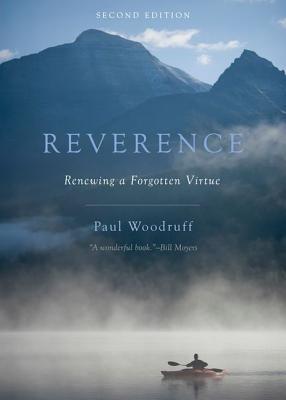
I like Paul Woodruff’s thinking on reverence in his book, Reverence: Renewing a Forgotten Virtue.
Betty Sue Flowers, the Emeritus Professor of English at the University of Texas at Austin, sums up Woodruff’s thesis. She says in the forward to the second edition:
…the opposite of reverence is not irreverence but hubris–forgetting, in the pride of power or glory, that you, too, are human, with human limitations, and must respect the humanity of others. Reverence, says Woodruff, is the source of the capacity for respect. But it lies deeper than respect, because it is not simply behavior; it is aligned with truth. Reverence is the “capacity to have feelings of awe, respect, and shame when these are the right feelings to have.
Reverence then is a mixture of humility and awe. It’s owning up to your smallness and at the same moment recognizing the greatness, and the “otherness” of something, or someone else. Christians and other religious theists know that this starts with reverence for God. But it shouldn’t surprise us that unbelievers are still capable of reverence. Unbelievers can still revere things, or people, or great truths. I’ve known atheists, for instance, who almost speak in hushed tones when discussing a scientific discovery. Is this wrong or idolatrous? No, not necessarily. The universe is tiered. If the inference is followed correctly, any thing, or person, worthy of reverence, will ultimately lead you back to the Creator of all things.
http://www.amazon.com/Reverence-Renewing-Forgotten-Paul-Woodruff/dp/0199350809/ref=asap_bc?ie=UTF8
So even R. Crumb should be capable of reverence. That doesn’t make him kind, or pleasant to be around, or someone you’d introduce your daughter to. But it does mean he may be more than a guy who thinks dirty thoughts.
This brings me back to the music Crumb likes; Robert Crumb loves roots music, and for good reasons. (I’m a fan too–but Crumb’s knowledge dwarfs mine). When discussing roots music–blues, jazz, genuine mountain music–you can hear the reverence in his voice; you can see his enthusiasm in his posture. You can see his love and respect in his drawings of obscure and forgotten musicians.
Why does he like roots music so much? Why do those gritty minstrels elicit reverence from him when almost nothing else can? I think there’s more to it than style, I think it is a matter of substance. Roots music recorded real suffering, real joy, real pleasure. It wasn’t “mouse music“. It wasn’t sung just for money. It wasn’t commercial, or canned, or phony. It was music that sprung up from the bottom. It is about the reality of genuine lives lived. That’s something that Crumb can respect, even revere. And this our clue, our hermeneutic for interpreting Crumb, dirty thoughts and all. Crumb wants the truth, warts, or dirty thoughts, and all. Anything less drives him to drawing. And this is the reason I called him a bohemian conservative earlier. Crumb is not a progressive, really. An Adamite maybe, but not a progressive.
Truth verses Exposure
This brings me to the biggest problem with Crumb’s work. He confuses exposure with truth.
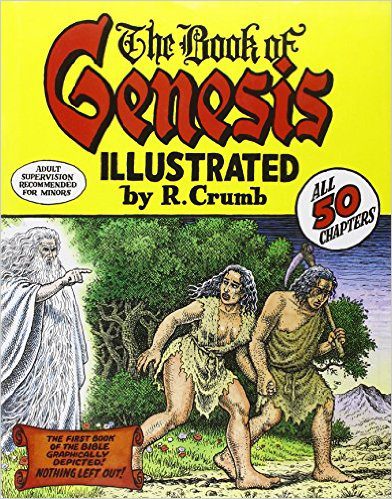
Crumb is that kid who turns over rocks to see the slimy, oozing stuff underneath. And that is what Crumb’s Genesis Illustrated attempts to do for us. He wants us to see the ugly truth beneath the sweet surface or the Bible.
He announces his objective right on the cover. “Nothing Left Out!”
At a minimum, there are two big problems here. One that can be attributed to contempt for a literary convention and the second is just stupid malice.
Problem One: Graphic sex.
Someone needs to hand Crumb a dictionary dogeared to the page with the definition for euphemism. When scripture reads, “And he knew her…” or a little more baldly, “He lay with her…” sex is clearly referred to while at the same moment being covered over. This is the sort of thing that Crumb cannot abide. (Yes, his treatment of sexual relations is pretty tame, especially for him. Still, he’s betrayed the text. He has not represented it correctly.)
http://www.amazon.com/The-Book-Genesis-Illustrated-Crumb/dp/0393061027
Some people believe that the only reason you would ever cover-over something as pleasurable as sex is because you believe it is dirty. While I’ve know a few people who do think this way, it is pretty unusual these days. Today we just don’t respect sex enough to keep it covered.
A covering does not necessarily hide a lie. It can protect valuable things. It can even be a way to convey a truth. Euphemisms help preserve the value of sexual pleasure because sex itself can be devalued by overexposure. Like currency, it loses value when you make too much of it. It also says, “This belongs to these people; it is not for you–you may not enter into their pleasures, even vicariously.” Euphemisms can be reverent.
In Genesis, after Adam and Eve sin, it is God who clothes them. In part to cover their shame, but also to adorn them. Paradoxically clothing draws the eye upward to the face, even as it draws the eye to itself. Euphemisms are like clothing in this way. Ironically, Crumb fails here. In his quest to “leave nothing out” he leaves out the euphemisms.
Problem Two: Graven Images.
What’s the deal with the cross between the Sistine Chapel and Charlton Heston?
The argument that since this is a graphic novel you have to draw God, is not an argument for drawing God, it is an argument for not making a graphic novel. Besides, it’s lame.
But I suspect there is more going on in Crumb’s mind than translating the biblical text into a visual form. I suspect that this is what the whole thing is about. Crumb wants to libel God or libel patriarchy, probably both. He wants to expose the hidden agenda of the Bible. “It’s all a evil scheme to promote male power!” It doesn’t take any work arriving at this conclusion. All you need to do is read a few of the many interviews with Crumb about the book that are available online. That, or just turn to the back of his book and read his commentary.
But he gets patriarchy wrong; it is not necessarily hubris, although it can lend itself to that (just like anything else, including drawing comics). It was just necessary, and it still is.
But we don’t even have to defend patriarchy to criticize Crumb’s images of God. Crumb just misses the substance of Biblical revelation in a spectacular manner.
You have to turn a blind eye to received Jewish, Christian, and Islamic teaching in order to do this. You also need to be ignorant of the book that follows Genesis and the prohibition found there concerning graven images. According to the traditions in which Biblical revelation has been reflected upon for thousands of years by reverent intellectuals, you cannot depict a transcendent God visually. That would necessarily locate him in time and space. And it would be a lie.
So again, Crumb errors by adding stuff. And in at least one place it leads to a visual faux pas.
The most disappointing treatment in his whole book is Genesis, Chapter 15. If there were ever a scene just tailor made for Crumb’s style, it is the one in that chapter. But not only does he miss the point of it (I’ll get to the reasons why in my next post), he visually bungles it.
It is the covenant God cuts with Abram. In that scene, I hope you can recall, two signs of God’s presence appear–the burning torch and the smoking pot. (Those should remind you of God’s presence with the Israelites in the wilderness.) But Crumb inserts his oversized version of Charlton Heston into the scene. What’s the point of the torch and the pot when we see him there as something out of the Sistine Chapel? Right, there is no point.
If you detect some anger in my prose it is because I am angry. I’m angry because Crumb is lying to himself and to the rest of us and it is time someone called him out on it.
But how could he miss these things so terribly? I’ll deal with next time in my final post of this review.
Previous Post

January 1, 2016
Robert Crumb's Book of Genesis, Part 2
Next Post

January 6, 2016 Robert Crumb's Book of Genesis, Part 4 (and last, at last)
Browse Our Archives
Select a Category Advising a Daughter Aristotle Art Atheism Author and Speaking Appearances Beauty Building Working Houses C R Wiley Children Community Creativity Cultural Apologetics Fatherhood Fiction Fidelity in marriage Film Freedom Gravitas H. P. Lovecraft Happiness Household Economy Infant Baptism Inklings Interpreting the Bible Interviews Jack Donovan Liturgy Localism Man of the House Manliness Martial Virtue Medieval Cosmology Metaphysics Mortimus Clay NecronomiCon New Left New Testament Household Codes Nietzsche Nominalism/Realism Politics Poverty Preaching Productive Property Reaching men Science Self-Sufficiency Side Hustles Social Ethics Social Security Spiritual Disciplines Sublime Techno-gnosticism The Pastor's Survival Guide Theology of the Family Tradition Uncategorized Virtue Weird Fiction
Select a Month February 2019 November 2018 October 2018 July 2018 June 2018 May 2018 April 2018 March 2018 February 2018 January 2018 December 2017 November 2017 October 2017 September 2017 August 2017 July 2017 June 2017 May 2017 April 2017 March 2017 February 2017 January 2017 December 2016 November 2016 October 2016 September 2016 August 2016 July 2016 June 2016 May 2016 April 2016 March 2016 February 2016 January 2016 December 2015
Follow Us!
TAKE THE
Religious Wisdom Quiz
Who played instruments in Temple?
Select your answer to see how you score.
Prophets Kings Levites Priests
Books by This Author Books by PaterFamilias Today
Books by C. R. Wiley

The Purloined Boy (The Weirdling Cycle #1)

Man of the House: A Handbook for Building a Shelter That Will Last in a World That Is Falling Apart
Related posts from PaterFamilias Today

Transcendence: Meaning from Above

Gutting Creation of Meaning Guts Scripture

Is This Evangelicalism's Red-Pill Moment?

Making the Good Life from Home
TRENDING AT PATHEOS Evangelical

The REST of Your Life: A Creative Wrestles...
This week I had a conversation with a good friend from church....

How the author of the world's best hymn...
I've been working with John Newton for a while now. This makes...

Long before this Lectio Divina, Psalm 130 - the song - started...

What About the Trees? Another Living Parable
After I finished writing the last article about falling leaves as a...

Why Classical Education Is a Conversation, Not a...
Come and Read: Joy in Classical Education When I was a little...

Cornell University has received a great deal of negative publicity and intense...
view all Evangelical blogs
Ad-Free & Subscriber Log-In Subscription Support
- About Us
- 2026 Calendar
- Videos
- Podcasts
- Library of World Religions
- Faith In Media Tracker
- Advertise With Us
- Write for Us
- Privacy Policy
- Terms of Service
- Do Not Sell My Data
- Contact Us
- Radiant Digital
- Manage Newsletter Subscriptions
- Unsubscribe From Notifications
- Sitemap
Copyright 2008-2026, Patheos. All rights reserved.
Subscription Support Ad-Free & Subscriber Log-In
Follow Patheos