
BuddhistCatholicContemplativeEvangelicalGeneral ChristianHinduJewishLatter-day SaintMuslimNew VisionsProgressive Christian
Beliefs
- Buddhist
- Catholic
- Contemplative
- Evangelical
- General Christian
- Hindu
- Jewish
- Latter-day Saint
- More Voices
- Muslim
- New Visions
- Pagan
- Progressive Christian
Topics
- Religion News
- Food and Religion
- Sports and Religion
- Religious Art
- Religious Music and Entertainment
- Religious Events
- History and Religion
- Style and Religion
- Politics and Religion
- Women in Religion
- Recreation Outdoors and Religion
- Business Finance and Religion
- Careers Workplace and Religion
- Education and Religion
- Family Parenting and Religion
- Health Fitness and Religion
- Home and Religion
- Relationships and Religion
- Technology and Religion
- Travel and Religion
Columnists
- Buddhist Columnists
- Business Finance and Religion Columnists
- Careers Workplace and Religion Columnists
- Catholic Columnists
- Contemplative Columnists
- Education and Religion Columnists
- Evangelists Columnists
- Family Parenting and Religion Columnists
- General Christian Columnists
- Health Fitness and Religion Columnists
- Hindu Columnists
- History and Religion Columnists
- Home and Religion Columnists
- Jewish Columnists
- More Voices Columnists
- Latter Day Columnists
- Muslim Columnists
- New Visions Columnists
- Nonreligious Columnists
- Pagan Columnists
- Politics and Religion Columnists
- Progressive Columnists
- Recreation Outdoors and Religion Columnists
- Relationships and Religion Columnists
- Religion News Columnists
- Religious Art Columnists
- Religious Events Columnists
- Religious Music and Entertainment Columnists
- Sports and Religion Columnists
- Style and Religion Columnists
- Technology and Religion Columnists
- Travel and Religion Columnists
- Women in Religion Columnists
Resource Library
- 2026 Calendar
- Library of World Religions
- The 100 Most Holy Places on Earth
- Patheos Answers
- Podcasts
- Videos
- Faith Leaders Database
- Anglican Episcopalian
- Bahai
- Baptist
- Buddhism
- Christianity
- Confucianism
- Eastern Orthodoxy
- Hinduism
- Holiness and Pentecostal
- ISKCON
- Islam
- Judaism
- Lutheran
- Methodist
- The Church of Jesus Christ of Latter-day Saints
- New Age
- Paganism
- Presbytarian and Reformed
- Protestantism
- Religion Behind the Scenes
- Roman Catholic
- Scientology
- Shia Islam
- Sikhism
- Sufism
- Sunni Islam
- Taoism
- Zen
- See all religions
Research Tools
 Ad-Free & Subscriber Log-In Subscription Support
Ad-Free & Subscriber Log-In Subscription Support
Follow Patheos 

- Trending:
- Forgiveness
- |
- Marriage
- |
- Consciousness
- |
- Death Penalty
- |
- Election
- |
- Halloween
 PaterFamilias Today
- Home
- Evangelical
- Nominalism and the Law of Unintended Consequences
Nominalism and the Law of Unintended Consequences
Last updated on: January 15, 2016 at 10:53 am by C. R. Wiley
Nominalism and the Law of Unintended Consequences 2016-01-15T10:53:23-04:00 C. R. Wiley
Patheos Explore the world's faith through different perspectives on religion and spirituality! Patheos has the views of the prevalent religions and spiritualities of the world.

https://simple.wikipedia.org/wiki/Occam%27s_razor
I like antibiotics and air-conditioning, and I’d like to keep them.
Many knowledgable people agree that we probably wouldn’t have either–or have many other worthwhile things–without Nominalism. I agree.
When I first heard that Nominalism maybe the culprit behind the disenchantment of the world, it seemed right to finger it for blame. But when I heard secularists give credit to Occam’s razor for contributing to the rise of science as we know it, the last of my reservations fell away.
But it left me with a problem, the one I’m sure you can see from what I said a moment ago. Science has made the material conditions of our lives better in many ways even as spiritual conditions have gotten worse. We now lead seemingly meaningless lives in conditions the ancients would have considered palatial.
Can we have it both ways? Or must we choose one or the other: either lives of ease amid plenty with nothing to live for, or spiritually rich lives that also tend to be brutish and short?
Christian defenders of Nominalism
Some folk defend the Nominalists by pointing out that they shouldn’t be blamed for unintended consequences; Nominalists had good intentions. They weren’t out to bleach the world of meaning.
I sort of agree with that. The consequences, both bad (the death of meaning), and good (science) were unintended. But that misses the problem. Here’s the problem: What now?
One way to have it both ways is by privatizing meaning. (That’s self-defeating because it gives away the stuff that makes selves possible.) Fundamentalism is another way to deal with the problem. It superimposes a heteronomous Word upon the stuff of life and culture. It can’t help but come across as alien and oppressive though. (Fundamentalism seems to produce as many atheists as believers.)
https://en.wikipedia.org/wiki/Vitruvian_Man
Two analogies that I find helpful (I coined them both…feel free to use them if you’d like.)
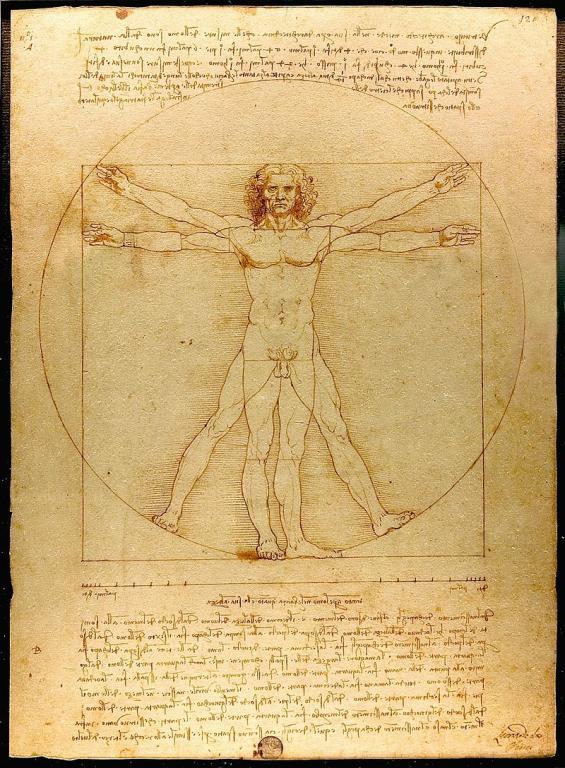
Because science is a quest for knowledge without reference to us, it necessarily loses a sense of human scale as our instruments of measurement grow more powerful. But meaning is all bound up with human scale. Meaning is occupied with the question, “What is the good life?” And since we live our lives in bodies, meaning must be discovered at the level of human scale. If you can accept this, then these two analogies may appeal to you.
Proper viewing distance
When you go to an art gallery the works are situated so as to facilitate proper viewing distance. This is tacit knowledge, embedded into the conditions for viewing. You don’t need to think about it, the thinking was done for you.
If you are too far away from a work, you can’t receive it properly, the meaning is lost with the increase in distance. The same goes for getting too close.
We are placed in the world with faculties that are appropriate to our place in it. Our senses serve our lives, not only by helping us survive, but by helping us to live meaningfully. When we pull back or get too close, we can lose our orientation and lose a sense of meaning.
There has been a revival of interest in human scale in architecture and tool making. (New Urbanism and ergonomics are what I’m thinking about.) But this point is larger, it presumes that our bodies and our universe were made for each other.
Does this make science, with its out-sized instruments for measuring the cosmos, somehow wrong? No. But we need to think about what we’re doing.
Artists know their media and they work with them knowledgeably, if not altogether consciously, to create works scaled to the embodied reception of those works. Science takes us into the realm of pigment mixing and brush making. It takes us into the world of meaning making. This can work itself out in two ways. We can either co-create–taking the forms already given by God and working harmoniously with them. Or we can attempt to overwrite those forms and dehumanize and deface the world.
How can we do science without doing the latter?
Science is basketball
If I were to run up to you and knock things out of your hand, or move back and forth laterally to keep you from getting to your goal, you’d probably think I was joking. But if I kept it up, you might call the police.
On the other hand, if you were to walk casually through a basketball game on your way somewhere and you got in the way of play, people on the court would consider you rude, and if the stakes were high (maybe there’s money on the line for the winning team), you might even get beat up. (Basketball is my sport of choice, but you can substitute your favorite if you’d like.)
Science is like basketball in this way. On the court of scientific study, rules apply that don’t apply off the court. Conversely, many of the rules that govern our lives and give them meaning are suspended. A scientist may study biochemistry all day long, but when he goes home he doesn’t treat his wife as though she were just a machine made of meat. She’s his wife and he should treat her as such. (If he were to attempt to fix electrodes to her skull at the dinner table it could lead to conflict.)
Now which is more real–biochemistry or the embodied life of a human being?
Every humane scientist knows the answer intuitively.
Previous Post

January 14, 2016
Upcoming Film Review: The Finest Hours--to be posted on 1/22
Next Post

January 18, 2016 Life After the Welfare State
Browse Our Archives
Select a Category Advising a Daughter Aristotle Art Atheism Author and Speaking Appearances Beauty Building Working Houses C R Wiley Children Community Creativity Cultural Apologetics Fatherhood Fiction Fidelity in marriage Film Freedom Gravitas H. P. Lovecraft Happiness Household Economy Infant Baptism Inklings Interpreting the Bible Interviews Jack Donovan Liturgy Localism Man of the House Manliness Martial Virtue Medieval Cosmology Metaphysics Mortimus Clay NecronomiCon New Left New Testament Household Codes Nietzsche Nominalism/Realism Politics Poverty Preaching Productive Property Reaching men Science Self-Sufficiency Side Hustles Social Ethics Social Security Spiritual Disciplines Sublime Techno-gnosticism The Pastor's Survival Guide Theology of the Family Tradition Uncategorized Virtue Weird Fiction
Select a Month February 2019 November 2018 October 2018 July 2018 June 2018 May 2018 April 2018 March 2018 February 2018 January 2018 December 2017 November 2017 October 2017 September 2017 August 2017 July 2017 June 2017 May 2017 April 2017 March 2017 February 2017 January 2017 December 2016 November 2016 October 2016 September 2016 August 2016 July 2016 June 2016 May 2016 April 2016 March 2016 February 2016 January 2016 December 2015
Follow Us!
TAKE THE
Religious Wisdom Quiz
Which Christian group is known for large-scale missionary work headquartered in Salt Lake City, Utah?
Select your answer to see how you score.
Catholic Anglican United Church of Christ Latter-day Saints
Books by This Author Books by PaterFamilias Today
Books by C. R. Wiley

The Purloined Boy (The Weirdling Cycle #1)

Man of the House: A Handbook for Building a Shelter That Will Last in a World That Is Falling Apart
Related posts from PaterFamilias Today

Transcendence: Meaning from Above

Gutting Creation of Meaning Guts Scripture

Is This Evangelicalism's Red-Pill Moment?

Manhood at First Things and Touchstone
TRENDING AT PATHEOS Evangelical

How the author of the world's best hymn...
I've been working with John Newton for a while now. This makes...

Long before this Lectio Divina, Psalm 130 - the song - started...

What About the Trees? Another Living Parable
After I finished writing the last article about falling leaves as a...

Why Classical Education Is a Conversation, Not a...
Come and Read: Joy in Classical Education When I was a little...

Falling Leaves: A Living Parable on Letting Go
I’ve spent the vast majority of my life in the southeast corner...

Cornell University has received a great deal of negative publicity and intense...
view all Evangelical blogs
Ad-Free & Subscriber Log-In Subscription Support
- About Us
- 2026 Calendar
- Videos
- Podcasts
- Library of World Religions
- Faith In Media Tracker
- Advertise With Us
- Write for Us
- Privacy Policy
- Terms of Service
- Do Not Sell My Data
- Contact Us
- Radiant Digital
- Manage Newsletter Subscriptions
- Unsubscribe From Notifications
- Sitemap
Copyright 2008-2026, Patheos. All rights reserved.
Subscription Support Ad-Free & Subscriber Log-In
Follow Patheos