
BuddhistCatholicContemplativeEvangelicalGeneral ChristianHinduJewishLatter-day SaintMuslimNew VisionsProgressive Christian
Beliefs
- Buddhist
- Catholic
- Contemplative
- Evangelical
- General Christian
- Hindu
- Jewish
- Latter-day Saint
- More Voices
- Muslim
- New Visions
- Pagan
- Progressive Christian
Topics
- Religion News
- Food and Religion
- Sports and Religion
- Religious Art
- Religious Music and Entertainment
- Religious Events
- History and Religion
- Style and Religion
- Politics and Religion
- Women in Religion
- Recreation Outdoors and Religion
- Business Finance and Religion
- Careers Workplace and Religion
- Education and Religion
- Family Parenting and Religion
- Health Fitness and Religion
- Home and Religion
- Relationships and Religion
- Technology and Religion
- Travel and Religion
Columnists
- Buddhist Columnists
- Business Finance and Religion Columnists
- Careers Workplace and Religion Columnists
- Catholic Columnists
- Contemplative Columnists
- Education and Religion Columnists
- Evangelists Columnists
- Family Parenting and Religion Columnists
- General Christian Columnists
- Health Fitness and Religion Columnists
- Hindu Columnists
- History and Religion Columnists
- Home and Religion Columnists
- Jewish Columnists
- More Voices Columnists
- Latter Day Columnists
- Muslim Columnists
- New Visions Columnists
- Nonreligious Columnists
- Pagan Columnists
- Politics and Religion Columnists
- Progressive Columnists
- Recreation Outdoors and Religion Columnists
- Relationships and Religion Columnists
- Religion News Columnists
- Religious Art Columnists
- Religious Events Columnists
- Religious Music and Entertainment Columnists
- Sports and Religion Columnists
- Style and Religion Columnists
- Technology and Religion Columnists
- Travel and Religion Columnists
- Women in Religion Columnists
Resource Library
- 2026 Calendar
- Library of World Religions
- The 100 Most Holy Places on Earth
- Patheos Answers
- Podcasts
- Videos
- Faith Leaders Database
- Anglican Episcopalian
- Bahai
- Baptist
- Buddhism
- Christianity
- Confucianism
- Eastern Orthodoxy
- Hinduism
- Holiness and Pentecostal
- ISKCON
- Islam
- Judaism
- Lutheran
- Methodist
- The Church of Jesus Christ of Latter-day Saints
- New Age
- Paganism
- Presbytarian and Reformed
- Protestantism
- Religion Behind the Scenes
- Roman Catholic
- Scientology
- Shia Islam
- Sikhism
- Sufism
- Sunni Islam
- Taoism
- Zen
- See all religions
Research Tools
 Ad-Free & Subscriber Log-In Subscription Support
Ad-Free & Subscriber Log-In Subscription Support
Follow Patheos 

- Trending:
- Forgiveness
- |
- Marriage
- |
- Consciousness
- |
- Death Penalty
- |
- Election
- |
- Halloween
 PaterFamilias Today
- Home
- Evangelical
- Is Evangelicalism a Secularizing Force?
Is Evangelicalism a Secularizing Force?
Last updated on: December 2, 2017 at 7:18 pm by C. R. Wiley
Is Evangelicalism a Secularizing Force? 2017-12-02T19:18:01-04:00 C. R. Wiley
Patheos Explore the world's faith through different perspectives on religion and spirituality! Patheos has the views of the prevalent religions and spiritualities of the world.

http://www.amazon.com/Pogo-We-Have-Met-Enemy/dp/0671212605/ref=asap_bc?ie=UTF8
I’ve thought long and hard about secularism and as I’ve done so I’ve come to wonder whether or not I am an unwitting agent of it.
I’m not thinking about that hobby horse of preachers, “practical atheism”. According to that thumbscrew of guilt our moral failures justify unbelief. It’s because I don’t give to the poor, or recycle, or whatever-the-thing-is-that-I’m-supposed-to-do-according-to-the-preacher, that people don’t believe in God.
I don’t really think I have that much power over what people believe. Instead I’m going a little deeper, down to the level of our presuppositions.
Presuppositions are difficult to think about because they are the very ideas we use to think in the first place. That’s why they are so powerful, not only do they stay out of view, they color the way we see other things.
Nominalism
When I was first introduced to Nominalism back when I took Introduction to Medieval Philosophy as an undergraduate, it made me vaguely uneasy. It didn’t appeal to me, but I didn’t rightly know why. I came to see over the years, with a growing sense of self-loathing, that I was a Nominalist. I’ve been working double-overtime to change that. It’s been doubly difficult because Evangelicalism is pretty much Christian Nominalism for the Everyman.
Most Evangelicals don’t have any idea what-in-the-world I’m talking about when I point this out. For Evangelicals a Nominalist is what those Catholics who only go to church at Christmas and Easter are. You know, they’re Christian in name only.
But Nominalism in philosophy basically says that’s the case for everything. A tree is a tree in name only, a man is a man in name only, and so on. The idea is the names we use to classify things don’t really refer to anything real.
Initially it may be difficult to see how this connects to secularism, so let me fill in some if the intervening space.
We’re all literalists now
To an older way of thinking, something called Realism, the world is a poem. It’s a meaningful place; it refers to something.
The word poem means “to make”, from the Greek, “poiein”. Poems must be interpreted, of course, and getting the meaning right can be tricky. But no one would say a poem is meaningless because people can’t agree to its meaning. That’s because poems are written by people and they refer to things.
Medieval Nominalists would have agreed with that. As a point of fact, they were concerned that God should be free to say whatever he pleased. They were reacting to the notion that God had to make the world the way it is by a force of necessity. So to free God, they had to cut the cords that tied the world to him. That freed him in our minds, but it has also left the world adrift.
Now, because the world doesn’t necessarily refer to God, the world can only refer to itself. And taken to an extreme, every particular thing in the world can only refer to itself. Why, even calling a leaf “a leaf” is stereotyping. Each leaf should have its own name. To call all leaves, “leaves” is almost unjust.
This is why we’re all literalists now. Even if we don’t go as far as giving a unique name to every individual leaf, we tend to think that the things in the world refer only to themselves. They don’t point to anything else, except, that is, by some arbitrary act by some person. And depending on what he’s talking about he can be said to be “creative” or “bigoted”.
The Secular Christian?
What Nominalism did for secularism is denature the world by cutting its meaning off from its creator. Instead of seeing a world of intrinsic meaning, most people, evangelicals included, think of it as neutral, just so much sweet cream to which we can add whatever flavor we’d like.
The influence on Christianity has been enormous, and Evangelicalism is one of the best places to see it. I’m going to limit myself to three of the more characteristic features of Evangelicalism to show what I mean.
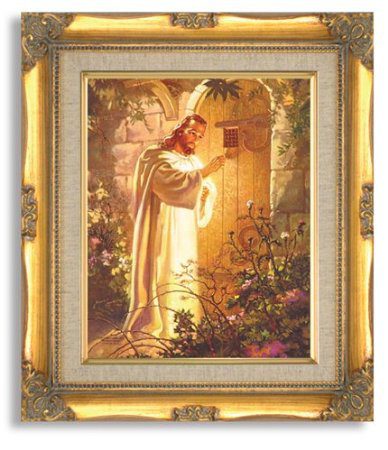
Christ at Heart’s Door
http://www.amazon.com/Sallman-Christ-at-Hearts-Door/dp/B000PS2E8I
A Personal Relationship with Jesus
Nominalism has created a problem for everyone, not just Christians. In the world of philosophy the challenge was met by retreating into the self. Descartes’ famous, “I think therefore I am” established a new basis for truth and meaning. It wasn’t as subjective as it may sound, Descartes worked overtime to build a mental causeway back to the external world. But the point is truth and meaning were not encountered out in the world, they were discovered in the mind.
Evangelicals do much the same thing. Jesus is someone who is known inwardly, in the heart. Think of that old standard, “He Lives” with the line: “You ask me how I know he lives, he lives within my heart!”
That’s not how the Apostles put it. But now the idea that you would appeal to the witness of the Apostles to establish the truth of the resurrection seems unspiritual to many Evangelicals. And many can’t even see Christ in the sacraments. But it all began with downgrading the world from a poem to meaningless stuff. Now meaning only lives in our hearts.
Artless Bible Study
For many Evangelicals you must choose between facts and metaphors. Because Evangelicals don’t think that creation itself is a kind of metaphor, anytime someone brings up the idea that something in scripture may be a metaphor it is assumed that he is undermining biblical authority, you know, like liberals do.
(It’s true that liberals undermine biblical authority; but the problem with liberals is not that they see metaphors in scripture, their problem is the locate metaphors solely in the human mind).
But if creation itself is a kind of metaphor, then historical facts can refer to bigger things. Quick example: Jesus did indeed walk on water, but that says more than, “Hey, look at what I can do!” The sea in the Bible refers to death and judgment as well as to itself. So, when Jesus walked on the sea he was saying, “I am greater than death.”
Because Evangelicals can’t read the poetry of creation, they can’t read the poetry of the Bible. We’re artless interpreters.
Instrumentalism
Last of all, at least for today, Evangelicals are guilty of crude and artless uses of creation. Our music tends to be sappy and didactic. Our architecture is destined for the wrecking ball. And the reason this is so is we don’t see the meaning in our materials.
In all my years of pastoral ministry I’ve never had a person say to me, “How does music express the glory of God?” I’ve had people say things like, “We need a band in order to appeal to young people.” And I’ve never had anyone even remotely concerned with whether medium density fiber board says the same thing as quarter-sawn red oak. I’ve had people say things like, “It doesn’t matter what we build it out of, so long as our hearts are in the right place.”
Really? That’s all that matters? We need to get Real, to get back to the Real world and Real meanings. More on that another time.
Previous Post

January 11, 2016
An Introduction to Productive Property
Next Post

January 14, 2016 Upcoming Film Review: The Finest Hours--to be posted on 1/22
Recent Comments
Browse Our Archives
Select a Category Advising a Daughter Aristotle Art Atheism Author and Speaking Appearances Beauty Building Working Houses C R Wiley Children Community Creativity Cultural Apologetics Fatherhood Fiction Fidelity in marriage Film Freedom Gravitas H. P. Lovecraft Happiness Household Economy Infant Baptism Inklings Interpreting the Bible Interviews Jack Donovan Liturgy Localism Man of the House Manliness Martial Virtue Medieval Cosmology Metaphysics Mortimus Clay NecronomiCon New Left New Testament Household Codes Nietzsche Nominalism/Realism Politics Poverty Preaching Productive Property Reaching men Science Self-Sufficiency Side Hustles Social Ethics Social Security Spiritual Disciplines Sublime Techno-gnosticism The Pastor's Survival Guide Theology of the Family Tradition Uncategorized Virtue Weird Fiction
Select a Month February 2019 November 2018 October 2018 July 2018 June 2018 May 2018 April 2018 March 2018 February 2018 January 2018 December 2017 November 2017 October 2017 September 2017 August 2017 July 2017 June 2017 May 2017 April 2017 March 2017 February 2017 January 2017 December 2016 November 2016 October 2016 September 2016 August 2016 July 2016 June 2016 May 2016 April 2016 March 2016 February 2016 January 2016 December 2015
Follow Us!
TAKE THE
Religious Wisdom Quiz
What did the soldier dress Jesus in after he was accused?
Select your answer to see how you score.
Nothing Thorns Golden Robe Scarlet Robe
Books by This Author Books by PaterFamilias Today
Books by C. R. Wiley

The Purloined Boy (The Weirdling Cycle #1)

Man of the House: A Handbook for Building a Shelter That Will Last in a World That Is Falling Apart
Related posts from PaterFamilias Today

Transcendence: Meaning from Above

Gutting Creation of Meaning Guts Scripture

Is This Evangelicalism's Red-Pill Moment?

Making the Good Life from Home
TRENDING AT PATHEOS Evangelical

How the author of the world's best hymn...
I've been working with John Newton for a while now. This makes...

Long before this Lectio Divina, Psalm 130 - the song - started...

What About the Trees? Another Living Parable
After I finished writing the last article about falling leaves as a...

Why Classical Education Is a Conversation, Not a...
Come and Read: Joy in Classical Education When I was a little...

Falling Leaves: A Living Parable on Letting Go
I’ve spent the vast majority of my life in the southeast corner...

Cornell University has received a great deal of negative publicity and intense...
view all Evangelical blogs
Ad-Free & Subscriber Log-In Subscription Support
- About Us
- 2026 Calendar
- Videos
- Podcasts
- Library of World Religions
- Faith In Media Tracker
- Advertise With Us
- Write for Us
- Privacy Policy
- Terms of Service
- Do Not Sell My Data
- Contact Us
- Radiant Digital
- Manage Newsletter Subscriptions
- Unsubscribe From Notifications
- Sitemap
Copyright 2008-2026, Patheos. All rights reserved.
Subscription Support Ad-Free & Subscriber Log-In
Follow Patheos