
BuddhistCatholicContemplativeEvangelicalGeneral ChristianHinduJewishLatter-day SaintMuslimNew VisionsProgressive Christian
Beliefs
- Buddhist
- Catholic
- Contemplative
- Evangelical
- General Christian
- Hindu
- Jewish
- Latter-day Saint
- More Voices
- Muslim
- New Visions
- Pagan
- Progressive Christian
Topics
- Religion News
- Food and Religion
- Sports and Religion
- Religious Art
- Religious Music and Entertainment
- Religious Events
- History and Religion
- Style and Religion
- Politics and Religion
- Women in Religion
- Recreation Outdoors and Religion
- Business Finance and Religion
- Careers Workplace and Religion
- Education and Religion
- Family Parenting and Religion
- Health Fitness and Religion
- Home and Religion
- Relationships and Religion
- Technology and Religion
- Travel and Religion
Columnists
- Buddhist Columnists
- Business Finance and Religion Columnists
- Careers Workplace and Religion Columnists
- Catholic Columnists
- Contemplative Columnists
- Education and Religion Columnists
- Evangelists Columnists
- Family Parenting and Religion Columnists
- General Christian Columnists
- Health Fitness and Religion Columnists
- Hindu Columnists
- History and Religion Columnists
- Home and Religion Columnists
- Jewish Columnists
- More Voices Columnists
- Latter Day Columnists
- Muslim Columnists
- New Visions Columnists
- Nonreligious Columnists
- Pagan Columnists
- Politics and Religion Columnists
- Progressive Columnists
- Recreation Outdoors and Religion Columnists
- Relationships and Religion Columnists
- Religion News Columnists
- Religious Art Columnists
- Religious Events Columnists
- Religious Music and Entertainment Columnists
- Sports and Religion Columnists
- Style and Religion Columnists
- Technology and Religion Columnists
- Travel and Religion Columnists
- Women in Religion Columnists
Resource Library
- 2026 Calendar
- Library of World Religions
- The 100 Most Holy Places on Earth
- Patheos Answers
- Podcasts
- Videos
- Faith Leaders Database
- Anglican Episcopalian
- Bahai
- Baptist
- Buddhism
- Christianity
- Confucianism
- Eastern Orthodoxy
- Hinduism
- Holiness and Pentecostal
- ISKCON
- Islam
- Judaism
- Lutheran
- Methodist
- The Church of Jesus Christ of Latter-day Saints
- New Age
- Paganism
- Presbytarian and Reformed
- Protestantism
- Religion Behind the Scenes
- Roman Catholic
- Scientology
- Shia Islam
- Sikhism
- Sufism
- Sunni Islam
- Taoism
- Zen
- See all religions
Research Tools
 Ad-Free & Subscriber Log-In Subscription Support
Ad-Free & Subscriber Log-In Subscription Support
Follow Patheos 

- Trending:
- Forgiveness
- |
- Marriage
- |
- Consciousness
- |
- Death Penalty
- |
- Election
- |
- Halloween
 PaterFamilias Today
- Home
- Evangelical
- Robert Crumb’s Book of Genesis, Part 1
Robert Crumb’s Book of Genesis, Part 1
Last updated on: December 30, 2015 at 11:55 am by C. R. Wiley
Robert Crumb’s Book of Genesis, Part 1 2015-12-30T11:55:22-04:00 C. R. Wiley
Patheos Explore the world's faith through different perspectives on religion and spirituality! Patheos has the views of the prevalent religions and spiritualities of the world.
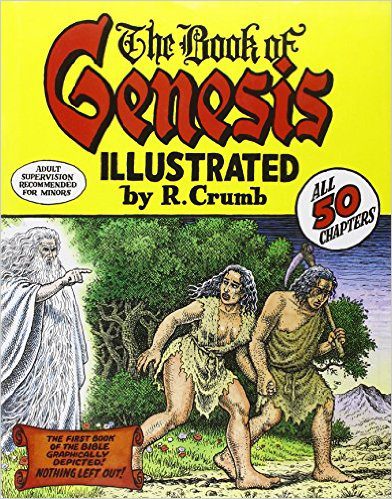
http://www.amazon.com/The-Book-Genesis-Illustrated-Crumb/dp/0393061027
I begin with a confession: I am not a fan of Robert Crumb.
But from what I’ve seen and read, I don’t think that would bother him. On the contrary, I think he’s puzzled by the adulation he does receive in some quarters because, it seems to me, Robert Crumb hates himself.
Concerning that last point, I’ll return to it in a minute. Back to me for a moment. I have been influenced by his draftsmanship, especially his wooly cross hatching and stippling techniques. (I’ve included a little sample below of a splash page of mine that I think owes something to Crumb–among others. Click on it to enlarge.)
Now let’s go big and forget about Crumb and me for a moment. All art, I am convinced, is autobiographical. Even realism requires a subject, and of all the things you could write about or draw, you must choose something that interests you, that speaks to you for some reason. And there you are again. There is no escape for the artist, wherever he turns, he turns up.
When you read Metamorphosis, or Smith of Wooton Major, you enter the mind of either Kafka or Tolkien respectively. (I prefer Tolkien’s.) And even when the subject is the book of Genesis, when we pick up his treatment, we enter into Crumb’s mind in some sense.
Crumb does contest this point right in his introduction. He insists that he has given us Genesis straight up, no snide or cynical treatment, he’s just illustrating the text. Yes, Crumb does exercise a great deal of self-control, and I appreciate the effort. In many respects the book is more faithful to the biblical book than other illustrated versions produced by evangelical publishers.
But it is an interpretation. Even a literary translation striving for accuracy is in some sense an interpretation. You must render the words of an ancient tongue into a modern one.Words are subtle things, with shades of meaning. As they say, things gets lost in the process. (Some things get added, even unintentionally.) That’s why these works come with marginal notes. And even then something can be lost.
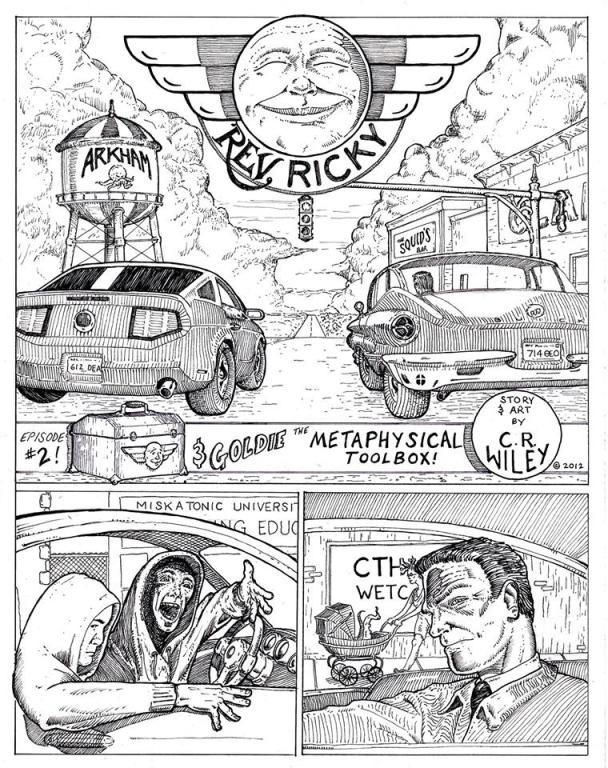
Some of my own work. Cross hatching and stippling owe something to Crumb.
So, Bob Crumb, there’s no getting away from the fact that this book has a lot of you in it. But that’s okay. That’s why I bought it. I knew the story already, I’ve read it many times. I even have a working knowledge of Hebrew. What I’m looking for when I read your book is whether or not you’ve seen something in the story that I’ve missed. And you have. But you’ve also distorted some things. I’ll get to both of those in a moment.
Who is Robert Crumb?
Warning: Robert Crumb is a dangerous object of study.
You may be tempted to “google” his name. If you do, prepare yourself for a cascade of disturbing images. Some people have accused him of being a pornographer. I don’t think that’s right. What Robert Crumb is is a “confessionalist”–something in the spirit of Augustine or Rousseau. He can’t help giving us, unwilling as we may be, the full and uncensored contents of his mind at any given moment.
Think about that. If you did the same, you might be accused of being a pornographer.
Now, we’re not all as bad as Robert Crumb. Crumb is on the edge of things, maybe beyond the edge. He was definitely an outsider back when he began his career, but things have moved and he’s on the inside now. (I think he’s surprised by that.)
Beginning with his work, Crumb is one of the fathers of underground comics. Underground was never that far underground. Back in the 70s, when I was really into the comics scene and I was only a teen, I had heard of him and had seen some of his stuff. It struck me as perverse, but strangely powerful.
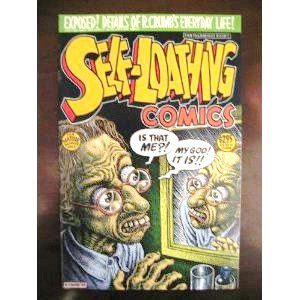
http://www.amazon.com/Self-Loathing-Comics-1-Robert-Crumb/dp/B000JMFHOI/ref=sr_1_2?s=books&ie=UTF8&qid=1451484018&sr=1-2&keywords=Robert+crumb+self-loathing
Now the world of comics is layered. The top layer, the one most people know about, is the superhero stuff–Marvel and DC–Spiderman and Batman–that stuff. I was never into that stuff much. What I enjoyed was the next layer down, the stuff you found in Creepy and Eerie magazines, Mad and Cracked, and even Heavy Metal. (Heavy Metal was yet another layer down, but still not underground.) The artists I enjoyed were Al Williamson, Wally Wood, Frank Frazetta, and Moebius. (Again, if you are tempted to google, prepare for mature themes.) These artists have been incredibly influential. Frazetta gave us the popular image of Conan the Barbarian and Moebius gave us an aesthetic that informed everything from Blade Runner to The Empire Strikes Back.
Crumb’s stuff you just couldn’t put on the shelves next to Superman, or even Creepy or Heavy Metal. It was just too disturbing and subversive. But Crumb has been influential in his own way. You’ve probably even seen his stuff. Remember “Keep on Truckin’!”?–yep, Crumb.
There have been a couple of documentaries about Crumb, so I’m not speculating here. The documentation is there for all to see.
Crumb had a miserable childhood. His father was the guy Robert Duval portrayed in The Great Santini. His mother seems to have been both passive and manipulative. The three Crumb boys were scrawny and a real disappointment to their over-the-top macho father. Couple this with the fact that the boys appear to have been more intelligent than the father and you have a formula for suffering. School was just as tormenting, if not more so for the Crumb boys, because it put girls into the mix. At both home and in school they found only rejection and humiliation.
As is so often the case with intelligent and creative boys who have been ostracized, the Crumbs escaped into fantasy worlds. And because they were gifted with pencil and pen, they drew comics.
There are thousands of boys like Robert Crumb out there. But few are as gifted as Crumb, and no one else is willing to put it all down on paper like Crumb–the full contents of the mind, uncensored. This is the secret to his success. If you are male, and you hate yourself, you will probably love Crumb. You will identify with him.
And this is why I purchased his visual interpretation of Genesis. Even though I don’t like him, I wanted to vicariously read Genesis through his eyes to see it as he sees it.
And next time I’ll tell you what I saw. Among those things you may be surprised to learn (Crumb might even be surprised to hear) that Crumb is a little bit of a bohemian conservative. To understand what I mean by that you’ll have to read my next post.
As a parting gift–here’s a link to an interview with Crumb from NPR from a while back:
http://www.npr.org/2009/11/02/120022241/genesis-r-crumb-illustrates-the-bible

Next Post

January 1, 2016 Robert Crumb's Book of Genesis, Part 2
Browse Our Archives
Select a Category Advising a Daughter Aristotle Art Atheism Author and Speaking Appearances Beauty Building Working Houses C R Wiley Children Community Creativity Cultural Apologetics Fatherhood Fiction Fidelity in marriage Film Freedom Gravitas H. P. Lovecraft Happiness Household Economy Infant Baptism Inklings Interpreting the Bible Interviews Jack Donovan Liturgy Localism Man of the House Manliness Martial Virtue Medieval Cosmology Metaphysics Mortimus Clay NecronomiCon New Left New Testament Household Codes Nietzsche Nominalism/Realism Politics Poverty Preaching Productive Property Reaching men Science Self-Sufficiency Side Hustles Social Ethics Social Security Spiritual Disciplines Sublime Techno-gnosticism The Pastor's Survival Guide Theology of the Family Tradition Uncategorized Virtue Weird Fiction
Select a Month February 2019 November 2018 October 2018 July 2018 June 2018 May 2018 April 2018 March 2018 February 2018 January 2018 December 2017 November 2017 October 2017 September 2017 August 2017 July 2017 June 2017 May 2017 April 2017 March 2017 February 2017 January 2017 December 2016 November 2016 October 2016 September 2016 August 2016 July 2016 June 2016 May 2016 April 2016 March 2016 February 2016 January 2016 December 2015
Follow Us!
TAKE THE
Religious Wisdom Quiz
Who saw a vision of a valley of dry bones?
Select your answer to see how you score.
Daniel Ezekiel Isaiah Jeremiah
Books by This Author Books by PaterFamilias Today
Books by C. R. Wiley

The Purloined Boy (The Weirdling Cycle #1)

Man of the House: A Handbook for Building a Shelter That Will Last in a World That Is Falling Apart
Related posts from PaterFamilias Today

Transcendence: Meaning from Above

Gutting Creation of Meaning Guts Scripture

Is This Evangelicalism's Red-Pill Moment?

Making the Good Life from Home
TRENDING AT PATHEOS Evangelical

How the author of the world's best hymn...
I've been working with John Newton for a while now. This makes...

Long before this Lectio Divina, Psalm 130 - the song - started...

What About the Trees? Another Living Parable
After I finished writing the last article about falling leaves as a...

Why Classical Education Is a Conversation, Not a...
Come and Read: Joy in Classical Education When I was a little...

Falling Leaves: A Living Parable on Letting Go
I’ve spent the vast majority of my life in the southeast corner...

Cornell University has received a great deal of negative publicity and intense...
view all Evangelical blogs
Ad-Free & Subscriber Log-In Subscription Support
- About Us
- 2026 Calendar
- Videos
- Podcasts
- Library of World Religions
- Faith In Media Tracker
- Advertise With Us
- Write for Us
- Privacy Policy
- Terms of Service
- Do Not Sell My Data
- Contact Us
- Radiant Digital
- Manage Newsletter Subscriptions
- Unsubscribe From Notifications
- Sitemap
Copyright 2008-2026, Patheos. All rights reserved.
Subscription Support Ad-Free & Subscriber Log-In
Follow Patheos